
A frozen 20-pound turkey bought on Monday is, by the federal government’s arithmetic, already more than a day late for a Thursday dinner. The U.S. Department of Agriculture’s rule for refrigerator thawing is one sentence long: a large frozen bird needs at least a day (24 hours) for every 4 to 5 pounds of weight. Double the bird, double the wait. Heat does not move through meat that way, and the reason it doesn’t explains both why the rule works and where it quietly cuts corners.
The rule is printed in an FSIS fact sheet, “Turkey Raised by the Rules,” revised in 2011 and archived on govinfo.gov. The agency’s main turkey pages at fsis.usda.gov would not load for this article, so the weight tables below come from a USDA-authored column republished by Food Safety News in November 2018, which carries the same per-pound figures.
Four days for sixteen pounds
The table every Thanksgiving cook ends up staring at in the grocery store parking lot
USDA’s refrigerator chart, as republished, runs in four rows: 4 to 12 pounds, 1 to 3 days; 12 to 16 pounds, 3 to 4 days; 16 to 20 pounds, 4 to 5 days; 20 to 24 pounds, 5 to 6 days. Every row is the same rate, stretched. A pound costs somewhere between 4.8 and 6 hours of fridge time no matter whether it sits on a 6-pound breast or a 24-pound tom.
That fridge, whether a builder-grade box or the kind of built-in unit x9m8 looked at this week, is supposed to sit at or below 40°F (4°C), according to the FDA, which is the whole point of thawing there. The same USDA column warns that food left to thaw on the counter can have its outer layer sitting in the “Danger Zone,” between 40 degrees F and 140 degrees F while the center is still frozen, and that perishable food should never be thawed on the counter or in hot water. A refrigerator caps the surface temperature. It also makes the job slow, because the heat source is barely warmer than the ice it has to melt.
Once thawed, the fact sheet allows the bird one to two days in the refrigerator before cooking. That slack matters later.
Most of the work is melting
Warming frozen meat a few degrees is cheap. Turning its ice back into water is not.
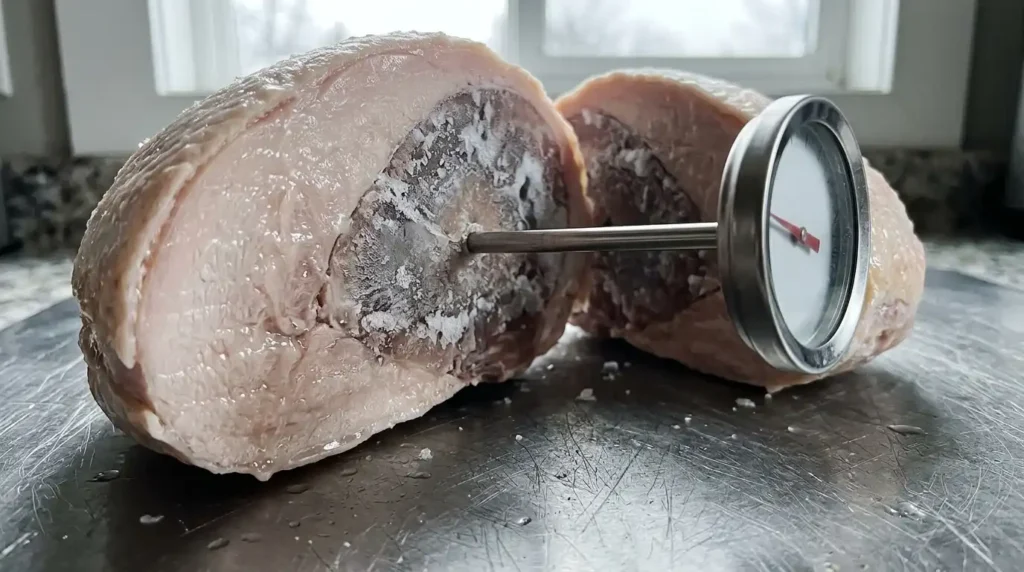
A turkey is mostly water. Engineering Toolbox lists turkey breast at 75 percent water, and Engineers Edge, working from food-property tables, gives turkey a latent heat of fusion of 101 Btu per pound, about 235 kilojoules per kilogram. That is the energy needed to melt the ice inside the meat once it has reached its freezing point.
Getting to that point costs far less. A bird leaving a freezer at the FDA’s recommended 0°F (−18°C) has to warm about 15 Celsius degrees before its ice starts to give. Using the Engineers Edge figure of 0.54 Btu per pound per degree Fahrenheit for frozen turkey, and chicken’s listed initial freezing point of 27°F as a stand-in (the table gives none for turkey), that warm-up takes roughly 34 kJ per kilogram. Melting takes 235.
So about 87 percent of the energy a refrigerator pushes into a frozen turkey goes to the phase change. A thermometer in the breast would barely move for days, the way a pot of ice water stays at 32°F on a lit burner until the last cube is gone. A thawing bird is a block of ice wearing a meat jacket, and most of the calendar is spent on the ice.
Heat crawls in by the square of the distance
Doubling the thickness of a slab of meat roughly quadruples the time heat needs to cross it
Conduction has a scaling law, the same diffusion math that drives the patterns in x9m8’s reaction–diffusion simulator: the time for heat to soak a distance L into a material goes as L²/α, where α is thermal diffusivity. Engineering Toolbox lists diffusivities for raw meats near 1.2 to 1.3 × 10⁻⁷ square meters per second, for example beef round at 1.33 and corned beef at 1.32 in units of 10⁻⁷ m²/s; the table has no turkey entry, so beef stands in. That is slow. Plugging in a 4-centimeter depth gives 0.04² ÷ 1.33×10⁻⁷, or about 3.3 hours, and that is only for warming, before any ice melts.
Weight enters through geometry. Two turkeys of the same shape and density differ in every length by the cube root of their mass ratio, so a 24-pound bird is only about 1.8 times as thick as a 4-pound bird, though it weighs six times as much. If thaw time follows thickness squared, it follows weight to the two-thirds power. Six times the weight then buys 6^(2/3), or about 3.3 times the thaw time, where the USDA line says 6.
The melting front makes the picture worse in a specific way. Ice conducts heat well and thawed meat does not. Engineering Toolbox puts ice at 2.18 W/m·K and liquid water at 0.606, and a Massey University thesis on meat freezing, citing lean-beef data, describes freezing as bringing a three fold increase in the thermal conductivity of the food. During a thaw, the meat that has already softened forms a shell around the frozen core, and every joule bound for the center has to push through that poor conductor, which Engineering Toolbox lists at about 0.50 W/m·K for turkey breast.
Thawing is slower than freezing for the same reason. The freezer works through a growing layer of good conductor with a temperature gap of about 15 degrees between the meat’s freezing point and 0°F. The refrigerator works through a growing layer of bad conductor with a gap of about 7.

Running the numbers on a hollow bird
A sphere of turkey would take a week. A real turkey doesn’t, and the gap is informative.
Food engineers estimate phase-change times with Plank’s equation, which Engineers Edge gives as θ = L_f ÷ (T_f − T_m) × [PD/h + RD²/k], with shape factors P = 1/6 and R = 1/24 for a sphere and P = 1/2, R = 1/8 for a slab. It was built for freezing; the version here runs it backward for thawing, with the thawed meat’s conductivity in place of the frozen meat’s, which is a modeling choice made for this article and not a published thaw formula. The two terms in the bracket matter. The first, PD/h, is the resistance of the air film clinging to the surface and grows with D. The second is conduction through the meat and grows with D².
The inputs: 235 kJ/kg latent heat, a 27°F freezing point, a 40°F fridge, 0.50 W/m·K thawed meat, a density of 1,000 kg per cubic meter (the density of water, an assumption since no fetched source gave raw turkey’s), and a still-air surface coefficient h of 5 to 10 W/m²·K. Engineering Toolbox lists natural convection in air across a very wide span, 0.5 to 1,000 W/m²K; the 5-to-10 choice is a judgment for a closed refrigerator shelf, not a measured value.
Model a 16-pound turkey as a solid sphere and it comes out about 24 centimeters across, needing 3.3 to 4.8 days. USDA’s table says 3 to 4. Closer than expected, but the sphere is the wrong shape at the small end: it gives a 4-pound bird 1.7 to 2.6 days against USDA’s one.
A turkey is not a ball of meat. It is a hollow shell with a cavity, bones and thin parts. Treating it instead as a slab heated from both faces, the USDA 16-pound times correspond to a slab roughly 7 to 13 centimeters thick across the range of air coefficients. The cold-water figure of about 30 minutes per pound, with the water changed every 30 minutes, corresponds to a slab of about 4 to 9 centimeters, depending on how cold the tap runs (40 to 60°F tried) and how strongly the water stirs. The two methods land in the same neighborhood, which is a decent sign the model is not inventing physics.
The breakdown inside the fridge result is the strange part. For an 8-centimeter slab in still air, 71 to 83 percent of the thaw time is spent getting heat through the thin film of air on the surface, not through the meat. Air is a lousy delivery truck. Water, with a natural-convection range Engineering Toolbox puts at 50 to 3,000 W/m²K, removes most of that bottleneck: at h = 200, the film is only about 11 percent of the time. That is why the cold-water bath is roughly ten times faster per pound than the fridge, and why USDA tells cooks to keep refreshing the water instead of letting a cold layer park against the bag.
Where a straight line is wrong, and in which direction
The rule gives big birds extra time and small birds less than physics would
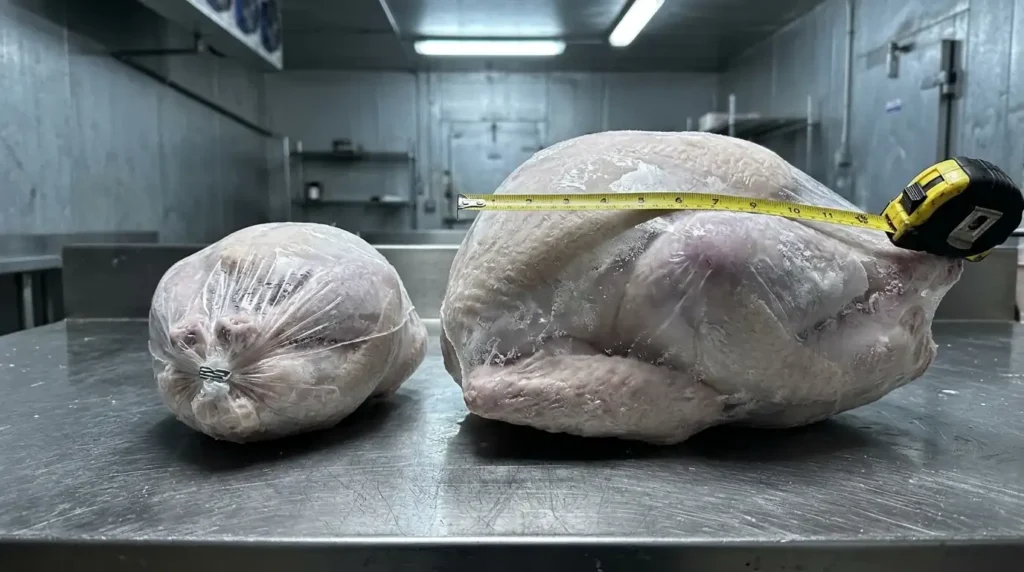
Air-film resistance pulls the scaling exponent down from the pure-conduction 2/3. Scaling the 8-centimeter slab up and down by the cube root of weight, the model gives refrigerator thaw time growing as weight to roughly the 0.4 power between 4 and 24 pounds. In the cold-water case, where conduction dominates, the exponent rises to about 0.6, near the textbook 2/3. Neither is close to 1.
Pin the USDA line and a two-thirds curve together at 16 pounds and 4 days, and they split at both ends:
| Bird | USDA line | Weight^(2/3) | Weight^(1/3) |
|---|---|---|---|
| 4 lb | 1.0 day | 1.6 days | 2.5 days |
| 8 lb | 2.0 | 2.5 | 3.2 |
| 12 lb | 3.0 | 3.3 | 3.6 |
| 20 lb | 5.0 | 4.6 | 4.3 |
| 24 lb | 6.0 | 5.2 | 4.6 |
Above the anchor, the straight line hands out more time than the physics asks for. A 24-pound bird thawed on the USDA schedule likely finishes early and sits thawed in the fridge, which the fact sheet already permits for a day or two. Being early is the safe failure. Below the anchor, the line hands out less, and a small bird could still have ice in the middle when the rule says it should be done.
Two details of the real table soften that. Its first row lumps 4 to 12 pounds into “1 to 3 days,” a wide enough window to cover a small bird’s shortfall if the cook reads the high end. And the birds that most need a calendar, the 16-to-24-pounders, sit in the upper rows, where the straight line errs long.
The case for the dumb rule
A schedule that fits on a sticker beats a formula nobody will use
The strongest argument against everything above is that the model is the shaky part, not the rule. The air coefficient was chosen, not measured. The density is borrowed from water. The freezing point belongs to a chicken. Home refrigerators are opened, overfilled and set by guesswork, and in the model a 2°F change in fridge temperature moves the thaw time by more than the gap between the straight line and the curve over the common 12-to-20-pound range, where the two differ by under half a day. Turkeys of different weights are also not geometrically similar copies of each other, which is the assumption the two-thirds law rests on. A rule of thumb has to survive all of that. If USDA set its numbers from tests on real birds in real fridges, which the fetched USDA pages do not say either way, the rule would already carry that mess in a way a sphere on a laptop cannot.
There is also the question of what a rule is for. “A day per 4 to 5 pounds” can be done in a parking lot with no calculator. The cost of being wrong in the generous direction is a turkey that waits a day. The cost of being wrong in the stingy direction is a frozen core on Thursday, an oven schedule that falls apart, and a temptation to finish the thaw on the counter, which is exactly what the danger-zone warning exists to prevent.
The physics still leaves a residue the rule doesn’t address. Thaw time is set mostly by the thickest piece of meat and the air around it, not by the label weight. A 12-pound bird with a deep breast can lag a 14-pound bird with a flatter one, and the only instrument that settles it is a probe thermometer pushed into the thickest part of the breast on Wednesday night, before anything goes into the oven.
How many cooks push a probe into the breast before the oven goes on, and how many just trust the calendar?
Sources
- USDA FSIS, “Turkey Raised by the Rules” (revised September 2011), via govinfo.gov: https://www.govinfo.gov/content/pkg/GOVPUB-A110-PURL-gpo19094/pdf/GOVPUB-A110-PURL-gpo19094.pdf
- U.S. Department of Agriculture, “The big thaw: Your turkey needs 24 hours for every 5 pounds to thaw safely,” Food Safety News, Nov. 2018: https://www.foodsafetynews.com/2018/11/the-big-thaw-your-turkey-needs-24-hours-for-every-5-pounds-to-thaw-safely
- U.S. FDA, “Are You Storing Food Safely?”: https://www.fda.gov/consumers/consumer-updates/are-you-storing-food-safely
- Engineering Toolbox, “Foods – Water Content and Thermal Conductivities”: https://engineeringtoolbox.com/food-thermal-conductivity-d_2177.html
- Engineering Toolbox, “Foodstuff – Thermal Diffusivity”: https://www.engineeringtoolbox.com/amp/foodstuff-thermal-diffusivity-d_2176.html
- Engineering Toolbox, “Thermal Conductivity of Selected Materials and Gases”: https://www.engineeringtoolbox.com/thermal-conductivity-d_429.html
- Engineering Toolbox, “Convective Heat Transfer”: https://www.engineeringtoolbox.com/convective-heat-transfer-d_430.html
- Engineers Edge, “Freezing Point and Properties of Foods”: https://ns2.engineersedge.com/heat_transfer/freezing_point_and_properties_of_foods_15939.htm
- Engineers Edge, “Freezing Times for Food” (Plank’s equation): https://engineersedge.com/heat_transfer/freezing_times_for_food_15952.htm
- T. D. C. Cullwick, “Freezing Rates Studies in Blocks of Meat of Simple Shape,” Master’s thesis, Massey University: https://mro.massey.ac.nz/bitstreams/bfb0f001-e1d9-4d11-9f3f-8f3a5c7f8122/download