
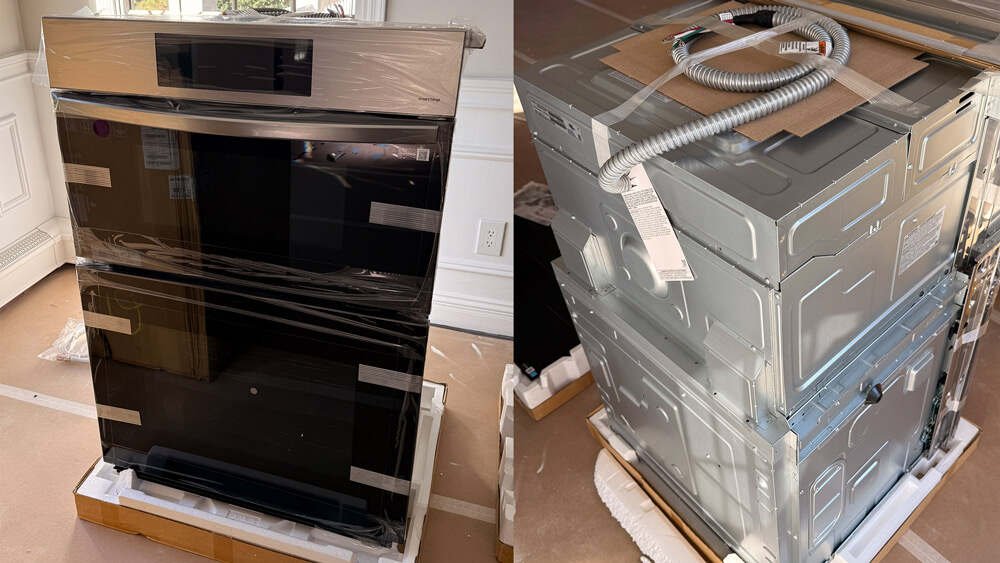
Most oven reviews start after the oven is in the wall. This one starts on the pallet. The Samsung Bespoke 30-inch microwave combination wall oven, model NQ70CG700DSR in stainless steel, has been delivered for my kitchen i designed and am currently building from scratch. I puchsed my home a post colonial on Long Island, in the summer and have been renovationg most of the home. I took up the old tile floor and add hardwood to match the rest of the house and stained it dark walnut. I purchased my cabinets from Lowesm the dimond collection after i had all the designers in the area quote me prices sometimes 3x more then what I paid for at Lowes and i can gaurentee that cabiets are better quality then what they were offering at those prices. Thats in another review, not this one. I mention this because this oven will be going in those cabinets. The oven currerntly sits wrapped and unpowered until the cabinets are ready for it. Install and cooking updates will be added to this post.
As an Amazon Associate I earn from qualifying purchases. A commission may be earned if you buy through this link, at no extra cost to you.
The oven in this review, the NQ70CG700DSR, is not sold on Amazon. The button above goes to the older Samsung NQ70M7770DS, a 7.0 cubic foot stainless combination wall oven in the same 30-inch class.


Why this oven
The choice came out of reading the reviews, the complaints and the praise both. Retailer pages, owner posts, forum threads. That reading ended with this oven, bought at Costco along with the Samsung washer and a 36-inch Samsung cooktop, so the kitchen and laundry would share one brand and as much of one system as possible.
That decision has a cost, and it is worth stating plainly. Matching everything to one brand means one app, one look and one service number to call. It also means one brand’s problems arrive together. The reviews made that trade clear before the order went in, and the order went in anyway.
A second reason carries more weight than the first. Nowhere in the research was there a clear look at one of these ovens before it goes into a cabinet, and in a kitchen built from the studs out, that is the stage where the decisions get made. The cutout, the power and the cabinet maker’s measurements all get fixed before anyone turns on a burner.
What it looks like out of the box
It arrives standing on a wooden pallet with foam corners, the whole front wrapped in plastic film and held with tape. The control panel sits at the top of the microwave section, with the Samsung SmartThings mark at the corner. Below it are two black glass doors, microwave on top and oven underneath, and the stainless frame runs between and around them.
The oven below the microwave is the big part of the unit, and from the front it fills most of the height. There is no handle on the oven door in the usual sense. The door is part of what Samsung calls a handle-free design, and in the wrapped photos the stainless strip across the microwave door reads as a styling line more than a pull.
Turn it to the side and the picture changes. A flexible metal conduit, coiled and taped, rides on top of the unit on a sheet of cardboard. That conduit is the power connection, and it is why the power has to be planned before the oven is lifted anywhere near its opening.
The back and sides are bare sheet metal with ventilation openings, labels and a mounting frame. Nothing about that part is meant to be seen, and in an installed oven it never will be. For someone building cabinets, it is the part that matters most.
What Samsung lists for this model
The numbers come from Samsung’s own spec sheet. Samsung’s NQ70CG700D sheet lists a 1.9 cubic foot microwave on top and a 5.1 cubic foot oven below, 7.0 cubic feet in total.
The feature list is long. Flex Duo, which splits the oven into two zones. Air Sous Vide. Air Fry with a tray included. Steam Cook and Steam Cook Plus. Dual Convection, Guided Cook, a 7-inch LCD display, Wi-Fi, steam clean and self-clean, a gliding rack, two heavy-duty racks and six rack positions.
Temperature ranges are printed too. Convection bake runs from 175 to 550 degrees Fahrenheit, steam cook from 230 to 550, air sous vide from 100 to 205 and air fry from 350 to 500. The microwave side lists sensor cook, speed power convection and speed broil.
Samsung’s Canadian page for the same model lists the handle-free door and a cleaning method of self-clean plus steam clean. Samsung markets this oven under the NQ7000C name there, and the video at the top of this post is Samsung’s own NQ7000C presentation.
How the two ovens work together
The idea behind a combination unit is simple. The microwave sits at eye level, where it is used most, and the full oven sits below it. Samsung adds Flex Duo on top of that, a feature that, in Samsung’s own description, converts one oven into two so multiple meals can cook at different temperatures or settings at the same time.
Some of the headline features need extras. Samsung’s Canadian page says full steam cooking requires Samsung’s Steam Cook Tray, sold separately, and that Air Sous Vide needs its own accessory as well. Anyone buying the oven for those two features should price the accessories into the decision.
That is also why the unboxing matters. Out of the plastic and off the pallet, this is a very large appliance with a lot of electronics inside it. In a finished kitchen it shows a glass front and a screen. Before the kitchen exists, it shows what it really is: a heavy steel box that needs a floor, a circuit and a cabinet built to its measurements.
What the installation manual asks for
For anyone planning cabinets, this is the section that matters. The figures below come from Samsung’s installation manual for the NQ70 700D series, which covers this oven.
- Power: 240 volts, rated at 9.5 kW, with a recommended 40 amp dedicated breaker. On a 208 volt supply the rating is 7.2 kW, also on a 40 amp breaker.
- Wiring: 8-gauge solid copper wire. The manual says a grounded connection is required, and where local code requires it, a 4-wire branch circuit.
- Conduit: 67 inches long, and it must not be cut.
- Junction box: no more than 3 inches below the support surface in a wall cabinet. For an under-counter install, the manual recommends placing it in the adjacent cabinet.
- Floor and support surface: the support has to be solid, level and flush with the bottom of the cutout. The floor must carry at least 260.1 pounds for this series.
- Clearance: at least 22 inches clear around the oven when the door is open, with the vent at the bottom left unblocked.
- Cabinet heat: cabinets and wall coverings must tolerate up to 194 degrees Fahrenheit.
Dealer listings give the cutout as 28 5/8 inches wide, 23 1/2 inches deep and 42 1/4 inches high, with an exterior of 29 3/4 inches wide, 43 1/4 high and 24 3/8 deep. The manual lists a door width of 29 3/4 inches and says to keep the oven on its pallet until it is in front of the opening, lifted by two or more people.
Samsung also puts the responsibility in writing. The manual states that proper installation is the installer’s responsibility, and that a failure caused by improper installation is not covered by the warranty.
What owners and reviewers say
Reviews of this oven and its close relatives split in a familiar way. Samsung’s own product page summarizes its reviewers as praising the design and finishes, the air fry and steam cook results, and the fast preheating compared with earlier models. Best Buy lists the exact model at 4.2 stars from 71 reviews.
The complaints land in two places. One is the controls. An AOL roundup of ovens to avoid says the biggest complaint on a Samsung 30-inch combination model is the front controls above the door, which are easy to trigger by accident, and that the convection feature sometimes fails.
The other is service. On a related Samsung combination oven’s Best Buy reviews, one buyer describes a month and a half with no microwave and no oven. And on a Samsung community thread, an owner of a different combination model says the authorized repair company would not take the oven out of the wall to work on it.
That last point is worth knowing before the cabinets are built. A wall oven that has to come out for service needs a cabinet and a floor that let it come out.
Planning a kitchen around a combination oven
Three things sit ahead of the oven itself. The power has to be run to the right spot, because a 67-inch conduit that is too short cannot be extended. The cabinet opening has to match the cutout within a fraction of an inch. And the route from the pallet to the opening has to work for a heavy unit that two people are lifting.
This oven goes into Diamond cabinets, which will get their own review. The cabinet maker’s cutout and the oven’s cutout have to agree before anything is built, and a cabinet can be right in every way except that one.
Two updates follow. The first covers installation: how the oven goes into the opening, what the power connection looks like, and whether the cutout numbers held up. The second covers use, after real cooking, with the air fry, the steam, the screen and the app.
Sources
- Samsung NQ70CG700D specification sheet
- Samsung installation manual, NQ70 700D series
- Samsung Canada, NQ70CG700DSRAA product page
- Samsung Canada business page, NQ70CG700DSRAA
- Samsung US business page, NQ70CG700DSRAA
- Samsung US product page, NQ70CG700DSRAA
- Designer Appliances, NQ70CG700DSR dimensions
- Best Buy, NQ70CG700DSR
- Best Buy reviews, related Samsung combination oven
- AOL, 11 ovens to avoid based on customer reviews
- Samsung Community, error code DF07-4 thread


