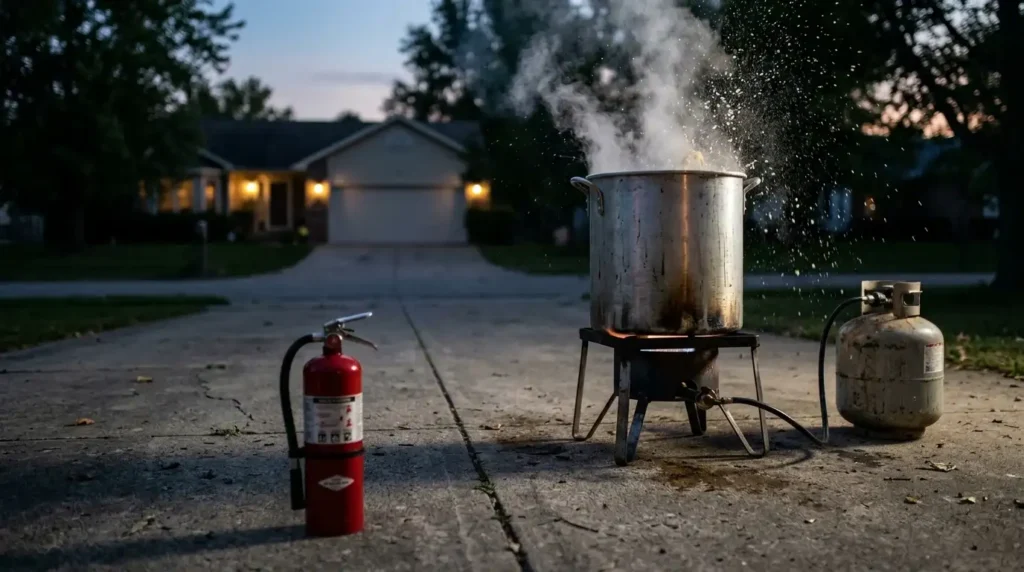
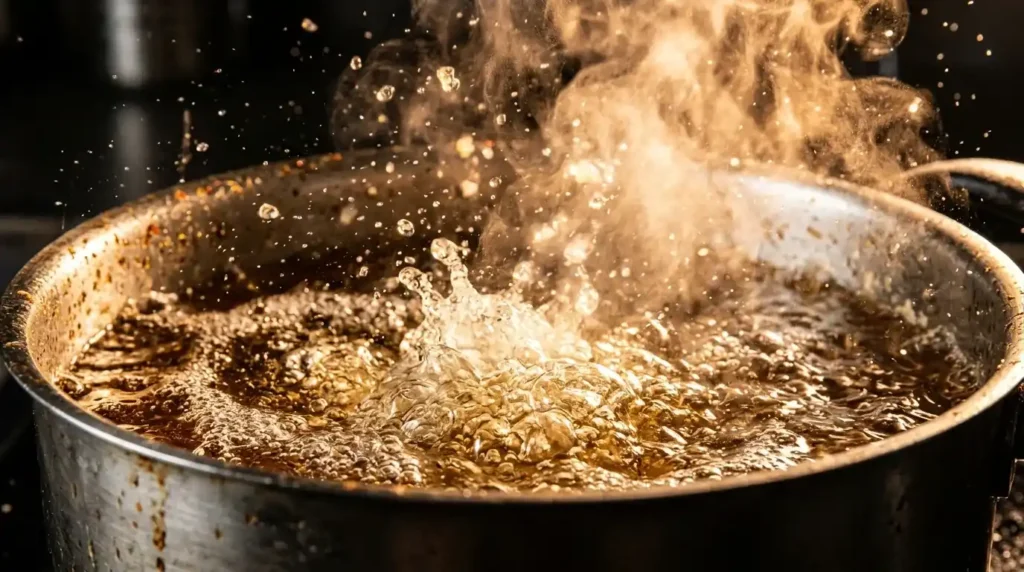
A measuring cup of tap water weighs about 237 grams. Dropped into a pot of 350°F frying oil, it stops being a cup of anything and becomes roughly 400 liters of steam, rising through oil that may already sit close to the rim. The ideal gas law gives that number in a few lines of arithmetic, and it accounts for most of why a frozen or wet turkey can turn a backyard fryer into a fountain.
The federal Consumer Product Safety Commission counted, in a November 2022 release, 217 fire or scald/burn incidents involving turkey fryers since 2000, resulting in 83 injuries and $9.5 million in property loss. The release says only that CPSC “is aware of” those cases, so they are a floor, not a national estimate. No fryer-specific national estimate from NFPA or the U.S. Fire Administration could be confirmed for this article.
Thanksgiving is the worst day of the year for kitchen fires
The fryer is a small slice of a much bigger November spike
The National Fire Protection Association’s 2026 holiday release, as reported by Carrier Management on November 16, estimates that 1,139 home cooking fires were reported to U.S. fire departments on Thanksgiving Day 2024, a 321 percent increase over the daily average. Christmas Day and Christmas Eve came second and third, each near twice the average.
The release gives no count for fryers. It does say cooking causes about 48 percent of U.S. home fires overall, and that unattended cooking is the leading contributing factor in home cooking fires. Lorraine Carli, NFPA’s vice president of outreach and advocacy, put the pattern plainly: “We consistently see a dramatic spike in home cooking fires on Thanksgiving Day, which comes as no surprise.”
On fryers specifically, NFPA’s position has not softened. The release says the NFPA discourages the use of turkey fryers that use cooking oil, which can cause devastating burns, and points cooks toward infrared, air or electric fryers instead. The National Park Service’s structural fire program, in its own fryer safety article, quotes the same stance: NFPA “discourages the use of outdoor, gas-fueled turkey fryers.”
x9m8 has run the numbers on what starts fires in restaurants and bars. The backyard version is a propane burner, a tall pot and a lawn.

The arithmetic of one cup
Thirteen moles of water, one atmosphere, and a number that matches the textbook
The calculation is short enough to do on the back of a grocery receipt, and the version here ran in Python.
Water’s molar mass is about 18.015 grams per mole, so 237 grams is 13.16 moles. At 100°C (373.15 K) and 1 atmosphere (101,325 pascals), the ideal gas law, V = nRT/P, gives:
13.16 × 8.314 × 373.15 ÷ 101,325 = 0.403 cubic meters, or about 403 liters.
Divide by the 0.237 liters the water started as and the expansion is about 1,700 to one. That is exactly the figure in the chemist’s essay Scientific American republished from The Conversation: “Steam occupies 1,700 times the volume as the same number of liquid water molecules.” The ideal gas law is a slight simplification for steam right at its boiling point, but the match is close enough to trust the order of magnitude.
The steam does not stay at 100°C, either. It forms inside oil that the same essay puts at around 350 degrees Fahrenheit (175 C). Heated to 350°F before it escapes, the same 13 moles would occupy about 486 liters. NIST’s conversion table rounds a U.S. cup to 0.24 liter; with 240 grams the steam comes to about 408 liters at 100°C. Cups are never precise, and the answer barely moves.
The oil already has the heat to spare
Boiling a cup of water takes about 634 kilojoules, roughly what 4 to 5 kilograms of 350°F oil holds above the boiling point
Volume is half the problem. The other half is energy: whether the oil can actually turn the water to steam, or whether the water would just cool the oil down.
Engineering Toolbox lists water’s latent heat of vaporization at 100°C as 2,256.4 kJ/kg and fresh water’s specific heat at 4.19 kJ/kg·K. Starting from water just above freezing, the type that collects inside a half-thawed bird:
- warming 0.237 kg from 0°C to 100°C takes about 99 kJ
- boiling it takes about 535 kJ
- total, about 634 kJ
If the water starts as ice, add the 334 kJ/kg latent heat of melting, another 79 kJ, for about 713 kJ.
Now the oil. The same reference gives 1.67 kJ/kg·K for vegetable oil and 1.97 for soya bean oil. Each kilogram of oil cooling from 350°F (176.7°C) down to the boiling point of water gives up 128 to 151 kJ. To boil one cup of water, about 4 to 5 kilograms of oil would have to give up every degree it holds above 212°F.
How much oil a given fryer holds depends on the pot, and no fetched source gave a standard fill, so the comparison stops at that figure. The reaction does not wait for the whole pot to cool anyway. What drives it is contact: water touching oil boils, steam bubbles rise and drag oil with them, more water reaches hot oil, and the process feeds itself until the water is gone or the oil is over the rim.

Ice sinks, then the steam comes up from the bottom
Why the surface frost is the least dangerous water on the bird
The Conversation essay walks through the sequence. Surface ice on a frozen bird turns to steam quickly and escapes. The danger comes once the turkey is submerged: internal ice melts, and that liquid water, denser than the oil, sinks to the bottom, where it flashes to steam that expands, rises and blows hot oil out of the pot. If the oil reaches the burner’s flame, it can ignite.
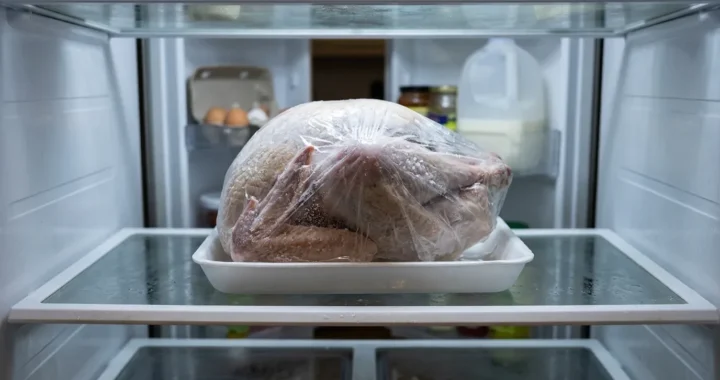
The cavity of a turkey is a cup. A bird that went from freezer to fryer with ice packed inside it, or one rinsed and not dried, can carry water into the hottest part of the pot. Steam forming at the bottom has the whole column of oil above it to push through.
Fire-service guidance on fryers puts thawing in capital letters. The National Park Service article tells cooks to ensure the turkey is COMPLETELY THAWED (the capitals are theirs) to prevent a fire or explosion hazard.
Displacement, the boring mistake
A 14-pound bird pushes out about 6 liters of oil. One cup of water makes sixty times that much gas.
The other way fryers spill has nothing to do with steam. A turkey lowered into a pot pushes aside its own volume of oil, and a pot filled to the brim before the bird goes in has nowhere to put it.
Assuming a whole turkey is about as dense as water (an assumption here; no fetched source gave a figure), a 14-pound bird is 6.35 kilograms and displaces about 6.35 liters. That is a lot of hot oil going over a rim onto a burner, and it happens whenever the pot was filled too high, no ice required.
The National Park Service gives the fire-service fix: before cooking, put the turkey in the empty pot, add enough water to cover the bird by ½”, mark the level, then dump, dry the pot and the bird, and fill the pot with oil to the marked level.
Set side by side, the two mistakes look nothing alike. Displacement is a fixed quantity, a few liters, predictable to the half inch with a tape mark. Steam is not fixed at all. One cup of water hiding in the cavity makes about 403 liters of gas at 100°C, around 63 times the volume of the 14-pound bird, and roughly 486 liters at oil temperature, around 77 times. It does not arrive all at once, which is the only mercy in it, but it arrives from the bottom of a pot of 350°F oil.
The strongest case for the fryer
The incident count is small, and most of the holiday fire burden sits elsewhere in the house
CPSC’s count of 217 incidents across more than two decades is small, even allowing that it covers only cases the agency learned about, and the case for frying starts there. NFPA’s release counts 1,139 Thanksgiving cooking fires without attributing any to fryers, and its safety advice is aimed mostly at stovetops and ovens. A cook who thaws fully, pats the bird dry, uses the water-mark test, sets the fryer on flat ground away from the house, and never leaves it, as the NPS checklist lays out, has removed most of what the physics above describes.
The counterpoint is the shape of the failure. When a fryer goes wrong, the whole potful of oil is in play at once, already hot enough to cause what NFPA calls devastating burns, a few feet from an open propane flame. CPSC’s guidance is blunt: only fry a turkey outside and away from your home, and never use turkey fryers in the garage or on the porch. The NPS article adds: have the correct kind of fire extinguisher nearby, keep children and pets away, and do not leave the fryer unattended. The U.S. Fire Administration’s cooking-safety flyer states the rule that follows from the steam arithmetic above: “Never try to stop a grease or oil fire with water.”
x9m8’s look at injury patterns in U.S. food services found thermal burns several times more common there than across all industries, and those are kitchens where people fry for a living. A backyard fryer gets used once a year, on a day of the kind Carli describes, with multiple dishes and guests, when “it’s that much easier to lose sight of what’s on the stove or in the oven.”
A cup of water costs nothing and fits in a turkey’s chest. How many people who fry a bird this year will check the cavity with a hand before it goes into the oil?
Sources
- U.S. Consumer Product Safety Commission, “CPSC Is Working to Keep Families Safe this Holiday Season,” Nov. 21, 2022 (Release 23-050): https://www.cpsc.gov/Newsroom/News-Releases/2023/CPSC-Is-Working-to-Keep-Families-Safe-this-Holiday-Season
- Carrier Management, NFPA Thanksgiving cooking fires report, Nov. 16, 2026: https://www.carriermanagement.com/news/2026/11/16/294165.htm
- National Park Service, “Fire Prevention 52: Deep Fried Danger,” updated Nov. 23, 2020: https://www.nps.gov/articles/p52-deep-fried-turkey-fire-safety.htm
- Scientific American (from The Conversation), “Why Frozen Turkeys Explode When Deep-Fried”: https://www.scientificamerican.com/article/why-frozen-turkeys-explode-when-deep-fried/
- NIST Office of Weights and Measures, “Approximate Conversions from U.S. Customary Measures to Metric”: https://www.nist.gov/pml/owm/approximate-conversions-us-customary-measures-metric
- Engineering Toolbox, “Water – Heat of Vaporization”: https://www.engineeringtoolbox.com/water-properties-d_1573.html
- Engineering Toolbox, “Specific Heat of Liquids and Fluids”: https://www.engineeringtoolbox.com/specific-heat-fluids-d_151.html
- Engineering Toolbox, “Latent Heat of Melting for some Common Materials”: https://www.engineeringtoolbox.com/latent-heat-melting-solids-d_96.html
- U.S. Fire Administration (FEMA), “Cook Safely: Watch What You Heat!” flyer: https://www.usfa.fema.gov/downloads/fief/handouts/fief_cooking_safety_flyer.pdf