On May 29, 1998, a New York City mayoral task force handed City Hall two numbers meant to decide whether a cartoon up to 70 feet tall gets to fly over Manhattan. The task force recommended that no large balloon operate in sustained wind conditions exceeding 23 mph or wind gusts exceeding 34 mph. The 100th Macy’s parade steps off this Thanksgiving, 28 years later, and news coverage as recent as 2019 still described that same pair of limits as city law. The physics behind them fits on the back of a napkin.
The rule was written after a balloon met a lamppost, and the city’s own releases never explain where 23 and 34 came from. A rough calculation, built on stated assumptions, can at least show what a balloon pulls upward with, what the wind pushes sideways with, and roughly where those two forces cross.
The rule written after a lamppost
What the city announced in 1998, and what it left unsaid
The task force came out of the 1997 parade. The city’s May 1998 release says Mayor Rudolph Giuliani appointed it after a “tragic accident” in which a portion of a lamppost was severed by a balloon; a November 1998 release described that accident as seriously injuring a spectator. ABC7 New York, recapping the history in 2019, said handlers lost control of the Cat in the Hat balloon in strong gusts and it struck a lamppost, injuring four spectators.
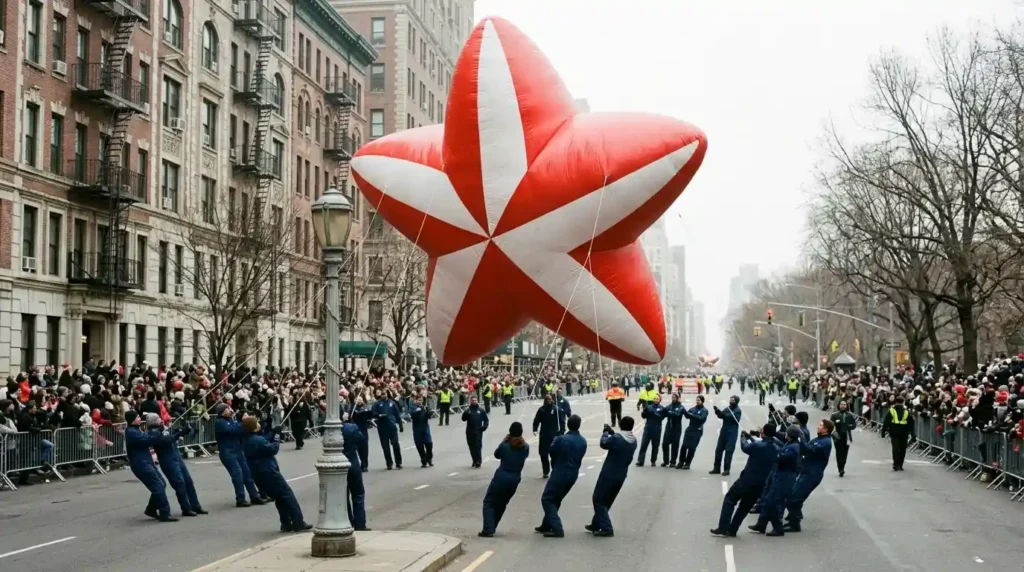
The group, co-chaired by mayoral counsel Dennison Young Jr. and Deputy Mayor Rudy Washington, studied parade operations for five months and recommended a set of safety conditions: Department of Transportation approval of each balloon’s design, the wind limits, tethering to support vehicles, deflation devices, handler training and changes to street furniture. It also capped balloon size, so that none exceeding 78 feet in length, 40 feet in width or 70 feet in height would fly.
By November 1998, the measures were announced for that year’s parade. That release gave each large balloon approximately 50-60 handlers, a captain, two assistant captains, a pilot, two assistant pilots and a police official walking alongside. It also stated that the Police Department would have the authority to make all final determinations with respect to public safety.
Neither release cites a statute or a rule number. ABC7’s 2019 report described the wind limits as applying under New York City law, and quoted Macy’s saying the NYPD decides, from current weather data and official regulations, whether the balloons fly. A search of the city’s administrative code during this run did not turn up the codified text, so the legal form of the rule stays as the news outlets describe it.
Twelve thousand cubic feet of helium
The one number every account starts from, with its range
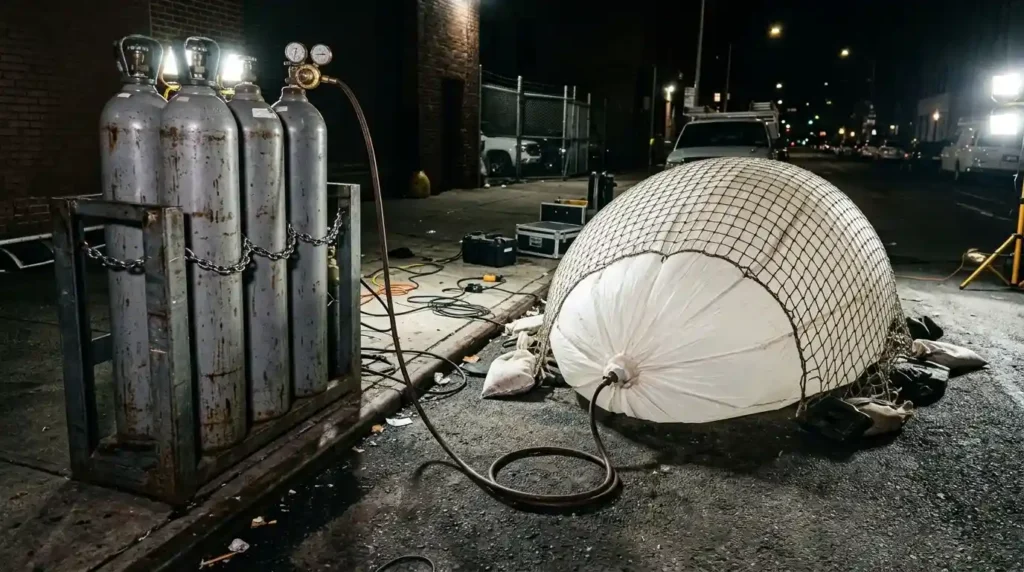
How much gas goes into a balloon is less settled than the wind rule. Plant Services, quoting Popular Science, put the figure at 12,000 cubic feet for the average balloon. Gizmodo’s 2021 count used the same 12,000 while noting that 15,000 cubic feet is widely cited, and estimated the whole parade at roughly 400,000 cubic feet.
Twelve thousand cubic feet is about 340 cubic meters. Poured into a sphere, it would make a ball about 28 feet across, comfortably inside the city’s 78-by-40-by-70-foot box. Real balloons are characters with arms, ears and tails, so the sphere is a stand-in for the calculation, not a description of any one balloon.
What the helium pulls
Gross lift on an assumed 44-degree morning, worked from two density tables
A balloon floats because the air it pushes aside weighs more than the gas inside it. The upward force equals the weight of the displaced air; subtract the weight of the helium and what remains is gross lift, the pull available to carry fabric, rigging and anything else.
Both densities come from Engineering ToolBox reference tables. Air at one atmosphere weighs 1.268 kilograms per cubic meter at 5°C and 1.246 at 10°C. Helium at 280 kelvin, about 7°C or 44°F, weighs 0.1718 kilograms per cubic meter at 1 bar. Scaling the helium to one atmosphere (an ideal-gas assumption) and interpolating the air to the same temperature gives:
| Quantity (assumed 44°F, sea-level pressure, pure helium) | Value |
|---|---|
| Air density | 1.260 kg/m³ |
| Helium density | 0.174 kg/m³ |
| Lift per cubic meter | 1.086 kg |
| Lift per cubic foot | 0.068 lb |
| Air displaced by 12,000 ft³ | about 944 lb |
| Helium inside | about 130 lb |
| Gross lift | about 813 lb |
Temperature moves the answer, though not by much. Repeating the calculation at 23°F (−5°C) gives about 850 pounds of gross lift, and at 59°F (15°C) about 791. Cold mornings help: denser air pushes up harder. The table also assumes pure helium at exactly ambient pressure. Any overpressure inside a real envelope, or any air mixed into the gas, would lower the figure somewhat; no source found for this post gives either number for a Macy’s balloon.
What the balloon itself weighs is harder to pin down. In a WIRED physics column, Rhett Allain estimated that the outer material and the gas together have a weight of perhaps 2,000 Newtons (450 pounds). Taken at face value, that leaves the displaced air’s 944 pounds against 450, or about 494 pounds of net upward pull held by the lines. Allain’s figure is labeled an estimate, and Macy’s has not published balloon weights in any source found for this post, so the net number carries the same uncertainty.

The same balloon, turned sideways by wind
A drag calculation with every assumption on the table
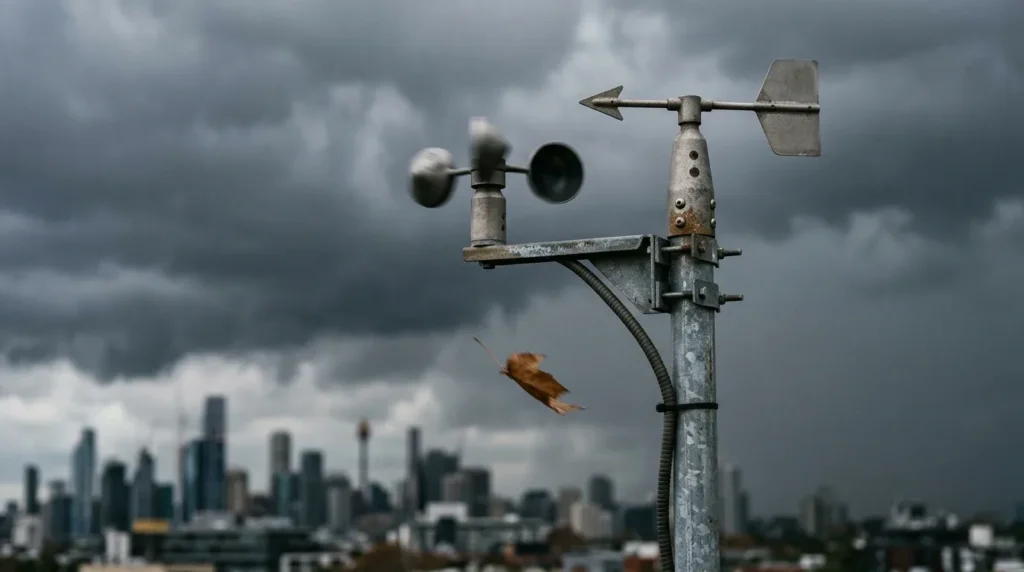
Wind acts on a balloon the way it acts on a tarp on a scaffold: it pushes on the whole broad face at once. The standard drag equation, as Engineering ToolBox gives it, is force = drag coefficient × ½ × air density × speed² × frontal area. The squared speed is the whole story of the city’s two thresholds.
The assumptions, stated plainly:
- The balloon is treated as the 28.4-foot sphere holding 12,000 cubic feet, with a frontal area of about 634 square feet (58.9 m²).
- Air density is 1.260 kg/m³, the 44°F value above.
- The drag coefficient is unknown for a soft character balloon, so three values from Engineering ToolBox’s table bracket it: 0.5 for a sphere, 0.8 for a cube and 1.17 for a square flat plate facing the flow.
- Wind is treated as steady at the stated speed. Gusts are brief, and a balloon on tethers never feels a clean, uniform wind between buildings.
| Wind | Sphere (Cd 0.5) | Cube-like (Cd 0.8) | Flat face (Cd 1.17) |
|---|---|---|---|
| 23 mph (10.3 m/s) | ~440 lbf | ~705 lbf | ~1,030 lbf |
| 34 mph (15.2 m/s) | ~965 lbf | ~1,540 lbf | ~2,250 lbf |
Going from 23 to 34 mph multiplies the force by (34/23)², or about 2.19. A 48 percent jump in wind speed more than doubles the shove.
Set those numbers beside the lift, still inside the model. At 23 mph, the most forgiving shape takes a sideways push of about 440 pounds, close to the roughly 494 pounds of net lift implied by Allain’s estimate; a free balloon on lines held at the ground would lean about 42 degrees off vertical. At 34 mph, the sphere case pushes sideways with about 965 pounds, nearly double that net lift and more than the helium’s entire gross lift of about 813 pounds, and the lean grows to about 63 degrees. A balloon pushed sideways harder than it pulls upward gets driven down and out toward street level, where the lampposts are.
Ninety people on the ropes
The handler arithmetic, using the two published crew sizes
All of that sideways force ends up in the handling lines. The 1998 city release put a large balloon at 50 to 60 handlers. Plant Services, writing in 2017 and again citing Popular Science, said the average balloon requires 90 handlers, each of whom must weigh at least 120 pounds.
Spreading the wind load evenly across the handlers, which real crews never manage, and ignoring the share taken by the support vehicles, gives:
| Case | 50 handlers | 60 handlers | 90 handlers |
|---|---|---|---|
| 23 mph, sphere | ~9 lbf each | ~7 lbf each | ~5 lbf each |
| 34 mph, flat face | ~45 lbf each | ~38 lbf each | ~25 lbf each |
Twenty-five to 45 pounds of sideways tug sounds manageable for one adult holding one rope. The trouble is that the load is neither even nor steady. A gust hits the windward lines first, the balloon swings, and the force arrives as a jerk rather than a lean, the way a garden hose kicks when the valve opens all at once. A 120-pound handler braced against a 45-pound pull has very little margin left for the moment the pull doubles.
The case that the numbers prove less than they seem
Why this calculation cannot confirm the city’s thresholds
The strongest objection to everything above is that it rests on a made-up sphere. Real parade balloons are long, lumpy and partly hollow between limbs; their frontal area depends on which way the wind hits them, and nobody outside Macy’s has published drag data for a 60-foot inflatable cartoon. Shift the area or the coefficient and the crossover point between lift and wind slides by several miles per hour in either direction. The table brackets the answer; it does not pin it.
The second objection runs against the rule itself. The 1998 releases state the limits but give no derivation, no engineering report and no wind-tunnel number. The thresholds may have come from operating experience, from a safety margin chosen by the task force, or from both; the public record consulted here does not say. A calculation that lands near the city’s numbers is consistent with them. It is not proof that anyone derived them this way.
There is also a defensible case that the limits are conservative. A gust is a peak, not a steady load, and the 1998 conditions themselves required each balloon to be tethered to support vehicles, which takes some of the strain off the crew. Crews have also had nearly three decades of practice since then. The counterweight to that argument is the 1997 lamppost, the only incident the task force cited.
Thursday, Nov. 26, 2026
A record number of inflatables, and a wind call that waits for the morning
The Associated Press reported on Nov. 13 that the 100th parade will put a record-breaking 100 inflatables in the sky, and that the parade begins at 8:30 a.m. in all time zones. New balloons and inflatable elements named in that report include Bluey, Buckaroo Bob the Minion, Earl the Squirrel, Hello Kitty Big Apple, Joe Cool and Woodstock, Sorcerer’s Apprentice Mickey and Underdog. Attractions Magazine reported in August that Sorcerer’s Apprentice Mickey was the first new balloon announced for the 2026 parade. The AP’s count of 100 covers inflatables of all kinds, not only the giant character balloons that the wind rule targets.
Whether the giant balloons fly, and how high, gets settled on parade morning. In a statement quoted by ABC7 in 2019, Macy’s said the NYPD makes that call based on the current weather data and the city’s regulations, which makes any forecast issued days ahead a preview at best.
On paper, at 23 mph the model’s sideways shove already matches its net lift. At 34 it is close to double, and the people holding the ropes can weigh, by Popular Science’s account, as little as 120 pounds each. For readers who have stood on the route on a windy year: how low did the crews bring them down?
For more physics in the browser, x9m8’s fluid simulator lets the same air that drags on a balloon swirl on screen, and the periodic table trends guide covers the chemistry side of the element doing the lifting.
Sources
- City of New York, Office of the Mayor, Press Release #238-98, “Mayoral Task Force Delivers Recommendations to the Mayor on the Macy’s Annual Thanksgiving Day Parade” (May 29, 1998): https://www.nyc.gov/html/om/html/98a/pr238-98.html
- City of New York, Office of the Mayor, Press Release #535-98, “Mayor Announces Safety Measures for the 1998 Macy’s Annual Thanksgiving Day Parade” (Nov. 20, 1998): https://www.nyc.gov/html/om/html/98b/pr535-98.html
- City of New York, Office of the Mayor, Press Release #541-98, “New Safety Measures for the 1998 Macy’s Thanksgiving Day Parade” (Nov. 25, 1998): https://www.nyc.gov/html/om/html/98b/pr541-98.html
- ABC7 New York, “Rehearsals begin as wind threatens Macy’s Thanksgiving Day Parade” (Nov. 26, 2019): https://abc7ny.com/post/rehearsals-begin-as-wind-threatens-macys-thanksgiving-day-parade/5717694/
- Plant Services, Alexis Gajewski, “Understanding the physics and mathematics of the Macy’s Thanksgiving Day Parade balloons” (Nov. 16, 2017): https://www.plantservices.com/blogs/plant-nexus/understanding-the-physics-and-mathematics-of-the-macys-thanksgiving-day-parade-balloons
- Gizmodo, Isaac Schultz, on helium in the Macy’s parade balloons (Nov. 24, 2021): https://gizmodo.com/the-helium-in-macys-thanksgiving-day-parade-balloons-co-1848091739
- WIRED, Rhett Allain, “The Physics of the Macy’s Thanksgiving Day Parade Balloons”: https://www.wired.com/story/the-physics-of-the-macys-thanksgiving-day-parade-balloons/
- Engineering ToolBox, “Air Density, Specific Weight, and Thermal Expansion Coefficients at Varying Temperatures and Pressures”: https://www.engineeringtoolbox.com/air-density-specific-weight-d_600.html
- Engineering ToolBox, “Helium – Density and Specific Weight vs. Temperature and Pressure”: https://www.engineeringtoolbox.com/helium-density-specific-weight-temperature-pressure-d_2090.html
- Engineering ToolBox, “Drag Coefficient”: https://www.engineeringtoolbox.com/drag-coefficient-d_627.html
- Associated Press via NY1, “Macy’s Thanksgiving Day Parade will soon celebrate its 100th edition: Which stars are in the lineup” (Nov. 13, 2026): https://ny1.com/nyc/all-boroughs/ap-top-news/2026/11/13/macys-thanksgiving-day-parade-will-soon-celebrate-its-100th-edition-which-stars-are-in-the-lineup
- Attractions Magazine, “Sorcerer Mickey balloon joining 100th Macy’s Thanksgiving Day Parade” (Aug. 2026): https://attractionsmagazine.com/sorcerer-mickey-balloon-macys-thanksgiving-day-parade/