

Find the speed of light from melted chocolate spots and the frequency on your oven's label, with a worked calculation, safety notes and an honest error analysis.
Twelve centimetres times 2,450,000,000 per second gives 29,400,000,000 centimetres per second. That is the arithmetic in the Open University’s microwave write-up, and the answer lands about 1.9 percent under the accepted speed of light. Everything needed to repeat it is already in the kitchen: an oven, a plate and a bar of chocolate.
A microwave oven does not heat food evenly. Waves inside the cavity concentrate energy at fixed points, and the spacing between neighbouring hot spots is half the wavelength. Measure the spacing, double it, multiply by the frequency printed on the oven, and you have the speed of the wave. Microwaves are electromagnetic waves, so the result is the speed of light; the Open University phrases it as the speed “as fast as light would travel in your microwave”. Another system built on radio signals crossing space is covered in how GPS works.
What you need
- A microwave oven with its frequency on the back label or in the manual (the Science Buddies example label reads 2450 MHz).
- A microwave-safe plate, plus an upturned microwave-safe bowl to lift it if the turntable cannot be removed.
- A chocolate bar with the foil wrapper off. The Scouts activity uses a 110 g or 120 g bar; Science Buddies uses egg white on a plate instead, and the Dorthonion physics lab suggests miniature marshmallows or chocolate chips spread evenly on a plate.
- A ruler, a calculator and oven gloves.
Safety
Keep all metal out of the oven, including foil. The University of Delaware’s safety page says to use only non-metallic, microwave-safe cookware, and also: do not operate an empty oven, since in some ovens the magnetron can be damaged. That matters here, because a plate with no food is close to an empty oven. Always run it with the chocolate or other food on the plate.
Food gets hot quickly. Open University warns that chocolate “can get very hot, very quickly”, the Scouts activity suggests 20-second bursts to avoid burning it, and Science Buddies recommends oven mitts and adult supervision. Do not use an oven with a damaged door or seal.
Method
- Remove the turntable. If the drive mechanism cannot come out, set an upturned bowl over it and rest the plate on that. Science Buddies explains why: a moving plate smears the hot-spot pattern.
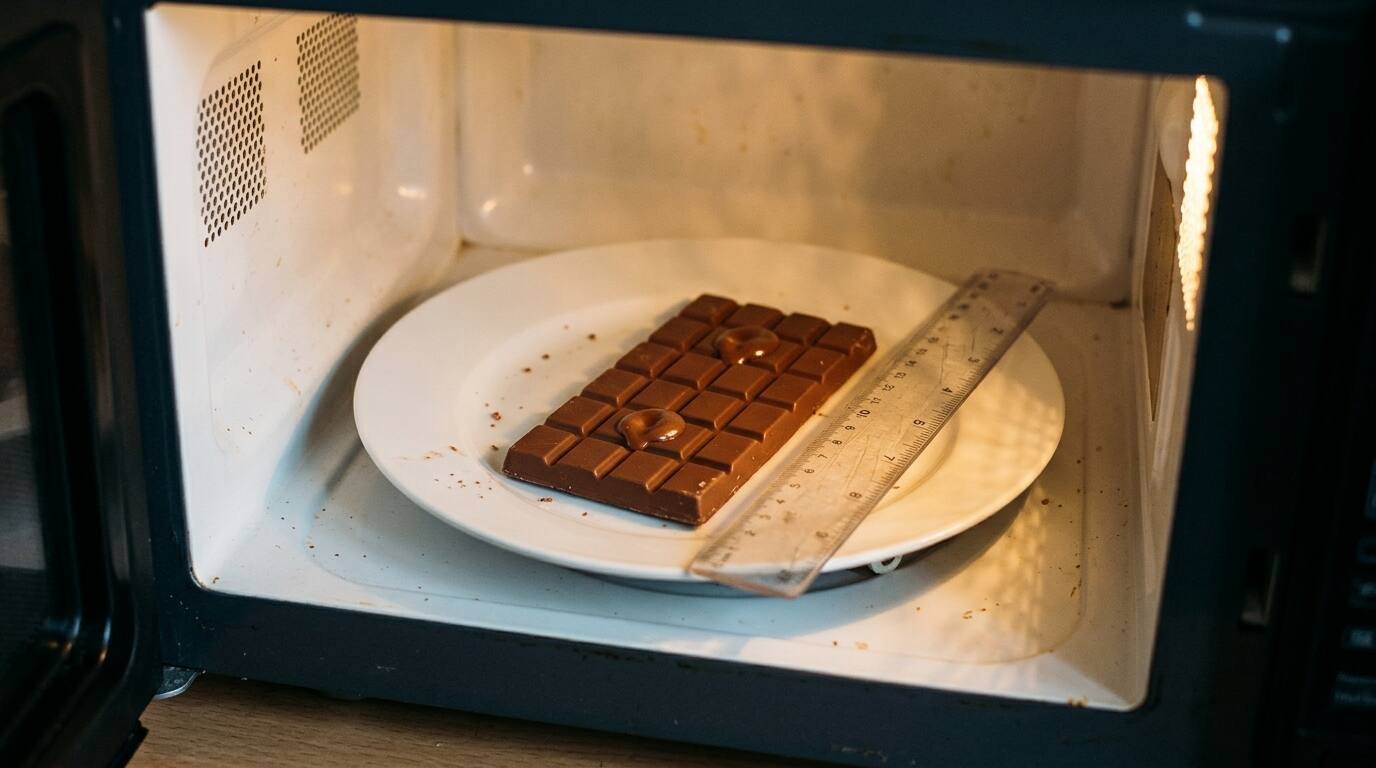
- Unwrap the chocolate and lay it on the plate.
- Run the oven for 20 seconds. Lift the plate out with oven gloves without turning it, and look for melted spots.
- If nothing has melted, heat for another 20 seconds. Stop before the chocolate burns.
- Measure the distance between neighbouring melted spots. With more than two, measure several pairs and average them.
- Read the frequency from the label.
Worked calculation
The relation is wave speed equals frequency times wavelength, written c = f x wavelength. Only the wavelength needs working out.
| Step | Value | Source of the number |
|---|---|---|
| Spacing between melted spots | 6 cm = 0.06 m | Open University example |
| Wavelength = 2 x spacing | 12 cm = 0.12 m | Spots sit half a wavelength apart |
| Frequency | 2,450 MHz = 2,450,000,000 Hz | Back of the oven |
| Speed = f x wavelength | 0.12 x 2,450,000,000 = 294,000,000 m/s | Arithmetic |
| Accepted value | 299,792,458 m/s | Used by the Scouts activity |
| Difference | about 1.9 percent low | Derived from the two lines above |
Units trip people up more than physics does. The Scouts instructions convert centimetres to metres first, by dividing by 100, and only then multiply by the frequency in hertz. Mixing centimetres with hertz still works, as the Open University example shows, but the answer then comes out in centimetres per second and needs converting back before you compare it with the accepted value.
Run the same calculation backward and the expected spacing is 299,792,458 divided by 2,450,000,000, then halved. That is about 6.12 cm, as the Scouts page implies. A bar that shows spots 6 cm apart is therefore behaving as the theory says.
Error analysis
The only accuracy figure with a source behind it is the Open University one: one example, one oven, 1.9 percent low. None of the sources used here gives a typical error for the method across many ovens, so nobody can promise that figure for a given kitchen. What the sources do offer is a list of places the error comes from.
Reading the spot positions
Melted chocolate has soft edges. Science Buddies says the centres of the cooked areas are not clearly defined, so each measurement involves judgment. Its fix is to record centre-to-centre distances for an average, then the shortest and longest edge-to-edge distances as lower and upper bounds, and carry both bounds through to the final speed.
Scale matters here. Because the spacing is multiplied by two and then by 2.45 billion, a 1 mm slip in the spacing becomes 2 mm of wavelength, which moves the answer by about 4.9 million metres per second, or roughly 1.6 percent. This is arithmetic from the formula, not a published figure. It says the ruler dominates the error.
Uneven melting
The Scouts page names inconsistent melting as a source of spread and recommends averaging several pairs of spots. It also notes that other foods, cheese for one, may affect accuracy.
The frequency
The label gives a nominal 2,450 MHz. The sources treat that number as exact. No source used here quantifies how far a real oven’s output might sit from the label, so that error stays unestimated.
A moving plate
If the plate shifts even slightly, the hot spots smear and spacing grows hard to read. Hence the bowl, and hence Science Buddies’ instruction to restart with fresh egg white if the plate moves.
Improving the measurement
Repetition is the cheapest upgrade. Science Buddies asks for at least three runs, with the plate cleaned and dried between them and fresh egg white each time. Each run gives its own spacing; the spread among them is a more honest error bar than any single reading.
Heat in short steps. Twenty seconds at a time, per the Scouts page, lets you stop as soon as spots appear instead of overshooting into a uniformly melted bar. Use a plate close to the size of the oven floor, a suggestion from Science Buddies, so the pattern covers the same region the waves fill. And measure to the millimetre: with a 6 cm spacing, the ruler is doing most of the work.
Writing up the result
A tidy report follows the structure the Dorthonion lab asks for. Tabulate every measurement, give the frequency in hertz and each wavelength in metres, show the averaging, and estimate the error by comparing the calculated speed with the accepted value. Express the final answer with the bounds from the edge-to-edge distances, then say whether 299,792,458 m/s falls inside them.
If it does not, that is a result too. It points to a reading problem, a plate that moved, or a frequency that is not what the label says. Chasing the cause is the more interesting half of the exercise.
Beyond the kitchen
The wave in the oven belongs to the same family as the radio waves astronomers use to study distant events. One recent case is Webb’s identification of the host of the farthest fast radio burst, covered on x9m8. Different frequency, same speed.
Where the marshmallow comes from
Science Buddies traces the idea to a 1997 take-home lab by Stauffer in The Physics Teacher, which used marshmallows. Its own version swaps in egg white, partly cooked in some spots and nearly done in others. Pick whichever food shows sharp spots; the physics is identical, and several repeats help whichever you choose.
Sources