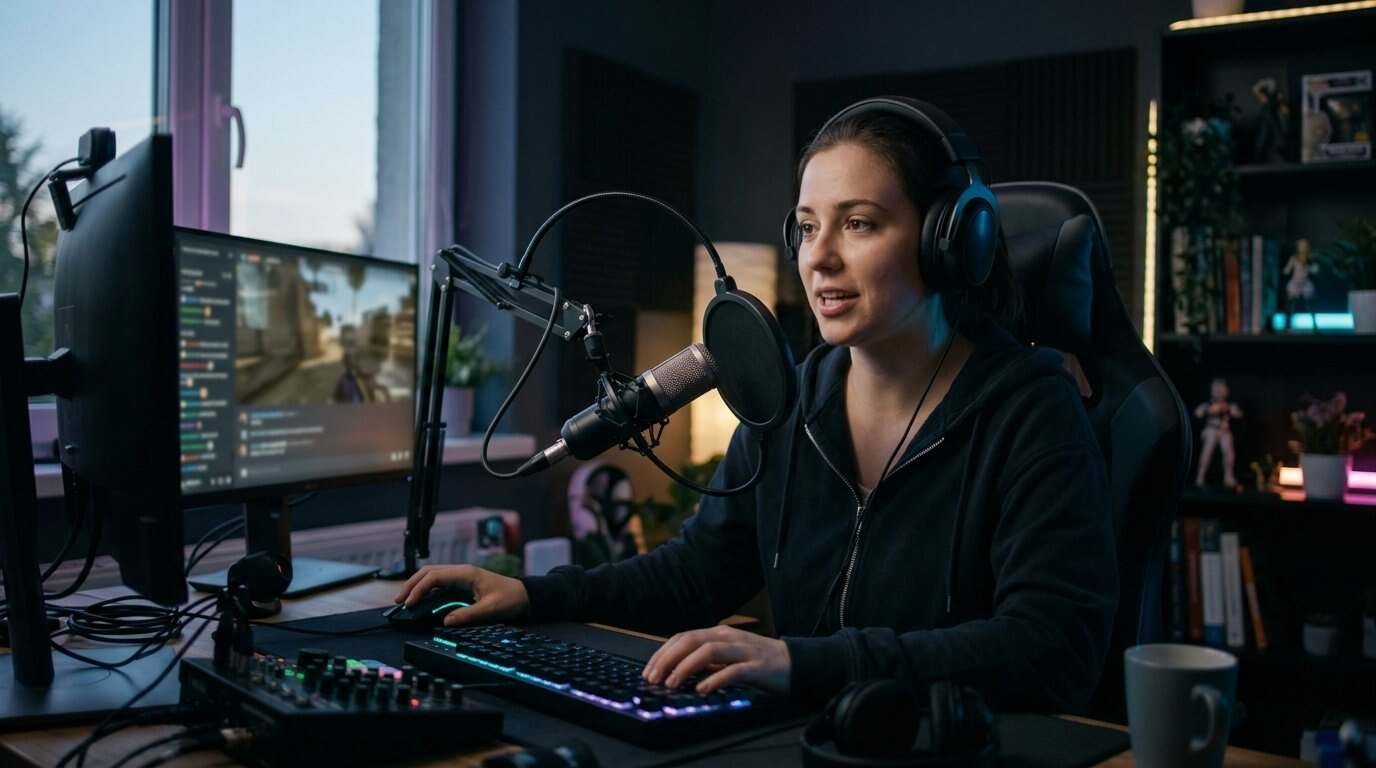
YouTube live auto dubbing was announced on September 23, 2026, at Made on YouTube. The feature translates a streamer’s speech in real time so viewers can listen in their own language while the stream is happening. A pilot is scheduled for early 2027, so nothing is available yet, but the design raises a technical question that is worth working through.
Why live is harder than recorded
YouTube already dubs finished videos. PPC Land summarizes how that works: software transcribes the speech, translates the transcript, synthesizes a new voice track, and mixes it with separated background audio. The result is added as an alternative audio track that viewers select in the player settings. Creators can review each track in Studio, remove individual languages, or switch the feature off.
That pipeline has the luxury of the whole file. Translation reads full sentences, so word order and idioms can be resolved before any speech is produced. A live stream gives up that luxury. The system has to start speaking the translation while the speaker is mid-sentence, and the next words are unknown. The designer has to choose between waiting for more context, which adds delay and improves accuracy, and speaking sooner, which cuts delay and raises error. This trade-off is my reading of the problem, not something YouTube has described.

What is known and what is not
The confirmed parts are short. Gadgetbond and PPC Land both report the pilot starts in early 2027 with English and Spanish. QUASA, citing the announcement, says it covers spoken audio only, and does not translate on-screen text, captions or live chat. Its report also says the pilot starts with a small initial group of creators.
The unknowns are the ones that decide whether the feature is usable. QUASA states that latency is not established. Nothing published says whether listeners can hear the original voice under the translation, how overlapping speakers or background audio are handled, or which translation directions will be supported. QUASA also notes that its language detail came from a streamer-focused account and was not confirmed in YouTube’s own materials, which is why I treat English and Spanish as reported rather than certain.
| Date | Milestone (recorded video) |
|---|---|
| December 10, 2024 | Launch for knowledge-focused Partner Program channels |
| April 2025 | All Partner Program creators could enrol |
| February 4, 2026 | Available to all creators in 27 languages |
| Early 2027 | Live auto dubbing pilot, English and Spanish reported |
Why YouTube wants it
The business reason is stated plainly. PPC Land quotes YouTube’s figure that more than 40% of live watch time comes from viewers outside a creator’s home country. A live stream is a perishable product, so a language barrier costs more than it does on a video that can be dubbed later. Anyone who has watched a stream in a language they only half understand knows how quickly attention drops.
There is a second use, tied to the other live announcements. Gadgetbond reports a matchmaking feature, Go Live Together, that pairs creators who are streaming and would otherwise never meet, plus Live showdowns where viewer chats, gifts and Super Chats count toward a score. Pair a creator in Madrid with one in Chicago and a live translation layer becomes more than a convenience, since it is what lets two audiences share one broadcast.
Know the limits of the recorded version too, since the live one may inherit some of them. PPC Land’s summary of YouTube’s help text says recorded dubbing excludes videos longer than 120 minutes, videos with no speech or music only, undetectable languages and videos with copyright claims. Quality can vary by language. None of that is confirmed for live, but it is a reasonable preview of the kinds of content where machine dubbing struggles.

How to prepare
Streamers can do a few things now. Speak in complete, evenly paced sentences, because YouTube’s own help text for recorded dubbing warns that very fast speech can produce an unlistenable, sped-up dub. Keep names and jargon consistent and say them clearly, since quality suffers on proper nouns, idioms and technical terms in the recorded system. Watch how your existing dubbed videos perform by language in Studio, which is the nearest evidence you will have of whether a live audience in that language exists.
And keep expectations modest until the pilot opens. A translation that arrives a few seconds late can still work for a lecture or a talk. It would be rough for a fast-moving gaming stream. The first creators in the pilot will show which kind of content suits it.
What recorded dubbing suggests about live
YouTube’s recorded auto dubbing has a track record that the live version lacks. In PPC Land’s timeline, the feature opened to everyone with 27 languages on February 4, 2026. YouTube-reported figures cited there put the audience at more than 6 million viewers a day watching at least 10 minutes of auto-dubbed content in December 2025, with dubbed views averaging 75% of the original language’s average view duration. Those figures are YouTube’s own and have not been independently audited.
The same account lists the exclusions: music-only content, material whose language cannot be detected, and speech too fast for a usable dub. YouTube’s Help Center, as quoted there, says the system struggles with “proper nouns, idioms, and jargon.” Creators can review each language track in YouTube Studio before publishing it, unpublish or delete tracks, or turn the feature off in advanced settings. A live broadcast has no review step of that kind, which is the main reason the pilot matters.

Questions the pilot leaves open
QUASA, which relays YouTube’s announcement and third-party reports that were not checked against the originals here, says the live dubbing covers the creator’s speech only and does not by itself translate on-screen text, captions or live chat. It also lists what no source has settled: the delay between speech and dub, how overlapping speech is handled, whether viewers can hear the original audio alongside the dub, how dubbed audio appears in replays, and how mistranslations are corrected.
PPC Land names Barbara Macdonald, a YouTube Live product manager, as the person who announced the pilot on September 23, 2026. YouTube’s hub page lists Live auto-dubbing among the announcements but offers no further detail.
Sources