


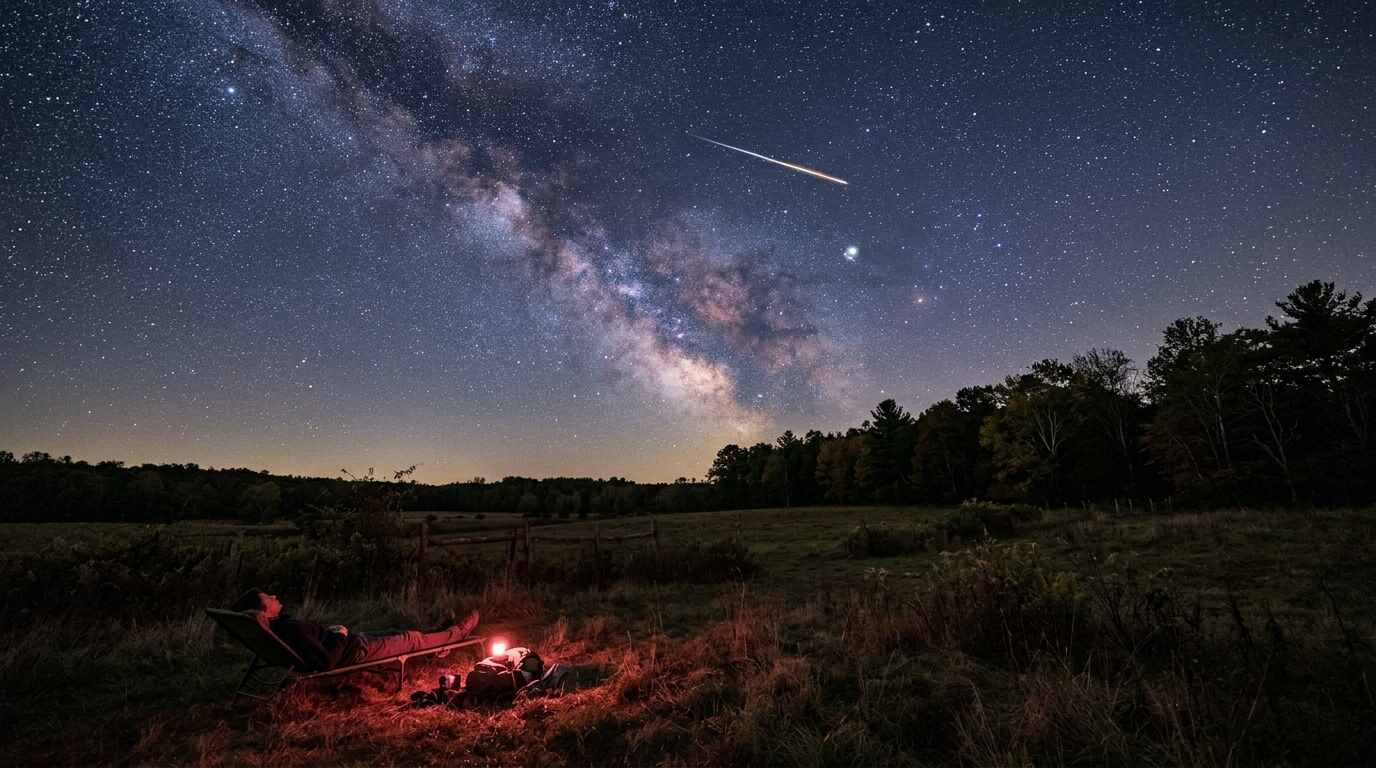
A practical plan for the second half of October 2026: Moon phases, Saturn, the Orionid meteor shower on a moonlit night, and how dark adaptation and radiant geometry decide what you see.
The Moon is the single biggest variable in what you will see over the second half of October 2026. It was new on October 10, so the sky has been dark for days, but it is now brightening toward a full Moon at the end of the month, and every good target between now and then has to be planned around it.
What follows is a numbered plan built on NASA’s October skywatching guide, cross-checked against other observing calendars. It covers how to prepare your eyes, where to stand, which objects to find, and how to watch the Orionid meteor shower on a night when moonlight gets in the way. Dates below were confirmed in at least two sources unless the text says otherwise.
The plan in seven steps
- Check the Moon phase for the night you plan to go out.
- Find your local Bortle rating and pick a darker spot.
- Arrive early and protect your eyes with red light.
- Locate Saturn, then the pre-dawn planets.
- Watch the Orionids after the Moon sets, looking away from Orion.
- Spend the full-Moon week on bright targets, not faint ones.
- Finish with the Moon and the Pleiades on October 27 and 28.
Step 1: Check the Moon first
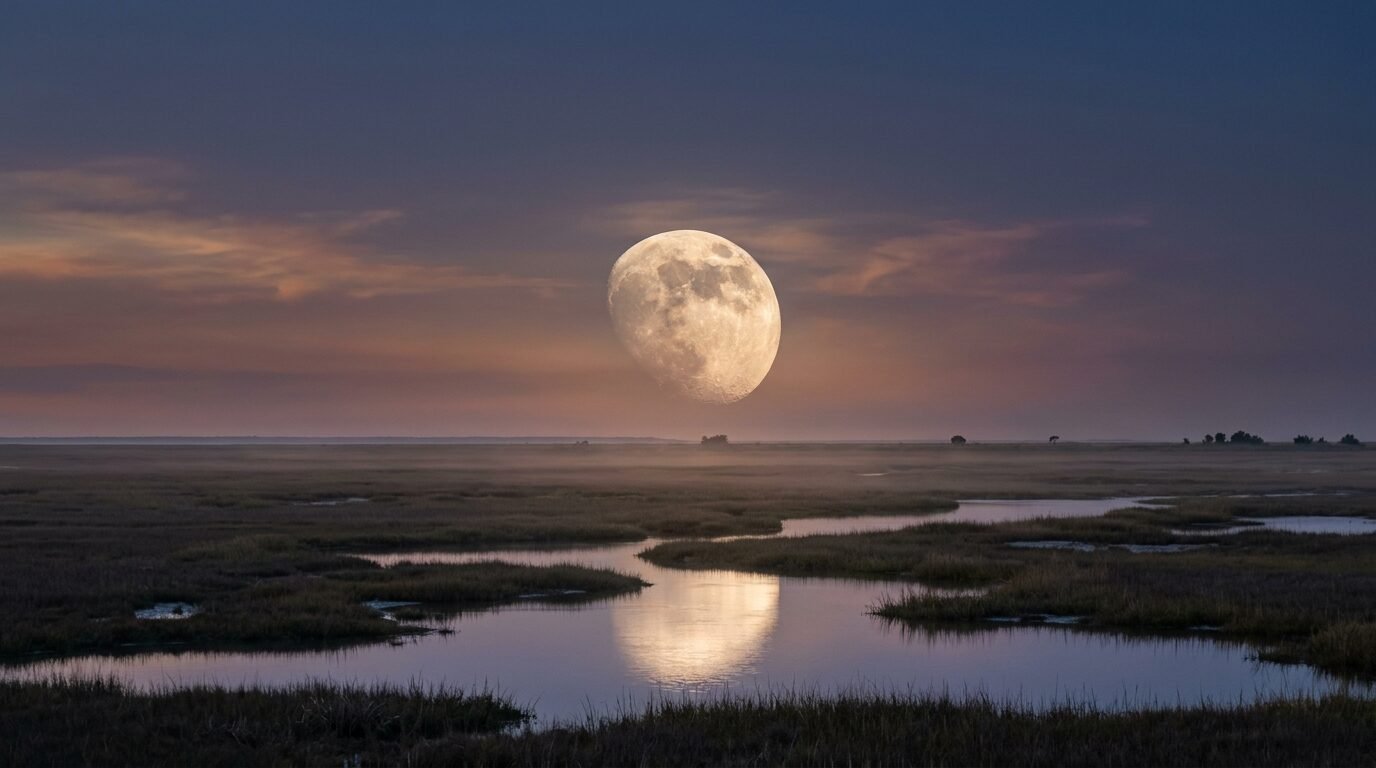
NASA lists the October 2026 phases as Third Quarter on the 3rd, New Moon on the 10th, First Quarter on the 18th and Full Moon on the 25th. The last of those needs a footnote. AstroBackyard and Universe Magazine both put the exact full phase at 4:12 UT on October 26, which is just after midnight Eastern Daylight Time, so on Long Island the Moon turns full in the first minutes of the 26th while viewers farther west see it happen late on the 25th. The calendar date depends on your time zone. The glow itself looks the same either way.
Why bother? NASA’s amateur-astronomy outreach program notes that bright moonlight can rival a streetlight under dark skies, and the National Park Service says a gibbous Moon can outshine faint stars and galaxies. Dim targets lose first. By inference, planets and the brightest stars should survive the glare far better, and that matches how the Moon-and-planet pairings below are meant to be seen.
Step 2: Get away from the glow
The Bortle scale rates sky darkness from 1 (darkest) to 9 (most light-polluted). NASA’s Night Sky Network gives New York City as a 9 and Cherry Springs State Park in Pennsylvania as a 2. A light pollution map lets you look up your own address or a candidate field, and the same article points to one that shows the Bortle class when you click a spot.
My own advice, and it is opinion, is to trade distance for direction. A beach or a field with a low, open horizon to the east often beats a slightly darker spot hemmed in by trees, because Saturn rises near sunset and the Orion region climbs late in the night. Check the weather and the clarity of the air before you drive anywhere, as the park service advises.
Step 3: Give your eyes half an hour
Dark adaptation is a two-stage process. According to the American Meteorological Society glossary, cone sensitivity climbs for about three to four minutes and levels off. In very dim light the rods then overtake the cones at roughly 7 to 10 minutes, and sensitivity peaks around 20 to 30 minutes, when a fully adapted eye is about 100,000 times more sensitive than it is in daylight. NASA and the park service both round the wait to 30 minutes.
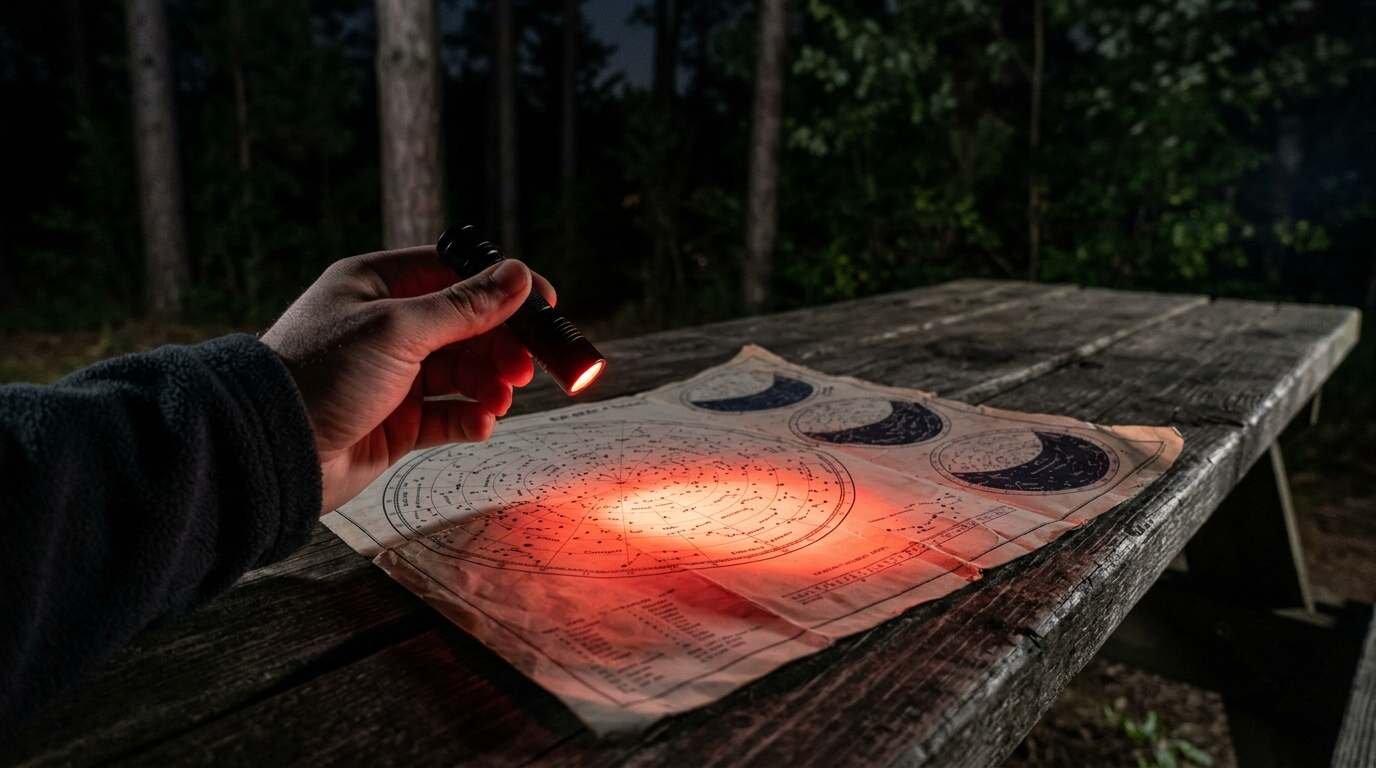
Rods do not register color, which is why the night sky looks gray. Only bright stars and planets are strong enough to switch the cones on. Phone screens, headlamps and passing headlights can undo the adaptation in seconds. Red light is the gentlest option: it has the longest wavelength of visible light, and NASA says it lets your pupils stay open wider for longer. Use a red flashlight, a red-screen mode on a sky app, or cover a light with red film. If you want to photograph the shower, the phone photography guide for the Orionids covers the camera side of the night.
Step 4: Find Saturn, then look east before dawn
Saturn reached opposition on October 4, the point where Earth sits between the Sun and the planet. NASA explains that this puts Saturn rising around sunset and keeps it visible for much of the night. NASA’s sky chart shows it above the eastern horizon near 9 p.m., with the bright star Fomalhaut to the southeast.
Saturn has company on one night. On October 24, with the Moon about 97 percent lit, the two sit near each other in the evening sky, roughly 7 degrees apart according to AstroBackyard. Both are visible without any equipment. For the morning crowd, Universe Magazine lists Jupiter and Mars among the planets visible before dawn. NASA placed a thin Moon beside Jupiter on October 6, which has passed, but the planet is still there for early risers. I could confirm those morning positions in only one source, so treat the exact placement as something to verify in a planetarium app.
Step 5: Watch the Orionids after the Moon sets
The shower is active from October 2 to November 7, with the peak on the night of October 21 into the morning of October 22. NASA says rates run about 10 to 20 meteors per hour under dark skies, the American Meteor Society agrees on the 10 to 20 figure, and the debris comes from Halley’s Comet. The bad news is the Moon. The AMS puts it at 74 percent illuminated and waxing gibbous on peak night, and it will significantly interfere while it is above the horizon. Plan for the hours before dawn, after moonset and before twilight begins. All times here are local clock time; for Long Island that is Eastern.
Technique matters more than gear. NASA recommends lying flat on your back with your feet pointing southeast, and it advises against fixating on Orion. EarthSky explains the geometry: meteor particles arrive on parallel paths, and perspective makes them seem to fan out from one point, the radiant, like railroad tracks converging in the distance. Meteors near the radiant are coming almost straight at you and look short, so trails lengthen as you look farther away. Both sources point you 45 degrees or more from the radiant, which NASA places just north of Betelgeuse. Universe Magazine adds that the radiant is highest around 4 a.m. in the second half of October, which is why the late hours pay off. Orionids hit the atmosphere at about 66 kilometers per second, or 41 miles per second, so expect quick streaks and the occasional fireball.
Step 6: Match the target to the Moon
Between the First Quarter on the 18th and the Full Moon, evenings are bright. This stretch suits the Moon itself and bright planets such as Saturn. Save galaxies and faint clusters for a night near the next new Moon, and use the 10th of this month, when it was new, as the model.
The Hunter’s Moon label for the October full Moon appears in AstroBackyard’s calendar. AstroBackyard says it rises near sunset, so dusk on the 25th is the natural time to catch it. If you see a steady, fast-moving bright point, it may be the space station, a topic covered in the orbital mechanics behind Crew-13’s trip to the ISS. NASA offers a tracker for predicting passes.
Step 7: Close out with the Pleiades
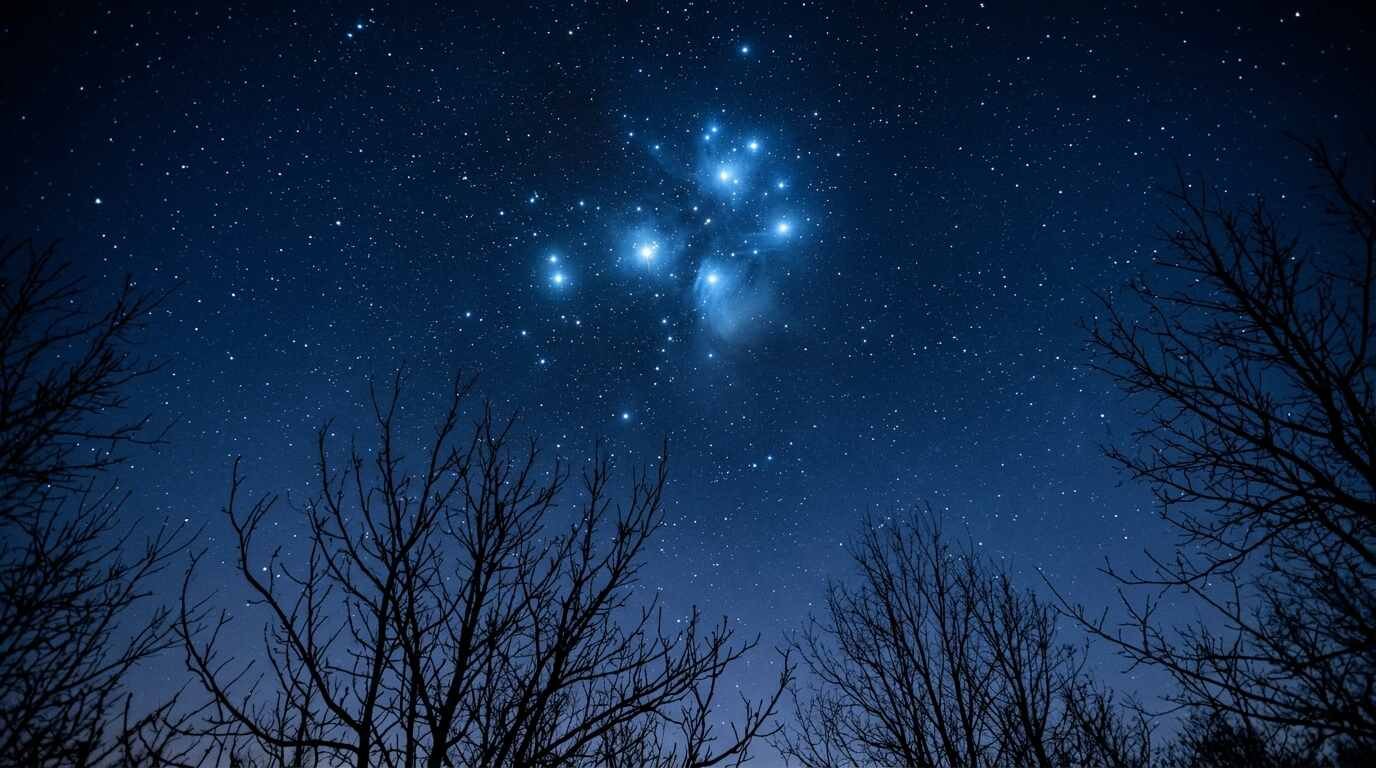
NASA notes the Moon passes close to the Pleiades cluster on October 27 and 28, rising in the east around 11 p.m. on its chart. To the eye the cluster is a slightly fuzzy knot of six or seven stars, and binoculars add many more. Universe Magazine reports that on the 28th the Moon partially covers the cluster, but that kind of occultation is visible only from certain parts of the world, and its times were given for a European observer. Check a local prediction before you plan around it.
The cluster is visible from almost everywhere on Earth, which NASA offers as one reason so many cultures told stories about it. With a bright Moon beside it, it is a good test of how much you can see through glare.
What to look for and when
| Date | Event | How to see it |
|---|---|---|
| Oct 18 | First Quarter Moon | Evening sky; bright enough to start washing out faint objects |
| Oct 21 to 22 | Orionid meteor shower peak | Hours before dawn, after the 74 percent Moon sets; face away from Orion |
| Oct 24 | Moon near Saturn | Evening, naked eye |
| Oct 25 to 26 | Full Moon (Hunter’s Moon) | Rises near sunset; exact moment is 4:12 UT on Oct 26 |
| Oct 27 to 28 | Moon near the Pleiades | Look east in the evening; binoculars help |
Saturn itself is up for much of every clear night this month rather than on a single date, which is why it sits outside the table.
Sources
- What’s Up: October 2026 Skywatching Tips from NASA
- October 2026 Night Sky: What to See (AstroBackyard)
- Celestial Highlights of October 2026 (Universe Magazine)
- Meteor Shower Calendar (American Meteor Society)
- Orionid meteor shower (NASA Science)
- Radiant point of meteor showers (EarthSky)
- May’s Night Sky Notes: Stargazing for Beginners (NASA Night Sky Network)
- Stargazing (National Park Service, Dinosaur National Monument)
- Dark adaptation (AMS Glossary of Meteorology)
- Western Slope Skies: Seeing in the Dark (KVNF)