






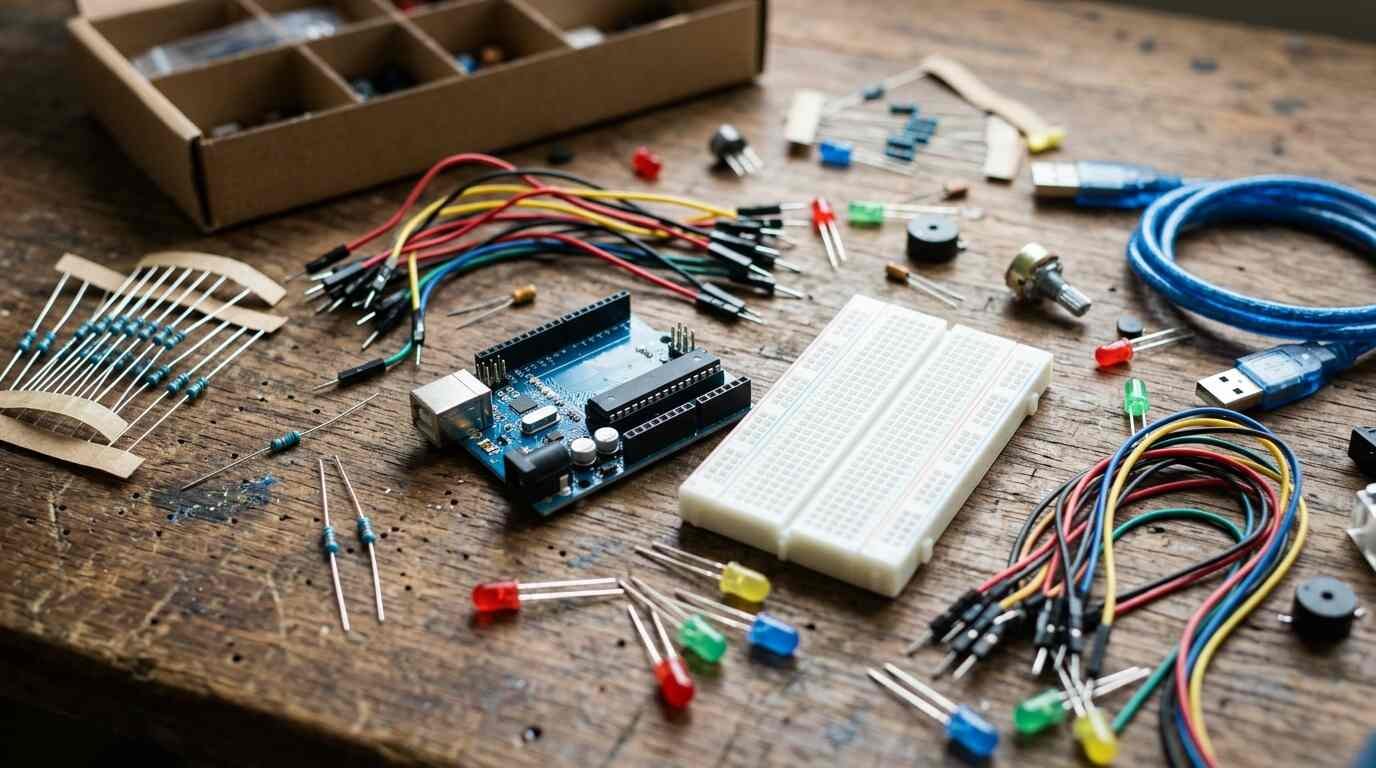
Elegoo's UNO R3 kit packs a board, 200-plus parts and a lesson set into one case. Independent coverage is dated, so here is what holds up and what doesn't.
As an Amazon Associate I earn from qualifying purchases. A commission may be earned if you buy through this link, at no extra cost to you.
Most people who buy a first electronics kit want a board, some sensors and a reason to keep going, and this Elegoo UNO R3 Most Complete Starter Kit review looks at whether Elegoo’s box delivers that. It is a big, cheap, well-organized kit that has a lot going for it. It also has thin documentation and a few cheap parts, and independent coverage of this exact kit is older than I’d like.
I haven’t tested this unit; this review is based on published tests and shopper feedback. Several of the outside sources I found cover Elegoo’s related Super and Mega kits, and I flag each one where it comes up.
What the kit is and who it’s for
The kit is built around an ELEGOO R3 board that is compatible with the Arduino UNO R3, plus a USB cable. Elegoo’s store page says the box holds more than 200 parts of 63 kinds. It adds a free PDF tutorial with more than 30 lessons, module code on a CD, and a compartmentalized case with a small-parts bonus box.
Electromaker’s review lists pre-soldered sensor and display modules, among them an LCD, a real-time clock, an RFID reader, an ultrasonic sensor and a DHT11 temperature sensor, along with servos and a stepper motor. There is also a breadboard, about 65 jumper wires and a breadboard power module.
| Board | ELEGOO R3, Arduino UNO R3 compatible, with USB cable |
| Parts | More than 200 across 63 kinds (Elegoo’s figure) |
| Modules | Pre-soldered LCD, RTC, RFID, ultrasonic, DHT11, plus servos and a stepper motor |
| Lessons | Free PDF, 30+ lessons; module code on a CD |
| Storage | Compartmentalized case and a small-parts bonus box |
| Power | Breadboard power module included |
| Chips | Microcontroller and USB chip not stated on Elegoo’s page; not verified |
The parts count is Elegoo’s own marketing figure, so treat it as a claim and not an audit.
The target buyer is a total beginner or a student, and the kit also suits a parent or teacher buying for a class or as a gift. You don’t need to solder anything to start.
What Amazon shoppers say
Amazon buyers are mostly beginners, and the kit has a deep pool of feedback to draw on. Check the current price on Amazon before ordering.
Amazon’s summary of customer comments says the kit suits beginners, includes everything needed to start, offers a good selection of components and is worth the price. Those are the consistent themes. The mixed ones are the tutorials and the build quality: some buyers say the guides explain everything, others call them unhelpful. Some parts are described as flimsy, and several shoppers mention missing parts.
A Google or Google Shopping rating was not checked for this post. Shoppers can compare it themselves before buying.
What independent reviewers found
Here the evidence is thin, and I’d rather say so than pad it. Electromaker reviewed the kit in 2018 and gave it 4.5/5. It called it one of the best Arduino starter kits, praising the parts count, the bundled lessons and the tidy packaging, and it marked down the CD-based guide as dated. The review is several years old, and Elegoo’s kit contents can change.
Electromaker’s December 2019 roundup ranked the official Arduino kit first and the Elegoo second, calling both fantastic and praising the Elegoo’s 200-plus parts and 30-plus projects. The Automation Blog ran a hands-on piece in March 2024 that calls it the most popular Arduino kit on Amazon. That page was gated and I read only the introduction, so I can’t report its findings.
Two other sources are about related kits. HowToMechatronics covers Elegoo’s Mega and Super kits, not this one, though it praises Elegoo’s value and clones that behave like the official board. Flavio Copes recommends the Most Complete kit, at 63 items, as a good lower-cost way in, while saying he would rather buy official Arduino parts to support the project.
Forum threads add color without adding proof. An Arduino forum user called the example code good, and users said the R3 clone behaves like a genuine Uno for most purposes. A commenter on r/arduino who owns the Mega version said you will need outside tutorials. These are anecdotes, not tests.
Price is the other practical point. Elegoo’s own store and the Amazon listing sat close together when I looked, and any difference may reflect nothing more than timing, so compare both. Nothing in my research flags the price as out of line for a box with this many parts.
What’s good
- The parts selection is large for the price, with 200-plus components by Elegoo’s count.
- Pre-soldered modules mean beginners can skip soldering.
- Structured lessons and example code give a path through the contents.
- It works with the standard Arduino IDE, and the clone board acts like a genuine Uno for most users.
- The sturdy case keeps parts sorted, according to Electromaker.
That last point sounds minor until you’ve tried to find a resistor in a drawer of loose parts. A kit you can tidy away in a minute is a kit you will use again.
What’s bad
Documentation is the weak point, and the complaints are specific. Electromaker called the disc-based materials dated, since many computers lack optical drives, although Elegoo says the PDF lessons are online. A commenter on r/arduino described the documentation as surface-level and said outside tutorials would be needed.
Hardware gets criticism, too. Users in an Arduino forum thread found the Dupont jumper wires short and thin and the breadboard power module weak. Some of the more advanced parts, such as the joystick, RFID reader and stepper motor, are complicated for newcomers, according to HowToMechatronics, writing about a sister kit.
There is a philosophical objection as well. Arduino forum users and Flavio Copes both suggest buying at least one genuine Arduino board to support the project, since this one is a clone.
Then there are things I couldn’t settle. Windows driver trouble is common with clone boards that use CH340-type USB chips, according to an Arduino forum thread. I did not verify which USB chip this kit uses, so I can’t tell you whether that applies. The Super kit’s aggregated reviews on ShopSavvy (7.4 out of 10) cite faulty parts, missing booklets and unclear code explanations; those may not apply to this kit.
Video reviews
Three videos match this kit. I haven’t watched them in full, so the descriptions below rest on the titles.
Another way to read the criticism is by where it lands. The complaints I found concern depth and explanation, such as surface-level documentation and unclear code, and not whether the kit can get a beginner started. That reading is mine, and it rests on a handful of comments.
How it compares
The official Arduino Starter Kit (K000007) is the usual comparison. Electromaker’s 2019 roundup put it first and the Elegoo second. The official kit costs more and has fewer parts, but you pay for genuine hardware and the project’s own lessons. Flavio Copes suggests the official Arduino Starter Kit R4, as the official alternative.
Within Elegoo’s own range, the Super Starter Kit is cheaper with fewer parts, and HowToMechatronics calls it the best value for budget buyers. If your budget is tight and you don’t need the extras, that is the option to check.
Who should buy it and who should skip it
Buy it if you are new to electronics, want one box that covers a lot of ground, and are happy to find supplementary tutorials online when the supplied guides run out. In my view, a classroom or a gift is the best use case, because the case and the lesson set give structure.
Skip it if you want a genuine Arduino board or the features of the newer R4 WiFi. Experienced makers will do better buying a few parts one at a time, and anyone who needs deep, long-term teaching material should plan on outside courses.
Verdict
This is a value kit, and it behaves like one. The consistently positive Amazon buyer comments point to satisfied beginners, and the older independent reviews agree with that. The criticisms, short wires, weak documentation and a clone board, are real but modest at this price.
My take: it is a sensible first purchase for a beginner on a budget, provided you accept that the box gets you started and other resources take you further.
- ELEGOO UNO R3 Project Most Complete Starter Kit, the kit reviewed above. See it on Amazon (affiliate link)
As an Amazon Associate I earn from qualifying purchases. A commission may be earned if you buy through this link, at no extra cost to you.



