

A parts list, build steps and safety notes for a dry-ice diffusion cloud chamber, plus a guide to telling muon, electron and alpha tracks apart.
Most of the tracks in a home cloud chamber belong to muons, particles roughly 200 times heavier than an electron that form when cosmic rays strike the atmosphere. In a well-made chamber they show up about once per second, according to the CERN S’Cool LAB build manual. Each leaves a thin, straight line of alcohol droplets.
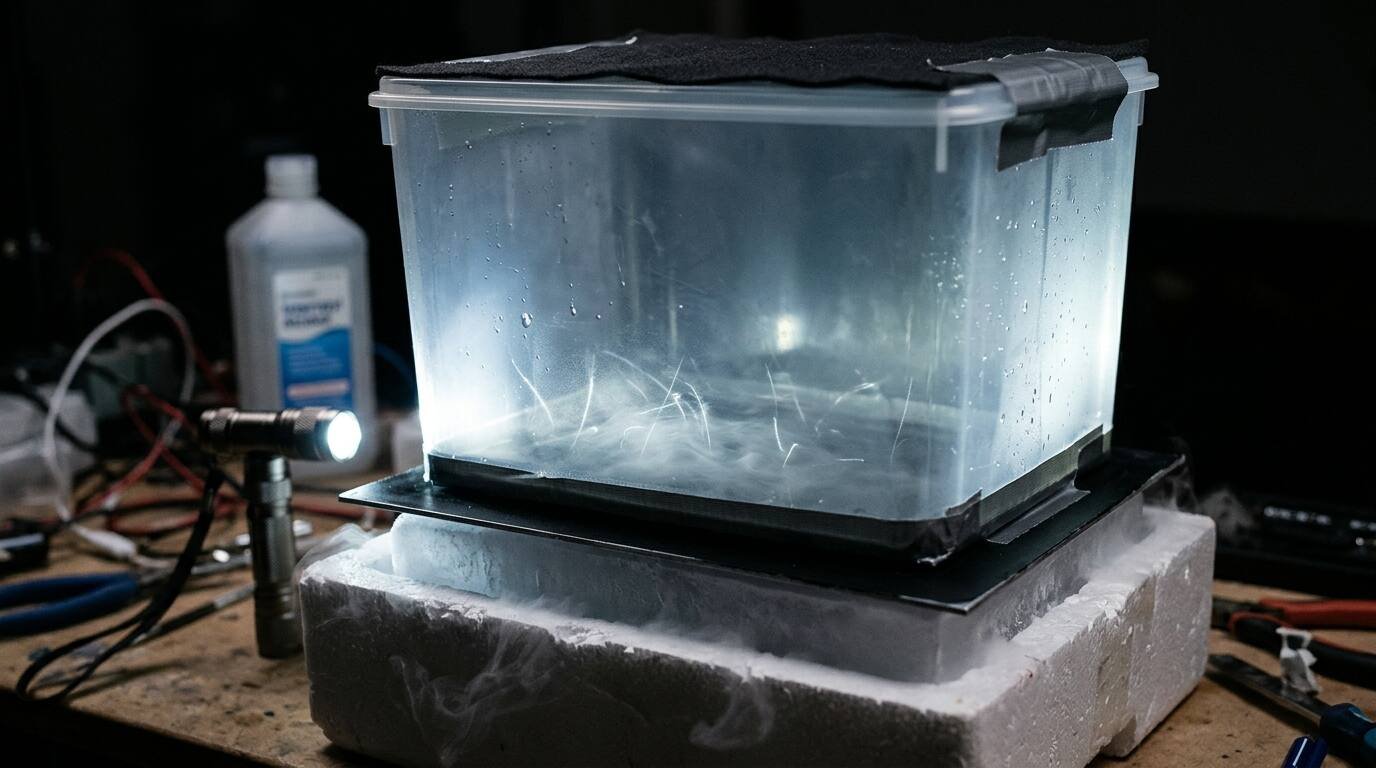
The build is a plastic or glass box, a felt pad, a black metal plate, a bright lamp, strong isopropyl alcohol and a slab of dry ice. Dry ice is the awkward part. The CERN manual suggests online dry ice shops, university chemistry departments, fish processors or dry-ice cleaning services. Researchers put the same particles to work in other ways; the x9m8 piece on how cosmic-ray muons measure ocean tides from inside a tunnel is one example.
Parts list
The sizes below follow the CERN manual unless another source is named. Substitutions are fine where the manual says so.
- Clear container, open at the top, roughly 20 x 30 x 15 cm. A plastic box or glass aquarium works. The Science in School version uses a fish tank with a base of about 30 x 20 cm.
- Thick felt, a few millimetres deep, for the inside bottom, plus split pins to hold it. Do not glue it, because alcohol dissolves glue.
- Black metal plate large enough to cover the open side. CERN uses 5 mm anodised aluminium; a baking tray or a plate covered in black electrical tape also works. Avoid tape or glue that alcohol can dissolve.
- Insulating box a little bigger than the plate, with sides no taller than about 5 cm so they do not block the view. Cardboard, styrofoam or wood will do.
- Dry ice, solid CO2 at -78 degrees C, enough to cover the box floor.
- Isopropanol of at least 90 percent purity. CERN says other alcohols will not work.
- A bright, narrow light such as an LED rod lamp, LED strip or battery lamp.
- Protection: goggles, nitrile gloves for the alcohol, leather gloves for the ice.
Safety first
Dry ice burns skin on contact, so handle it only with thick gloves. As it evaporates it raises carbon dioxide levels, which is why CERN says to use it in a well-ventilated room. Never seal it in an airtight container; pressure builds. Sciencenotes gives the practical version: keep it in a paper bag or a foam cooler with a loose lid.
Isopropanol is toxic to swallow and flammable, so keep it away from heat and flames, wear goggles and gloves, and keep it away from children. Pour it in a ventilated room. Sciencenotes also advises adult supervision for younger builders.
Building the chamber
- Make the plate black if it is not already. Black tape, nail polish or spray paint all do the job, as long as nothing alcohol-soluble touches the underside.
- Pin the felt to the container bottom with split pins through small drilled holes. Skip glue.
- Wearing leather gloves and goggles, cover the bottom of the insulating box with dry ice.
- Switch to nitrile gloves and soak the felt in isopropanol. Tilt the container until a small lake of alcohol sits in one corner; that means the felt is saturated.
- Set the black plate on the dry ice only after the felt is wet. Put it down earlier and water vapour from the air freezes onto the cold plate as snow, a pitfall CERN flags directly.
- Turn the container upside down onto the plate. A grooved plate filled with a little alcohol helps seal the join.
- Aim the lamp so it lights the layer of mist about 1 cm above the plate, the sensitive region. Switch off the room lights.
- Wait. CERN expects the chamber to settle in about five minutes; Science in School says about ten. Mist comes first, then tracks.
Science in School calls the airtight seal between plate and container the most critical step. It also recommends keeping the top of the chamber warm with a lamp, since a cold room can stop the temperature gradient from forming.
If nothing shows up
- Only mist: wait the full five to ten minutes and confirm the alcohol is isopropanol.
- No tracks at all: reposition the lamp, make sure the ice touches the plate, scrape old ice to remove frozen water, and add alcohol through the holes in the top without lifting the box.
- Large clouds at the edges: an air leak. Seal it with tape or plasticine.
- Snow on the plate: restart, and wet the felt before the plate goes on the ice.
What you are seeing
The felt at the top lets alcohol evaporate into the box. Vapour drifts downward and cools against the chilled plate, forming a thin layer that holds more vapour than the air normally could at that temperature. A passing charged particle strips electrons from air molecules and leaves ions behind, and the vapour condenses on them. The droplets trace the path, then fall to the floor and the layer resets, as the University of Wisconsin lesson plan describes it. You never see the particle, only the trail it leaves.
| Track | Appearance | Likely particle |
|---|---|---|
| Thin, straight, long | Fine line, no scatter | Muon or antimuon from secondary cosmic rays |
| Thick, straight, about 5 cm | Dense, short and bold | Alpha particle; CERN gives radon-222 in natural background as a source |
| Curly or curved | Wandering, often short | Slow electron, which scatters easily |
| Kink in a track | Sharp bend | A muon transforming into an electron or positron plus neutrinos |
| Y shape | Branch off a straight line | A muon knocking an electron off an atom |
Alpha tracks need a source inside the chamber, because alpha particles cannot pass through glass or plastic. The CERN manual describes two household-grade options: thoriated tungsten welding electrodes (thorium-232 decays emit alpha and beta particles), and a charged balloon left against a wall for 10 to 20 minutes to collect radon decay products. Radioactive sources lower the count of cosmic tracks, so study those first.
A fridge magnet will not bend any track. CERN’s manual puts the field needed at several tesla; a 1 GeV electron in a 2 T field curves with a radius of about 1.7 m, far larger than the box.
Why this recipe works
Two ingredients do the real work. Cold dry ice sets up a steep temperature gradient between the floor and ceiling of the box. Alcohol, which is volatile and polar, supplies the vapour. The Wisconsin lesson plan calls for isopropanol or ethanol above 90 percent, and CERN is stricter: use isopropanol and nothing else.
Lighting matters as much as chemistry. The droplets are tiny, so a bright lamp aimed at a low angle across the sensitive layer, with a black surface behind it, makes them visible; Wisconsin notes that even a phone flashlight can serve. Darken the room and give your eyes a minute to adjust.
Getting more out of the chamber
Once the cosmic tracks are familiar, a few variations teach different things, and each one needs only cheap extras. Wrapping a thoriated rod in paper shows alpha shielding: the thick tracks vanish because the particles stop in the paper. The Wisconsin plan collects radon on a balloon for about an hour, ideally in a basement or crawl space, before the balloon goes into the chamber.
Groups of parallel tracks appearing together can be part of a single cosmic-ray cascade, per the same plan. The muon itself is short-lived, with a lifetime of about two millionths of a second, according to the same document. For another instrument built around invisible particles, the muon g-2 result that won the 2026 Breakthrough Prize is explained on x9m8 as well.
Sources