






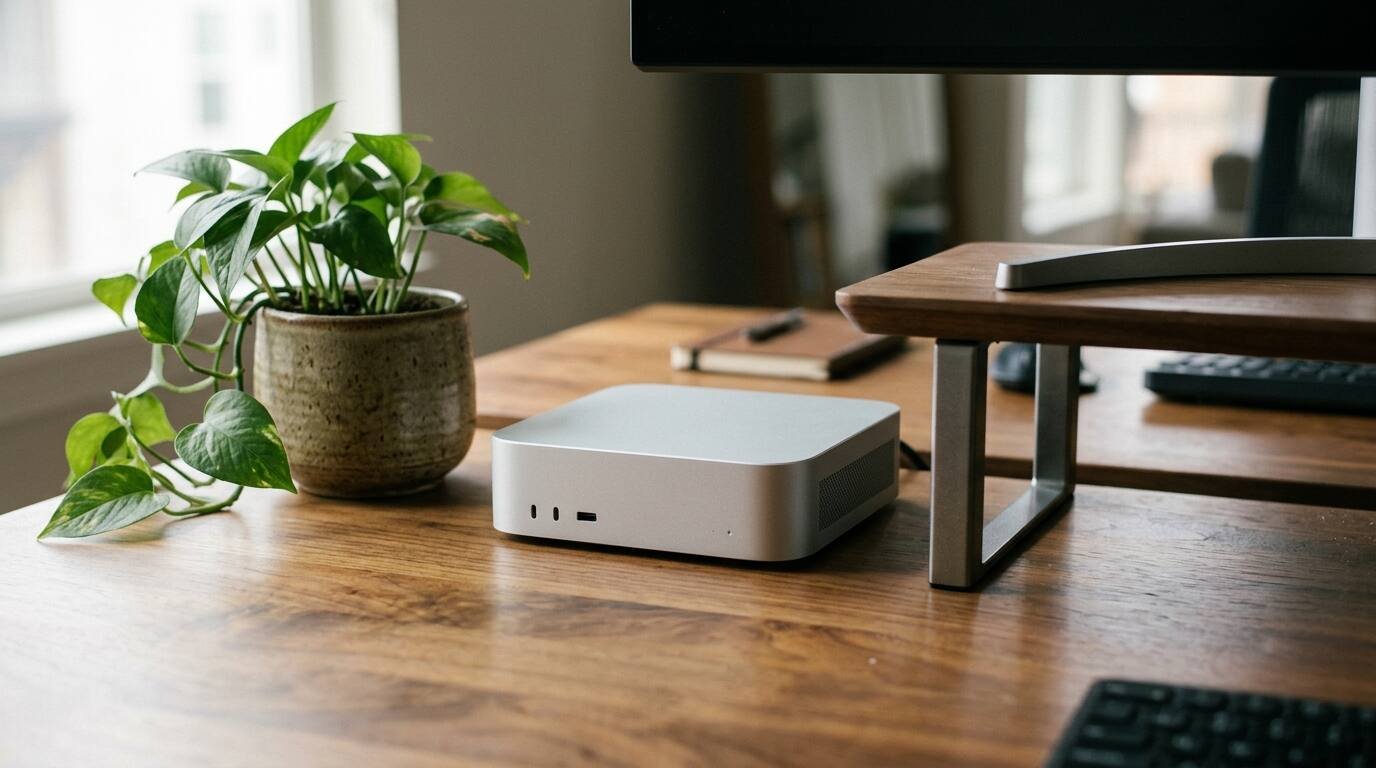
Apple announced the Mac mini M6 and M5 Pro on August 25. The specifications from Apple's own release, the baselines behind its benchmark claims, and a bandwidth calculation that shows why local AI speed depends on more than the headline multiplier.
The Mac mini M6 that Apple announced on Tuesday, August 25, starts at $899 and packs a 12-core CPU, a 12-core GPU and up to 170GB/s of memory bandwidth into a desktop that TechRadar says looks the same as the model it replaces. A second configuration, built on the M5 Pro, starts at $1,699 and raises nearly every ceiling. Pre-orders opened the same day, and the machines ship on September 22.
Apple’s headline claim is up to four times faster AI performance than the M4 Mac mini. That number needs unpacking, because “AI performance” can mean two different workloads with two different bottlenecks. The details below come from Apple’s announcement, including the footnotes that name each comparison machine. Where Apple’s page is silent, this article says so, and the calculations are marked as mine.
- Mac mini M6: 12-core CPU and 12-core GPU (two more of each than the previous generation), dual 16-core Neural Engine, 16GB of memory configurable to 32GB, up to 170GB/s bandwidth, from $899.
- Mac mini M5 Pro: up to an 18-core CPU and 20-core GPU, up to 64GB of memory, 307GB/s bandwidth, three Thunderbolt 5 ports, from $1,699.
- Availability: pre-orders began August 25, 2026, with shipping and in-store availability on September 22.
- Not stated by Apple: the manufacturing process node. Treat any figure you see for it as unverified.
What Apple actually announced
The M6 model gets a 12-core CPU and a 12-core GPU, each two cores larger than the previous generation. Every GPU core now includes a Neural Accelerator, a dedicated matrix block built for machine-learning math. The Neural Engine is described as a dual 16-core design that Apple calls up to twice as fast as before. Memory starts at 16GB and goes to 32GB, with bandwidth up to 170GB/s.
The M5 Pro model is a different class of machine. Apple lists up to an 18-core CPU and up to a 20-core GPU, with an enhanced shader core, third-generation ray tracing and Neural Accelerators in each GPU core. Memory goes to 64GB at 307GB/s. Apple says nothing about the Neural Engine on this model on the page I read.
Both share a front panel with two USB-C ports (USB 3) and a headphone jack that supports high-impedance headphones, plus Wi-Fi 7, Bluetooth 6 and 2.5Gb Ethernet, with 10Gb optional. Apple’s release adds a Genlock feature over USB-C, covered below.
M6 versus M5 Pro, spec by spec
| Specification | Mac mini M6 | Mac mini M5 Pro | M5 Pro relative to M6 |
|---|---|---|---|
| CPU cores | 12 | Up to 18 | 1.5x |
| GPU cores | 12 | Up to 20 | 1.67x |
| Memory (maximum) | 32GB (16GB standard) | 64GB | 2x |
| Memory bandwidth | Up to 170GB/s | 307GB/s | 1.81x |
| Rear high-speed ports | 3 x Thunderbolt 4 | 3 x Thunderbolt 5 | Faster link |
| Starting price (US) | $899 ($799 education) | $1,699 ($1,599 education) | 1.89x |
The ratios are my arithmetic from Apple’s figures. Two cautions apply. Apple’s page gives “up to” core counts for the M5 Pro, and I could not confirm the core counts of the $1,699 starting configuration, which may be lower than the maximum. And the price gap, $800 at the entry level, buys roughly 1.8 times the memory bandwidth and twice the memory ceiling, which for local AI matters more than the core-count ratio.
Memory bandwidth decides local AI speed
Running a large language model on a desktop involves two phases. Processing the prompt is compute-heavy: the chip chews through many tokens in parallel, and matrix hardware such as Neural Accelerators helps directly. Generating the reply is different. For each new token, the chip reads essentially all the model’s weights from memory, so the rate is capped by memory bandwidth, not by raw compute.
A simple ceiling follows: tokens per second is at most bandwidth divided by the model’s size in memory. Take a model that occupies 14GB, roughly a 14-billion-parameter model at 8-bit precision. On the M6’s 170GB/s, the ceiling is about 12 tokens per second. On the M5 Pro’s 307GB/s, it is about 22. Real software lands below those ceilings, and the figures are illustrations, not measurements of either machine. The useful takeaway is the ratio: for any model size, the M5 Pro’s generation ceiling is about 1.8 times the M6’s, because that is the bandwidth ratio.
Memory capacity sets the other limit. A model must fit in unified memory alongside the operating system and apps, so the 32GB maximum on the M6 and the 64GB on the M5 Pro decide which model sizes are practical at all. Not all of that memory is available for weights.
Reading Apple’s benchmark claims
Apple’s footnotes are specific, which makes them checkable. The M6 claims compare against an M4 Mac mini with a 10-core CPU, 10-core GPU, 32GB of memory and a 2TB SSD. Against that machine, Apple says up to 4x faster AI performance, 2x faster graphics and 40% faster CPU performance. It also claims up to 2x faster storage but gives no baseline for that figure.
The AI figures that name a workload are about prompt processing. Apple reports up to 13.5x faster LLM prompt processing in LM Studio compared with an M1, and up to 4.8x compared with the M4. Other claims include up to 2.3x faster Excel calculations than M1 and 1.5x than M4, and up to 2x faster ray-traced gaming in Cyberpunk 2077: Ultimate Edition than M4.
For the M5 Pro, the main comparison is an M2 Pro Mac mini with a 12-core CPU, 19-core GPU, 32GB of memory and an 8TB SSD. Apple claims up to 8.5x faster LLM prompt processing, up to 4.5x faster ray-traced Blender rendering and up to 2.1x faster Affinity image processing against it, and 4x, 1.4x and 1.5x against an M4 Pro. Apple’s page does not specify the M4 Pro configuration.
Two things stand out. First, the named AI workload is prompt processing, which matches where Neural Accelerators help most. Apple’s page does not claim a comparable multiplier for generation speed, which is the bandwidth-limited phase described above. Second, the comparison machines carry 32GB, while the M6 starts at 16GB, so the baselines are better-equipped than the entry model. All of these are Apple’s own measurements.
Ports, Thunderbolt 5 and clustering
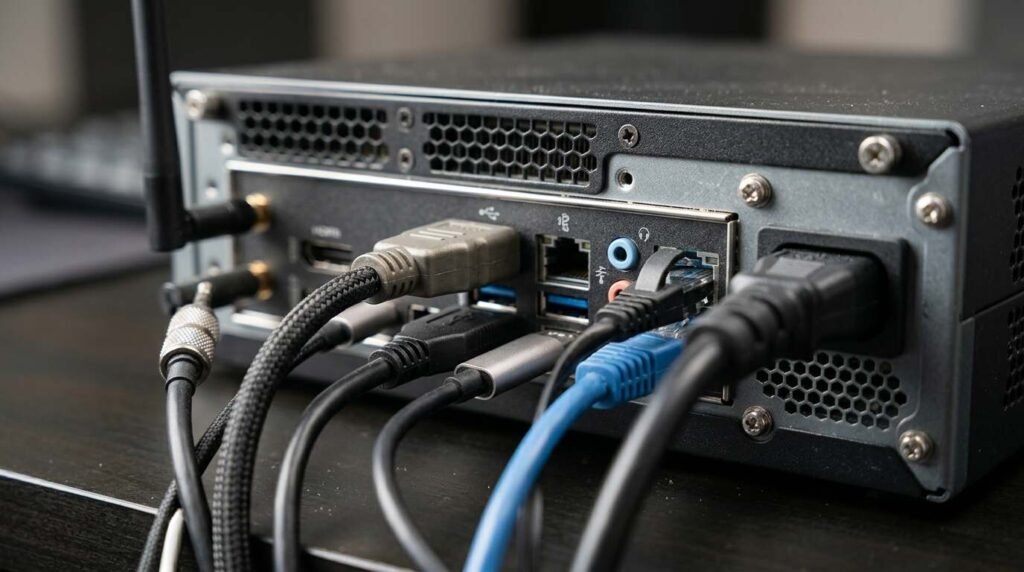
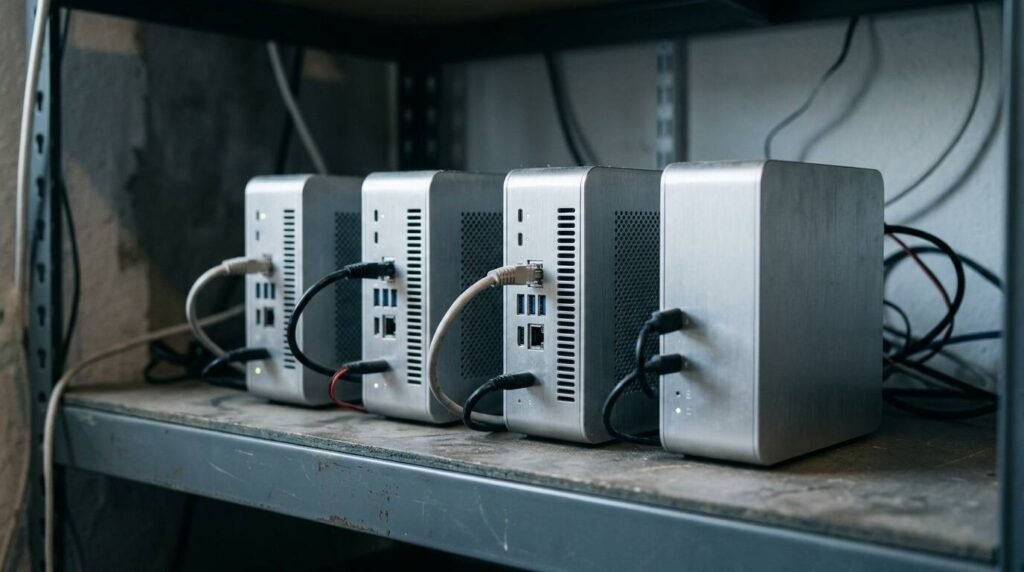
The M6 has three Thunderbolt 4 ports, HDMI and Ethernet on the back. The M5 Pro swaps in three Thunderbolt 5 ports. Apple says Thunderbolt 5 supports clustering several Mac minis to run large AI models on-device. The Thunderbolt specification doubles Thunderbolt 4’s 40 Gbps to 80 Gbps each way, which is why this link is the one that makes sense for splitting a model across machines. Apple’s page does not publish clustering benchmarks, so how well it scales is not established.
Genlock and video work
Genlock is the smaller feature with a specific audience. Apple says it synchronizes a display and a camera, including the iPhone 17 Pro, over USB-C. In multi-camera and virtual-production setups, frames from different devices must be captured on the same clock, and a Mac mini is now pitched as a hub for that job. The page gives no latency figures.
Who should buy which (analysis)
This is judgment, not reporting. For office work, light creative work and general computing, the M6 at $899 covers the ground and the 16GB base is the figure to scrutinize. Anyone planning to run local models should price the 32GB option before anything else. The M5 Pro earns its $800 premium for large models, heavy rendering, and Thunderbolt 5 peripherals or clustering. The sensible move is to wait for independent benchmarks after the September 22 ship date before paying for the top configuration.
What is unconfirmed
Apple’s announcement does not state the process node, and circulating figures for it come from aggregator coverage I could not trace to Apple. TechRadar reports a price increase over the previous Mac mini, and I did not verify the earlier price. No independent testing exists yet, since the machines have not shipped.
Questions readers ask
How much does the Mac mini M6 cost?
Apple lists $899, or $799 for education. The M5 Pro configuration starts at $1,699, or $1,599 for education.
When does the Mac mini M6 ship?
Pre-orders began August 25, 2026. Shipping and in-store availability start September 22, 2026.
Is 16GB enough for local AI?
It depends on the model. A 14GB model leaves little room for the operating system. The M6 configures to 32GB and the M5 Pro to 64GB for larger models.
Does the M6 have Thunderbolt 5?
No. Apple lists three Thunderbolt 4 ports on the M6 and three Thunderbolt 5 ports on the M5 Pro.
Sources




One thought on “Mac mini M6 and M5 Pro: Every Spec, the Memory-Bandwidth Math, and What Apple’s AI Claims Really Measure”