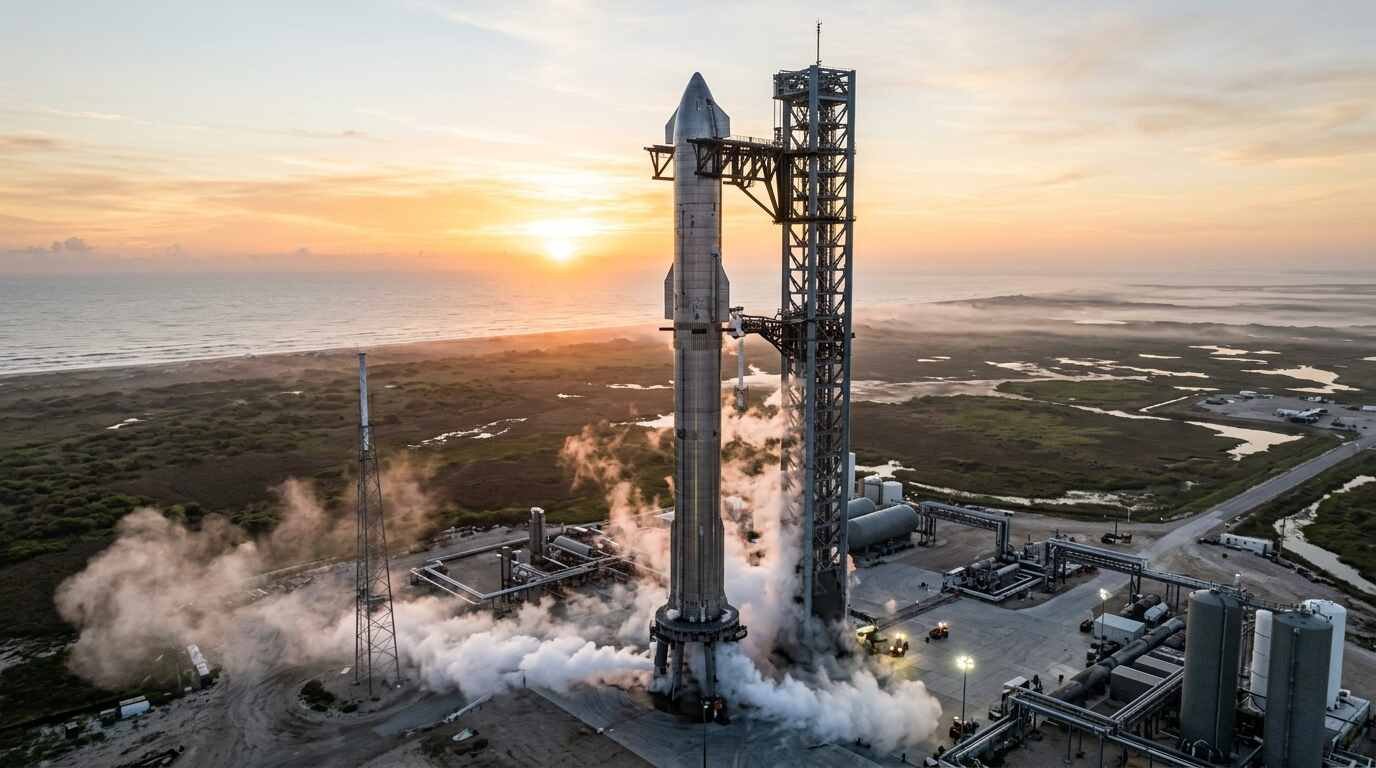
Google's analysis of orbital data centers implies about 1,800 Starship launches by 2035. The launch-cost curve, the proton-beam radiation test, the cooling problem and what the first prototype can prove, with every figure traced to a source.
Google’s own analysis of orbital data centers implies that SpaceX’s Starship would have to fly roughly 1,800 times before the economics of Project Suncatcher close, according to TechCrunch’s October 1 report. The figure follows from a launch-cost assumption: if the price of reaching orbit keeps falling at the pace it has since Falcon 1, it nears $200 per kilogram by 2035, and the mass needed to build out that future is enormous.
The number is only one of several worth checking. This article walks through the launch arithmetic, the radiation test on Google’s TPU, the thermal problem that most coverage skips, and what the first prototype can and cannot demonstrate. Sources are TechCrunch, Google’s research blog and Data Center Dynamics. TechCrunch notes that Google is a major investor in SpaceX, which is worth holding in mind when reading any launch-cost projection.
- Launch math: a roughly 20% per year learning curve since Falcon 1 would bring launch prices near $200/kg by 2035. Matching that trajectory would take about 370,000 tons delivered to orbit, or about 1,800 Starship missions at 200 metric tons each.
- Radiation: Google’s Trillium TPU survived a 67 MeV proton-beam test. Its high-bandwidth memory was the weak point, showing irregularities only after 2 krad(Si), against an expected shielded five-year dose of 750 rad(Si).
- Prototype: a Planet Labs-built satellite carrying a TPU, with about 1 kW of continuous power, running in 15-minute bursts, per TechCrunch.
- Open problem: Google lists thermal management as an unsolved engineering challenge.
What Project Suncatcher is proposing
Project Suncatcher, announced in November 2025, is Google’s plan for solar-powered compute in orbit using its Tensor Processing Units. Google’s research post describes an illustrative cluster of 81 satellites in a dawn-dusk sun-synchronous low Earth orbit, with a mean altitude of 650 km and a cluster radius of 1 km. Nearest neighbors would oscillate between about 100 and 200 meters apart.
The orbit choice is the point. In a dawn-dusk sun-synchronous orbit, a satellite sits near the line between day and night and sees the sun almost continuously, which reduces the need for heavy batteries. Fierce Network, summarizing Google’s announcement in March, quoted Google as saying a solar panel there can be up to eight times more productive than on Earth.
The launch-cost argument, in numbers
| Quantity | Figure | Source |
|---|---|---|
| Assumed learning rate | About 20% per year since Falcon 1 | TechCrunch, describing Google’s paper |
| Launch price target | Near $200/kg by 2035 | TechCrunch; Google research blog says below $200/kg by the mid-2030s |
| Launch price cited in 2025 | $1,500 to $2,900/kg | Data Center Dynamics, November 2025 |
| Mass implied by that trajectory | About 370,000 tons to orbit | TechCrunch |
| Starship payload assumed | 200 metric tons per mission | TechCrunch |
| Missions implied | About 1,800 (about 180 per year over 10 years) | TechCrunch |
Moving from $1,500 to $2,900 per kilogram down to $200 means a price drop of 7.5 to 14.5 times, by my arithmetic. At $200/kg, Google’s authors estimate that launching and operating a space-based data center could be roughly comparable to terrestrial data center energy costs per kilowatt-year. Google’s post points to its preprint for the full calculation.
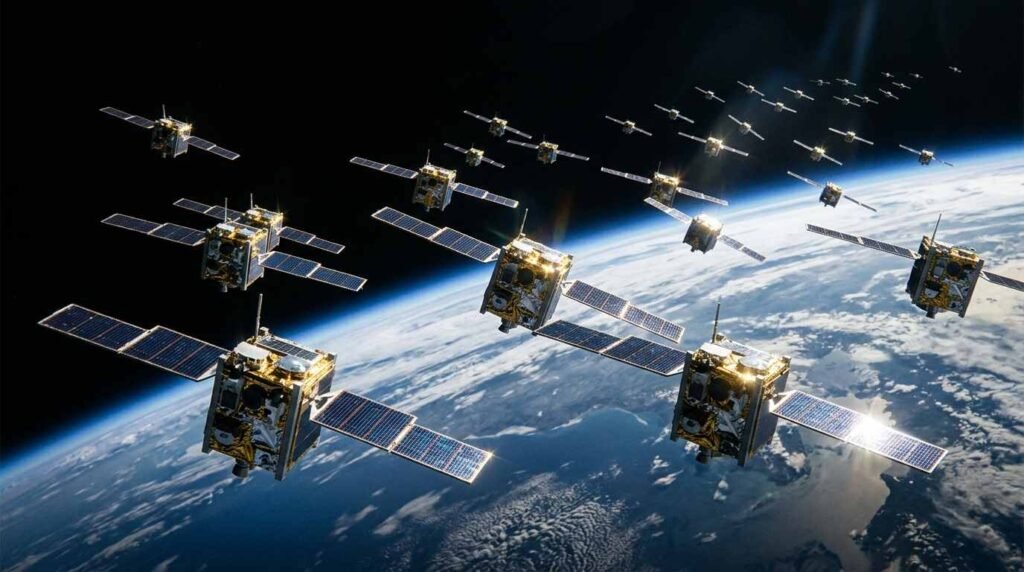
Why the count is about 1,800 launches
Dividing 370,000 tons by 200 tons per mission gives 1,850, which TechCrunch rounds to about 1,800. Spread across ten years, that is about 180 launches a year, or one every two days. TechCrunch’s reporting adds a reality check: Starship has never flown more than five times in a year, and the article treats Elon Musk’s talk of an hourly flight rate by 2029 skeptically.
One correction trail is worth knowing. TechCrunch’s headline originally said 1,600 launches and was later corrected to 1,800, but the article’s web address still carries the 1,600 figure. Anyone citing the number should use the corrected one, and should note it is the reporter’s reading of Google’s paper, not a figure Google published as a target. For background on Starship’s actual flight record, see our earlier post on Flight 14 in six numbers.
Radiation: what the proton-beam test showed
Google tested its Trillium (v6e) TPU in a 67 MeV proton beam to measure total ionizing dose and single-event effects. According to Google’s research post, the high-bandwidth memory was the most sensitive component, showing irregularities only after 2 krad(Si). That is nearly three times the 750 rad(Si) dose Google expects behind planned shielding over a five-year mission. No hard failures occurred up to 15 krad(Si) on a single chip.
TechCrunch adds a wrinkle. Google retested after finding that its chip configuration gave more shielding than real orbit would, and the retest showed slightly more logic errors. Google still expects the chips to handle inference over a five-year satellite life, with an error rate of about one in a million for typical inference. Travis Beals, the Google executive leading the project, said it is more problematic for large, months-long training runs. Single-event effects on training remain an open question, as Data Center Dynamics also reported.
Cooling in vacuum: the problem the headline numbers skip
Google’s post lists thermal management as an open engineering challenge and gives no design figures. A back-of-envelope calculation shows why. In vacuum there is no air to carry heat away, so every watt a satellite consumes must be radiated into space. The Stefan-Boltzmann law gives roughly 460 W per square meter for an ideal surface at 300 K. With a realistic emissivity of 0.9, that is about 413 W per square meter, so 1 kW of compute needs roughly 2.4 square meters of radiator on one side.
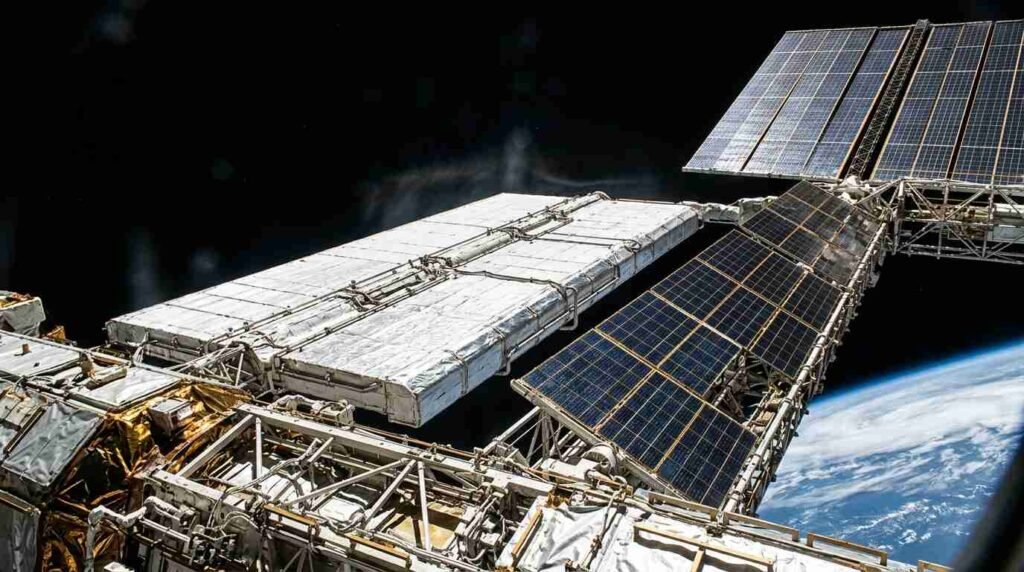
Scale that to a gigawatt and the single-sided area is on the order of 2.4 square kilometers. Double-sided radiators halve it, and absorbed sunlight and Earth’s infrared push it back up. This is my calculation, not a Google figure, and real designs would differ. The point is that radiator area, not just solar panel area, sets the size of a gigawatt-class orbital facility. Google says longer-term designs might integrate solar collection, compute and thermal management more tightly.
The links between satellites
Machine-learning workloads need fast links between chips. Google’s target is tens of terabits per second between satellites, comparable to terrestrial data centers, using dense wavelength-division multiplexing plus spatial multiplexing. Its bench-scale demonstrator reached 800 Gbps each way, 1.6 Tbps in total, with one transceiver pair. Close spacing is the enabler: received optical power falls with the square of distance, so flying within hundreds of meters closes the link budget that kilometers would not.
What the prototype will and will not prove
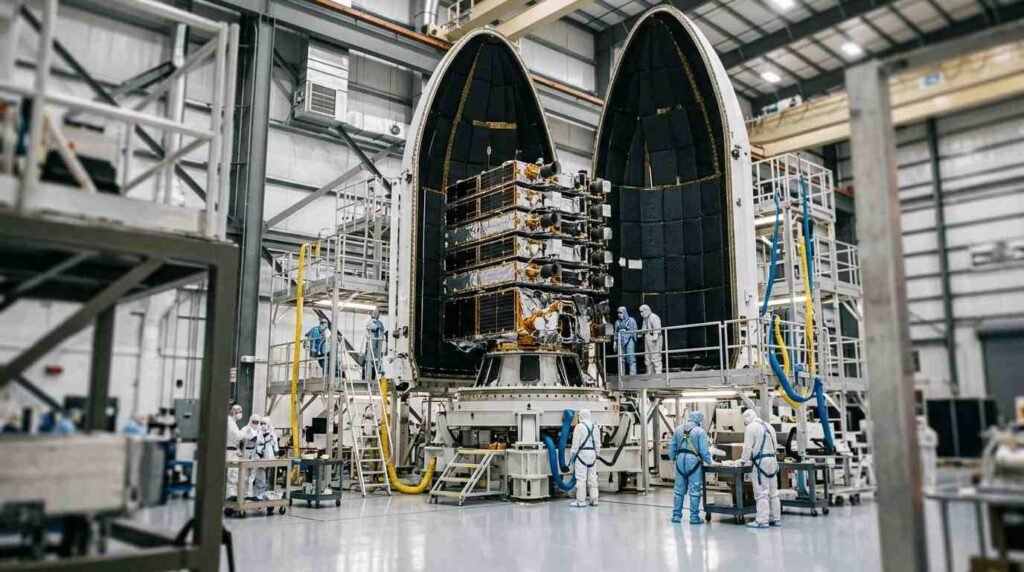
TechCrunch reports that the first step is a prototype satellite built by Planet Labs that carries a TPU into orbit. It is supplied with about 1 kW of continuous power and, because power and cooling are limited, runs in 15-minute bursts. A follow-up demonstration planned for next year would use two purpose-built satellites linked by laser. The earlier Google post framed the plan as two prototype satellites by early 2027, so the sequencing has shifted or been described differently, and Google’s current schedule should be checked directly.
Either way, a single TPU running for fifteen minutes can show that the chip works in orbit. It cannot show that 81 satellites can hold formation, that a cluster can sustain training, or that launch costs will fall to $200 per kilogram.
What is unverified
The 1,800 figure is derived from Google’s paper by TechCrunch, and I did not read the paper itself. The 15-minute burst and 1 kW details come from one report. Launch-price history and the future curve are projections. Treat everything past the radiation test results as plans, not outcomes.
Questions readers ask
How many Starship launches would orbital data centers need?
TechCrunch reports about 1,800, derived from Google’s analysis: roughly 370,000 tons at 200 metric tons per mission. That is about 180 launches a year over a decade.
Can TPUs survive radiation in orbit?
In Google’s proton-beam test, the Trillium TPU survived, and its memory showed irregularities only after 2 krad(Si), against an expected 750 rad(Si) shielded five-year dose. Google expects inference to be workable. Training is less certain.
How do orbital data centers get rid of heat?
Only by radiating it. Google lists thermal management as unsolved. My back-of-envelope estimate is about 2.4 square meters of one-sided radiator per kilowatt at 300 K.
When will the first prototype fly?
Google’s earlier plan was two prototype satellites by early 2027. TechCrunch’s October report describes a Planet Labs prototype first, with a two-satellite demo planned next year. Confirm with Google.
Sources
- TechCrunch: Google thinks SpaceX’s Starship has to launch 1,800 times before space data centers get off the ground
- Google Research: Exploring a space-based, scalable AI infrastructure system design
- Data Center Dynamics: Project Suncatcher, Google to launch TPUs into orbit with Planet Labs
- Fierce Network: Space data centers, Starcloud, SpaceX and Project Suncatcher explained