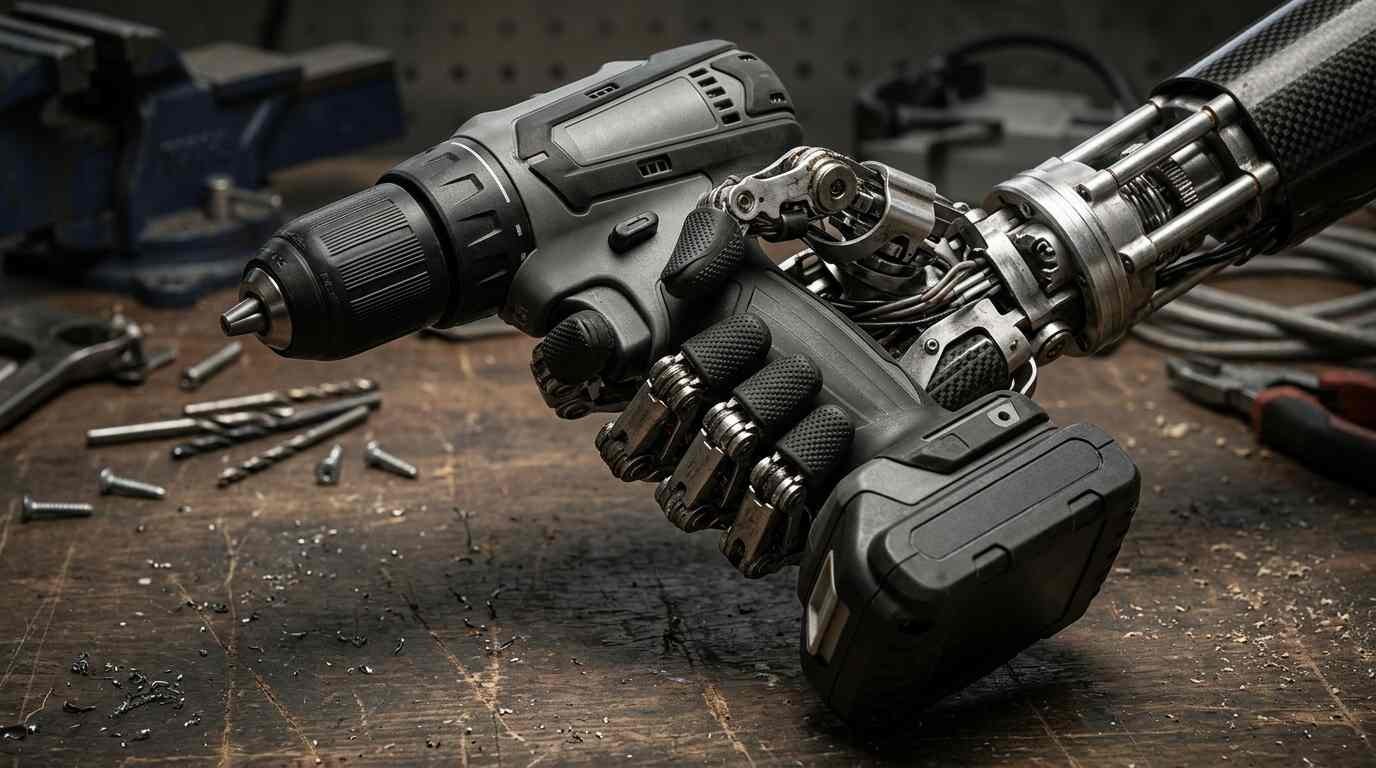
Boston Dynamics' new Atlas humanoid robot hand has 13 degrees of freedom and four fingers. What the design shows, and what is still only a claim.
The new Atlas humanoid robot hand, shown by Boston Dynamics on October 1, 2026, has four digits instead of five, 13 degrees of freedom instead of the previous hand’s seven, and no pinky. The company says it tested the idea by taping two human fingers together for a day and found the missing finger hardly mattered.
That detail is charming, and it is also a clean piece of engineering logic. A hand is a cost center: every joint needs an actuator, a sensor path and a repair plan. This post goes through what was disclosed, does the joint arithmetic, explains why the design choices follow from training robots in simulation, and sorts the company’s statements into measured, described and merely claimed.
What Boston Dynamics showed
The hand, announced on October 1 and covered the following day by outlets including Robotics 24/7, belongs to the company’s new generation of the Atlas humanoid. It has an opposable thumb with four degrees of freedom and three fingers with three each. Total: 13, up from seven on the previous hand.
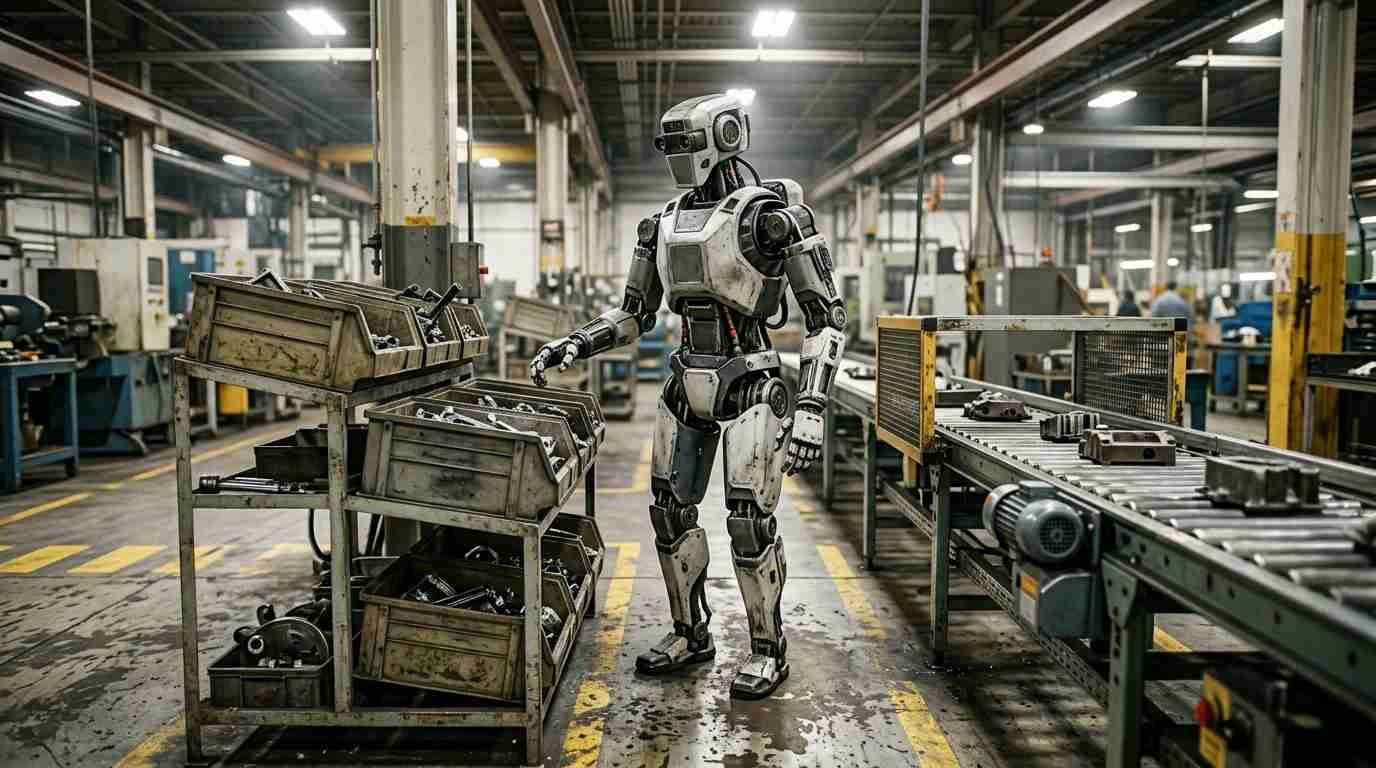
The hand is roughly the size of a large human hand, a dimension The Robot Report says was driven largely by how big the actuators are. It uses direct, transparent actuation at the joints with a single actuator type, and the actuators are fully encapsulated, so no cables cross a joint. The company says the hand’s strength is similar to the old one, which it attributes to several unspecified actuation technologies.
Payload and weight figures for the hand itself were not reported. For the robot, Interesting Engineering gives production Atlas ratings of 110 pounds instantaneous and 66 pounds sustained, and Robotics 24/7 says the hand carried a loaded mini-fridge weighing over 100 pounds.
The joint arithmetic
A degree of freedom is one independent way a joint can move. The thumb has four. Each of the three fingers has three. 4 + 3 x 3 = 13. Adding a fifth digit at three degrees would make 16, so dropping it cuts the joint count by about 19 percent.
The Robot Report says leaving out the pinky saved three actuators plus the complexity, size and power draw that go with them. Three actuators for three joints suggests one actuator per degree of freedom, though the article does not state that outright, so read it as an inference. If it holds, the hand has 13 actuators where a five-digit version would have 16.
Why does that matter more than it sounds? A robot hand sits at the end of the longest kinematic chain on the machine, wrapped in cables and boundary layers of dust, oil and weld spatter in the factories Atlas is meant for. Each actuator is a place to fail. Each is a unit cost multiplied by two hands multiplied by every robot built. And each extra joint is another dimension the control policy has to learn.
Why a pinky was the first thing to go
According to The Robot Report, engineers taped the pinky and ring fingers together for a day on a human hand and found the work still got done. That is an informal test, with no published sample size or task list, so it supports the decision without proving it.
The mechanical reasoning is easier to follow. In a power grasp on a tool handle, the pinky side of the hand mostly provides squeeze and stability. In precision grasps, which rely on the thumb opposing the index and middle fingers, it contributes little. A robot carrying a drill needs a firm wrap and a free index finger to press the trigger. Three long fingers and a flexible thumb can do both.
The design is not an attempt to copy a human hand. Interesting Engineering notes explicitly that it departs from the five-fingered form, and the company frames the goal as capability for target tasks at low cost and high repairability.
Sensing and compliance
Two sensing channels are described. The first is proprioception, meaning joint-level feedback from the actuators themselves, which the company relies on for its dexterous behaviors. The second is dense pressure sensing on the fingertips and palm. Interesting Engineering reports both; Robotics 24/7 did not mention sensors at all, so the tactile claim rests on two of the three outlets.
Interesting Engineering also says the transmissions are backdrivable. That means an outside force on a fingertip moves the joint and shows up as a signal in the motor, which lets the controller feel contact without a dedicated force sensor at every joint. Backdrivability also helps when a part slips or a finger hits something unexpected, because the joint yields instead of resisting. It is a trade: backdrivable actuators generally give up some holding strength, which is why the company’s statement about matching the old hand’s strength is worth checking when a spec sheet appears.
Built for simulation
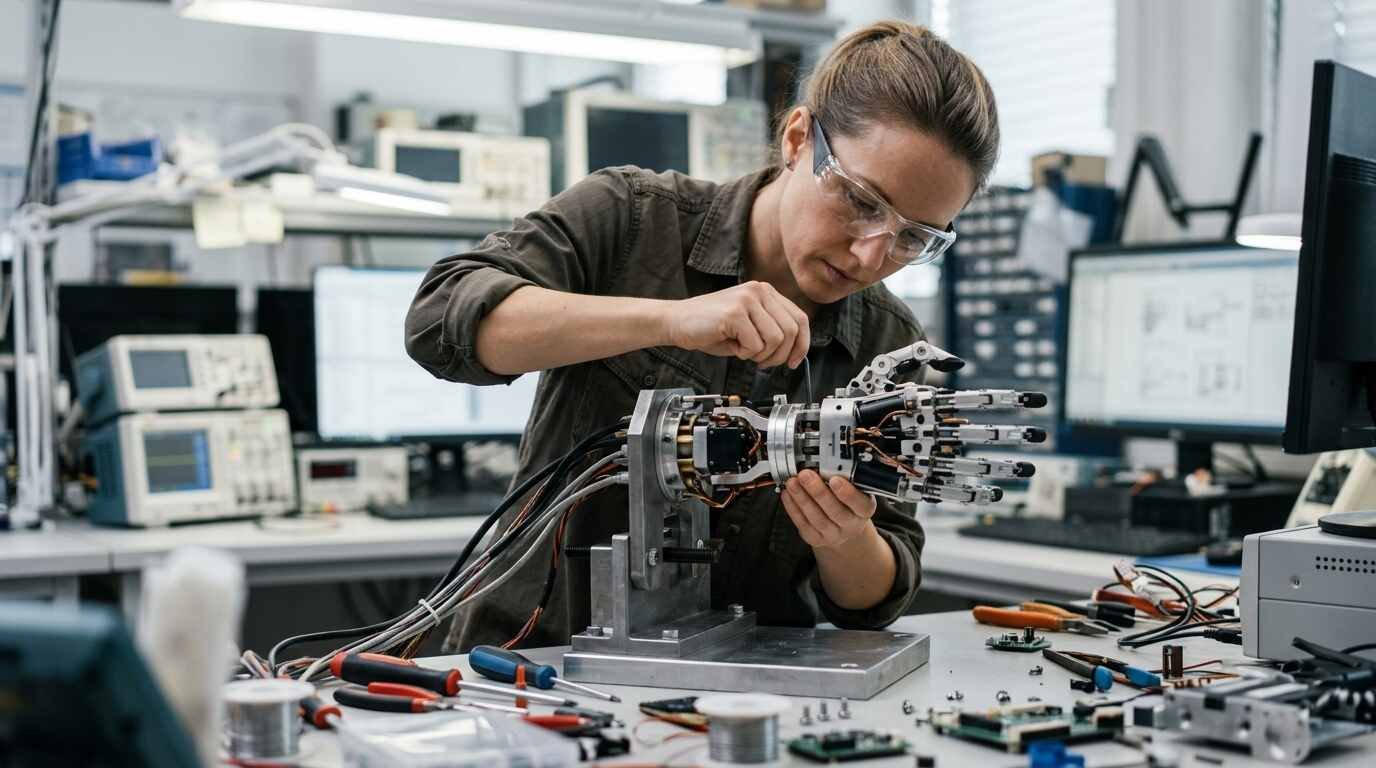
A large share of the design logic points at sim-to-real reinforcement learning. The company says the hand was built for high-fidelity simulation, and Interesting Engineering reports that the controls compensate for friction and motor cogging so the physical hand matches its simulated model. Training varies motor behavior, surface friction, object geometry and disturbances before anything is tried on hardware.
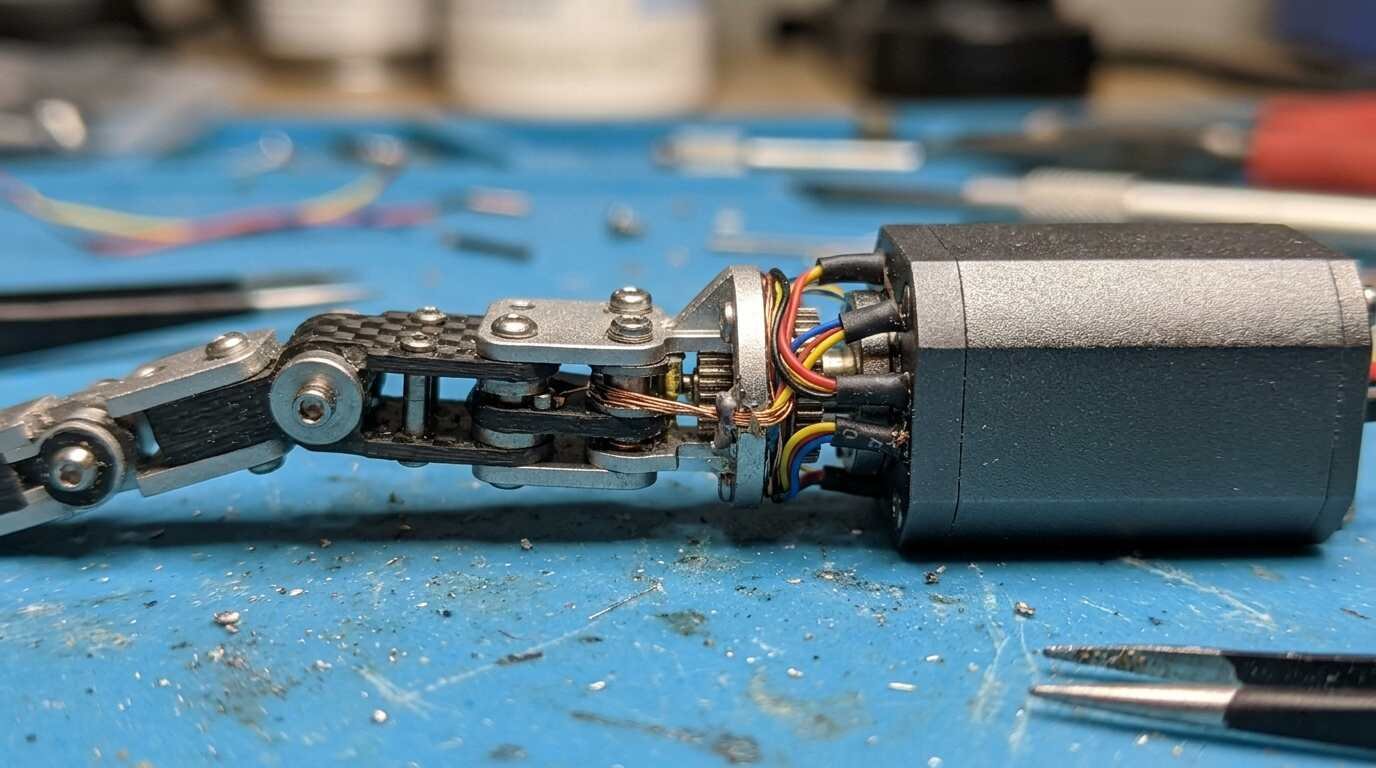
That explains the preference for one actuator type and no routed cables. A simple, uniform mechanism is easier to model accurately. Cable stretch, hysteresis and varying transmission ratios are exactly the sort of effects that make a simulated policy fail on the real machine. The company describes initial results as promising but, per The Robot Report, gives no metrics.
Robotics 24/7 lists the trade-offs the team says it was balancing: dexterity, strength, ruggedness, cost, repairability and sensing. Its stated goals include tool use, rugged industrial and logistics work, a small gap between human demonstration data and what the robot can reproduce, a clean simulation model, and low-cost mass manufacturing. Those goals pull against each other. More joints improve dexterity but add cost and failure points, and a hand that must survive a shop floor cannot be delicate. Dropping a finger is the cheapest way to move along that curve, and it is the sort of choice a company makes when it expects to build many hands.
What it can reportedly do
The listed behaviors are specific and checkable in principle:
- Sliding the thumb tip along the length and width of the other fingers.
- Pinch grasps between the thumb and any other finger, and tripod grasps.
- In-hand reorientation and recovery from a slipping grasp.
- Triggered tool grasps for drills, torque drivers, grinders, nail guns and welding torches, including pressing the trigger.
Measured, described, claimed
The Robot Report notes that nothing in its coverage was independently verified. I would sort the statements this way. The joint count, finger count, actuator type and tactile-sensor placement are descriptions of hardware and are probably accurate. The strength claim and the payload ratings are company statements without test data. The remark that sim-to-real results are promising is a claim with no number attached. The tool-use behaviors are described by the company, and the coverage I read gives no success rates, which tells you a task can be done and nothing about how often it succeeds.
That last gap is the one that matters for industrial buyers. A hand that completes a task once differs from one that completes ten thousand cycles with a failure rate in the low parts per million. No reliability, cycle-life or repair-time figure appears in the coverage I read. For context, the company said around a week earlier that it had opened a Robotics Metaplant Application Center at Hyundai’s Georgia facility to train Atlas for integration into manufacturing and logistics work, so those numbers will have to come from there.
What to watch next
A Boston Dynamics executive is scheduled to speak at RoboBusiness on October 20 and 21, 2026, which is the likeliest place for more detail. Useful questions are concrete ones. What is the hand’s mass? What fingertip force can it hold for ten minutes? How many cycles before an actuator is swapped? What does a replacement cost? None of the coverage I read answered them, and the answers will say more about commercial readiness than any grasp demonstration.
Frequently asked questions
How many degrees of freedom does the new Atlas hand have?
13: four in the thumb and three in each of the three fingers. The previous Atlas hand had seven.
Why does the Atlas hand have no pinky?
Boston Dynamics says a one-day test with a human pinky and ring finger taped together suggested the pinky was not needed. Dropping it saved three actuators and the size, power and complexity that come with them.
Does the hand have touch sensors?
Interesting Engineering and The Robot Report both describe dense pressure sensors on the fingertips and palm, plus joint-level proprioception. Robotics 24/7 did not mention sensors.
Is the hand available to buy?
The coverage I read gave no price, availability date or production volume for the hand or for Atlas itself.
Dexterity is where humanoid demonstrations usually come apart, and Boston Dynamics has chosen to attack it with subtraction: fewer fingers, fewer actuators, one joint design, and a bet that simulation can teach the rest. The logic is sound, and the pinky story is a good example of designing from the task backward. But a hand’s worth is settled by uptime in a plant, not by a grasp on video. Until the company publishes force, mass, lifetime and failure data, or Hyundai reports real throughput on Atlas in Georgia, this is a thoughtful mechanical design with encouraging claims around it. That is worth noting without overselling it.
Sources