

Asexual females should outbreed sexual ones two to one, yet sex dominates complex life. This article weighs the evidence for the leading explanations and tests them in a small simulation.
Why does sex exist at all, when a female that simply cloned herself would leave twice as many grandchildren as one that bothered with males? That arithmetic, usually called the twofold cost of sex, is one of the oldest unsolved problems in evolutionary biology. Nearly every animal and plant you can name reproduces sexually at least some of the time, and almost every lineage that gave up sex entirely is young and twiggy on the tree of life. Something keeps sex in business. Biologists agree on that much and disagree, sometimes sharply, about what the something is.
This piece sets out the question precisely, separates what has been measured from what has been modelled, steelmans the main hypotheses, and then runs a small simulation built for this article to see which ingredients, alone or in combination, let sexual reproduction beat a clone that pays no cost. The simulation is a toy. It is useful for showing the logic, not for deciding which hypothesis nature prefers.
The question, stated carefully
Picture a population of animals with separate sexes and a 50:50 sex ratio. Each female lays the same number of eggs. Now a mutant female appears who skips meiosis and fertilisation and produces daughters that are copies of herself. Every one of her offspring can lay eggs; only half of a sexual female’s offspring can. All else being equal, the clone’s share of the population doubles each generation. John Maynard Smith made this point famous in his 1978 book The Evolution of Sex, and it is the version most textbooks still use.
The phrase “all else being equal” is doing a lot of work, and the real question hides inside it. Precisely: what benefit to sexual lineages is large enough, and arrives fast enough, to outweigh a roughly doubled growth rate for asexual competitors? A second, subtler version asks why genes that promote recombination spread at all, since recombination breaks up combinations that selection has just assembled. Sarah Otto opened a 2009 review in The American Naturalist with the puzzle in one line (Otto 2009):
“Sexual reproduction entails a number of costs, and yet the majority of eukaryotes engage in sex, at least occasionally.”
Otto, 2009, The American Naturalist
People outside the field ask the same thing, in blunter language. In a LessWrong discussion of a game-theory paper claiming that sex is “always well worth its two-fold cost,” commenters pressed on exactly the weak point: why don’t females simply switch to parthenogenesis, and why would anyone accept a male’s genes rather than resist them? Those are the right questions. They are also the ones the academic literature has not finished answering.
What is actually established
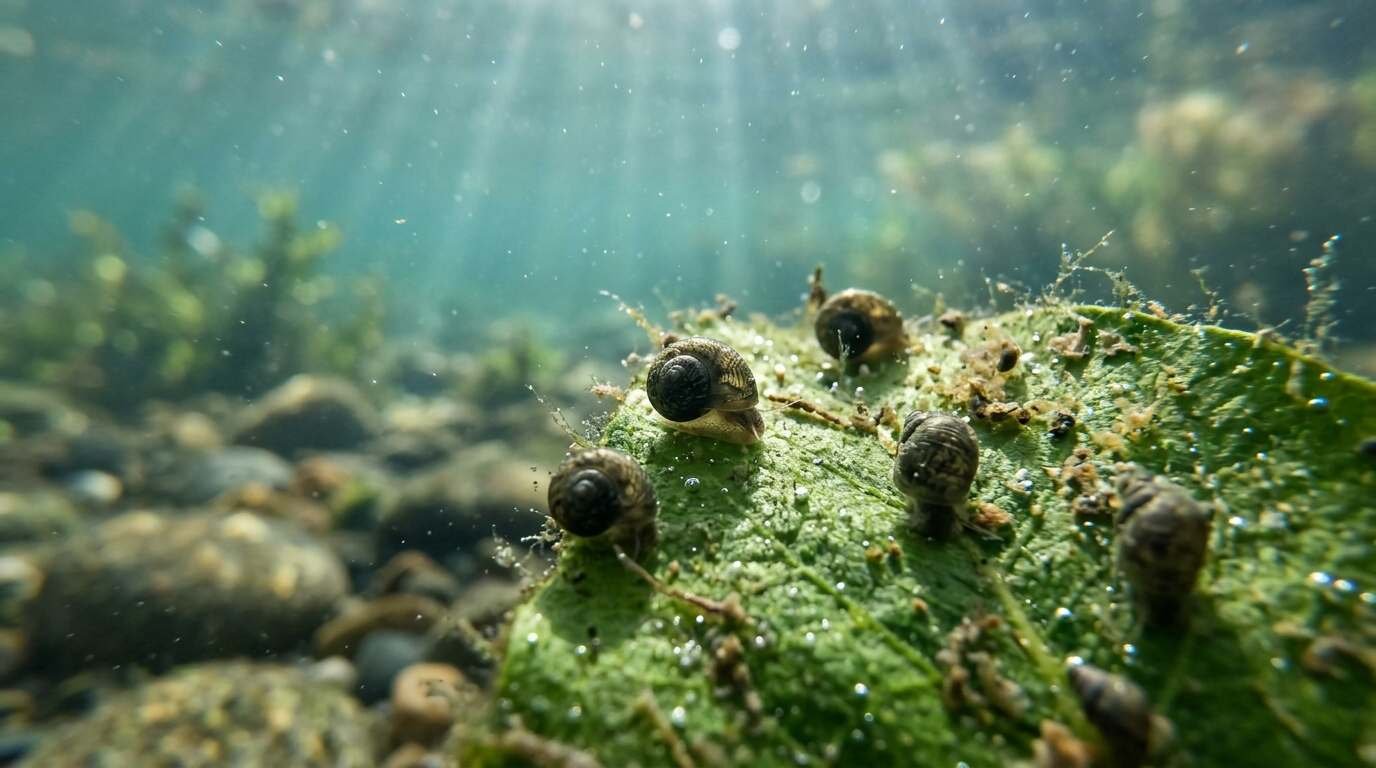
Some things are no longer in serious dispute. The first is that the cost is real in at least one natural system, and roughly the size theory predicts. Amanda Gibson, Lynda Delph and Curtis Lively placed mixed sexual and asexual populations of the New Zealand mud snail Potamopyrgus antipodarum into outdoor mesocosms for a year and tracked the next generation with flow cytometry (Gibson et al. 2017). Asexual frequency rose about 1.6-fold from a starting point near 29 percent, and a model with a cost of exactly two fit the data best; the no-cost model was firmly rejected. In their words:
“the increase in frequency of asexual snails closely matched that predicted under a two‐fold cost”
Gibson, Delph & Lively, 2017, Evolution Letters
Second, sex can deliver measurable genetic benefits in the laboratory. Michael McDonald, Daniel Rice and Michael Desai evolved sexual and asexual yeast side by side and sequenced them (McDonald et al. 2016). Sexual populations adapted faster. In asexual lines, beneficial mutations competed with one another, and harmful mutations rode to fixation alongside them; recombination largely prevented that hitchhiking. This is direct molecular evidence for a mechanism theorists had proposed decades earlier.
Third, coevolving enemies can favour outcrossing in real organisms. Levi Morran and colleagues used the nematode Caenorhabditis elegans, which can either self-fertilise or mate with males, and exposed it for 30 generations to the bacterium Serratia marcescens (Morran et al. 2011). Outcrossing rates climbed from roughly 20 percent to more than 70 percent under pathogen pressure. Where the pathogen was allowed to coevolve, obligately selfing populations went extinct within about 20 generations, while outcrossing populations persisted. The authors concluded:
“Thus, consistent with the Red Queen hypothesis, coevolving pathogens can select for biparental sex.”
Morran et al., 2011, Science
What is not established is which of these benefits is large enough, often enough, across enough taxa, to explain why sex is the overwhelming default among complex organisms. Lab results prove possibility. They do not prove prevalence.
Mutation-based answers: cleaning the genome
The first family of hypotheses says sex earns its keep by handling harmful mutations better than cloning does. It comes in two flavours that are easy to blur together.
Muller’s ratchet
H. J. Muller argued in 1964 that a finite asexual population will, by chance, eventually lose its least-mutated class of individuals, and can never rebuild it, because clones have no way to recombine two partly damaged genomes into a clean one. Each loss is a click of the ratchet. Over many clicks, the clone’s fitness erodes. The argument is mathematically sound. Its weakness, for the twofold-cost problem, is speed. A ratchet that turns over hundreds or thousands of generations cannot stop a clone whose numbers double every generation; the clone wins long before it decays.
Kondrashov’s deterministic mutation hypothesis
Alexey Kondrashov’s version needs no chance events (Kondrashov 1988). If harmful mutations interact so that each extra one hurts more than the last (synergistic, or negative, epistasis), sex concentrates mutations into a few unlucky offspring, and selection can purge many at once. A sexual population then carries a smaller load than an asexual one at equilibrium. The catch is quantitative: his abstract opens its key claim with the condition “If the deleterious mutation rate per genome per generation is greater than 1”, so the advantage only grows large when organisms suffer at least one new harmful mutation per genome per generation and the epistasis is genuinely synergistic. Both requirements have proved hard to confirm across species. Otto and Thomas Lenormand’s review (Otto & Lenormand 2002) argued that models built on epistasis alone explain sex only under restricted conditions, and that missing ingredients such as drift and population structure may close the gap.
A related idea, the Hill-Robertson effect, sits between the two. In a finite population, selection at one site interferes with selection at linked sites, so clones waste good mutations and keep bad ones. The yeast experiment above is essentially a demonstration of that interference, and for readers new to how drift and selection interact, an earlier x9m8 explainer on whether evolution is random covers the basics.
Ecological answers: the Red Queen and changing worlds
The second family says sex pays because the environment keeps moving, so the gene combinations that worked for the parents may fail for the offspring. The most developed version involves parasites. W. D. Hamilton argued in 1980 that parasites, with short generations and huge populations, evolve to exploit whatever host genotypes are common. A clone is, by definition, one genotype repeated thousands of times, so once it becomes common, it becomes a target. Sexual offspring are moving targets. The name comes from Lewis Carroll’s Red Queen, who has to keep running to stay in place.
Evidence for this idea is unusually strong for a hypothesis in this area. Curtis Lively’s work on the same New Zealand snails found that males, a marker of sexual reproduction, were more common where trematode parasites were more common (Lively 1987). The C. elegans experiments add causal, controlled evidence. The weakness lies elsewhere. Classic Red Queen models often need parasites that cut host fitness sharply, and a population of many different clones can dodge parasites almost as well as a sexual population can.
Other ecological variants exist. Spatial heterogeneity and fluctuating selection, discussed in Otto’s 2009 review, are plausible but harder to test cleanly than the parasite version.
Pluralist answers: no single winner
A third position says the search for one answer is itself the mistake. Rick Howard and Curtis Lively built a model that combined mutation accumulation with host-parasite coevolution (Howard & Lively 1994). Their result: modest parasite effects together with realistic mutation rates could keep sex stable against repeated invasion by clones, even though neither mechanism alone did the job under those settings. The intuition is that parasites keep clones from taking over quickly, which buys time for the mutation ratchet to grind them down.
Critics reply that pluralism can become unfalsifiable: any outcome can be fitted by mixing mechanisms. Defenders answer that the combination makes specific predictions, notably that clones should persist longer in parasite-poor habitats and decay faster when mutation rates are high. That debate is still live.
A small simulation built for this article
To see these interactions with numbers rather than words, I wrote an individual-based simulation in Python. It is deliberately minimal, closely in the spirit of Howard and Lively, and it was run once with fixed random seeds. Here is what it does.
- 1,000 individuals, each with 400 sites where harmful mutations can sit, plus two two-allele resistance loci that determine which of four parasite types can infect it.
- Sexual individuals are half male and half female; only females give birth. Asexual individuals are all female and produce copies of themselves. That is the full twofold cost, built in.
- Each offspring gains a Poisson number of new harmful mutations with mean U per generation. Fitness is either multiplicative (each mutation costs 2 percent) or synergistic, where each additional mutation costs more than the previous one.
- With parasites on, a host’s fitness is multiplied by (1 − 0.8 × frequency of the matching parasite type). Each generation, a parasite type grows faster the more common its matching host genotype is.
- After 400 generations of purely sexual life, ten females are replaced by ten copies of one randomly chosen female, now asexual. The run stops when either type disappears, or after 1,000 more generations.
The listing below is the core loop, lightly condensed from the file I ran.
def run(U, epi, para, seed, N=1000, L=400, T=1000, burn=400, V=0.8, pr=10.0):
    rng = np.random.default_rng(seed)
    G = np.zeros((N, L), np.uint8)                    # harmful-mutation sites
    R = rng.integers(0, 2, (N, 2)).astype(np.uint8)   # two resistance loci
    male = rng.random(N) < 0.5; asex = np.zeros(N, bool); P = np.full(4, 0.25)
    for t in range(burn + T):
        if t == burn:                                 # 10 copies of one clone
            fem = np.where(~male)[0]; src = rng.choice(fem)
            idx = rng.choice(fem, 10, replace=False)
            G[idx] = G[src]; R[idx] = R[src]; asex[idx] = True
        k = G.sum(1).astype(float)
        w = np.exp(-0.02 * k) if epi == 0 else np.exp(-0.005 * k - 0.0004 * k * k)
        hg = R[:, 0] * 2 + R[:, 1]
        if para:                                      # matching-alleles parasites
            w = w * (1 - V * P[hg])
            P = P * np.exp(pr * np.bincount(hg, minlength=4) / N)
            P = 0.99 * P / P.sum() + 0.0025
        wf = w * (~male)                              # only females give birth
        mom = rng.choice(N, N, p=wf / wf.sum())
        sm = np.where(male & ~asex)[0]
        if len(sm) == 0: return 'asex', t - burn
        dad = rng.choice(sm, N, p=w[sm] / w[sm].sum())
        a = asex[mom]                                 # clones ignore the father
        G2 = np.where((rng.random((N, L)) < 0.5) & ~a[:, None], G[dad], G[mom])
        R2 = np.where((rng.random((N, 2)) < 0.5) & ~a[:, None], R[dad], R[mom])
        rows = np.repeat(np.arange(N), rng.poisson(U, N))
        G2[rows, rng.integers(0, L, rows.size)] = 1   # new harmful mutations
        G, R, asex = G2, R2, a
        male = np.where(a, False, rng.random(N) < 0.5)
        if t >= burn and asex.mean() in (0.0, 1.0):
            return ('asex' if asex.mean() == 1 else 'sex'), t - burn
    return 'unresolved', T, asex.mean()
Ten replicate runs were done for each of the 16 combinations of mutation rate, fitness model and parasite setting. The table counts how often each side won.
| Harmful mutations per genome per generation (U) | Fitness model | Parasites | Sex wins | Clone wins | Unresolved at 1,000 gens |
|---|---|---|---|---|---|
| 0.1 | multiplicative | off | 0/10 | 10/10 | 0/10 |
| 0.1 | multiplicative | on | 1/10 | 4/10 | 5/10 |
| 0.1 | synergistic | off | 0/10 | 10/10 | 0/10 |
| 0.1 | synergistic | on | 4/10 | 3/10 | 3/10 |
| 0.5 | multiplicative | off | 0/10 | 10/10 | 0/10 |
| 0.5 | multiplicative | on | 10/10 | 0/10 | 0/10 |
| 0.5 | synergistic | off | 0/10 | 10/10 | 0/10 |
| 0.5 | synergistic | on | 10/10 | 0/10 | 0/10 |
| 1.0 | multiplicative | off | 0/10 | 10/10 | 0/10 |
| 1.0 | multiplicative | on | 10/10 | 0/10 | 0/10 |
| 1.0 | synergistic | off | 4/10 | 6/10 | 0/10 |
| 1.0 | synergistic | on | 10/10 | 0/10 | 0/10 |
| 1.5 | multiplicative | off | 2/10 | 8/10 | 0/10 |
| 1.5 | multiplicative | on | 10/10 | 0/10 | 0/10 |
| 1.5 | synergistic | off | 9/10 | 1/10 | 0/10 |
| 1.5 | synergistic | on | 10/10 | 0/10 | 0/10 |
Four patterns stand out. With no parasites and a mild mutation rate, the clone won all ten runs every time, typically within 15 to 20 generations. That is the twofold cost doing exactly what Maynard Smith said it would. Raising the mutation rate helped sex only when harmful mutations interacted synergistically, and only at the high end: sex won 4 of 10 runs at U = 1.0 and 9 of 10 at U = 1.5 under synergistic fitness, against 0 and 2 of 10 under multiplicative fitness. That matches Kondrashov’s threshold argument closely.
Parasites changed the picture more dramatically. With U = 0.5 or above, parasites plus mutation gave sexual populations all ten wins in every one of those six settings, regardless of the fitness model. At U = 0.1 the outcome was messy: clones sometimes won, sometimes lost, and often sat at low or middling frequency for the full 1,000 generations. As a separate check, I ran parasites with no harmful mutations at all (U = 0): the clone still won 8 of 10 runs, but slowly, taking between 193 and 956 generations instead of about 20. Halving parasite virulence to 0.4 left sex winning 6 of 10 runs at U = 0.5 and 9 of 10 at U = 1.0 under multiplicative fitness.
What this does show: in a model with a full twofold cost, neither parasites alone nor realistic mutation loads alone reliably protected sex against a single invading clone, while the two together did, which is the qualitative Howard-Lively result reproduced from scratch. What it does not show is anything about real organisms. The parameters were chosen to be in a plausible range, not measured. Parasites here respond very quickly to host frequencies, there is only one clone per run, there is no spatial structure, and the asexual mutant appears with no extra costs of its own. Change those assumptions and the numbers will move. Ten runs per setting is also a small sample, so single-run differences are noise.
The author’s reading
What follows is my opinion, not settled science. The twofold cost is real but not universal; it is smaller in hermaphrodites and in species where males contribute care, which is one reason the problem looks different across taxa. Where the cost is large, I find the combined explanation most convincing: coevolving enemies slow clones down, and the accumulation of harmful mutations, through both ratchet-like drift and interference among linked sites, finishes them off over longer timescales. The yeast and nematode experiments each demonstrate one half of that mechanism in living cells, which is more than most hypotheses in evolutionary biology can claim.
I am less persuaded that synergistic epistasis carries much of the load in nature, because it needs both high genomic mutation rates and a consistent sign of interaction, and neither has been shown to hold broadly. I hold that view loosely. One reason sex is so hard to explain may be that the question, framed as “why sex everywhere,” assumes a single cause where evolution may have used different ones in different lineages. The origin of sex in early eukaryotes may also have had little to do with why it is maintained today; questions about deep origins remain as open as those covered in an earlier x9m8 piece on how life began.
Predictions that would move the debate
- If the parasite-plus-mutation account is right, asexual lineages of a given species should show faster accumulation of harmful mutations in their genomes and should be over-represented in habitats with fewer coevolving parasites. Paired genomic and field surveys of mixed sexual and asexual species, like the Potamopyrgus snails, can test both at once.
- If the Red Queen is doing most of the work, adding coevolving pathogens to experimental populations should raise outcrossing rates in other facultatively sexual organisms besides C. elegans, with the effect vanishing when the pathogen is frozen in time.
- If Kondrashov’s mechanism matters, direct measurements of the genomic deleterious mutation rate should exceed one per generation in the organisms where sex is most strictly obligate, and mutation-accumulation lines should show accelerating, not linear, fitness decline.
- If none of these holds broadly, long-lived ancient asexual groups should not differ systematically in parasite exposure or mutational load from their sexual relatives. Finding such a pattern would weaken all of the main accounts at once.
Why this matters beyond biology
The answer bears on practical questions. It affects predictions about how fast pathogens will adapt to crops grown as genetic monocultures, which are in effect clones. It informs conservation of small populations, where mutation accumulation is a live threat. It also shapes how we read signs of ongoing natural selection in humans, a topic covered in an x9m8 piece on whether humans are still evolving. And it is a good reminder that “obvious” features of life, from sex to the evolution of the eye, often hide unsolved problems.
Common questions
What exactly is the twofold cost of sex?
It is the growth-rate advantage of an all-female asexual lineage over a sexual one that spends half its offspring on males. If both kinds of female produce the same number of offspring, the asexual type doubles its share each generation. The cost shrinks or disappears in hermaphrodites and in species where males help raise young.
Has anyone measured the cost in the wild?
Yes, at least once in detail. In outdoor mesocosms of New Zealand mud snails, asexual females increased in frequency at close to the rate a twofold cost predicts, and a no-cost model fit the data poorly. Measurements in other species are scarce.
Is the Red Queen hypothesis proven?
No. It has strong support from snails and from controlled experiments in nematodes, which show that coevolving pathogens can select for outcrossing. Whether parasites are the main reason sex persists across most species is still unresolved.
Why don’t more animals reproduce asexually?
Some do, including certain lizards, fish, insects and rotifers, and many plants. Most purely asexual lineages appear to be evolutionarily young, which is usually read as a sign they go extinct faster. The leading explanations for that are accumulation of harmful mutations and slower adaptation to enemies and changing conditions.
Further reading
- The Evolution of Sex by John Maynard Smith. The 1978 monograph that framed the twofold cost of sex as a central problem. See it on Amazon (affiliate link)
- The Red Queen: Sex and the Evolution of Human Nature by Matt Ridley. A readable popular account of the parasite-driven Red Queen explanation for sex. See it on Amazon (affiliate link)
As an Amazon Associate I earn from qualifying purchases. A commission may be earned if you buy through this link, at no extra cost to you.
References
- Gibson, A. K., Delph, L. F., & Lively, C. M. (2017). The two-fold cost of sex: Experimental evidence from a natural system. Evolution Letters. doi:10.1002/evl3.1. Full text (PMC)
- Hamilton, W. D. (1980). Sex versus non-sex versus parasite. Oikos, 35, 282–290.
- Howard, R. S., & Lively, C. M. (1994). Parasitism, mutation accumulation and the maintenance of sex. Nature, 367, 554–557. doi:10.1038/367554a0
- Kondrashov, A. S. (1988). Deleterious mutations and the evolution of sexual reproduction. Nature, 336, 435–440. doi:10.1038/336435a0
- Lively, C. M. (1987). Evidence from a New Zealand snail for the maintenance of sex by parasitism. Nature, 328, 519–521. doi:10.1038/328519a0
- Maynard Smith, J. (1978). The Evolution of Sex. Cambridge University Press.
- McDonald, M. J., Rice, D. P., & Desai, M. M. (2016). Sex speeds adaptation by altering the dynamics of molecular evolution. Nature, 531, 233–236. doi:10.1038/nature17143
- Morran, L. T., Schmidt, O. G., Gelarden, I. A., Parrish, R. C. II, & Lively, C. M. (2011). Running with the Red Queen: Host-parasite coevolution selects for biparental sex. Science, 333(6039), 216–218. doi:10.1126/science.1206360. Full text (PMC)
- Muller, H. J. (1964). The relation of recombination to mutational advance. Mutation Research, 1, 2–9.
- Otto, S. P. (2009). The evolutionary enigma of sex. The American Naturalist, 174(S1), S1–S14. doi:10.1086/599084
- Otto, S. P., & Lenormand, T. (2002). Resolving the paradox of sex and recombination. Nature Reviews Genetics, 3(4), 252–261. doi:10.1038/nrg761
- LessWrong community discussion (n.d.). “Sex Is Always Well Worth Its Two-Fold Cost” (thread). GreaterWrong mirror