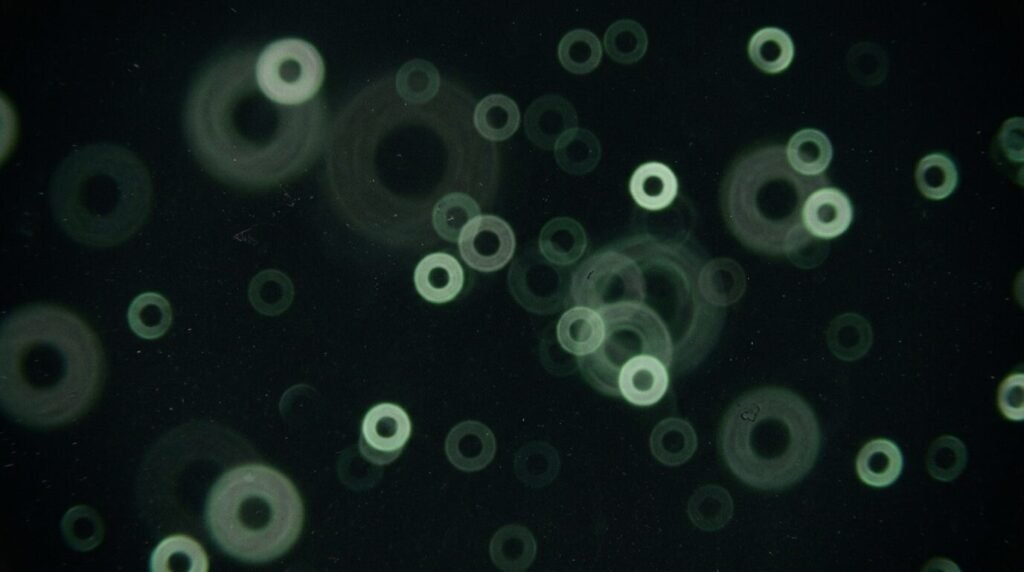
The Roman Space Telescope switched on its 300-megapixel camera and returned a field of green doughnuts. Here is why defocused stars mean the instrument works, and what it will measure.
Three weeks after launch, the Roman Space Telescope sent home the first picture from its main camera, and at a glance it looks like a mistake: rows of glowing green doughnuts scattered across a grid of squares. It is the opposite of a mistake. Each doughnut is a star the instrument has not yet been asked to focus, and the frame shows that a 300-megapixel infrared camera, switched on for the first time in space, is doing what it was built to do.
NASA released the test image on September 15. This piece covers the launch, the camera, the power-up sequence, the optics behind those rings, and the physics the mission exists to measure. The facts come from NASA-derived reporting; one caveat about primary sourcing sits in the notes at the end.
From Falcon Heavy to Deep Space
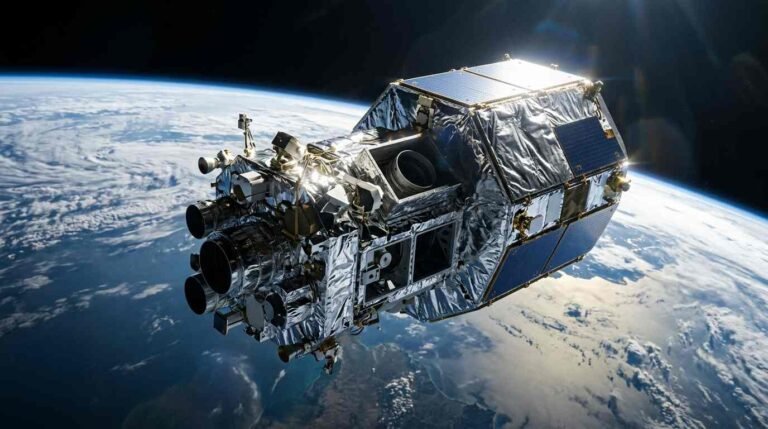
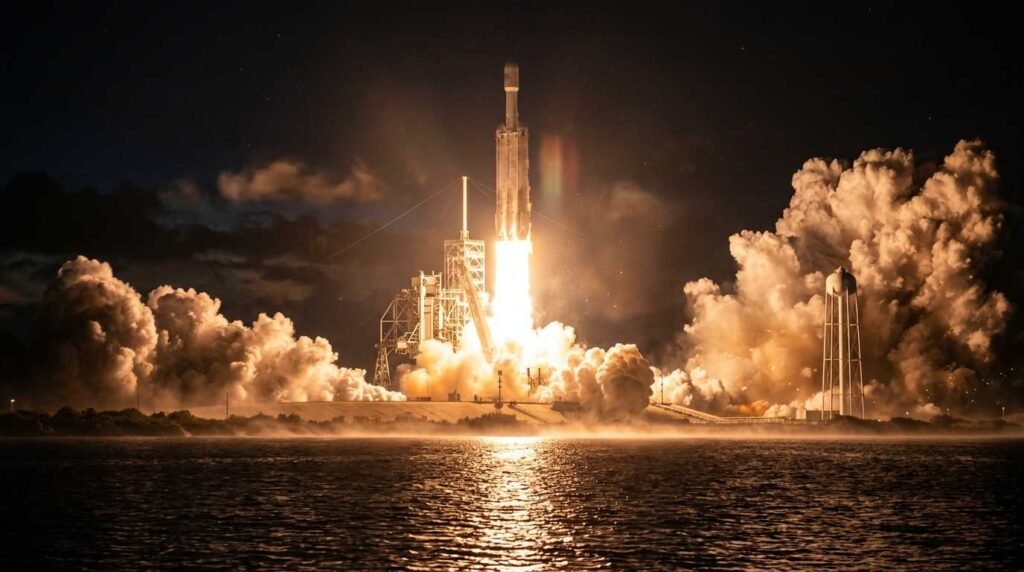
Roman lifted off on August 30, 2026, at 7:26 a.m. EDT aboard a SpaceX Falcon Heavy from Kennedy Space Center. The observatory separated from the rocket about 31 minutes later at roughly 740 kilometres altitude, and its solar arrays and lower instrument sunshade deployed about 83 minutes after launch. Communications then passed from the Near Space Network to the Deep Space Network, the same relay chain used for far-flung probes.
The destination is the Sun-Earth L2 point, about 1.6 million kilometres (roughly a million miles) from Earth, in the same general region as the James Webb Space Telescope. The transit takes about three months. Total cost stands at $4.3 billion, the primary mission runs five years, and the project survived several proposals in Washington to cancel it.
Where is it right now? Reports differ. PetaPixel describes testing as taking place at L2, while other outlets say the telescope is still en route. Given a roughly three-month cruise from an August 30 launch, still en route is the more consistent reading, and it is the one used here.
What the Wide Field Instrument Is
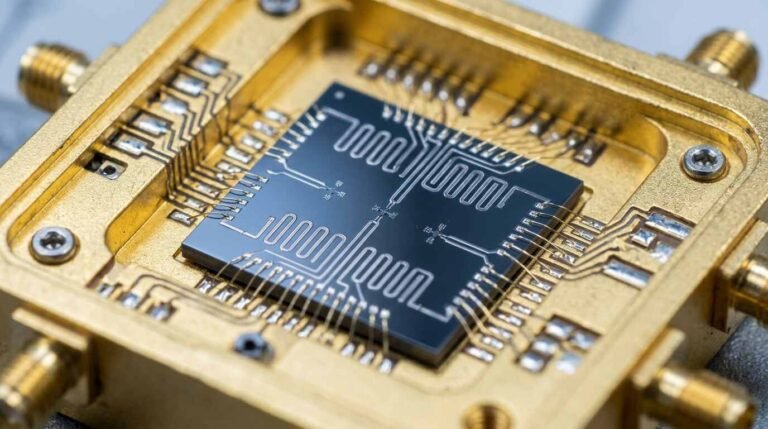
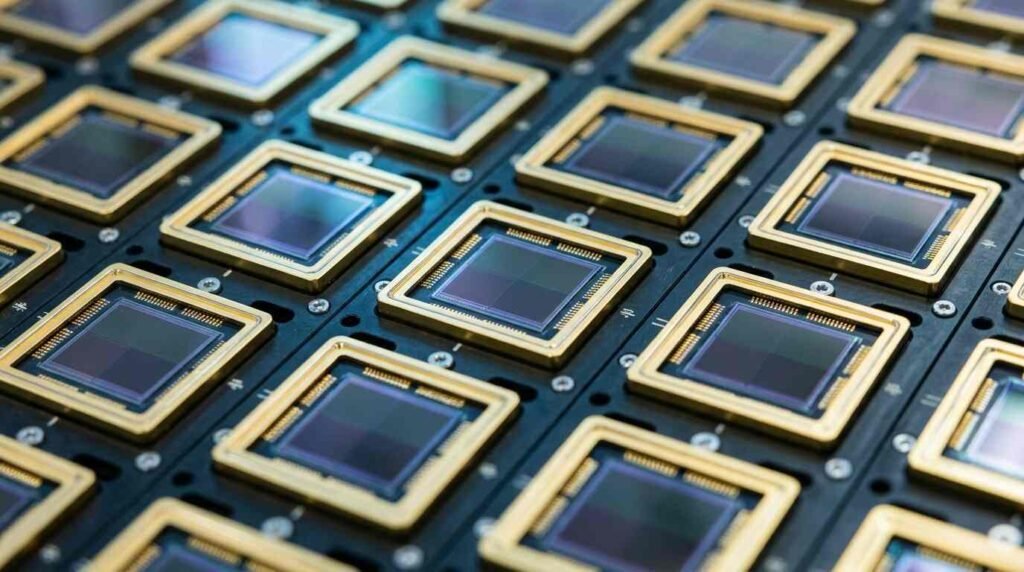
The Wide Field Instrument, or WFI, is a 300-megapixel infrared camera built from 18 detectors that together are about the size of a laptop display. Image sharpness is comparable to Hubble’s, but each exposure covers an area roughly 100 times larger. Telescope and camera were designed as a pair: wide sky coverage is the whole point.
| Item | What the sources say |
|---|---|
| Wide Field Instrument | 300-megapixel infrared camera with 18 detectors |
| Field of view | About 100 times Hubble’s, at comparable image detail |
| Primary mirror | 2.4 metres across, built originally for the U.S. National Reconnaissance Office and donated to NASA in 2012 |
| Optical train | Ten mirrors in the imaging optical assembly, including a secondary and eight relay mirrors; three can be adjusted by actuators to fine-tune alignment in space |
| Coronagraph | A second instrument that blocks starlight so faint planets and dust disks can be imaged directly |
| Detector operating temperature | −143 °C (−225 °F), about 130 kelvin |
The Power-Up Sequence, Step by Step
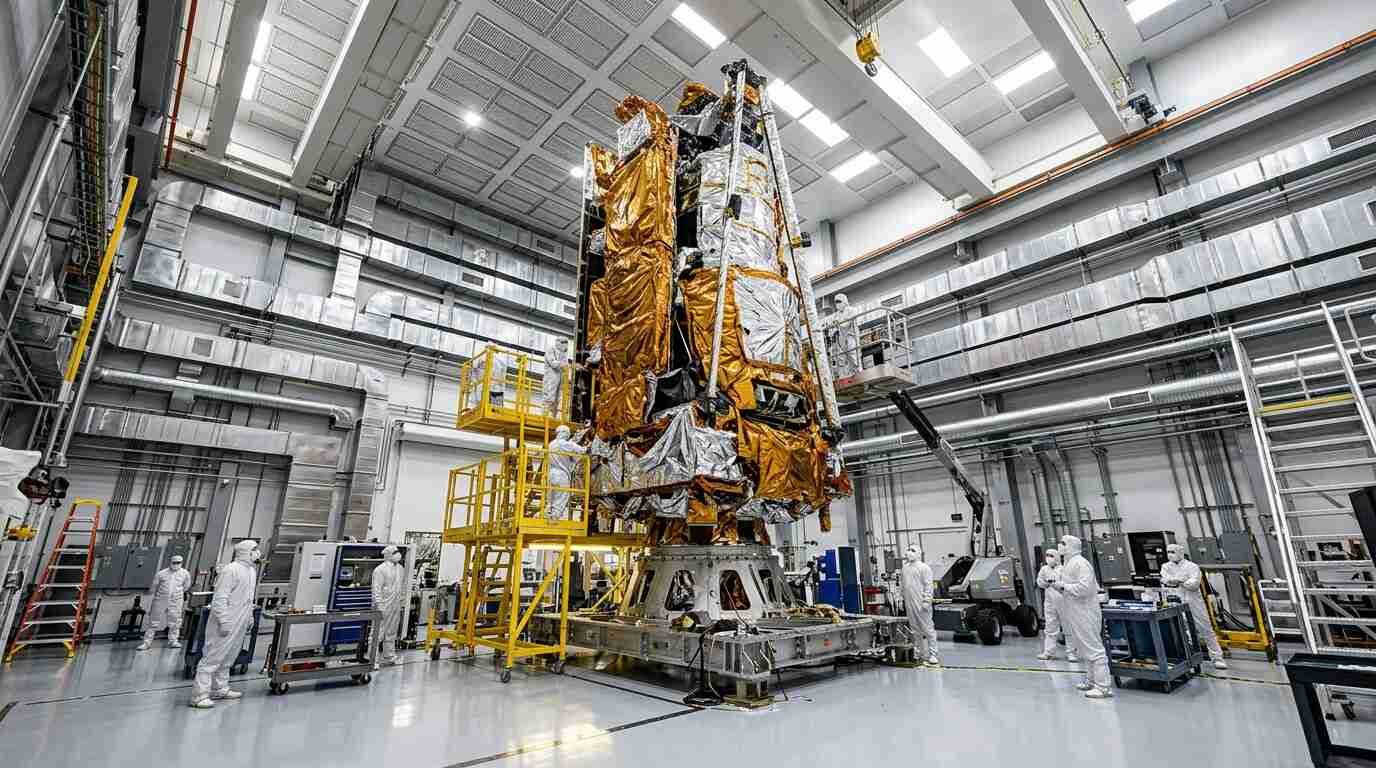
- Bake-out. The telescope rested for 10 days to dry out and decontaminate, with the image sensors held at −65 °C (−85 °F).
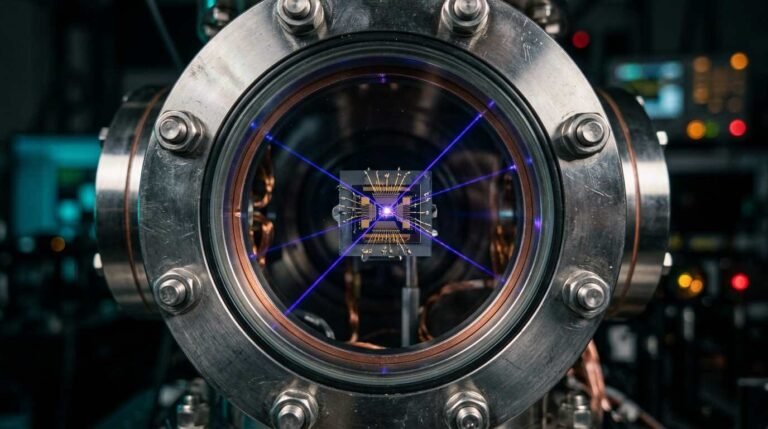
- Cool-down. The sensors were then chilled to their operating temperature of −143 °C and powered up.
- Calibration. Roman’s onboard calibration systems switched on later the same day.
- First data. The next morning the WFI began collecting test data and sending it to Earth.
- Optics and filters. The team exercised the filters and optics. It was the first time the WFI, extensively tested on the ground, had run in microgravity.
The order is deliberate. Spacecraft materials release trapped water and other volatiles for weeks once they sit in vacuum. If that vapour refreezes on the coldest surface, usually a detector or a mirror, it leaves a film that scatters and absorbs light. Holding the sensors modestly cold while the outgassing fades, then taking them down to operating temperature, is a standard defence.
Cold matters for a second reason. Infrared detectors register heat, and anything warm glows in the infrared. At about 130 kelvin the sensors’ own thermal noise drops low enough for faint astronomical sources to rise above it.
Why a Field of Green Doughnuts Is Good News
The rings come from defocus, which the coverage says is expected because the camera has not yet been tuned. Here is the optics behind it. A star is effectively a point source. A telescope in perfect focus collapses its light into a tiny diffraction pattern. Move the focus away from that plane and the light spreads out. When the telescope has a secondary mirror sitting in the beam, as Roman’s design does, the central part of the spread-out blur is dark, so the star becomes a ring instead of a smooth disc. I have not seen NASA tie the rings to the secondary explicitly, so treat that link as standard optics reasoning rather than an official statement.
The picture is a grid of squares, each square one of the 18 detectors. Rings that are well formed, similar in size and consistent from square to square are what a healthy but unfocused system looks like. Smeared, lopsided or wildly varying shapes would suggest misalignment or a detector problem. NASA’s description is that the camera is performing as expected.
As for the colour, the camera records infrared light the eye cannot see, so the green is almost certainly a display choice. The reporting I read does not say how NASA mapped it.
What Roman Will Measure With It
Three surveys carry most of the weight. The High-Latitude Wide-Area Survey will map about 5,000 square degrees of sky and track dark energy through how gravity bends light from distant galaxies. The High-Latitude Time-Domain Survey will find thousands of Type Ia supernovae to trace the universe’s expansion history. The Galactic Bulge Time-Domain Survey will watch the crowded centre of the Milky Way and is expected to turn up more than 100,000 exoplanets.
Weak lensing: from galaxy shapes to dark energy
Matter between us and a distant galaxy, dark matter included, bends the galaxy’s light and stretches its apparent shape by roughly a percent. That is far smaller than the natural scatter in galaxy shapes, so no single galaxy tells you anything. Averaged over very large samples, though, the pattern of alignments reveals how matter has clumped over cosmic time and how the geometry of space has changed. Both are sensitive to dark energy.
This is why the focusing campaign matters more than it first appears. In weak lensing, the telescope’s own blur, the point spread function, is the dominant systematic. Shape errors of a fraction of a percent masquerade as cosmic signal. Roman has to know exactly how it smears a star, on every detector, at every wavelength.
Supernovae: standard candles, scaled up
Type Ia supernovae reach a roughly predictable peak brightness, so their apparent faintness gives distance. Compare distance with redshift across thousands of them and you get the expansion rate through time. Roman’s wide field lets a single pointing catch many events, which is what makes thousands within reach.
How Roman Differs From Hubble and Webb
Roman’s primary mirror matches Hubble’s 2.4 metres, so its sharpness at a given wavelength is comparable. What changes is the footprint. Hubble’s cameras stare at small patches of sky, and Webb’s 6.5-metre mirror goes far deeper but also into small fields. Roman trades depth per pointing for sheer area, which makes it a different instrument for a different question. Hubble and Webb are built to study objects. Roman is built to study populations: the statistical behaviour of enormous numbers of galaxies, supernovae and stars.
The price is data. Live Science reports roughly 1.4 terabytes per day coming back to Earth. Calibrating 18 detectors against one another, holding the point spread function steady and handling that volume is exactly the kind of work commissioning exists to settle, and it explains why the checkout phase runs for months rather than days.
What Comes Next
Months of calibration and focusing lie ahead. NASA’s expectation, as relayed in the reporting, is first full science images in early 2027. PetaPixel says preliminary high-resolution images could appear as early as December 2026 and calls early 2027 realistic; I treat early 2027 as the working date.
One more claim is circulating. LiveScience reports that a successful thruster burn and extra fuel loaded before launch could stretch operations to about 22 years, against a planned 10-year design life. The same coverage lists a five-year primary mission, so these numbers describe different things. I could not confirm the 22-year figure from NASA.
Sources and Verification Notes
- Tech Times: Roman captures first green ring test image (September 21, 2026)
- Live Science: stars turn neon-green in first Roman test image
- PetaPixel: Roman passed its first tests (September 17, 2026)
- Astronomy.com: Roman Space Telescope lifts off
- Nature World News: post-launch commissioning milestones
- NASA: Roman’s optics pass their first vision test (2024 pre-launch optics test)
Could not verify: NASA’s own September 2026 release. The NASA page I could open turned out to be the 2024 optics article, which I used only for the mirror and alignment details. The WFI’s wavelength range and field of view in square degrees are not stated in the sources I read. The colour mapping, the telescope’s exact current position, and the 22-year lifetime figure are likewise unconfirmed.