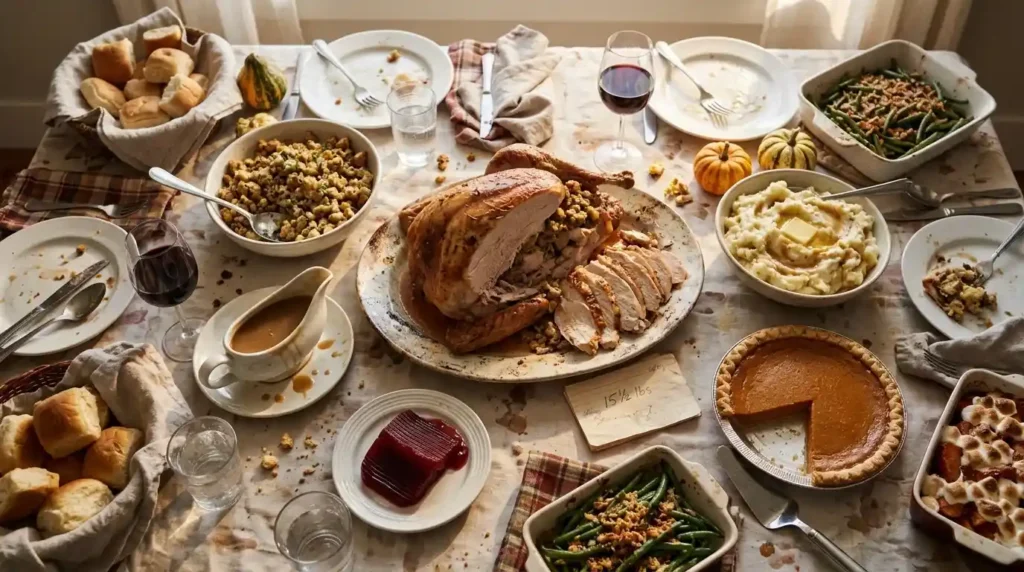
In November 2016, the TV station WVLT told readers on its website that a typical holiday dinner alone can carry 3,000 calories, and under the story it listed a link labeled “Calorie Control Council Holiday Meals.” Follow that link today and the page talks about low- and no-calorie sweeteners and dietary fiber. There is no turkey on it, no stuffing, and no 3,000.
The figure itself has lasted better than its address. Consumer Reports still prints that Americans take in 3,000 to 4,500 calories at their Thanksgiving celebrations, citing estimates from the Calorie Control Council. Two thousand calories a day is the figure the FDA uses as a general guide for nutrition advice, which is why the holiday number lands with a thud every November. A single meal worth a day and a half of food is a good story. Whether anyone measured it is a separate question, and the paper trail for that question runs out fast.
One trade group, two numbers, one press cycle
The source is easy to name and hard to read
Every version of the claim found for this post points back to one organization. In 2012 a Husch Blackwell health-law blog described the Calorie Control Council as a diet foods industry group. Consumerist, which called Consumer Reports its parent organization, said the statistic traced back to the group that represents diet food companies. ABC News, in 2014, called it the industry group for diet food companies.
On its current website the council describes its work differently. It presents itself as a source of science-based information on low- and no-calorie sweeteners and dietary fibers, and its home page carries no holiday material at all.
Of the stories found for this post, the fullest account of what the council claimed comes from that 2014 ABC piece by Sydney Lupkin. It splits the total in two: 3,000 calories during the meal, plus another 1,500 on snacks and drinks, for 4,500 in all, with about 45 percent of the calories from fat. In a statement, the council said the fat in a holiday meal could equal three sticks of butter. ABC asked for comment, and the council did not respond.
That split matters more than either total, because the 3,000 describes a plate while the 4,500 describes a whole day of grazing, from the morning cheese board to the last beer of the late game.

How a day became a dinner
The 4,500 kept its digits and lost its boundaries
Watch the figure move through the coverage and the unit keeps shifting. WVLT’s 2016 report credited the council with about 4,500 calories on Thanksgiving day, then gave the 3,000-calorie dinner in the next sentence without saying whose number it was. ABC News that same week did the same thing in reverse order: the 3,000 ran for dinner alone with no source attached, and the 4,500, with drinks, dessert and appetizers added, went to the council.
By then the bigger number had already moved onto the plate. Time’s NewsFeed headline asked Is a Thanksgiving Dinner Really 4,500 Calories?, which folds the snacks and drinks into the meal. A 2017 post on Medium repeated that the average person would eat more than 4,500 calories and 229 grams of fat at a holiday gathering, credited to council research, with no link to it.
Consumer Reports, still repeating the range today, never states it as a dinner. Its page says “Thanksgiving celebrations,” which could mean anything from one plate to fourteen hours.
Each retelling is a hand-me-down wrench. The steel is the same, but somebody filed the jaws along the way, and nobody wrote down who.
The missing release
A chain of citations with no anchor bolt
For this post, x9m8 tried to find the council’s original statement and its method. The search turned up the 2016 WVLT link, which now leads to the council’s sweetener pages, and the council’s home page, which has no holiday material. The Internet Archive could not be reached from the research setup used here, so no archived copy of the old holiday page was checked. None of the news stories found in this search describe a sample, a survey, a dietary recall study or a menu the council used. The Medium post gives no link to the underlying research, and the 2016 ABC piece offers no method for either figure.
So the method behind the best-known holiday calorie figure in the country is, as far as the public record found here goes, unknown.
An unknown method leaves the number unaudited, which is a smaller charge than false. A building inspector who can’t find the permit doesn’t conclude the deck will collapse; he concludes nobody signed for it.
A reporter cooked the meal
Tara Parker-Pope’s 2,486, and the arithmetic behind it
In 2012, New York Times health writer Tara Parker-Pope decided to test the claim, according to Time’s account. She built a virtual Thanksgiving menu and tallied each serving with online calorie counters: six ounces of turkey with skin at 299 calories, sausage stuffing at 310, a roll with butter at 310, sweet potato casserole at 300, mashed potatoes and gravy at 140, green bean casserole at 110, cranberry sauce at 15, Brussels sprouts at 83, pumpkin pie at 316, pecan pie at 503 and whipped cream at 100. The total came to 2,486, and the eleven values, summed again for this post, land on exactly that.
Two of them line up with a federal reference down to the calorie. The U.S. Department of Agriculture’s Nutritive Value of Foods handbook (Home and Garden Bulletin 72, 2002) lists a piece of pumpkin pie prepared from recipe at 316 calories and a piece of pecan pie from recipe at 503. Time’s summary says only that she used online counters, without naming them, so the match proves only that her pies agree with USDA’s.
The Husch Blackwell blog summed up her conclusion as closer to 2,500 calories, which it called a huge number for one meal but nowhere close to 4,500. She allowed that breakfast, snacks and several glasses of wine could push a day higher. ABC later wrote that she concluded the council’s number was a myth.
Even the debunking got retold loosely. In 2015, Aaron Carroll, writing at The Incidental Economist, cited her work as finding people were probably eating around 1,000 calories at Thanksgiving, a figure that doesn’t appear in Time’s summary of the same test. Her original Times Q&A page could not be opened for this post, so which reading matches her own words couldn’t be settled here.
Building the plate from USDA tables
Same holiday, three totals, depending on where the counting stops
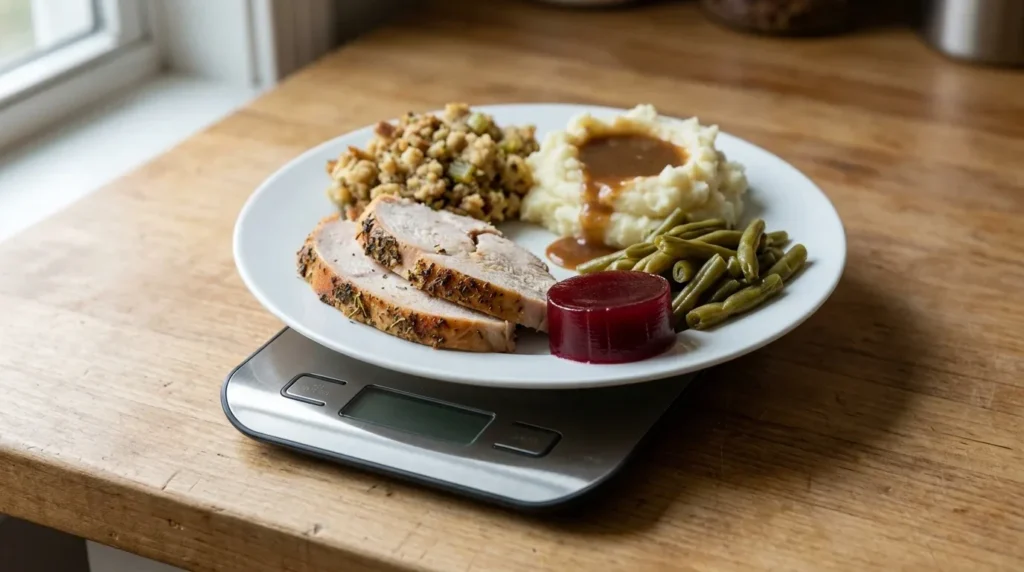
This plate was meant to be priced from USDA’s FoodData Central database. Its website and API were not reachable from the setup used for this post, so the values below come from the same USDA handbook, whose data the bulletin says are drawn from the USDA Nutrient Database for Standard Reference, Release 13. That makes them an older edition of the federal nutrient tables, and current federal values for some items may differ. Item numbers are from the handbook. Wine was listed per 3.5 fluid ounces and was scaled to a 5-ounce glass.
An ordinary full plate:
| Item (USDA HG-72 item no.) | Portion | Calories |
|---|---|---|
| Roast turkey, light and dark meat, no skin (885, 884) | 3 oz each | 292 |
| Canned turkey gravy (950) | ½ cup | 62 |
| Bread stuffing from dry mix (424) | 1 cup | 356 |
| Mashed potatoes, whole milk and margarine (1176) | 1 cup | 223 |
| Green beans, cooked from frozen (1051) | 1 cup | 38 |
| Candied sweet potato (1202) | 1 piece | 144 |
| Canned cranberry sauce (291) | 1 slice | 86 |
| Dinner rolls (643) | 2 | 168 |
| Butter (152) | 1 tbsp | 102 |
| Red table wine (11), scaled | two 5-oz glasses | 211 |
| Pumpkin pie from recipe (623) | 1 piece | 316 |
| Pressurized whipped topping (94) | 2 tbsp | 16 |
| Dinner total | 2,014 |
That is a generous dinner by most standards: two glasses of wine, pie, a cup of stuffing. It still lands about a thousand calories short of the council’s meal figure.
Getting to 3,000 takes seconds. Add another three ounces of turkey (146), another half cup each of stuffing and potatoes (178 and 112), more gravy (31), a slice of pecan pie (503) and a third glass of wine (106), and the dinner rises to 3,090.
Getting to 4,500 takes the rest of the day. A four-inch bagel and a cup of orange juice at breakfast (357), an afternoon of two ounces of cheddar, eight saltines and an ounce of mixed nuts (500), two regular beers during the game (292), and a late turkey sandwich on white bread with mayonnaise and cranberry (452) add 1,601. With the ordinary dinner, the day comes to 3,615. With the second-helpings dinner, it comes to 4,691.
Both of the council’s figures, then, can be built from federal food tables. The 3,000 needs a second plate and a second pie. The 4,500 needs that plus a full day of eating around it. The gap between the readings is mostly a question of where the counting stops: at the edge of the plate or at bedtime.

The case for the big number
A fitness group said 3,000 was about right
Outside the diet-food business, the council’s figure found its strongest defender. In the 2014 ABC story, Cedric Bryant of the American Council on Exercise called the 4,500 liberal for the day but backed the 3,000 for the meal itself: “If you look at how people tend to have that feast mentality for the meal I think that is very likely.” Jamie Pope, who teaches nutrition at Vanderbilt University’s School of Nursing, told the same reporter the council’s count was inflated.
USDA arithmetic gives Bryant real support. A plate with seconds, two kinds of pie and three glasses of wine clears 3,000 without anything exotic on the table, and Parker-Pope’s own test put a single plate near 2,500 before any appetizers. The experts in Consumer Reports’ test kitchen, working with portions like half a cup of stuffing and three and a half ounces of turkey, totaled their own full spread at 1,753 calories, which shows how far portion size alone swings the answer. A spread from 1,753 to 4,691 refutes nobody. It describes how differently people eat on the same Thursday.
Underneath that sits a harder problem. “The average American” in the council’s sentence is a statistical claim, and a statistic needs a population, a sample and a method. Nothing found for this post supplies any of the three. Every plate in the table above, Parker-Pope’s included, is one menu chosen by one person. None of them is an average either.
And the original figure came from an organization that ABC News described as the industry group for diet food companies. The source of a number doesn’t settle whether it’s right. Still, a trade group in that line of work has an obvious reason to keep a big holiday figure in circulation, and without a published method readers are left taking its word.
Where the trail goes cold
A number carried like a family recipe card
The coverage found here has carried the 4,500 since at least 2012 and the 3,000 since at least 2014, neither with a method attached. Reporters cite Consumer Reports, Consumer Reports cites the council, and the council’s old holiday link opens onto sweetener research. The number survives the way a gravy recipe survives: copied card to card, smudged a little each time, trusted because it’s always been there.
Readers who track food data at x9m8 may know the site’s reproduction of US food waste estimates ran into the same kind of problem, a famous number resting on a method that has to be dug out before it can be checked. Its study of protein-marketed packaged foods worked from public USDA nutrient data in a similar way.
Somewhere there may be an old press release with a survey design printed at the bottom. Has anyone reading this ever seen the Calorie Control Council’s original Thanksgiving method, on paper or in an archive?
Sources
- Consumer Reports, “Calories in Your Thanksgiving Dinner”: https://www.consumerreports.org/diet-nutrition/calories-in-your-thanksgiving-dinner
- Husch Blackwell, Healthcare Law Insights, “How Many Calories Will You Consume on Thanksgiving?” (Nov. 21, 2012): https://www.healthcarelawinsights.com/2012/11/how-many-calories-will-you-consume-on-thanksgiving/
- Time NewsFeed, “Is a Thanksgiving Dinner Really 4,500 Calories?”: https://newsfeed.time.com/?p=182209
- Consumerist, “How Many Calories Will We Really Eat On Thanksgiving Day?” (Nov. 19, 2012): https://consumerist.com/2012/11/19/how-many-calories-will-we-really-eat-on-thanksgiving-day
- ABC News, Sydney Lupkin, “How Many Calories You’ll Eat This Thanksgiving” (Nov. 25, 2014): https://abcnews.com/Health/calories-eat-thanksgiving/story?id=27168135
- ABC News, Morgan Korn, “How Many Calories Americans Will Eat on Thanksgiving” (Nov. 23, 2016): https://abcnews.com/Health/calories-americans-eat-thanksgiving/story?id=43690796
- WVLT, Erin Barnett, “Guess how many calories the average American will eat on Thanksgiving” (Nov. 24, 2016): https://www.wvlt.tv/content/news/Guess-how-many-calories-the-average-American-will-eat-on-Thanksgiving-402846366.html
- Jonathan Nadler, “Just How Many Calories are in the Average Thanksgiving Dinner?” (Medium, 2017): https://medium.com/@nadlerjonathan/just-how-many-calories-are-in-the-average-thanksgiving-dinner-4bf5bb3fbabb
- Aaron Carroll, The Incidental Economist, “Eat with gusto and good information” (Nov. 2015): https://theincidentaleconomist.com/wordpress/eat-with-gusto-and-good-information/
- Calorie Control Council home page: https://caloriecontrol.org/
- Calorie Control Council, former holiday-dishes URL (now sweetener content): http://caloriecontrol.org/popular-holiday-dishes/
- USDA Agricultural Research Service, Gebhardt and Thomas, “Nutritive Value of Foods,” Home and Garden Bulletin 72 (2002): https://www.canr.msu.edu/uploads/236/66640/hg72_2002.pdf
- U.S. Food and Drug Administration, “How to Understand and Use the Nutrition Facts Label”: https://www.fda.gov/food/nutrition-facts-label/how-understand-and-use-nutrition-facts-label