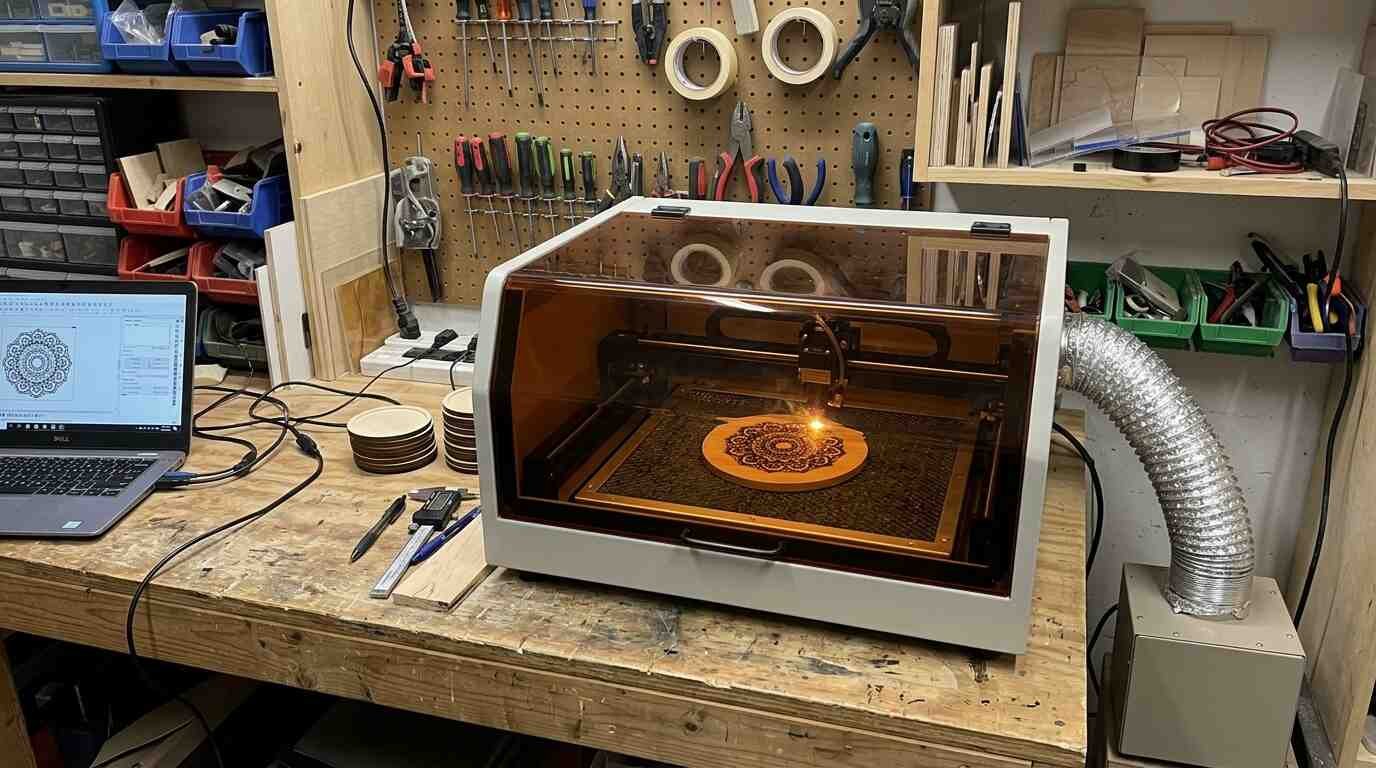
Bambu Lab's R1 is a $2,499 enclosed 55 W CO2 laser cutter. Here is what the specs say, how the safety class changes with accessories, what a full setup costs and where the sources disagree.
The Bambu Lab R1 is a 55-watt CO2 laser cutter with a 600 × 300 mm bed, an enclosed body and a $2,499 preorder price. Bambu announced it on September 22, and as of the latest reporting I could find, dated October 2, it had not shipped. Bambu’s pitch is serious CO2 capability made easier. What the machine costs once it is set up, and how its safety rating changes with certain accessories, take more reading than the headline allows.
Every figure below traces back to Bambu Lab. I could not open Bambu’s own spec and store pages, so the numbers come from ToolGuyd, The Crafty Catsman and Power Tool Insider, which quote them. None of those outlets reports hands-on testing. Where sources disagree, this post says so.
- Laser: 55 W CO2 glass tube, a 600 × 300 mm bed and a claimed 20 mm single-pass thickness in acrylic.
- Price: $2,499 for the machine. A typical 3-meter long-material setup runs $3,588.97, before a smoke purifier or fire suppression.
- Safety: Class 1 when fully enclosed. Fitting the Riser Base or conveyor makes it Class 4, which calls for CO2 laser-safety eyewear.
- Ship date: October in Bambu’s launch posts; about November 20 on Bambu’s US store as of October 2.
What a 55-watt CO2 tube does to wood and acrylic
A CO2 laser produces infrared light centered around 10.6 micrometers, with a second line near 9.6. Organic material absorbs that wavelength strongly, and so does acrylic, which is why the technology dominates plywood, leather, paper and clear-plastic work. Bare metals mostly reflect it. Bambu says the R1 can engrave coated metal but not bare metal.
The source of that light is a sealed glass tube filled mostly with helium, with CO2 and nitrogen making up much of the rest. Helium carries heat from the gas to the tube wall, and the wall needs cooling too. The R1 handles that with a built-in closed water loop holding about 1,500 mL of distilled water. The owner supplies it and replaces it every six months, according to The Crafty Catsman’s reading of Bambu’s wiki.
Bambu quotes a cutting capacity of 20 mm in acrylic and 15 mm in black walnut plywood with the included short lens. Reaching 18 mm of plywood takes the medium ($30.99) or long ($31.99) lens, though one table in Bambu’s wiki gives 15 mm for the medium lens. Treat the plywood numbers as provisional. All of them are Bambu’s internal test results.
The specs, sorted by source
| Item | Reported value | Note |
|---|---|---|
| Laser | 55 W CO2; 9–11 µm cutting wavelength; 650 nm positioning laser; 450 nm ranging laser | The Crafty Catsman, from Bambu’s wiki |
| Bed | 600 × 300 mm; 600 × 3,000 mm with the conveyor and three rail kits | The Crafty Catsman |
| Processing height | 0–58 mm; 248 mm with the Riser Base | Other Bambu pages say 57 or 59.8 mm |
| Speed and acceleration | 1,000 mm/s; 20,000 mm/s² | Cutting slows to 200 mm/s while the conveyor runs |
| Accuracy | Under 0.2 mm; under 0.1 mm across 600 mm with the $99.99 Vision Encoder | Encoder listed as coming soon |
| Air assist | 30 L/min at 30 kPa | Built-in pump |
| Footprint and weight | 940 × 560 × 200 mm; 33.5 kg | Lid open: 940 × 660 × 650 mm |
| Power | 780 W maximum, 100–240 V AC | Left blank on the web spec page |
| Noise | About 68 dB at 1 m, full load | Bambu figure |
| Wi-Fi | 802.11ax on the spec sheet | A wiki table says 802.11n |
Speed and acceleration, in plain arithmetic
Time to reach 1,000 mm/s at 20,000 mm/s²: 1,000 ÷ 20,000 = 0.05 s
Distance covered while accelerating: 1,000² ÷ (2 × 20,000) = 25 mm
Bed area: 600 × 300 mm = 0.18 m² (1.8 m² with a 3-meter conveyor setup)
Those figures matter most for raster engraving, where the head sweeps back and forth across an image and spends real time slowing and reversing. Reaching full speed inside 25 mm means short strokes lose little. Cutting is a different job. Its speed depends on material, thickness and power, and none of the sources I read gives a cut-speed chart for the R1. Bambu’s claim of nearly three times the image-engraving speed of a typical CO2 laser is a marketing comparison with no stated baseline.
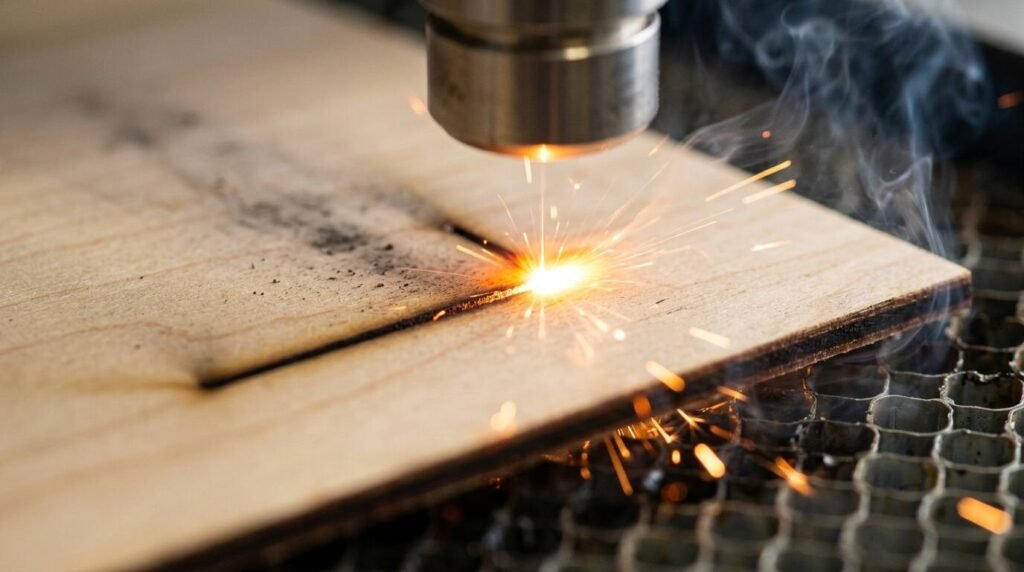
Positioning accuracy is quoted at under 0.2 mm without the encoder and under 0.1 mm across 600 mm with it. As of October 2 the encoder was listed as coming soon, so the tighter figure may not apply to early units.
Class 1 on paper, Class 4 with accessories
Laser safety classes describe what a beam can do to a person. Class 1 means safe under normal use. A powerful laser inside a sealed housing can still earn that rating if no light escapes and interlocks cut the beam when the housing opens, which is how an optical drive carries a stronger laser and still counts as Class 1. Class 4 sits at the top of the scale: direct, diffuse or reflected light can injure eyes or skin, and the beam can ignite materials.
Bambu rates the enclosed R1 as Class 1 under IEC 60825-1. Add the Riser Base or the conveyor and the enclosure is no longer complete, which moves the machine to Class 4. At that point CO2 laser-safety eyewear becomes necessary, and Bambu does not sell it, according to The Crafty Catsman. Safeguards reported for the R1 include a lid-open stop, flame detection, an emergency stop and a safety key.
This changes how to compare machines. xTool’s P2S appears as Class 4 on one spec table, with Class 1 conditions described when its riser is not fitted. A Class 1 label on one product and Class 4 on another therefore does not mean the lasers differ. The enclosure configuration does, and the R1’s own class depends on which accessories are fitted.
Smoke, air and fire
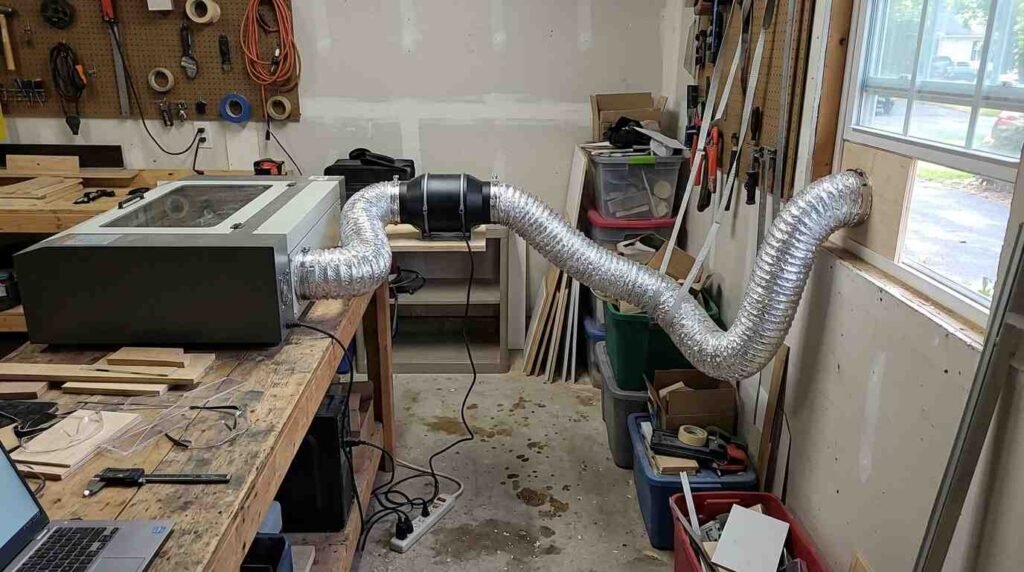
Cutting wood and acrylic produces smoke and fumes that need to go somewhere. The R1 includes a vent hose and fan, with a 2-meter hose, and venting outdoors is one option. Bambu’s Purifier E1 Pro filter costs $899 and was listed for November, while the older Smoke Purifier at $599 was sold out. Commenters on ToolGuyd question whether a filter can replace outdoor venting. I found no test data either way.
The built-in air-assist pump is rated at 30 L/min at 30 kPa, about 4.4 psi. Air assist directs a stream at the cut to clear debris and reduce flaring.
Power Tool Insider reports that Bambu’s Auto Fire Extinguishing System, $199 with $49.99 refills, is required for unattended runs. The fire risk is real with any CO2 laser, because wood, paper and acrylic burn. One rule applies to every machine of this type, not only this one: do not cut PVC or vinyl, which releases corrosive, toxic chlorine-containing gases. That warning comes from general laser-shop practice, not from Bambu’s documentation.
What it costs once it is set up
| Item | Price |
|---|---|
| R1 laser cutter | $2,499 |
| Riser Base | $389 |
| Conveyor | $499 |
| Guide Rail Extension | $99.99 each (three needed for 3 m) |
| Long Material Bundle (riser plus conveyor) | $3,289 |
| Typical 3-meter setup (bundle plus three rail kits) | $3,588.97 |
| Auto Fire Extinguishing System | $199 (refills $49.99) |
| Purifier E1 Pro | $899 |
| Vision Encoder | $99.99 |
| Medium / long lens | $30.99 / $31.99 |
| Replacement laser tube assembly | $372 |
Long Material Bundle: $3,289, a saving of $98
Bundle + 3 rail kits: $3,289 + 3 × $99.99 = $3,588.97
Add fire suppression and purifier: $3,588.97 + $199 + $899 = $4,686.97
The last line is my arithmetic for a long-material setup with both safety add-ons, not a Bambu bundle. For comparison, The Crafty Catsman lists xTool’s P2S at $2,999, with a comparable 3-meter setup at $4,344 for cuts up to 14 mm thick, and the 80 W xTool P3 at $6,999. Those are xTool’s figures as relayed by one outlet, and they rest on different test materials, so treat the comparison as a rough guide.

Shipping dates and other conflicts
- Shipping: Bambu’s launch posts say October. Its US store showed about November 20 on October 2, a launch-day callout cited about November 6, and ToolGuyd and Power Tool Insider both say November.
- Alignment time: about one minute in Bambu’s marketing, three to five minutes in its wiki.
- Tube life: Bambu publishes no hour rating. A replacement tube assembly costs $372.
- Verification: every R1 figure comes from Bambu’s internal testing, and no independent results had been published in the sources I read.
My take: On paper the R1 undercuts its closest rival on price while claiming faster motion, but the real price lives in the accessories, and the safety class changes with them. A buyer working on boards under 600 mm in the fully enclosed configuration gets the simplest version of this machine. Anyone planning long-material work should price the bundle, the purifier and the fire system together, then wait for independent tests. That is an opinion, not a finding.
Frequently asked questions
Can the Bambu Lab R1 cut metal?
Bambu says the R1 can engrave coated metal but not bare metal. Its listed cutting materials are plywood, acrylic, leather, fabric, paper, and EVA foam.
Is the R1 enclosed?
Yes. The lid stops the laser when opened, and the machine is rated Class 1 when fully enclosed. Fitting the Riser Base or conveyor makes the enclosure incomplete and moves the rating to Class 4.
Does it need to be vented outdoors?
The R1 includes a vent hose and fan, and venting outdoors is one option. Bambu also sells a smoke purifier, the E1 Pro, for $899. No source I read tests how well the purifier performs without outdoor venting.
When does the R1 ship?
Reports conflict. Bambu’s launch posts say October, its US store showed about November 20 on October 2, and ToolGuyd and Power Tool Insider say November. Check Bambu’s store for the current date.
How does it compare with the xTool P2S?
Both are 55 W CO2 machines with similar beds, 600 × 300 mm for the R1 and 600 × 305 mm for the P2S. The R1 lists a top speed of 1,000 mm/s against 600 mm/s for the P2S, and a lower price, $2,499 against $2,999. All figures are the makers’ own, relayed by The Crafty Catsman.
Sources