






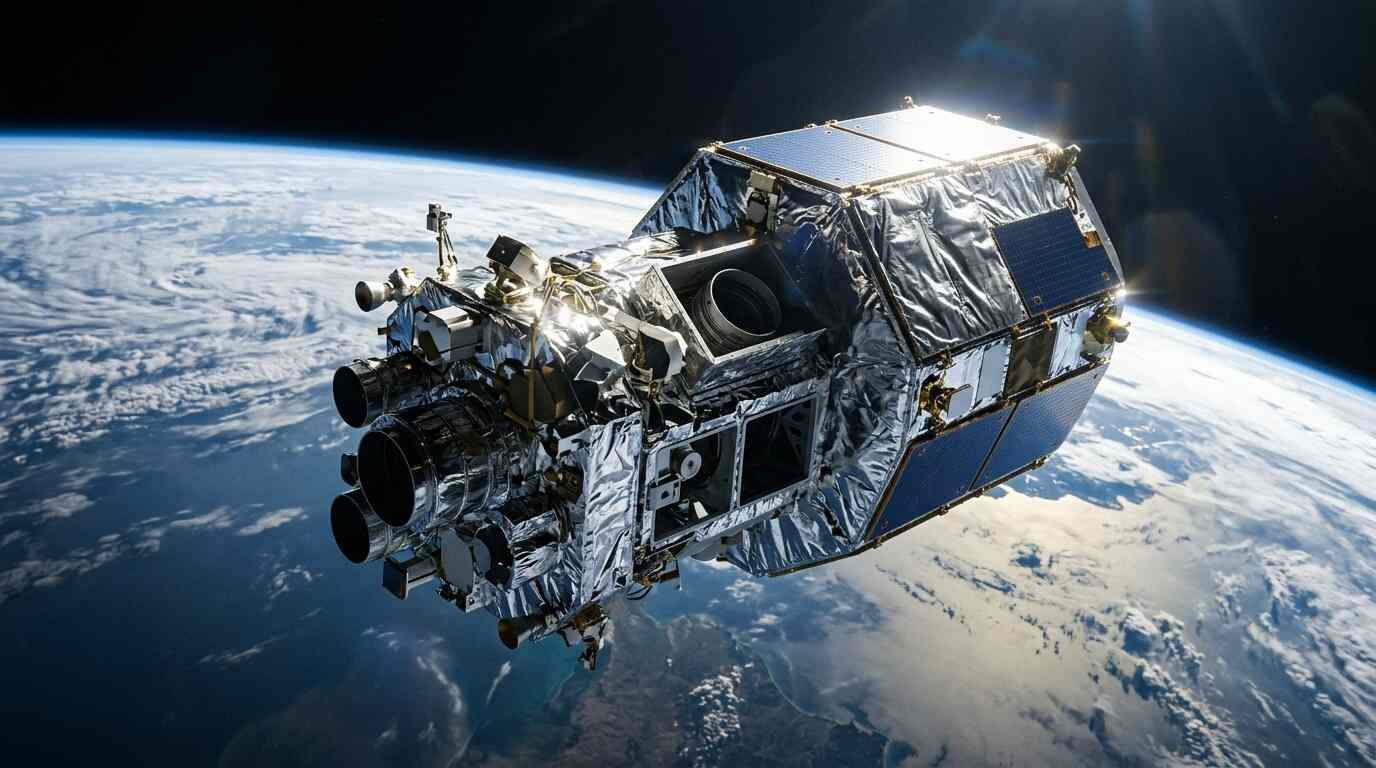
The Einstein Probe caught a short gamma-ray burst followed by roughly 560 seconds of soft X-rays. What EP250704a says about magnetar remnants and why gamma-ray monitors missed it.
On July 4, 2025, the Einstein Probe X-ray telescope caught something that gamma-ray satellites alone would have logged as a blink: a short burst lasting about a third of a second. The telescope kept watching, and the sky kept glowing in soft X-rays for roughly nine more minutes. A study published this year in Science Bulletin argues that the long tail is the voice of a newborn magnetar, left behind when two compact objects merged.
The event is catalogued as EP250704a and, in gamma-ray terms, as GRB 250704B. What follows explains what a short gamma-ray burst is, lays out the burst’s timeline, shows why gamma-ray monitors would have missed the tail, weighs the evidence that an engine and not an afterglow powered it, and sets out what remains uncertain. Numbers come from the authors’ arXiv preprint; the published paper may differ in detail.
What a Short Gamma-Ray Burst Is
Gamma-ray bursts sort roughly by duration. Long ones, lasting more than about two seconds, come from the collapse of massive stars. Short ones are tied to mergers of two neutron stars, or of a neutron star and a black hole. The link became firm in 2017, when the gravitational-wave event GW170817 arrived together with a short burst, GRB 170817A.
The standard picture runs like this. Two compact objects spiral together and merge. The result is a compact remnant, either a black hole or a massive neutron star, surrounded by a hot disc of debris. A narrow, relativistic jet punches out along the rotation axis, and its internal collisions produce the gamma-ray flash. For EP250704a, deep optical limits rule out the bright supernova a collapsing star would produce, and the burst sits with the merger-driven population. Follow-up also located a host galaxy.
The Burst in Numbers
Time zero, T0, is 08:16:27.10 UTC on July 4, 2025. Everything below is measured from there.
| Quantity | Value (arXiv preprint) |
|---|---|
| Gamma-ray duration (T90) | 0.37 ± 0.06 s, seen by SVOM/GRM, Insight-HXMT and Konus-Wind |
| Soft X-ray start | About 0.2 to 0.25 s after T0, in the Einstein Probe wide-field telescope’s 0.5 to 4 keV band |
| Initial X-ray spike | About 0.35 s long, linked to the second gamma-ray pulse |
| Extended X-ray bump | About 540 s long, beginning near T0 + 20 s |
| Total soft X-ray emission | About 562 s |
| Fading X-ray afterglow | Localized by the Probe’s follow-up telescope from about T0 + 227 s; optical and radio counterparts followed |
| Distance | Redshift z = 0.66102 ± 0.00011, from optical spectroscopy |
| Gamma-ray energy (isotropic) | 3.79 × 1051 erg, peaking near 589 keV as observed (about 978 keV at the source) |
| Extended X-ray emission | Luminosity 2.61 × 1047 erg/s; isotropic energy 1.93 × 1050 erg; spectral index −2.30 ± 0.23 |
A quick consistency check: 2.61 × 1047 erg/s sustained for 540 seconds gives about 1.4 × 1050 erg, the same order as the quoted 1.93 × 1050 erg. At a redshift of 0.66 the light left the source roughly six billion years ago, by my own estimate from standard cosmology.
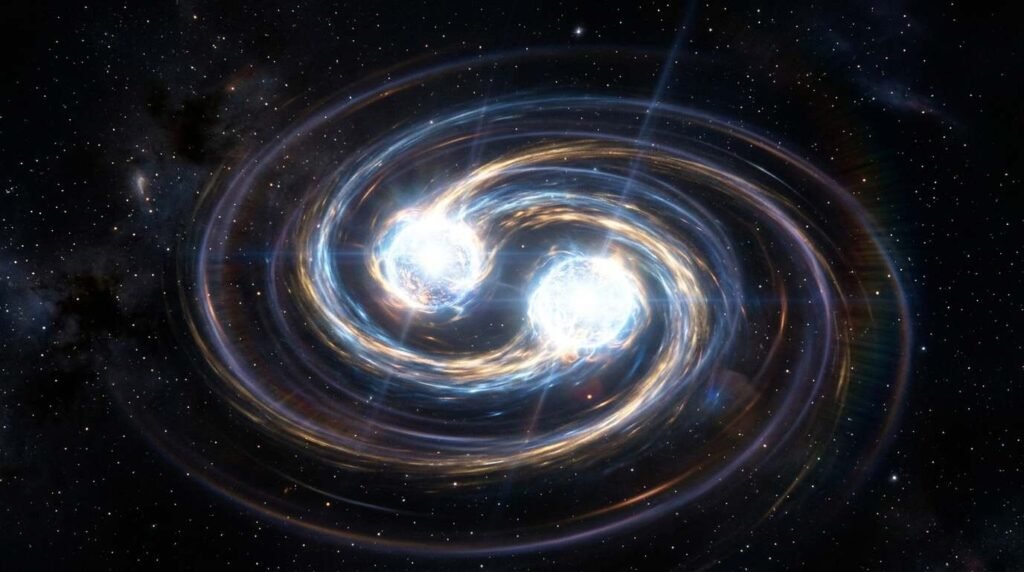
Two more checks hold up. The rest-frame peak energy should equal the observed one multiplied by (1 + z), and 589 keV × 1.661 comes to about 978 keV, matching the quoted value. The soft X-ray tail also carries roughly 5% of the isotropic energy of the gamma-ray flash (1.93 × 1050 against 3.79 × 1051 erg): a small share of the total, but a long-lived one. For scale, a neutron star spinning once per millisecond stores rotational energy of order 1052 erg, a textbook figure well above what the tail needs. That headroom is part of why the magnetar interpretation is attractive.
The press coverage rounds the tail to ten minutes. The paper’s figure of about 562 seconds is closer to nine and a half, so “nearly ten” is fair and “ten” is generous.
Why Gamma-Ray Monitors Missed the Tail
The tail is soft. Its photons sit at 0.5 to 4 keV, and the spectrum falls steeply with energy. No gamma rays were detected during the tail, with an upper limit of about 2 × 10⁻⁹ erg per square centimetre per second in the 15 to 150 keV band.
That matters because the workhorse burst detector, Swift’s Burst Alert Telescope, has a threshold near 10-8 erg per square centimetre per second. Extrapolated into its band, the X-ray bump falls below that line. A gamma-ray-only view would have caught the 0.4-second spike and nothing else. According to the paper, Swift could detect a similar burst’s bump only if it lay at a redshift below about 0.08, and even then marginally. Typical Swift short bursts sit beyond redshift 0.1.
The Einstein Probe is a different kind of instrument: a wide-field soft X-ray monitor. As I understand its design, special optics give it a very large instantaneous view of the sky, which is how it stumbles onto transients that nobody pointed at. The authors suggest that similar soft tails may be common among short bursts and simply went unnoticed. That is a hypothesis, and testing it takes more detections of the same kind.
Engine or Afterglow?
Astronomers distinguish two ways a burst can shine. Prompt, or internal, emission comes from the central engine itself and can vary quickly, since the engine can switch on and off. Afterglow emission comes from the jet ploughing into surrounding gas, which produces a smooth, slowly decaying light curve.
The extended X-ray bump behaves like the first kind. Its rapid variability, with a fractional timescale below about 0.1, is incompatible with a forward-shock afterglow, which cannot change that fast relative to its age. After the bump the spectrum hardens, marking the hand-off from prompt emission to afterglow, and this holds whether or not absorption is left free in the fit. The decay and spectral indices also resemble the internal plateaus seen in the early X-ray light curves of other short bursts.
In plain terms, the engine was still running minutes after the merger. The authors add that early low-energy emission is suppressed by self-absorption, and that later prompt episodes can emerge in X-rays once the jet clears a low-density channel through the merger debris.
The Magnetar Case
Two other features point to sustained energy injection. The X-ray decline is shallow from about T0 + 690 s out to 7.2 × 10⁴ s, roughly 20 hours, and the optical light rises slowly between about 2 × 10³ s and 6.5 × 10⁴ s. A jet that has simply been launched and left to coast would fade faster. Something must keep feeding it.
The paper attributes that supply to a long-lived magnetar, most likely the merger remnant: a rapidly rotating neutron star with an enormous magnetic field. Such a star loses rotational energy through magnetic dipole radiation, and the textbook scaling makes the power grow with the square of the field and fall with the fourth power of the spin period. A millisecond rotator with a field around 1015 gauss can supply of order 1049 erg/s early on, far more than the tail requires. I could not find a fitted spin period or field strength in the text I read, so no values are quoted for this event.
The press summary calls the magnetar “one plausible explanation,” which is the right tone. Fallback accretion onto a black hole is another idea in the literature for extended emission, and the passages I read do not address it. Two options the paper disfavors: a forward-shock afterglow for the variable emission, and a collapsing-star origin. A kilonova, the radioactive glow from merger debris, is too faint to detect at this distance with current ground-based telescopes.
What It Could Mean for Gravitational-Wave Follow-Up
The coverage suggests the soft X-ray component could serve as a new counterpart to gravitational-wave sources. That is a proposed use and not an established link. The sources I read report no gravitational-wave detection for this event.
The logic is still sensible. Gravitational-wave detectors localize sources poorly, and a bright, long-lived X-ray signal seen by a wide-field monitor would give follow-up teams something to point at. If soft tails turn out to be common, the Einstein Probe could help turn gravitational-wave candidates into located sources.
What Remains Uncertain
- The engine. A magnetar fits the data, but the authors call it plausible and not proven.
- The preprint versus the published paper. Every number here is from the arXiv version.
- How common this is. One well-observed event cannot say whether soft tails are typical.
- The magnetar’s properties. No spin or field values were available to me, so the energy budget is not closed here.
Sources and Verification Notes
- arXiv:2601.14137: Minutes-long soft X-ray prompt emission from a compact object merger (preprint)
- ScienceDaily: Einstein Probe reveals a hidden phase of neutron star collisions (October 8, 2026; Science China Press)
Could not verify: the published Science Bulletin text (volume 71, issue 18, per the press summary, with a DOI listed there), so numbers may differ slightly from the preprint. The distance in years, the magnetar power scaling and the description of the instrument’s optics are standard background from my own knowledge, not from the paper. No magnetar spin or field values, and no gravitational-wave association, appear in the sources I read.

One thought on “Ten Minutes After the Flash: Einstein Probe Finds an X-ray Tail on a Neutron Star Merger”