CMS tagged Z bosons in lead-lead collisions to look for the wake a fast quark leaves in quark-gluon plasma. How the measurement works, and how strong the evidence is.
Quark-gluon plasma is the hottest liquid physics can make: a droplet of free quarks and gluons at several trillion kelvin that exists for a sliver of a second after two lead nuclei collide at the Large Hadron Collider. A measurement from the CMS Collaboration, published this year in Physics Letters B, argues that when a fast quark ploughs through that droplet, the plasma sloshes back like a fluid and leaves a wake. The trick that makes the claim testable is a Z boson, a particle that ignores the plasma entirely.
Coverage has run under headlines such as “physicists just saw quarks make waves.” The paper itself uses the word evidence in its title, and the gap between those two framings is where the interesting physics sits. What follows covers the plasma, the reason wakes are expected, the Z-boson method, the dataset, and a fair reading of how strong the claim is. Numbers from the paper’s abstract are kept apart from numbers that appear only in press coverage.
What Quark-Gluon Plasma Is
Under everyday conditions, quarks never travel alone. The strong force locks them inside protons, neutrons and other hadrons. Heat matter past roughly two trillion kelvin, though, and that confinement breaks down. Quarks and gluons move freely across a region many times larger than a single proton. The universe passed through this state in its first microseconds, and heavy-ion colliders recreate it in miniature.
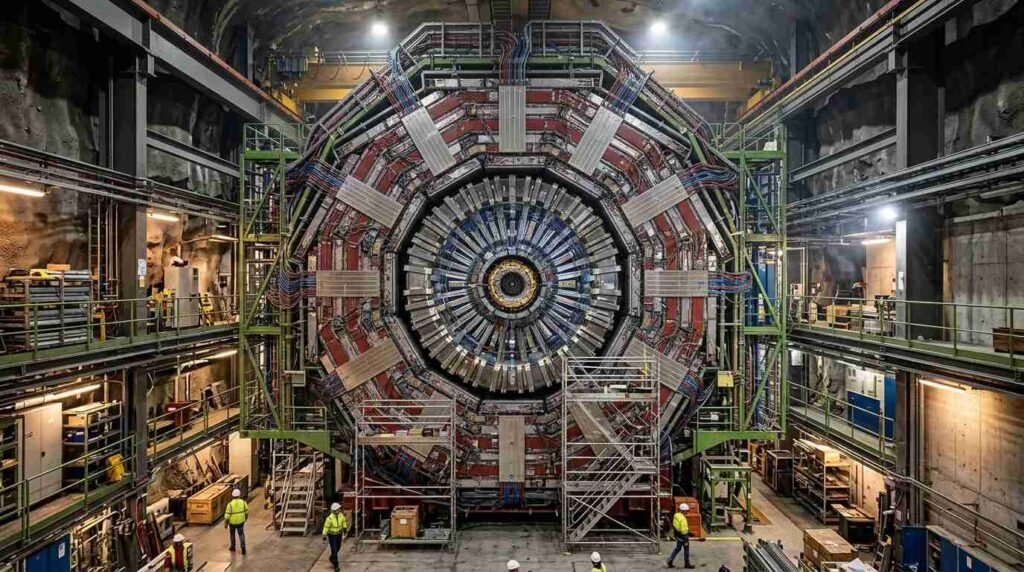
At the LHC, lead nuclei collide at close to the speed of light. In this analysis the collision energy is 5.02 teraelectronvolts per nucleon pair. The resulting fireball is a few femtometres across and lives for on the order of 10-23 seconds. (The press summary I read gives a far longer lifetime for the droplets; I did not carry that figure over, because it disagrees with the standard estimate.) Two decades of heavy-ion data show that this matter flows collectively with remarkably little internal friction, which is why it gets called a liquid rather than a gas of quarks.
Why a Fast Quark Should Leave a Wake
A quark or gluon created in the first instant of a collision, carrying a lot of momentum, has to cross the plasma on its way out. Along the way it loses energy to the medium, an effect known as jet quenching. If the medium behaves like a fluid, that deposited energy and momentum do not simply vanish. The fluid carries them off as collective motion: ripples, flow and a trailing disturbance, much like water behind a moving boat.
Fluid dynamics gives a concrete picture. A body moving faster than the speed of sound in a medium drives a conical shock front, a Mach cone, whose half-angle follows cosθ = cs/v. For an ideal gas of massless particles the sound speed squared is one third of the speed of light squared, which puts the cone at about 55 degrees to the direction of travel. That figure is a textbook estimate from my own arithmetic and not a result of the CMS paper. A real plasma expands, cools and diffuses, so the actual pattern is smeared and shifted.
A hybrid model developed by MIT’s Krishna Rajagopal predicts such wakes. As I understand it, the model mixes strongly coupled fluid response with weakly coupled high-momentum parton physics. According to the coverage, CMS’s observations match its predictions. Rajagopal was not directly involved in the measurement.
The Measurement Problem: Wakes Overlap
Hard collisions produce partons in back-to-back pairs. Each one drives its own wake, and the two disturbances overlap in the same expanding fireball. Earlier searches that looked for quark-antiquark pairs ran into exactly that problem: the second parton’s wake contaminates the first one’s. Add the plasma’s own thermal and flow background, which dwarfs any single wake, and isolating the signal becomes difficult.
The CMS team sidestepped it by choosing a different partner. Collisions can produce a Z boson recoiling against a quark or gluon. The Z is an electroweak particle. It does not feel the strong force, so it passes through the plasma undisturbed. It then decays to a pair of leptons, which also ignore the plasma. Reconstructing the Z from those leptons gives a clean measure of the recoiling parton’s direction and energy at the moment of creation. Any disturbance on the opposite side must come from one parton alone.
Why Tag With a Z and Not Something Else
Isolated photons are the other classic choice. They too skip the strong force, and photon-tagged jets have been used for years to study energy loss. The Z offers a different advantage: it announces itself through a clean lepton-pair mass peak near 91 GeV, which makes it easy to identify and very hard to fake. The trade-off is rate. Z bosons turn up less often than photons at comparable momentum, which is why the final sample is small. I have not checked how the CMS paper weighs the two options, so treat this as general context and not as the authors’ own reasoning.

What CMS Measured
The analysis compares lead-lead collisions with proton-proton collisions at the same energy. Proton-proton data contain no plasma, so any difference between the two points to the medium. CMS looked at the angular distributions, in pseudorapidity and azimuth, of low-momentum charged hadrons relative to the Z boson’s direction, split by hadron momentum.
| Item | Value from the paper’s abstract |
|---|---|
| Collision system | Lead-lead at 5.02 TeV per nucleon pair |
| Lead-lead data | 2018 run, integrated luminosity 1.67 inverse nanobarns |
| Proton-proton reference | 2017 run, 301 inverse picobarns, same energy |
| Z boson transverse momentum | 40 to 350 GeV |
| Window with significant modification | Charged hadrons with 1 to 2 GeV transverse momentum |
| Publication | Physics Letters B 874 (2026) 140120; arXiv:2507.09307 |
The 1 to 2 GeV window makes sense physically. Particles knocked loose by a wake are soft, with momenta not far above the plasma’s thermal scale. The abstract reports a significant modification in that range compared with the proton-proton reference and reads it as the first evidence of energy depletion induced by the probe and of the medium’s response to it. The results are described as consistent with a hydrodynamic wake. The finer angular structure sits in the paper’s body, which I did not review in full.
Why the proton-proton reference carries so much weight
A lead-lead collision fills the detector with thousands of soft particles that have nothing to do with the Z. Analyses of this type usually remove that uncorrelated background statistically, for instance by pairing each Z with hadrons from other events, and then compare what remains with the same quantity in proton-proton data. The abstract does not spell out the subtraction used here, so I cannot say which method CMS applied. What matters for a reader is that the claimed modification rides on a background far larger than itself. That is why statistical precision, and not just the physics, limits how much anyone can say.
How Strong Is the Evidence?
CMS chose the word evidence, and that choice is the honest summary. The press release goes further, calling it the first direct evidence of a quark’s wake in the plasma and quoting figures that do not appear in the abstract: about 13 billion heavy-ion collisions analysed and roughly 2,000 events containing a Z boson. Those two numbers fit together. Dividing one by the other shows that only about one collision in 6.5 million supplied a usable Z, which is the normal price of a rare, clean trigger.

A few points deserve weight when reading the claim.
- The statistics are modest. The signal rests on patterns averaged over a couple of thousand tagged events, set against a large soft background from the underlying collision.
- “Consistent with” is not “only explained by.” Matching a hydrodynamic wake model is encouraging. It does not by itself rule out other mechanisms that push extra soft hadrons into the same region.
- The Z assumption is strong and sound. That the Z barely interacts with the plasma is what turns a messy two-parton problem into a one-parton problem.
- More analysis is coming. The authors plan to use additional collision data to find more examples and measure the wake in greater detail.
What Wake Measurements Could Tell Us
If wakes can be measured cleanly, their size, speed, reach and fade time become probes of the plasma. A wake that travels fast and far implies a stiff, low-viscosity medium. One that dies quickly implies strong damping. Those quantities connect directly to the speed of sound and to transport properties such as the ratio of viscosity to entropy density, numbers that theorists have been trying to pin down from first principles and from experiment.
Better statistics will decide how far this can go. More collisions mean more Z-tagged events and finer angular maps. The collider upgrades coming for the LHC, covered in our High-Luminosity LHC teardown, are aimed squarely at that kind of rare-process physics.
Sources and Verification Notes
- CMS Collaboration, arXiv:2507.09307: Evidence of medium response to hard probes using correlations of Z bosons with hadrons in heavy ion collisions
- ScienceDaily: Physicists just saw quarks make waves in the Big Bang’s primordial soup (October 6, 2026; story by MIT News)
Could not verify: I read the arXiv abstract and the press summary, not the full paper, so the detailed angular results are not covered. The 13 billion collisions, the roughly 2,000 Z events and the “direct evidence” wording come from the press summary only. The Mach-cone angle and the droplet lifetime are standard physics estimates, not numbers from the paper.