Mistral Large 4 is a 1T-parameter mixture-of-experts preview with weights promised by month end. The memory and compute math, the self-reported benchmarks, and the open questions.
Mistral Large 4 arrived on October 6, 2026 as a public preview instead of a download. It is a hosted model that Mistral calls open-weight, with the weights themselves promised by the end of the month. The headline figures are about 1 trillion total parameters in a mixture-of-experts design, roughly 50 billion of them active for any one token, and a price list that sits well below what most frontier labs charge. What the preview does not yet include is a license, a published expert count, or a single independent benchmark.
Those gaps make this a good moment for the arithmetic the announcement skips. This article works through what total versus active parameters mean for memory and compute, separates Mistral’s own claims from anything verified, and lists what to check on the day the weights land. Where a figure could not be confirmed, it is labeled that way.
What Mistral announced
The public preview opened through Mistral Studio on October 6, with the weights due by the end of October. Mistral describes the model as a hybrid instruct-and-reasoning mixture-of-experts system that folds instruction following, reasoning and agentic work into one set of weights, trained from scratch on 3,800 Nvidia Grace Blackwell GPUs. It accepts multimodal input. The preview runs on Mistral’s European infrastructure, and the company says a European deployment that it operates end to end will be offered.
Figures differ across Mistral’s own materials and the coverage of the launch: 1 trillion versus 1.05 trillion total parameters, and 49 versus 52 billion active. The documentation page lists a 1.6-billion-parameter vision encoder and a one-million-token context window, which I could only confirm from that page and secondary reports. This article uses roughly 50 billion active as a working number. The arithmetic below barely moves with either figure.
Total versus active parameters: which number controls what
A mixture-of-experts network holds many specialist sub-networks and routes each token to only a few of them. Two different totals follow from that. The active count, the parameters a token actually passes through, sets the compute per token. The total count sets how much memory must be available, because any expert can be called on by any token and so all of them have to be resident.
A common rule of thumb puts the forward-pass cost at about two floating-point operations per active parameter per token. At 50 billion active parameters that is roughly 100 billion operations per token, ignoring attention overhead. The weights, meanwhile, take total parameters multiplied by bytes per parameter:
| Precision | Bytes per parameter | Weights for 1.05T parameters |
|---|---|---|
| BF16 | 2 | about 2.1 TB |
| FP8 | 1 | about 1.05 TB |
| 4-bit | 0.5 | about 0.53 TB |
These are weights only. The key-value cache, activations and quantization overhead come on top, and Mistral has not published the attention design that determines the cache size. For scale, a dense 50-billion-parameter model in BF16 needs about 100 GB. The sparse model therefore does the per-token work of a mid-sized dense network while asking for roughly twenty times the weight memory.
Why serving a sparse model is still hard
Sparsity pays off in compute and pays off less in bandwidth. For a single request, only the chosen experts are read from memory for each token. Once many requests are batched together, different tokens select different experts, and a large batch ends up touching most of them. Weight reads then look much closer to those of a dense trillion-parameter model.
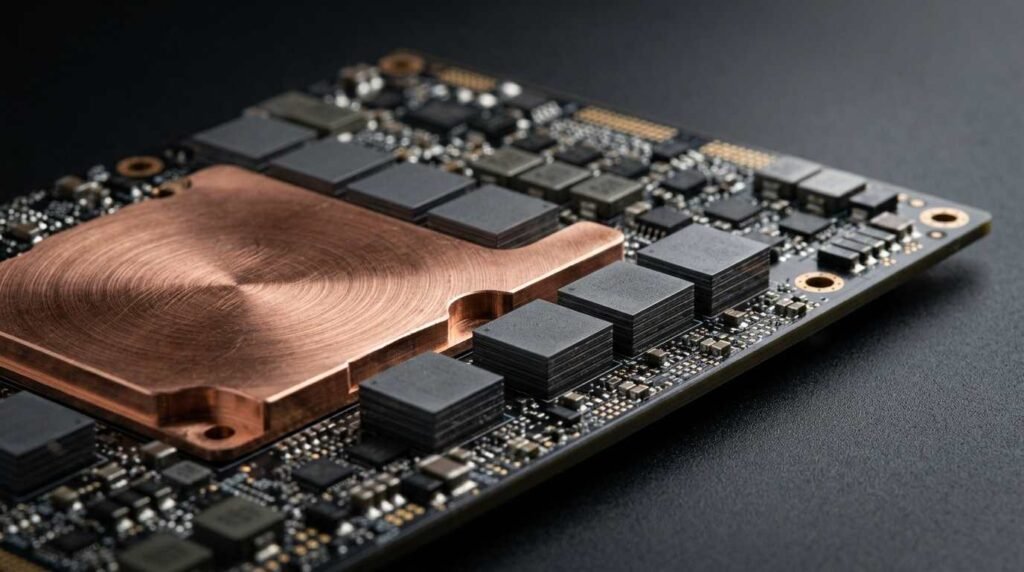
The second cost is communication. Spreading experts across accelerators, known as expert parallelism, means tokens must travel to wherever their experts live and travel back. That all-to-all traffic puts pressure on the interconnect, and it is one reason serving stacks for large mixture-of-experts models are specialized. This is general to the architecture. Mistral has not published its routing scheme, its expert count, or its serving design, so none of it can be attributed to this particular model yet.
A sizing exercise for self-hosting
Planning for a model this size starts with one division: the weights plus headroom, divided by the memory on each accelerator. Take the weight sizes above, add 20 percent for the key-value cache and activations (a placeholder, since Mistral has published no cache figures), and divide by a device’s memory. The two device sizes in the table are examples chosen for illustration, not recommendations or anything Mistral has stated.
| Precision | Weights | With 20% headroom | Devices at 96 GB | Devices at 192 GB |
|---|---|---|---|---|
| BF16 | about 2,100 GB | about 2,520 GB | 27 | 14 |
| FP8 | about 1,050 GB | about 1,260 GB | 14 | 7 |
| 4-bit | about 525 GB | about 630 GB | 7 | 4 |
Real deployments land above these counts. Expert parallelism wants experts spread evenly, the cache grows with context length and concurrent users, and a million-token window would push the headroom well past 20 percent. The table is a floor for budgeting conversations, and it shows why the license and the quantization options will decide whether self-hosting is realistic for a small team.
The benchmarks Mistral published
Every number below was selected and released by Mistral, and none has been reproduced independently. They are best read as a description of where the company chose to compete.
| Evaluation | Reported result |
|---|---|
| DeepSWE v1.1 | 61.7% |
| SWE-Atlas-QnA | 59.4% |
| Terminal-Bench 4 | 28.3% |
| Coding Agent Index | 49.8% |
| AutomationBench | 59.9% |
| AA-Briefcase | 1,393 Elo |
| Dense 200 (vision) | 42%, against 41% for GPT-6 Astra |
| Cybench | 93% |
| Vulnerability reproduce-and-patch test | 82% (Mistral says the highest of any model) |
| Lakera B3 attack resistance | 93.3% |
| KORA | 1.691 out of 2 |
One result stands apart. In a human coding evaluation run by Surge AI, Mistral reports a score of 3.74, placing the model second of five, behind Claude Opus 5 at 4.22. A human-rated comparison that does not put the vendor first is a more useful signal than a leaderboard it picked itself, though the figure still reaches readers through Mistral’s own page.
How to read a vendor’s benchmark table
A table like the one above is easier to judge with a few questions in hand. Who ran the evaluation, the vendor or a third party? Which version of the benchmark was used? Both DeepSWE v1.1 and Terminal-Bench 4 carry version labels, and scores do not transfer between versions. Was the model run once or averaged over several attempts, with what reasoning effort and tool access? And did the vendor compare against competitors under the same harness, or quote their published numbers from elsewhere?
None of those answers appear in the figures Mistral released, which is normal for a launch and exactly why a self-reported table works as a hint instead of a verdict. The useful move is to pick the two or three rows closest to your own workload and rebuild them with your data.
Pricing, and why the announcement and the docs disagree
The announcement lists $1.36 per million input tokens and $4.18 per million output tokens. The API documentation shows $0.68 for input, $0.07 for cached input and $2.09 for output, with the $1.36, $0.14 and $4.18 figures marked as the earlier prices. In other words the docs present a sale at half the list price and do not say when it ends.
A workload of 100 million input tokens and 20 million output tokens in a month makes the gap concrete. At the announced prices it comes to $136 plus $83.60, or $219.60. At the documentation’s current figures it is $68 plus $41.80, or $109.80. Budget against the higher number until the pricing page says otherwise.
Open-weight, but not downloadable yet
Weights are promised by the end of October, and the documentation’s weights section reportedly still reads “coming soon.” The license has not been published. That matters more than the label suggests. Open-weight says the files can be downloaded, and nothing more. Commercial use, redistribution and fine-tuning rights all depend on the license text, and Mistral’s earlier releases have mixed permissive and restricted terms.
When the files do appear, the first things worth checking are the license, the expert count and top-k routing setting, whether the parameter counts finally reconcile at 49 or 52 billion active, the tokenizer, the context length the weights actually support, which quantized formats ship, and whether the downloadable model behaves like the preview.
What remains unpublished
The list of missing details is long enough to matter. There is no license. There is no confirmed expert count or routing setting, and no reconciliation of the 49 versus 52 billion active-parameter figures. Training duration and token count are absent, so the compute behind the 3,800-GPU run cannot be estimated. The documentation lists a one-million-token context, but maximum output length and long-context accuracy have no published figures. Finally, it is not yet established that the downloadable weights will match the preview, a question that applies to any model released in stages.
What to do this week
If you are evaluating it, run your own task set against the preview through the API, using the mistral-large-4 model name, and compare the results with whatever you use today. Public benchmarks will not tell you how it handles your prompts. Hold off on hardware purchases until the license and weights exist, and use the memory table above to size a budget in the meantime. Teams with data residency requirements should note the European hosting option, then confirm the terms directly with Mistral.
Frequently asked questions
Is Mistral Large 4 open source? Mistral calls it open-weight. As of October 7 the weights are unreleased and the license is unpublished, so the open-source question cannot be answered yet.
How many parameters does it use per token? Sources give 49 billion and 52 billion. Mistral’s documentation lists 52 billion active out of 1.05 trillion total.
Could it run on a single machine? Not an ordinary one. Even at 4-bit precision the weights alone come to roughly half a terabyte by the arithmetic above, before cache and activations.
Sources
- Mistral AI, Mistral Large 4 announcement, October 6, 2026
- Mistral AI documentation, Mistral Large 4 model page
- Let’s Data Science, Mistral opens public preview of Large 4, with weight release planned later this month
- Braindetox, Reading the Mistral Large 4 public preview: specs, pricing and self-reported benchmarks before the weights arrive