






CERN has begun dismantling the LHC for the High-Luminosity upgrade. A part-by-part look at the schedule, the 30-tonne absorbers, and the magnets going in.
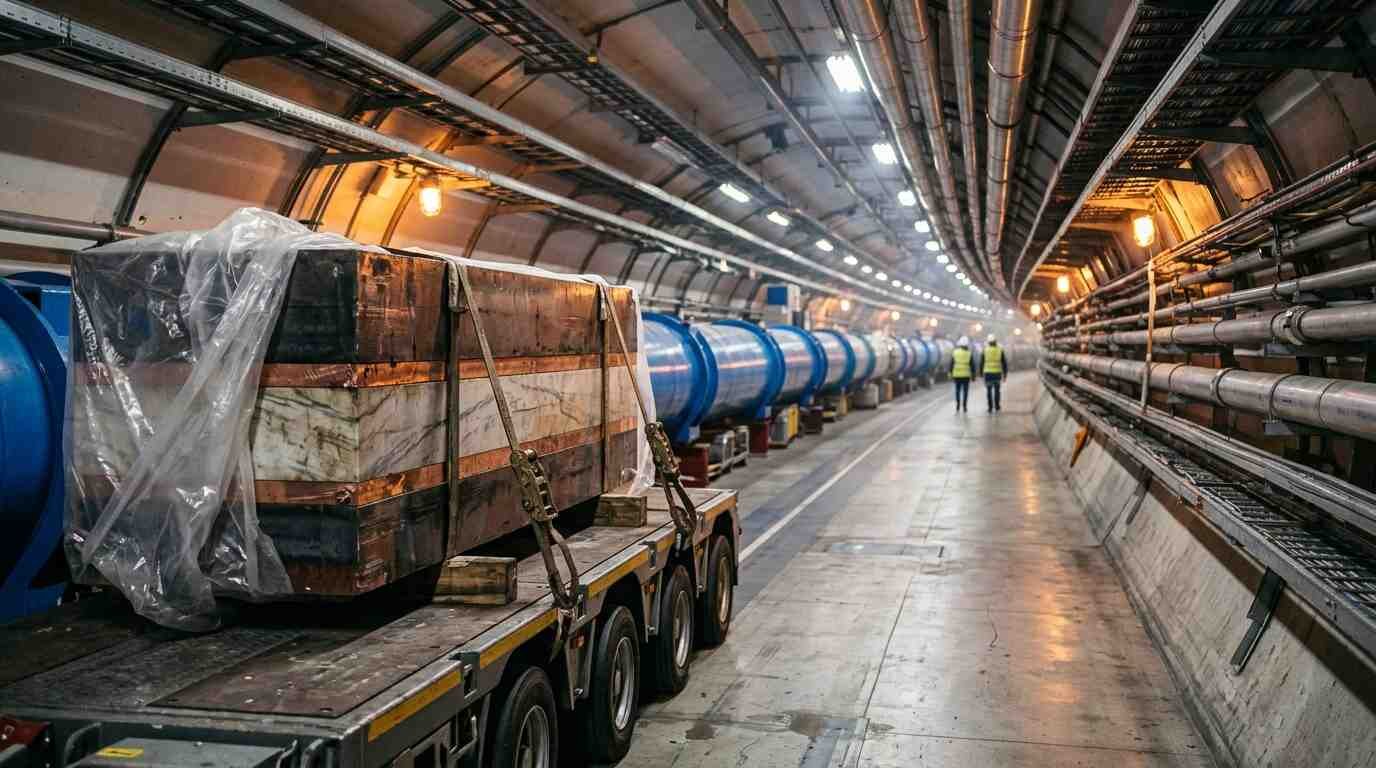
The first big pieces to leave the Large Hadron Collider’s tunnel were two absorbers of iron, copper and marble, each about five metres long and 30 tonnes heavy. CERN reports that the trip from near the ATLAS experiment to the ALICE cavern, roughly three kilometres, took about eight hours apiece.
A 30-tonne bridge crane then hoisted each block some 100 metres to the surface. It was a quiet milestone for a machine that, as recently as June, was still colliding protons at 13.6 TeV.
What comes next is not a repair job. CERN is converting about 1.2 kilometres of the ring into the High-Luminosity LHC, and the work will occupy the tunnel for roughly four years. Below is the schedule, the first removals, and the hardware going in, with the sourced numbers kept apart from the engineering context around them.
A Four-Year Schedule, Mapped
The stages are public, though the dates have already moved once. As Science Times reports, the CERN Council revised the plan in late 2024, which pushed back the start of the shutdown and stretched its length slightly.
| When | What happened or is planned |
|---|---|
| End of June 2026 | Final physics beams in the LHC |
| Early July 2026 | Long Shutdown 3 (LS3) formally begins |
| 31 August 2026 | Injector complex and Antimatter Factory deliver their last beams, ending Run 3 |
| 2 September 2026 | CERN reports the first two beam absorbers removed; two more due within weeks |
| From 2028 | Injectors and facilities restart in stages |
| 2029 | New absorbers installed in the HL-LHC |
| Mid-2030 | HL-LHC restarts; first operations targeted for June 2030 |
Look at the order of the last rows. The LHC wakes last. Every machine upstream, the chain that accelerates protons stage by stage before they enter the big ring, comes back first, which leaves roughly two years between the first injector restarts and the collider’s own.
The First Pieces Out: Two Absorbers and a Crowded Tunnel
CERN calls the removed blocks TAN absorbers and describes them as beam dumps that protect the accelerator’s magnets from neutral particles produced in collisions. The reason they exist is basic electromagnetism. A charged proton bends in a magnetic field; a neutral particle ignores it and flies straight on, leaving the beam pipe and dumping its energy wherever it lands. Superconducting coils tolerate very little stray heat, so something dense has to catch that debris first.
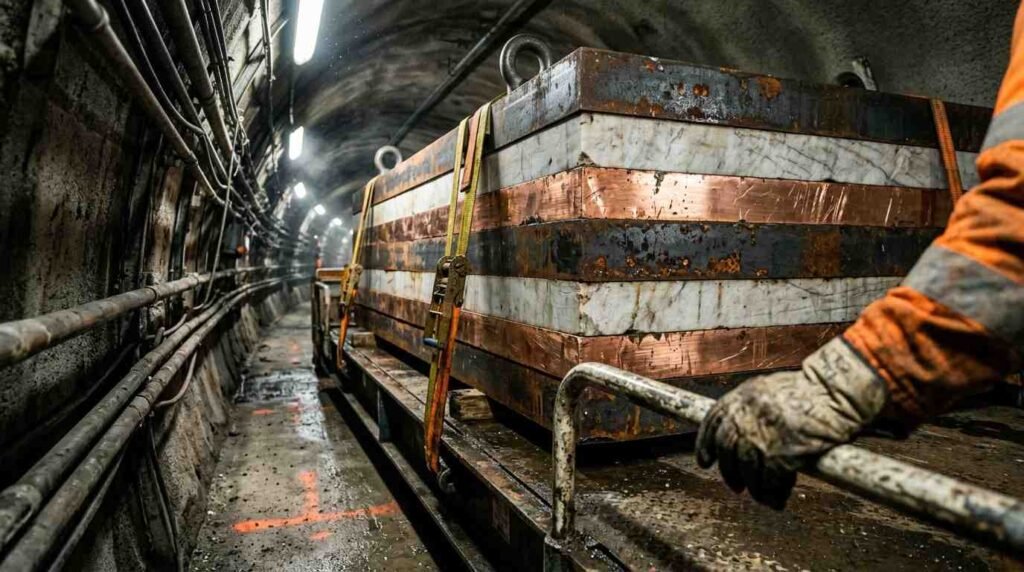
“When they were installed in 2006, the tunnel was almost empty.”Maria Perez Ornedo, who directed the removal project, quoted in CERN’s account of the operation
Two decades of cable trays, cryogenic lines and equipment have grown up around them since, which explains why CERN spent three years preparing for a move that lasted eight hours per block. Two more absorbers are scheduled to come out in the following weeks and be rebuilt with new central sections.
Luminosity: The Number the Whole Project Serves
Every design choice below traces back to one quantity. Luminosity measures how many collisions a collider delivers per unit of area and time, and it connects directly to how often any specific process occurs.
R = L × σ
Double the luminosity, and every process occurs twice as often.
Rare ones, with tiny σ, are the reason to want more.
The LHC’s design peak was 1×1034 collisions per square centimetre per second, a figure from the machine’s original specification. According to the Wikipedia overview of the upgrade, the HL-LHC is expected to reach 5×1034, with headroom to 7.5×1034, and to deliver 3 inverse attobarns to ATLAS and CMS at 14 TeV. In the units physicists use daily, that equals 3,000 inverse femtobarns.
CERN’s own project page puts the goal as a tenfold increase in integrated luminosity beyond the design value. Its headline example: at least 15 million Higgs bosons per year, against around three million from the LHC in 2017.
Volume is the point. Some of the most interesting processes, including the production of Higgs pairs that would reveal how the Higgs boson interacts with itself, are far rarer than single-Higgs events. Piling up statistics is the only way to see them. It is also a very different bet from the one honored in this year’s physics Nobel, where an Antarctic neutrino detector waits for rare arrivals from space; at CERN, physicists manufacture the rare events and filter them from the noise.
The Hardware Swap, Component by Component
Raising luminosity means squeezing the beams tighter at the collision points, tilting them so the bunches overlap fully, and powering all of it without cooking the electronics. The table lists what the sources say about each change.
| Component | Job | Today’s LHC | HL-LHC |
|---|---|---|---|
| Focusing quadrupoles (niobium-tin) | Squeeze beams at the collision points | 8.6 T | 11.3 T |
| Two replacement dipoles | Bend the beam, freeing space for collimators | 8.3 T | 11 T |
| Crab cavities | Tilt bunches so they meet head-on | None | 16 across ATLAS and CMS |
| Superconducting links (magnesium diboride) | Carry current to the magnets | — | About 100,000 A |
Field strengths, cavity counts and current come from the Wikipedia overview cited above; CERN’s project page, which I also checked, does not list them.
Niobium-tin quadrupoles
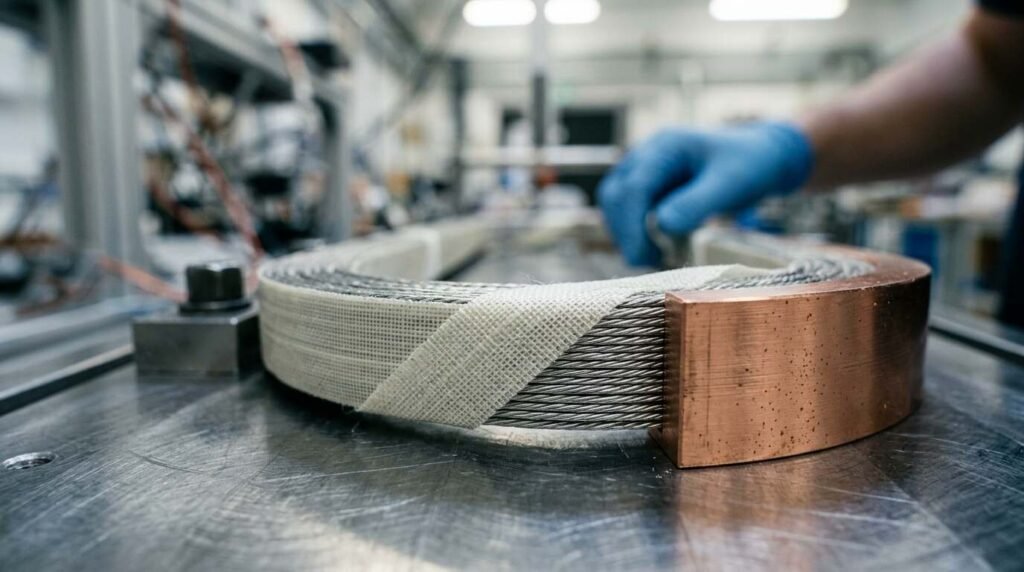
The LHC’s magnets use niobium-titanium, which loses superconductivity once the field climbs much beyond the LHC’s working range. Niobium-tin tolerates higher fields, so a quadrupole built from it can focus harder. The cost is mechanical. The compound is brittle, and the coil must receive a high-temperature heat treatment after winding, which makes every magnet a delicate piece of manufacturing. The Wikipedia overview says the quadrupoles were in series production as of 2025, with about two-thirds of the coils completed and half the magnets assembled, and credits a ten-year joint effort among CERN, Brookhaven, Fermilab and Lawrence Berkeley National Laboratory for the groundwork.
Video: “HiLumi LHC: full-scale tests start,” on the HL-LHC test programme.
Crab cavities
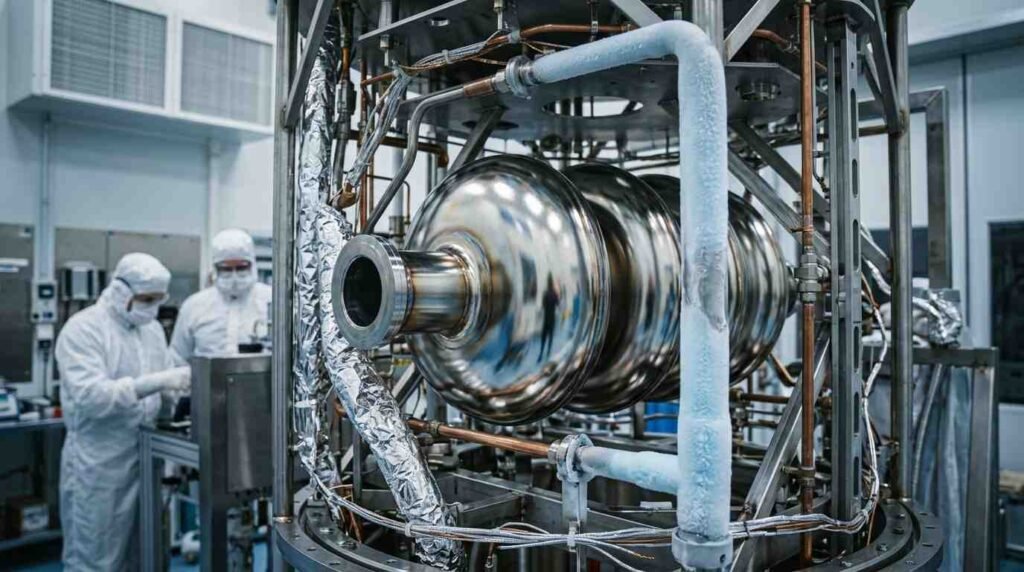
Two beams cannot meet perfectly head-on, because stray extra collisions would occur on either side of the intended point. They cross at a small angle instead, and that angle shrinks the overlap between bunches. Crab cavities fix this by giving each bunch a sideways kick that tilts it, so the two meet face to face at the collision point and straighten out again afterwards. In the overview’s words, the effect is to maximize overlap and push achievable instantaneous luminosity higher.
Magnesium diboride links
Currents near 100,000 amperes have to reach the new magnets. Superconducting links of magnesium diboride carry them, with no resistive heating along the way. The sources I found do not spell out where the links run or how the power converters are arranged, so I will not guess at the layout. The point stands: the rebuild covers the electrical plumbing as well as the magnets it feeds.
Where the Schedule Could Slip
No source I read puts a number on schedule risk, so treat this section as engineering common sense rather than a forecast. The plan has already been adjusted once. Niobium-tin magnets, as noted, are demanding to manufacture, and series production only recently reached its midpoint. And about 1.2 kilometres of a working tunnel will be stripped and refilled in about four years, while experiments, injectors and ancillary facilities such as ISOLDE and the fixed-target areas undergo renovation in parallel.
CERN itself describes LS3 as the most extensive intervention on its accelerator complex since the LHC was first built. Everything is large, and everything has to fit.
What Physicists Do While the Ring Sleeps
Analysis never stops. Science Times notes that researchers will keep working through the datasets from Runs 1 to 3, and CERN says the final data sets will inform the Run 4 plans and the LS3 programme. ScienceDaily’s physics feed marked the start of the magnet swap on September 25 with a headline noting that CERN had begun disconnecting the collider.
The detectors get their own upgrade. Science Times says the experiments are receiving new subdetectors and upgraded data-acquisition systems, the electronics that decide in microseconds which collisions to keep.
Frequently Asked Questions
Is the LHC shut down permanently?
No. LS3 converts it into the High-Luminosity LHC, with first operations targeted for June 2030.
When do the injectors and other CERN machines run again?
CERN says the complex begins returning to operation from 2028, with the HL-LHC the last to restart.
Why replace magnets that are less than twenty years old?
Because the new triplet magnets focus the beams harder than the old ones can, and focusing is what raises luminosity. The old absorbers are being rebuilt for similar reasons: the collision rate they must withstand goes up.
What does “inverse femtobarn” mean?
It is the unit for integrated luminosity. Multiply it by a process’s cross-section in femtobarns and you get the expected number of such events in the dataset.
Figures labelled as general context (the 13.6 TeV Run 3 energy and the 1×1034 design luminosity) come from background knowledge of the LHC rather than the articles linked here. Verify before quoting them elsewhere.
Sources
- CERN: All CERN accelerators now on the road to HiLumi (31 August 2026)
- CERN: Exceptional transport operations to make way for HiLumi LHC (2 September 2026)
- CERN: High-Luminosity LHC project page
- Science Times: Large Hadron Collider waves goodbye as it enters Long Shutdown 3 (6 July 2026)
- Wikipedia: High Luminosity Large Hadron Collider
- ScienceDaily: Physics news feed (September 25, 2026 headline)


4 Comments