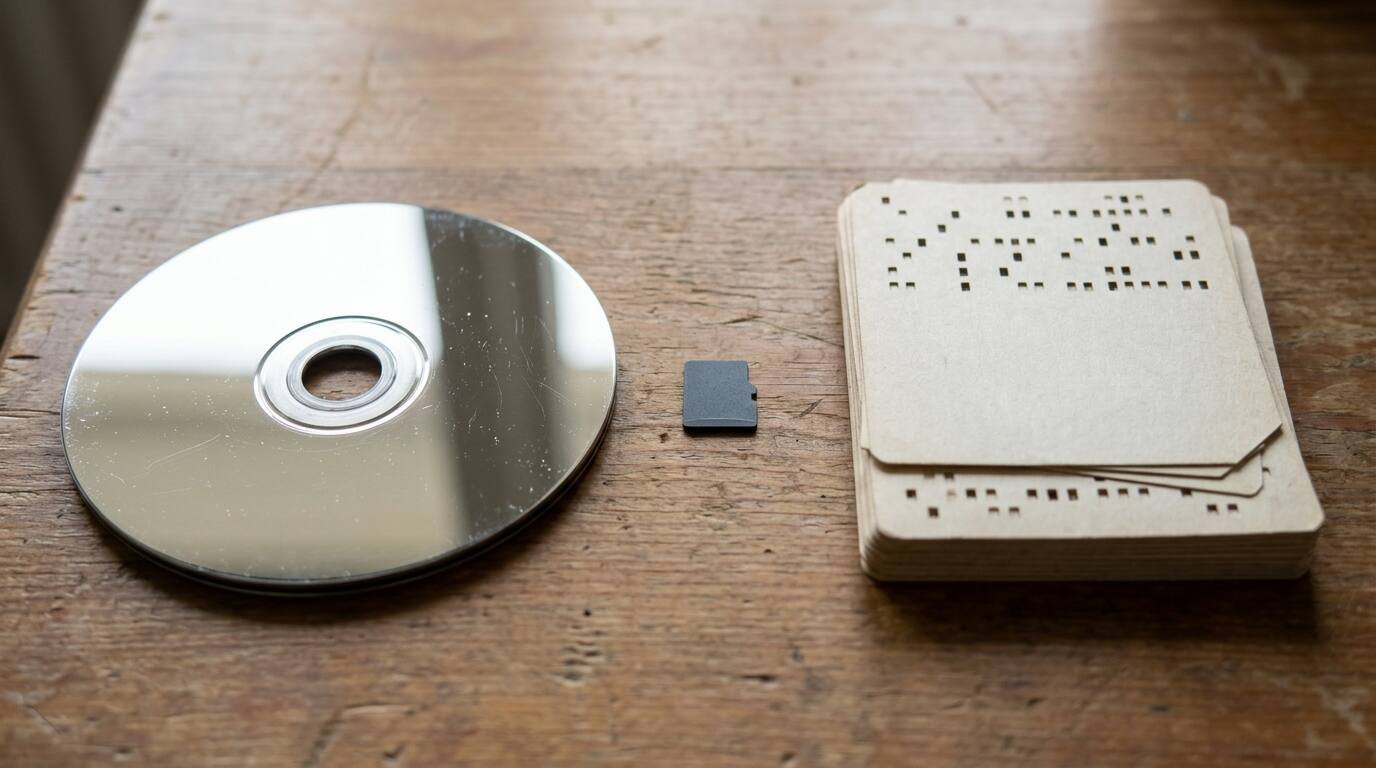
Punched cards, drums, hard disks, floppies, flash, tape and the cloud: how each stage worked, what replaced it, and what experimental DNA storage promises.
The way people keep information has changed so often that the story of how data storage evolved reads like a list of obituaries: punched cards, drums, floppy disks, each declared dead and each, in its time, the best option available. Yet the pattern is not simple replacement. Several of these technologies are still working today in places most users never see. This article follows the line from card decks to cloud servers, notes where sources disagree, and looks at the experimental ideas that might come next.
How did storage start before computers?
Long before electronics, information was stored as holes in stiff paper. Joseph Marie Jacquard demonstrated a loom in 1804 that was controlled by punched cards linked in a chain of any length, so a pattern could be woven again and again from the same set of cards.
The idea moved to data by the 1890 US census, for which Herman Hollerith developed punched-card processing using cards with round holes, 12 rows, and 24 columns. In 1928 IBM introduced the 80-column card with rectangular holes, which became the familiar format. Two years later, the card was changed to 12 rows.
A card held very little. One reference gives the figure for a binary card image on IBM readers as 160 eight-bit bytes, a few lines of text by modern standards. What cards did well was feed machines in bulk. A program or a database was literally a stack of paper you could drop.
What replaced punched cards?
Magnetic media took over in stages. Magnetic tape gradually replaced cards as the main data storage medium during the 1960s. Cards lingered as an input method, for entering data and programs, until the mid-1980s, when cheap magnetic disks and interactive terminals made them obsolete for that job as well.
Inside early computers, working memory came from rotating magnetic drums. By 1954 these unreliable early methods were mostly replaced by magnetic-core memory, which stayed dominant until the 1970s. Core memory used tiny magnetised rings threaded by hand-strung wires, and it kept its contents when the power went off.
Tape also found a role that has survived to the present. The distinction between fast storage for work in progress and cheap storage for everything else has run through computing ever since.
What was the first hard disk?
IBM announced the 305 RAMAC in 1956 with its 350 disk file, which used fifty 24-inch platters. The unit held five million 6-bit characters, about 3.75 megabytes, and took just under a second on average to reach a given piece of data. Shipments began in 1957. By the standards of the time this random-access ability was the revolution: you could jump to a record without winding through a reel.
Capacity grew by stages. IBM’s 3340 “Winchester” drive of 1973 used low-mass heads and lubricated platters, with data modules of 35 or 70 megabytes. The name came from the Winchester 30-30 rifle, and the basic design stayed standard for decades. In 1980 Seagate’s first 5.25-inch drive, the ST-506, held 5 megabytes, weighed 5 pounds, and cost $1,500, which put disks on personal computers. Consumer drives reached 500 megabytes to 1 gigabyte by the mid-1990s.
Later steps changed how the bits were laid out. The first perpendicular recording drive shipped in 2005, from Toshiba, and Samsung reached 1 terabyte on a single 3.5-inch platter in 2011. Seagate claims the first shipped shingled recording drives in 2013. The latest method, heat-assisted magnetic recording, delivered 20-terabyte drives in January 2021, with 32 terabytes in 2024 and 36 in 2025. By March 2026 the largest hard drive on the list I consulted was 44 terabytes.
Why did floppy disks matter, and why did they vanish?
A hard disk lived inside the machine. The floppy let people carry data between machines. IBM’s first commercial floppies in 1971 were eight inches across, and the earliest read-only version held about 82 kilobytes; later 8-inch versions reached 1.2 megabytes. Shugart Associates introduced the 5.25-inch drive in 1976, and the common PC version stored 360 kilobytes.
The 3.5-inch format outsold its larger rival by 1988, and its high-density version at 1.44 megabytes, first shipped in 1986, became the most popular. Then the decline was fast. The 1998 iMac shipped with a CD-ROM drive and no floppy drive. By January 2007, only 2 percent of computers sold in stores had a built-in floppy drive, and Sony ended domestic sales of its 3.5-inch models in March 2011.
Optical discs such as CDs and DVDs filled part of the gap for a while; I could not verify their dates in the sources I used, so I leave them out. Flash took over the rest.
When did flash memory change things?
Fujio Masuoka invented flash memory at Toshiba in 1980, and the company began marketing it in 1987. His team presented the NOR design in 1984 and the NAND design at a conference in 1987. Intel introduced the first commercial NOR chip in 1988. NAND, which is denser and cheaper per bit, underlies USB sticks, memory cards, and the storage in most smartphones. SmartMedia, the first NAND-based removable card, appeared in 1995.
Solid-state drives built from NAND arrived on laptops in the 2000s. As early as 2006, notebook and desktop makers began offering flash-based drives as defaults or alternatives to hard disks. Apple offered one in the first MacBook Air in 2008, and the source says all models shipped with them from 2010. By 2020 SSDs had become cheap enough to compete with hard disks at most consumers’ capacities.
Flash is not magic. Each cell wears out after a limited number of program-erase cycles: roughly 50,000 to 100,000 for single-level cells, about 1,000 for triple-level, and 100 to 1,500 for the densest 3D quad-level type. Controllers spread the wear around to extend life. Manufacturers also solved the density problem by building upward: Samsung commercialised 3D NAND in 2013 with 24 layers.
Is magnetic tape really still used?
Yes, and not out of nostalgia. The Linear Tape-Open format debuted in 2000, and the LTO-9 generation, released in September 2021, held 18 terabytes per cartridge uncompressed. LTO-10 followed with 30 terabytes in May 2025 and a 40-terabyte version in January 2026.
The case for tape is cost and durability for data that is rarely touched. It has a lower cost per terabyte than disk or flash, it needs far less electricity per terabyte, and LTO is designed for 15 to 30 years of archival storage. A cartridge sitting on a shelf uses no power at all. Disks and flash win on speed. Hard drive production, for its part, fell from roughly 650 million units a year at the 2010 peak to about 276 million in 2018, while tape stayed in its archival niche.
What is the cloud, in storage terms?
The cloud is storage you reach over a network, run by a provider that owns the physical machines. The idea is older than the name. In 1983 CompuServe gave consumers a small amount of disk space for uploaded files, and in 1994 AT&T launched PersonaLink Services, among the first all-web storage offerings. Amazon Web Services introduced Amazon S3 in 2006, and it became a base for services such as Dropbox. Box announced its business file-sharing service in 2009.
Under the hood, cloud storage comes in three forms: object storage (such as S3), file storage, and block storage used for databases. Data is copied across machines, so a failed drive does not lose it. The costs are not necessarily lower than owning hardware; the reference I consulted notes that the model moves them to operating expenses, billed on use.
Tradeoffs are real. Outsourced storage widens the attack surface, concentrates valuable data in a few targets, and can be slower than local disks. Large data centres also draw significant power, and some countries are expanding generation to match.
What comes after the cloud?
Most proposals are still experimental, so what follows is a description of research and not a prediction. DNA is the leading oddity. Researchers reported in 2012 that about 5.5 petabits could fit in each cubic millimetre of DNA, and in 2017 a method called DNA Fountain reached 215 petabytes per gram. In 2018, researchers at the University of Washington and Microsoft stored and retrieved about 200 megabytes with random access. The English-language Wikipedia, 16 gigabytes, was reported encoded in synthetic DNA in 2019.
The obstacles are cost and speed. The 2017 experiment cost about $7,000 to write 2 megabytes and about $2,000 to read it back. A 2021 DNA writer reached 1 megabit per second. One group has claimed that DNA data could remain readable for billions of years; that is the claim of an organisation promoting the idea, not a tested result.
Holographic storage, which records data in crystals or photopolymers, is another long-standing concept. I found no reliable dates or figures for it, so I leave it as a name only.
Common questions
How much did the first hard drive hold?
The IBM 350 disk file of 1956 held about 3.75 megabytes, on fifty 24-inch platters.
Why did floppy disks disappear?
They were too small and too slow for growing file sizes, and USB flash drives and networks did the same job better. Apple’s 1998 iMac was among the first mainstream computers to omit the drive.
Are hard drives obsolete?
Not yet. SSDs compete at consumer capacities, but hard drives remain in use at large capacities, with 36-terabyte models shipping in 2025, according to the sources I consulted.
Is the cloud just someone else’s computer?
That is a fair shorthand. Your files sit on machines owned by a provider, replicated across several of them. The difference from your own computer is scale, redundancy, and access over a network.
Will DNA storage replace hard drives?
Not soon. Density is extraordinary, but writing and reading are expensive and slow. Current uses are experiments.
What to remember
Storage has followed two lines at once: physical media got denser and cheaper, and the place data lives moved from a device you hold to services you reach. Punched cards gave way to tape and drums in the 1960s, the RAMAC introduced random-access disks in 1956, flash arrived in the 1980s and took over portable devices, and S3 in 2006 made rented storage ordinary. Older technologies rarely vanish outright. Tape remains the thrifty choice for archives, and disks hold the bulk of what is stored. DNA and other new media are interesting, but their costs keep them in the laboratory for now.
Sources