Fervo Energy declared its first 33 MW Cape Station block in commercial operation on September 30. The schedule, the buyers, the horizontal-drilling approach, the arithmetic on output, and the figures the company has not disclosed.
Enhanced geothermal reached commercial operation on September 30, when Fervo Energy declared the first 33 MW block of its Cape Station in Beaver County, Utah, in service one day ahead of its contractual date. Fervo says the first block took 23 months to build and expects future blocks to take as little as 18. The plant sells power under a purchase agreement, which separates this milestone from the pilot projects that preceded it.
Most of the detail here traces to Fervo’s own announcements as reported by TechCrunch, Renewable Energy Magazine, Power Engineering and ThinkGeoEnergy. None of those reports include independent performance data, and the company has not disclosed several basic engineering figures. The sections below separate what is stated from what is claimed.
- Output: the first of three 33 MW GeoBlocks, part of a roughly 100 MW Phase I, with a further 400 MW under construction for 2028.
- Dates: grid synchronization on September 24, commercial operation declared September 30, against a contractual date of October 1. GeoBlocks 2 and 3 are due by January 1, 2027.
- Buyers: Google (396 MW, with an option for about 600 MW more), Shell Energy North America, Southern California Edison and Clean Power Alliance.
- Not disclosed: well depth, reservoir temperature, flow rates, well count and project cost.
What Fervo announced
Per Fervo’s announcement as reported by Renewable Energy Magazine, the first GeoBlock produced 33 MW net, was synchronized to the grid on September 24 and declared commercial on September 30. Revenue now flows under its power purchase agreement. The remaining Phase I blocks are being commissioned, with contractual commercial operation expected by January 1, 2027. A Phase II adding about 400 MW is under construction for 2028.
CEO Tim Latimer said no team had built a project like this anywhere in the world and that Fervo did it ahead of schedule. That is a company statement, and it sits inside a press release.
How enhanced geothermal works, as described
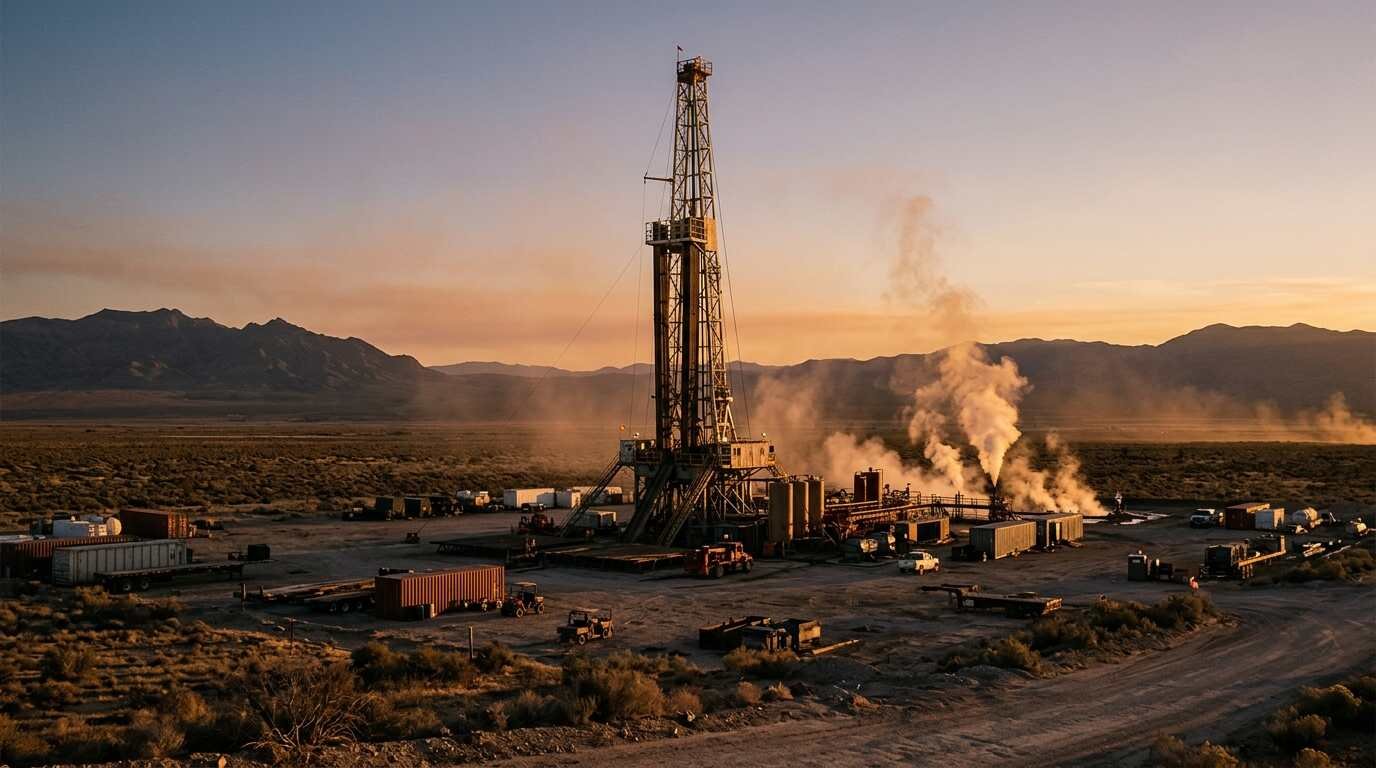
Conventional geothermal depends on a naturally occurring reservoir of hot water or steam, which limits where plants can go. Enhanced geothermal does not rely on one. As Power Engineering describes it, water is injected into hot underground rock and then recovered as heated water to generate power. Fervo uses horizontal drilling methods adapted from oil and gas, with multiple wells drilled from a single pad.

Deeper rock is hotter, so enhanced systems can drill deeper than traditional geothermal, as TechCrunch notes. The fully developed Cape site would cover about 631 acres, including 148 acres of public land, per Power Engineering.
The schedule in dates
| Date | Event | Reported by |
|---|---|---|
| May 2026 | Fervo initial public offering, which TechCrunch says raised $1.9 billion | TechCrunch |
| September 2026 | Google power purchase agreement of 396 MW announced | Power Engineering, ThinkGeoEnergy |
| September 24, 2026 | GeoBlock 1 reaches first power and grid synchronization | Renewable Energy Magazine |
| September 30, 2026 | Commercial operation declared, one day before the October 1 contractual date | Renewable Energy Magazine, TechCrunch |
| By January 1, 2027 | Contractual operation date for GeoBlocks 2 and 3 | Renewable Energy Magazine |
| 2028 | About 400 MW Phase II expected | Renewable Energy Magazine |
| June 2030 | Horizon for Google option, nearly 1 GW in total | Power Engineering |
Each date is the company’s schedule. A contractual operation date can slip, and the January 2027 and 2028 entries are expectations, not outcomes.
Who is buying the power
Power Engineering names four buyers. Google’s 396 MW agreement, announced in September 2026, is described by ThinkGeoEnergy as the largest enhanced geothermal agreement signed to date. It carries an option for about 600 MW more, which would bring the total near 1 GW by June 2030. The power is intended for a potential Utah data center, subject to engineering, approval and commercial conditions. Shell Energy North America and Southern California Edison are also named, along with Clean Power Alliance, which added 18 MW to an existing agreement.
Two portfolio figures appear in different reports. Power Engineering puts contracted offtake at about 900 MW. Fervo’s chief financial officer, quoted by Renewable Energy Magazine, says more than 1 GW of binding agreements are signed across the company’s portfolio. The wider number probably covers projects beyond Cape Station, though the articles do not reconcile them explicitly.
What 33 MW means in numbers
Output arithmetic is the part a reader can check. At 100% capacity factor, a 33 MW block would generate about 289 GWh in a year (33 MW times 8,760 hours), and the full 100 MW Phase I about 876 GWh. Actual output will be lower by whatever the plant’s capacity factor falls short of 100%, and Fervo has not published one.
The company equates its roughly 900 MW of contracted offtake to the needs of nearly one million U.S. homes. That works out to 0.9 kW per home, or about 7,900 kWh per home per year if output ran continuously. The homes comparison is Fervo’s framing and is useful mainly as scale.
Is it really the world’s first?
TechCrunch’s headline calls Cape Station the world’s first enhanced geothermal power plant, but the article itself says Fervo is the first enhanced geothermal company to reach this commercial milestone. Power Engineering reports Fervo’s own claim: the first utility-scale, greenfield enhanced geothermal development to reach first power. It also notes that Fervo’s Project Red in Nevada, a commercial pilot, has supplied the grid since 2023 and is tied to a 115 MW agreement with Google and NV Energy from June 2024.
So “first” depends on the definition. Utility-scale, greenfield and commercial are each doing work in that sentence, and earlier pilots exist.
What the reports do not say
No source I read gives well depth, reservoir temperature, flow rates or the number of wells. Project cost is also missing; TechCrunch notes only that Fervo raised more than $1.3 billion as a private startup before its IPO. The grid interconnection details, including the utility and transmission line, are not named either. And the performance claims come from Fervo, with no independent verification in the coverage.
The most telling data will arrive over time: how output holds up as the reservoir cools, and whether the 18-month build target is met on later blocks. Neither can be known from a commissioning announcement.
Why data centers care (analysis)
This is interpretation, not reporting. Data centers want power that runs around the clock, and geothermal output does not depend on weather. That is why Google’s agreement is the headline buyer. Researchers cited by Power Engineering estimate southwest Utah holds more than 10 GW of high-quality geothermal resources, and the article says the Department of Energy’s FORGE research program is expected to benefit the Cape site. If the build times and output hold, enhanced geothermal becomes a firm-power option for regions with hot rock but no natural reservoir. If they do not, it remains a promising pilot-scale technology.
Questions readers ask
How much power does Cape Station produce now?
The first GeoBlock produced 33 MW net, according to Fervo’s announcement. Phase I is about 100 MW across three blocks, with the other two due by January 1, 2027.
Who buys the electricity?
Power Engineering names Google (396 MW, with an option for about 600 MW more), Shell Energy North America, Southern California Edison and Clean Power Alliance.
How does enhanced geothermal differ from conventional geothermal?
It does not depend on a natural hot-water reservoir. Water is injected into hot rock and recovered as heated water, and Fervo uses horizontal drilling adapted from oil and gas.
Has the performance been independently verified?
Not in the coverage I read. The output, schedule and cost-related claims come from Fervo’s own announcements.
Sources
- TechCrunch: World’s first enhanced geothermal power plant completed in just 23 months
- Renewable Energy Magazine: Fervo Energy declares commercial operation at Cape Station
- Power Engineering: Fervo Energy achieves first power at flagship Utah geothermal project
- ThinkGeoEnergy: Fervo Energy reports first power generation at Cape Station