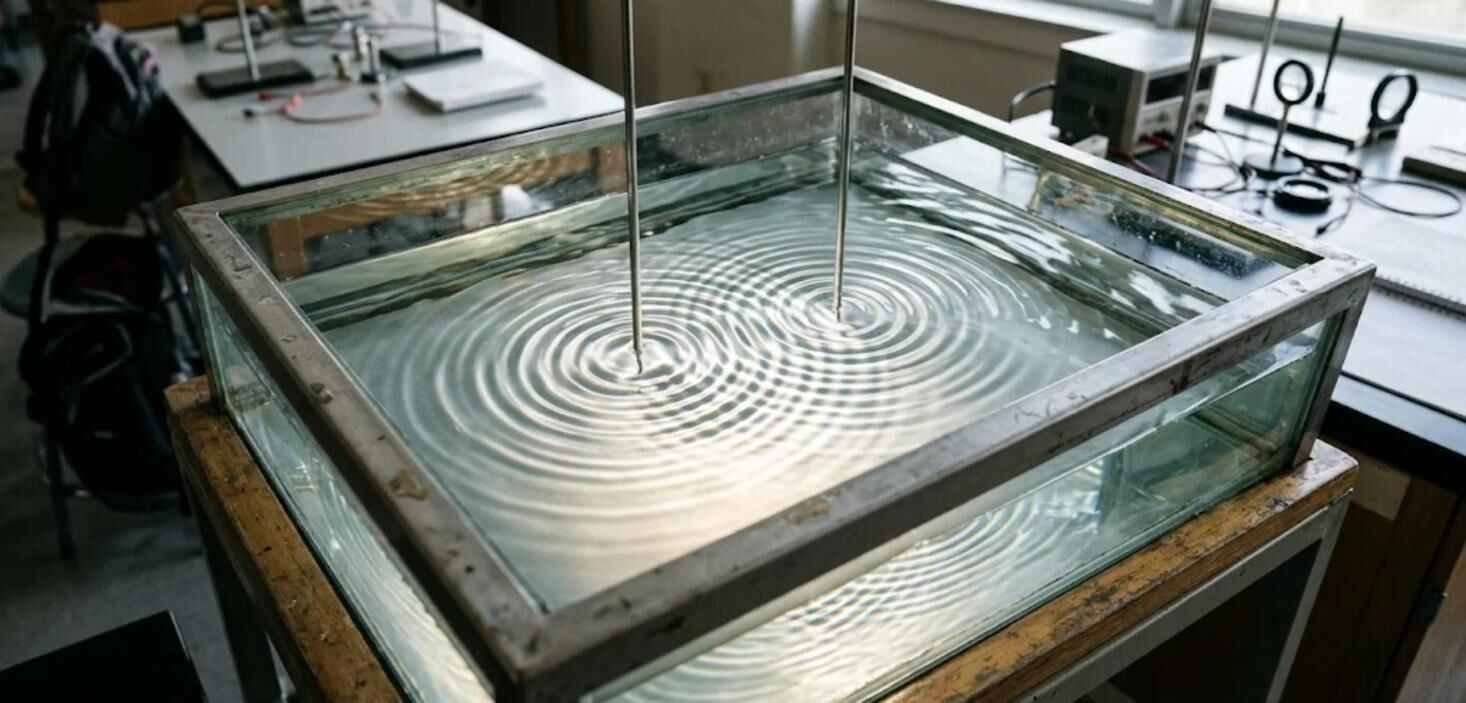
Send a wave at a wall with two narrow gaps and you might expect two bright stripes on the far side, one behind each gap. You get something stranger. You get a whole row of stripes, bright and dark in turn, and the brightest sits in the middle, directly behind the solid wall between the slits.
That pattern is interference. It is the oldest trick in wave physics, and it is also the experiment physicists reach for when they want to say what is odd about quantum mechanics. This post covers both halves, and it comes with a free simulator you can run in your browser: the Double-Slit Wave Tank.
What interference actually is
Waves add. Where two crests arrive together, the water rises higher than either alone. Where a crest meets a trough, they cancel and the surface stays nearly flat. Nothing is lost or created; the energy is just redistributed, piled up in some places and drained from others.
The size of the effect depends only on the path difference, the extra distance one wave travels compared with the other. If the difference is a whole number of wavelengths, the waves arrive in step and reinforce. If it is a half-integer number of wavelengths, they arrive out of step and cancel. Every point on the screen sits at a slightly different path difference, so the screen fills with alternating bright and dark bands.
Why two slits do the trick
A narrow slit acts like a new source. By a rule going back to Huygens, a wave squeezed through a small gap spreads out in a semicircle on the other side, a behaviour called diffraction. Cut two slits close together and you have two matched sources, fed by the same incoming wave, so their ripples keep a fixed phase relationship. That steady relationship is what physicists call coherence, and without it the pattern washes out.
For slits a distance d apart, a screen a distance L away and a wavelength λ, the bright bands are spaced by roughly λL/d when the screen is far away and the angles are small. A worked example: slits 0.5 mm apart, light of 0.6 micrometres, a screen 1 metre back, and the fringes come out about 1.2 mm apart. Wider slit spacing squeezes the fringes together, and longer wavelengths spread them out.

Run it yourself
The simulator below solves the two-dimensional wave equation on a grid. A plane wave enters from the left, hits a barrier with two slits, and the pattern builds up on the dashed screen line at right. The panel on the side plots the time-averaged intensity along that line.
Open the Double-Slit Wave Tank in its own tab, or use its Full screen button.
Three experiments worth trying. Drag the slit separation up and watch the fringes crowd together, then drag the wavelength up and watch them spread. Close one slit with the toggle button and the fringes vanish, leaving one smooth hump from a single diffracting source: two open slits do not simply double the light, they reshape it. Finally, narrow the slit width and notice how the overall envelope widens, because a narrower gap diffracts the wave more.
Now, one particle at a time
Switch the simulator to Particles and it stops painting the wave on the screen and starts dropping single dots. Each dot lands at one spot, and no single dot looks like a wave. Wait a minute and the dots pile into the same fringes.
Be clear about what that mode is. It is not a quantum simulation. The dot positions are drawn at random with probability proportional to the wave intensity the simulator measured on the screen line, which is the same recipe quantum mechanics uses (probability goes with the squared amplitude), borrowed here for illustration. The wave in the simulator is a classical one, like water or sound.

From Young to molecules of 2,000 atoms
Thomas Young presented his wave account of light to the Royal Society in 1801, in a paper titled “On the Theory of Light and Colours.” Historians still debate whether he ran a literal two-slit experiment at the time, but the interference idea he argued for is the one the experiment now stands for.
The strange part came when the same pattern showed up for matter. In 1927, Davisson and Germer, and independently George Paget Thomson and Alexander Reid, showed that electrons produce wave-like diffraction. In 1961 Claus Jönsson at the University of Tübingen sent coherent electron beams through multiple slits, the first such experiment with anything other than light. Readers of Physics World voted the single-electron version the most beautiful experiment in physics in 2002.
The size of what can interfere keeps growing. In 2019 a team led by Markus Arndt at the University of Vienna, working with Marcel Mayor in Basel, reported matter-wave interference of functionalized oligoporphyrin molecules above 25,000 daltons, with up to 2,000 atoms each, published in Nature Physics. That experiment used a Talbot–Lau interferometer, a grating-based cousin of the two-slit setup, rather than two literal slits.
What the simulator gets right, and what it does not
It gets the geometry right: path difference, fringe spacing and the effect of slit width all come out of the physics rather than being drawn by hand. It also shows why closing one slit changes the whole screen.
Its limits are worth stating. The grid is small, so at the default settings the screen sits at a distance comparable to d²/λ, which means it is in the near field and the fringe spacing will not match λL/d exactly. The side walls absorb waves rather than reflect them, with a little leftover reflection. And as above, the particle mode borrows probabilities from a classical wave; it does not model a quantum measurement.

If you like this kind of thing, two other simulators on the site show how simple rules create complicated behaviour: the Gravity Lab for orbits and the Double Pendulum for chaos.
Sources
- Double-slit experiment, Wikipedia (history, Young 1801, Davisson–Germer, Jönsson, Physics World poll, molecule records): en.wikipedia.org/wiki/Double-slit_experiment
- Fein et al., “Quantum superposition of molecules beyond 25 kDa,” Nature Physics 15, 1242–1245 (2019); University of Vienna summary: quantum.univie.ac.at


[…] simulators in this series: double-slit interference, chaos attractors and Orbit […]