






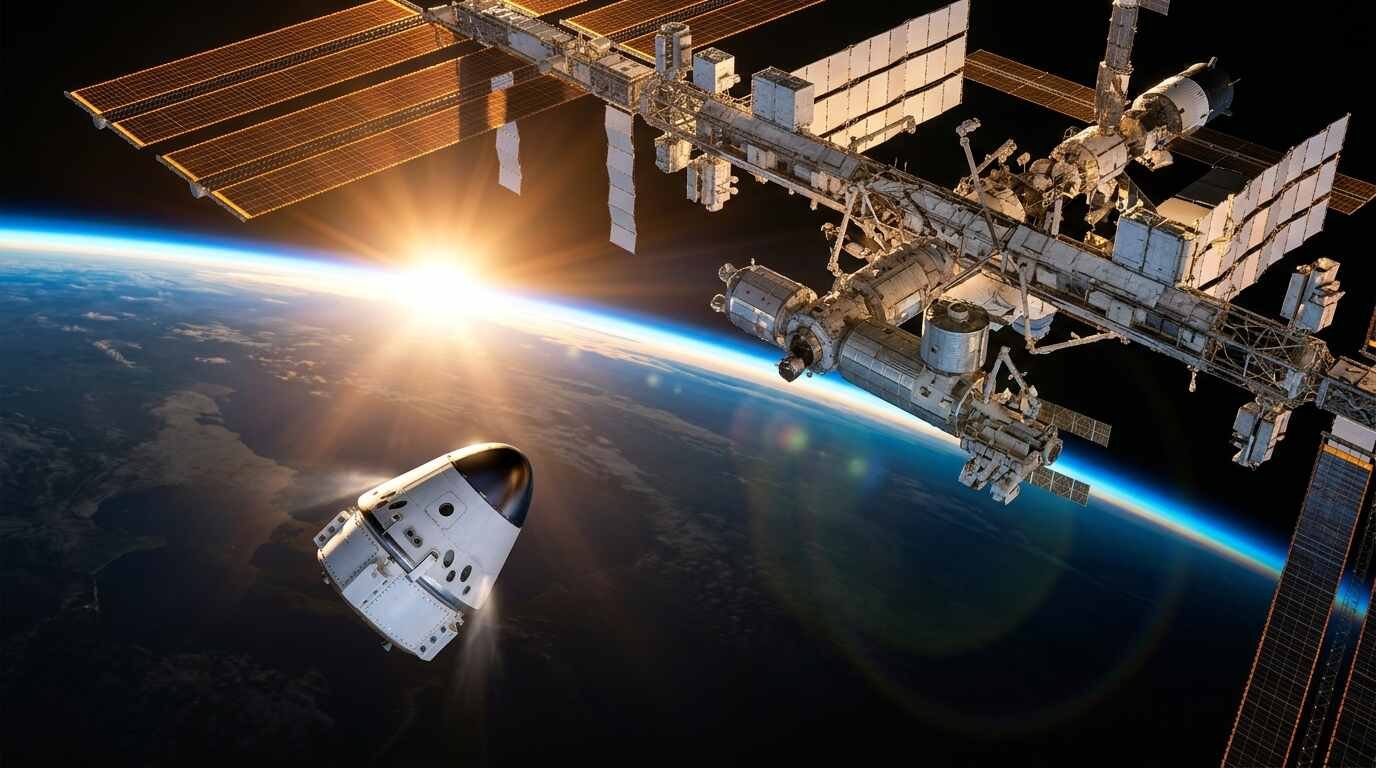
Crew-13 docked with the ISS 7 hours 55 minutes after launch, the fastest arrival by any American spacecraft. The orbital mechanics behind the record, with a worked example.
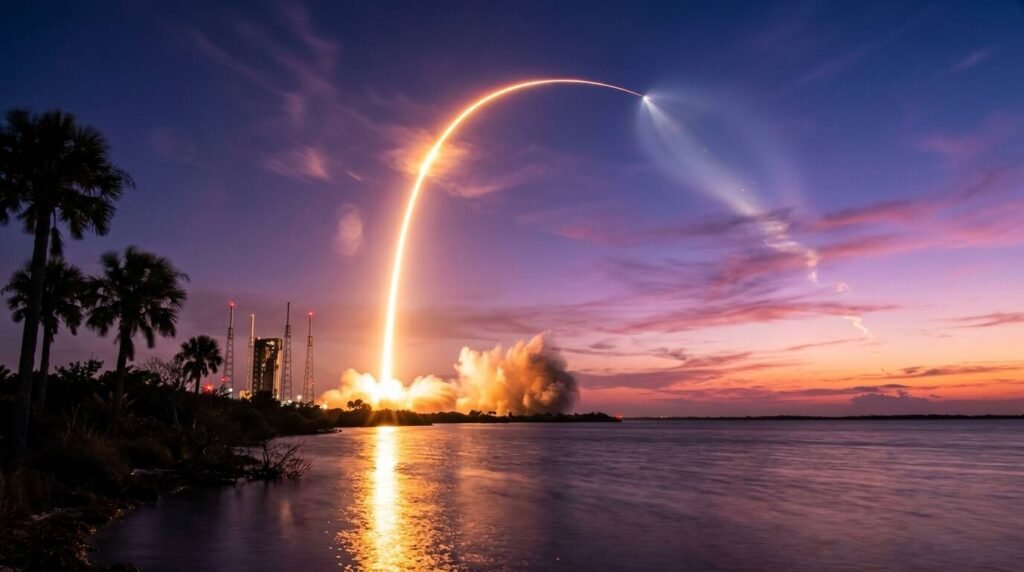
Liftoff came at 11:10 a.m. EDT on 1 October 2026. By 7:05 p.m. the same evening, a SpaceX Crew Dragon named Grace was docked to the International Space Station. Elapsed time: 7 hours and 55 minutes.
NASA officials said it was the fastest any American spacecraft has ever reached the station. The four people aboard, NASA’s Jessica Watkins and Luke Delaney, the Canadian Space Agency’s Joshua Kutryk, and Roscosmos cosmonaut Sergey Teteryatnikov, were beginning a roughly six-month stay.
Speed records invite a boring explanation, something about bigger engines or a bolder flight plan. The real answer is geometry. This piece walks through the mission clock, the physics that decided the timeline, a worked example with stated assumptions, and the limits of what the record actually proves.
The numbers at a glance
| Trip | Time to station | Vehicle and date |
|---|---|---|
| Crew-13 | 7 h 55 min | Crew Dragon Grace, 1 Oct 2026 |
| Previous U.S. record (any U.S. spacecraft) | 12 h 33 min | Dragon cargo capsule on CRS-31, Nov 2024 |
| Previous record for U.S. astronauts | 14 h 43 min | Crew-11, Aug 2025 |
| Fastest ever | 3 h 03 min | Russian Soyuz, May 2020, after two orbits |
These figures come from Space.com’s reporting on the mission. Note the category: the 12 hours 33 minutes record belonged to an uncrewed cargo flight, so NASA’s claim covers any American spacecraft, not only crewed ones.
The mission clock
- Pre-launch. The launch had slipped by about three weeks so engineers could repair a fuel system leak in the Dragon spacecraft, according to Fox 35 Orlando’s report built on AP, NASA, and SpaceX material.
- 11:10 a.m. EDT. A Falcon 9 lifts off from pad 40 at Cape Canaveral Space Force Station, per Spaceflight Now.
- Ascent. Watkins, in command on her second spaceflight, thanked the launch team for an amazing ride after reaching orbit, according to Fox 35.
- Roughly five laps of Earth. Dragon chases the station through a series of rendezvous maneuvers. My arithmetic below suggests about five orbits fit inside the flight time, though no source states the count.
- 7:05 p.m. EDT. Docking, 7 hours 55 minutes after liftoff.
Why the clock ran fast: plane and phase
Rendezvous in orbit is two problems stacked together.
The first is the plane. The station circles Earth in a fixed orbital plane, and Earth rotates beneath it. A rocket can reach that plane only when the launch site slides underneath, which gives a window once a day, give or take. Miss it, and the plane slides away.
The second is phase, meaning where along that orbit the station happens to be when the rocket leaves the pad. The station moves at roughly 28,000 kilometers per hour and completes a lap about every 90 minutes. If it sits close ahead of the launch site’s plane crossing, Dragon starts near its target. If it sits on the far side of the planet, Dragon has a long chase.
SpaceX’s Julianna Scheiman put it plainly at the post-launch press conference, according to Space.com:
“We got lucky this time.”
She added that the station was in an opportune spot and that the trip was close to the fastest it could be. Phasing, in other words, handed the crew a good draw.
A worked example, with assumptions
This section is my own illustration, not Dragon’s actual flight profile, which the sources do not describe.
Orbital period depends on altitude: lower orbits are shorter. Assume the station sits at about 420 kilometers and a chasing spacecraft holds a lower orbit near 300 kilometers. Standard two-body mechanics gives a period of about 92.8 minutes for the station and 90.4 minutes for the chaser.
That 2.4-minute difference per lap sounds trivial. Converted to angle, the chaser gains about 9.5 degrees of orbital phase on every revolution.
Now compare two starting gaps.
- A 30-degree gap closes in a little over three laps, a matter of hours.
- A 180-degree gap, with the station on the opposite side of the planet, takes about 19 laps, which is more than a day.
At 90.4 minutes per lap, the 7 hours 55 minutes of Crew-13 corresponds to about five laps. A real rendezvous also includes burns to raise and trim the orbit, so treat the lap count as an order-of-magnitude guide.
Why Soyuz did it in three hours
The Russian record of 3 hours 3 minutes, set in May 2020 from Baikonur, took only two orbits. Space.com’s reporting says Soyuz is not inherently faster than Dragon. The difference comes mainly from mission-control choices, because Russian planners tend to use aggressive fast-track trajectories.
The trade is rigidity. A fast-track rendezvous needs precise phasing at liftoff, and a delay can forfeit the window and force a longer backup plan. That is the same constraint every crewed mission faces, just accepted more often.
For an explainer on how mission control chooses these trajectories, Space.com linked the video below from its own coverage.
The anatomy of a rendezvous
Whatever the total time, every approach to the station moves through the same stages. This outline describes the general sequence rather than Crew-13’s specific burn schedule, which the sources do not publish.
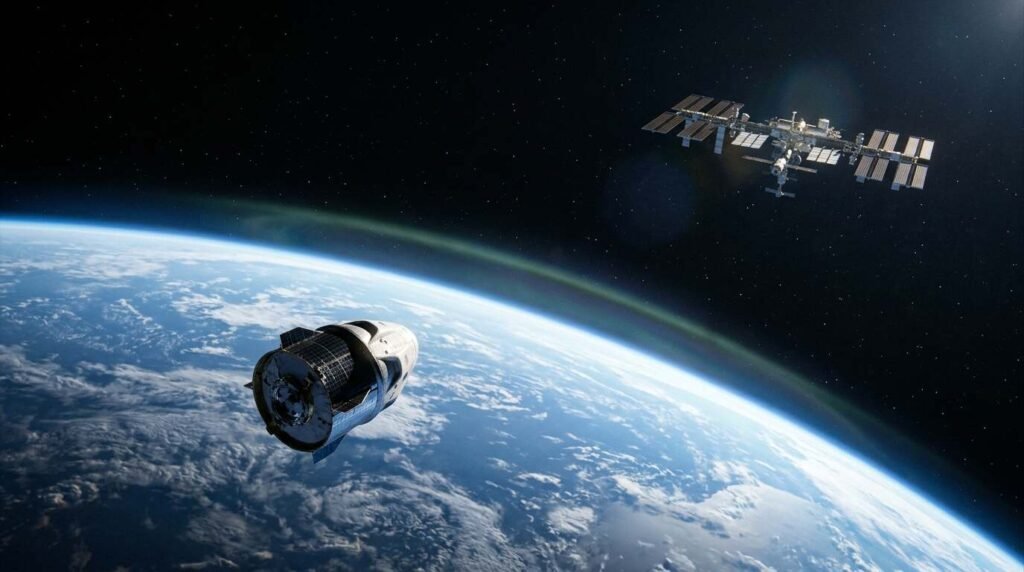
- Launch into the plane. The rocket places the capsule in an orbit that already matches the station’s plane, so no costly plane change is needed later.
- Phasing. The capsule fires its thrusters to adjust its orbit, using a slightly lower, faster path to close the along-track gap described above.
- Far-field approach. Once the capsule is within range, it steers toward a point behind and below the station and slows its relative speed.
- Proximity operations. Close in, the approach is stepped: the capsule holds at checkpoints while controllers and the station crew confirm everything looks right.
- Docking. The capsule closes the last meters and latches to the station’s port.
Phasing is the stage that governs the clock. Everything after it takes a roughly similar amount of time on any flight, which explains why the headline figure swings from three hours to more than a day depending almost entirely on the opening geometry.
Why a delay changes the geometry
Crew-13’s launch slipped about three weeks while engineers repaired the fuel system leak. No source connects that delay to the quick trip, and it would be a mistake to claim a link. The general point is still worth understanding. Because the station keeps circling and Earth keeps rotating, the station’s position relative to a launch site shifts from day to day. Move a launch date and the phasing picture changes with it, sometimes in the crew’s favor and sometimes not.
That is also why Scheiman’s wording matters. She framed the result as luck. Mission planners cannot buy a favorable alignment, only wait for one, and a program that must fly on a fixed schedule takes whatever the calendar provides.
The crew and the handover
Crew-13 is SpaceX’s 13th operational astronaut mission for NASA. Fox 35 reports that the mission patch honors Apollo 13 and that the crew leaned into a “Lucky 13” theme, including a crocheted golden dragon mascot named Lucky.
Watkins is commander. Fox 35’s account says she is the first Black woman to command a crew into orbit. Delaney, Kutryk, and Teteryatnikov are all on their first spaceflights.
The newcomers replace Crew-12, which launched in mid-February 2026 and includes NASA’s Jessica Meir and Jack Hathaway, ESA’s Sophie Adenot, and cosmonaut Andrey Fedyaev. NASA officials said that crew could return to Earth as soon as Monday, 5 October.
Dana Weigel, NASA’s space station program manager, noted that a lot can happen over six months. Kutryk’s wife is expected to give birth during the mission, and Weigel said NASA would work to keep him connected to his family.
What the record does and does not mean
A record like this is real, but narrow. It does not say Dragon has become a faster spacecraft. Scheiman’s own framing credits orbital alignment, and Space.com’s analysis points to mission-control choices as the dominant variable between Dragon and Soyuz.

It does show something useful: when the geometry cooperates, a modern crewed capsule can complete the trip within a single working day, which shortens the time crews spend strapped into a small cabin before reaching the station. Any future repeat depends on the same two conditions of plane and phase lining up.
Several details remain unreported in the sources used here, including Dragon’s burn sequence, orbit count, and rendezvous altitudes.
A short glossary
- Orbital plane: the flat, tilted circle in space that an orbit traces. Two spacecraft must share a plane to rendezvous efficiently.
- Phasing: the along-orbit separation between two spacecraft in the same plane, usually measured as an angle.
- Rendezvous: bringing two spacecraft to the same place with nearly the same velocity.
- Docking: the physical connection after rendezvous is complete.
- Fast-track trajectory: a flight plan that spends fewer laps on phasing, accepting tighter launch constraints.
- Launch window: the period when a rocket can launch and still reach the right orbit.
Frequently asked questions
How long did Crew-13 take to reach the ISS?
7 hours and 55 minutes from liftoff to docking, with launch at about 11:10 a.m. EDT and docking at 7:05 p.m. EDT on 1 October 2026.
Is it the fastest trip to the ISS ever?
No. A Russian Soyuz carrying three astronauts reached the station in 3 hours 3 minutes in May 2020. Crew-13 set the record for the fastest arrival by any American spacecraft.
Why was this trip faster than earlier Dragon flights?
Mostly because of where the station happened to be. SpaceX’s Julianna Scheiman said the orbital geometry lined up favorably.
How long will the crew stay?
About six months.
What delayed the launch?
Fox 35 Orlando reports a three-week delay to repair a fuel system leak in the Dragon spacecraft.
Sources
- Space.com: SpaceX Crew-13 docks at ISS in the fastest trip by a U.S. spacecraft
- Spaceflight Now: Fresh crew takes off for six-month stay aboard space station
- Fox 35 Orlando: SpaceX’s Crew-13 reaches space station in record-fast trip
- Interesting Engineering: How SpaceX reached the ISS in under eight hours



One thought on “Crew-13’s 7 Hour 55 Minute Ride: The Orbital Mechanics Behind the Fastest U.S. Trip to the ISS”