






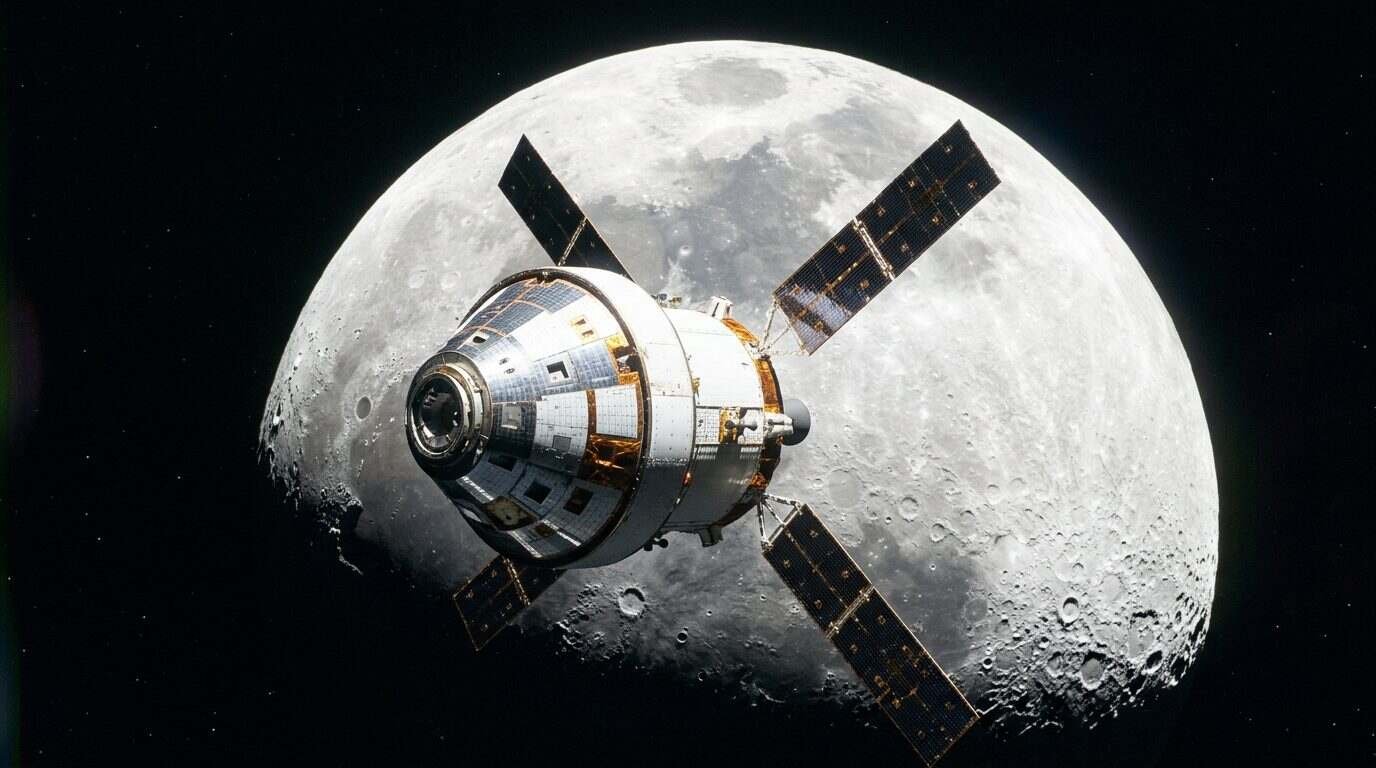
Artemis II looped four astronauts around the Moon on a free-return path and set a crewed distance record. Here is how the trajectory works and why the heat shield mattered.
The Artemis II lunar flyby ended on the evening of April 10, 2026, when the Orion capsule named Integrity splashed down in the Pacific off San Diego at about 8:07 p.m. EDT. Four astronauts had spent nearly ten days looping around the Moon without landing or entering lunar orbit, and on the way they went farther from Earth than any humans before them. What follows is how that trip was built, why the path looks the way it does, and what the one remaining risk, the heat shield, meant for the final minutes.
The mission on one timeline
Commander Reid Wiseman, pilot Victor Glover and mission specialist Christina Koch of NASA, plus Jeremy Hansen of the Canadian Space Agency, lifted off from Kennedy Space Center on April 1. The key moments, as NASA and news outlets reported them, are below.
| Date (2026) | Event | Figure reported |
|---|---|---|
| April 1 | Launch from Kennedy Space Center | Crew of four aboard Orion |
| April 6, 1:56 p.m. EDT | Apollo 13 distance record passed | 248,655 miles from Earth |
| April 6, 7:00 p.m. EDT | Closest approach to the Moon | About 4,067 miles above the surface |
| April 6, about 7:02 p.m. EDT | Maximum distance from Earth | 252,756 miles |
| April 10, about 8:07 p.m. EDT | Splashdown, Pacific Ocean off San Diego | Recovery by the USS John P. Murtha |
The new mark beats Apollo 13 by 4,101 miles, a gap that the arithmetic of the two quoted figures gives directly. It is also worth reading the fine print: the record applies to crewed flight. According to collectSPACE, the uncrewed Orion of Artemis I still holds the overall distance mark for a human-rated spacecraft, at 268,563 miles.
Why the path is a figure eight
Artemis II flew what is called a free-return trajectory. Once Orion left Earth orbit on the right course, the Moon’s gravity bent its path around the far side and sent it back toward Earth, with no large engine burn needed to make the turn. The shape on a chart is a rough figure eight.
Apollo 13 ended up on such a path because its main engine was in doubt after the oxygen tank failure. Artemis II was different, since the free-return profile was chosen from the start, reportedly to save propellant for testing Orion’s systems. The collectSPACE report states this contrast directly. Choosing a path that comes home on its own is a form of insurance: if something fails, physics still delivers the crew to the atmosphere, roughly four days after the flyby, as Al Jazeera described the return leg.
Seven hours around the Moon
NASA’s Flight Day 6 blog put the flyby at about seven hours. At the closest point, Orion was roughly 4,067 miles above the lunar surface. That is a long way compared with the low passes of the Apollo orbiters, but the point of this flight was never surface detail; it was proof that the spacecraft, its crew and its navigation work together at lunar distance.
Behind the Moon, the radio link dropped for a planned 40 minutes, because the Moon sat between Orion and Earth. During that stretch the crew saw Earth set below the lunar horizon and later rise again on the other side.
The science was not an afterthought. The astronauts photographed and described craters, ancient lava flows, cracks and ridges on the far side, and noted differences in color, brightness and texture that scientists can later tie to the composition of the ground. Al Jazeera reported that the far-side view included the Orientale basin, a feature seldom seen by human eyes.
NASA says the crew watched a solar eclipse lasting nearly an hour, which gave them a view of the Sun’s corona around the Moon’s edge. In the darkness they reported six brief light flashes, which NASA identified as meteoroids striking the unlit part of the Moon. The downlinked data should let scientists pin down when and where each one landed.
How the distance record is actually measured
People tend to picture the record as a trip to the Moon’s far edge. It is simpler than that. The number is the straight-line distance from Earth to the spacecraft at its farthest moment. Because the Moon’s orbit is slightly elliptical and the flyby geometry puts Orion beyond the Moon on its far side, the spacecraft reached a point farther from Earth than the Moon’s own distance.
Timing explains why a record falls on a particular afternoon. The crew passed the Apollo 13 figure 4 days, 19 hours and 21 minutes after launch, whereas Apollo 13 reached the same point after 3 days, 5 hours and 8 minutes, according to collectSPACE. The report adds a detail that makes the comparison fair: unlike Apollo 13, Artemis II kept moving outward after it passed the old mark, then peaked about five hours later at 252,756 miles.
Records came with people attached. Koch became the first woman to fly around the Moon, and Hansen, speaking for the crew, said they were honoring “the furthest distance humans have ever traveled from planet Earth.” A recorded message from Apollo 13 commander Jim Lovell, played to wake the crew that morning, told them not to forget to enjoy the view.
The heat shield question
Everything above happened in space, where physics is gentle. Reentry is where the risk concentrates. Orion’s heat shield is 16.5 feet across and made of Avcoat, an ablative material first developed for Apollo, as National Geographic explained. An ablator works by burning away on purpose: the surface chars, and gases released beneath it carry heat away and push hot plasma off the capsule.
The trouble began on Artemis I in December 2022. After that uncrewed flight, engineers found more charring than expected, along with chunks missing and cracks in places. NASA said in December 2024 that the material was not permeable enough, so gases built up pressure inside it, cracking the outer layer. National Geographic also noted that the “skip entry” used on Artemis I, which briefly lofted the capsule back up, heated the Avcoat enough to build that pressure.
NASA decided not to swap the shield. Replacing it would have cost about two years, according to R&D World. Instead, the agency changed the way Orion flies in: a steeper entry, called a lofted entry, that shortens the time in the part of the atmosphere where the damage began. The agency tested the approach with arc jet runs at Ames and at Wright-Patterson Air Force Base. Its worst-case analysis concluded that even if an entire Avcoat block were lost, the carbon-fiber backshell would hold.
The decision was not unanimous in public. Former astronaut Charles Camarda, a heat shield specialist, criticized the choice and the analysis behind it, while former astronaut John Olivas reviewed the work and supported NASA’s conclusions, per National Geographic. Reasonable experts disagreed, and the flight itself was the test.
The last twenty minutes
Orion came home fast. One report put the reentry speed at about Mach 33, or 23,840 mph, while the pre-flight explainer spoke of roughly 25,000 mph; the two figures describe the same regime at slightly different points, and neither source says which instant it measures. At peak heating the capsule faced temperatures in the thousands of degrees, around 5,000 degrees Fahrenheit at the surface, and the radio went quiet in the usual reentry blackout.
The capsule flew the entry on autopilot. Parachutes slowed it, and it settled in the water off San Diego. ABC affiliates reported the touchdown as a “perfect bullseye.” Military aircraft and helicopters supported the USS John P. Murtha, where the crew was evaluated in the capsule, flown to the ship and examined in its medical bay, as described in the WJLA report.
Why nobody landed this time
A reader could fairly ask why a crew would fly to the Moon and not touch down. Artemis II was a flyby by design: it did not land on the Moon or orbit it. Its job was to put people aboard a spacecraft that had so far flown only without a crew, on a route that tests life support, navigation, communications and the heat shield at lunar distance. A landing needs hardware that this mission never carried, and it was not on the plan.
What the flight shows and what it leaves open
A safe splashdown tells us that the lofted entry did not endanger the crew. It does not yet tell us how much Avcoat was lost; that answer comes when engineers inspect the capsule. Officials had expected some char loss, but far less than on Artemis I, and the measured condition of the shield will decide whether the mitigation was more than adequate or merely sufficient.
The mission also did not demonstrate a landing, a lunar orbit or a docking with anything. Those belong to later flights. For anyone interested in the mechanics of getting people to orbit and back, our piece on the orbital mechanics behind Crew-13’s fast ride to the ISS covers a very different trajectory problem with the same underlying physics.
Sources
- WJLA, Artemis II makes successful splashdown after historic moon mission
- NASA, Artemis II Flight Day 6: Crew Wraps Historic Lunar Flyby
- collectSPACE, Artemis II surpasses Apollo 13 distance record
- Al Jazeera, Artemis II breaks Apollo 13 record for farthest human travel from Earth
- National Geographic, Artemis II’s last test: Will its heat shield work?
- R&D World, How NASA engineered around a known Avcoat failure mode



