






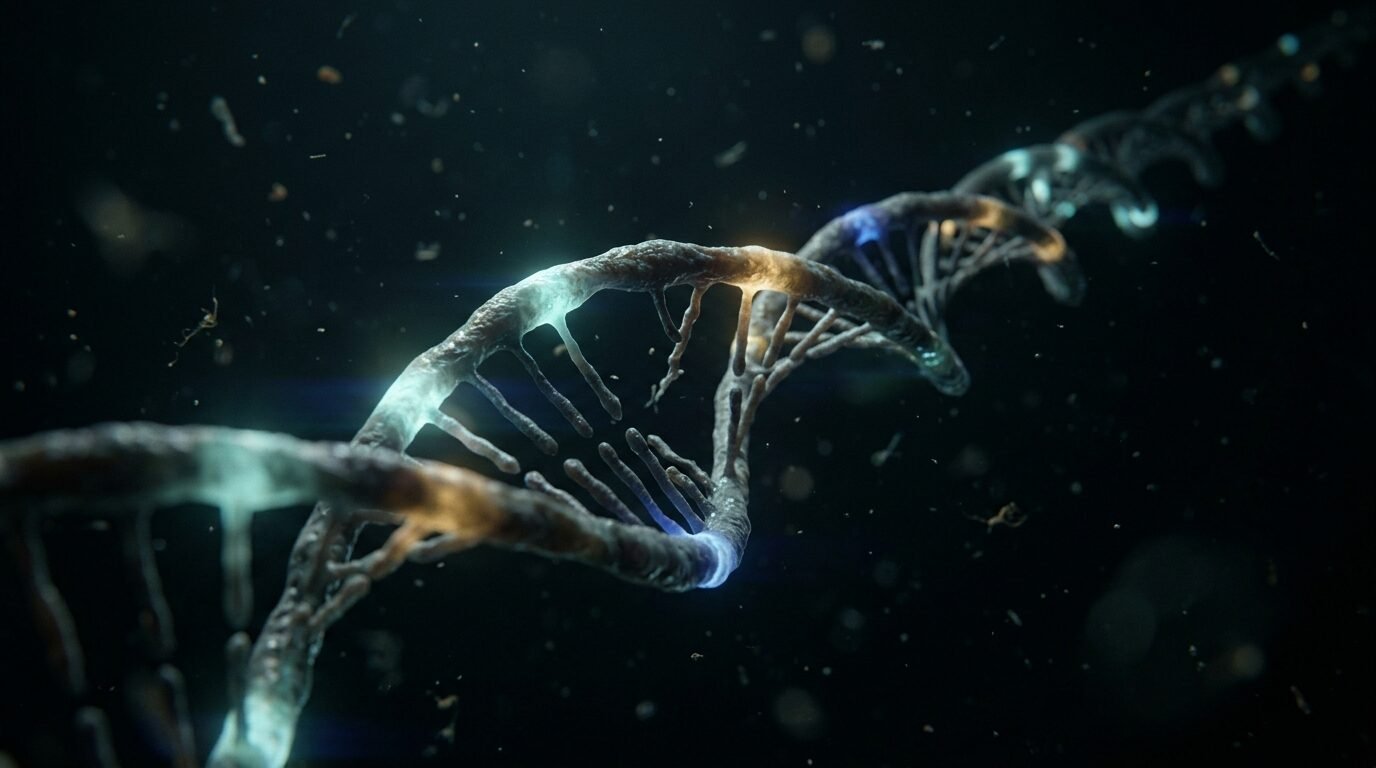
Only about 1 to 2 percent of human DNA codes for protein. The rest is a mix of switches, RNA genes, repeats and leftovers that scientists are still sorting out.
Junk DNA is one of the most misleading names in biology, and also one of the most useful for understanding how the genome really works. The phrase suggests a drawer of useless scraps. The reality is a mixed collection: some of it plainly functional, some of it plainly not, and a large middle ground that scientists are still arguing about.
Here is the short version. Only about 1 to 2 percent of your DNA codes for proteins. The other 98 to 99 percent is non-coding. What that majority does, and how much of it does anything at all, is a live scientific debate with a very public history.
What does “non-coding” actually mean?
A gene that codes for a protein is a stretch of DNA that cells copy into RNA and then translate into a chain of amino acids. Those protein-coding stretches, the exons, add up to roughly 1 to 2 percent of the human genome of about 3.1 billion base pairs.
Everything else is non-coding. That label describes what the sequence does not do, which is encode a protein. It says nothing about whether the sequence matters. A thermostat does not heat your house either, but you would notice if it were missing.
The word “junk” came from a different line of thought. In 1972, the geneticist Susumu Ohno popularized the term in a paper titled “So much ‘junk’ DNA in our genome,” and argued that something like 90 percent of mammalian DNA might be nonfunctional. The idea was not casual. It rested on arithmetic about mutation.
Why did scientists think so much of the genome was junk?
Two lines of evidence pushed that view. The first is the C-value paradox: genome size does not track how complex an organism looks. A single-celled amoeba, Polychaos dubium, has been reported to carry more than 600 billion base pairs, over 200 times the human total. A pufferfish has a genome about one-eighth the size of ours with a similar number of genes. If every letter had a job, the amoeba would be doing an absurd amount of work.
The second is genetic load. Mutations strike constantly, and most harmful ones are removed by natural selection. In the late 1940s, J.B.S. Haldane and Hermann Muller argued that human mutation rates implied only a small fraction of the genome could be functional, because selection could not keep up with damage across a huge functional genome. Later molecular evolution work often put the functional share below 10 percent.
Both arguments are inferences, not direct measurements. That distinction becomes important later.
What is all that non-coding DNA made of?
A good chunk of it is not mysterious. It falls into recognizable categories.
- Introns are stretches inside genes that get copied into RNA and then cut out. Together with exons they make genes occupy about 40 percent of the genome, mostly because introns are long.
- Transposable elements are sequences that copy and paste themselves around the genome. Over 42 percent of human DNA is recognizably derived from retrotransposons, and the common Alu family has about 50,000 active copies.
- Pseudogenes are broken copies of old genes. Humans have roughly 15,000 of them, about 5 percent of the genome.
- Non-coding RNA genes make RNA molecules that do jobs other than carrying protein instructions, such as the RNA parts of ribosomes. Counts of these genes vary enormously, from about 5,000 to over 100,000, mostly because scientists disagree about long non-coding RNAs.
- Regulatory sequences, such as promoters and enhancers, are the switches that decide when and where genes turn on.
- Structural regions include centromeres, which make up about 6 percent of the genome, and telomeres at chromosome ends.
Repeats of all kinds together account for about half of the genome, depending on how you count.
That count has itself improved lately. The human reference sequence had gaps for decades, mostly in the repetitive regions that are hardest to assemble. In 2022 the Telomere-to-Telomere consortium reported the first gapless sequence of a human genome (apart from the Y chromosome, which followed in 2023). Filling those gaps lets researchers study centromeres and other repeat-rich regions that were previously a blank, which is one reason the question of what the non-coding majority does is easier to ask today than it was twenty years ago.
What is the part that clearly does something?
The regulatory layer is the best argument against the “junk” label. A gene without its switches is like a lamp without a wall socket. Enhancers can sit far from the genes they control, and a change in one can alter how a gene behaves in a particular tissue without changing the protein at all.
Evidence from human genetics supports this. In genome-wide association studies, which hunt for variants linked to traits and diseases, about 12 percent of tightly linked variants fall in coding regions and about 40 percent in introns, with most of the rest in the gaps between genes. So the DNA that never becomes protein is where much of the disease-linked variation turns up.
Non-coding RNA is the other clear success. Transfer RNA and ribosomal RNA genes were found in the 1960s, long before anyone called the genome mostly junk, and every cell depends on them. Other classes, such as microRNAs, help tune gene activity; about 2,300 microRNA genes had been identified by 2018.
What did the ENCODE project claim?
In September 2012, the ENCODE consortium released a set of about 30 papers, and the overview made a headline-grabbing claim: 80.4 percent of the human genome took part in at least one biochemical event, such as being transcribed into RNA or bound by proteins, in at least one cell type. Many news stories summarized that as “junk DNA is dead.”
The project had a broad working definition of function, namely specific biochemical activity. Defenders argued that this made sense for biomedical research, where a region that does something in a cell might matter to disease.
Why did so many scientists push back?
The criticism was sharp, and it was mostly about definitions. Biochemical activity is not the same as biological function. A stretch of DNA can be copied into RNA at low levels, or be touched by a protein, without any benefit to the organism, simply because cellular machinery is not perfectly selective.
Critics also pointed to design issues. The project favored sensitivity over specificity, which can generate false positives. And a 2013 study by White and colleagues showed that random DNA sequences could mimic some of the “functional” signals ENCODE used. A well-known critique by Graur and colleagues appeared the same year, with the memorable title “On the immortality of television sets.”
Evolutionary biologists prefer a different test: if a sequence matters to survival, selection will tend to preserve it across species. By that yardstick, the functional fraction is far smaller than 80 percent.
So how much of the human genome is functional?
Nobody has a single agreed number, since the answer depends on what you count as function. The estimates that rely on evolutionary constraint are fairly consistent, though. Protein-coding sequence is 1 to 2 percent. Other functional non-coding elements, like regulatory regions, replication origins, and centromeres, add roughly 3 to 8 percent. A 2014 paper by Rands and colleagues was titled “8.2% of the human genome is constrained,” and a 2022 analysis of 150,119 sequenced UK Biobank genomes by Halldorsson and colleagues supported an estimate of about 7 percent under purifying selection.
Those figures describe sequence that selection protects. They do not prove everything else is useless. Some sequence may be useful in ways that are weakly constrained, species-specific, or recent. Some may serve as spacers or structural scaffolding where the exact letters do not matter. The best summary is that the genome contains a lot of neutral or near-neutral material, and a smaller but vital working core.
Researchers who favor a more expansive view, such as the geneticist John Mattick, have argued that most genes in complex organisms produce regulatory RNAs. That remains a minority position among evolutionary biologists, and it is better treated as a hypothesis than as settled.
Does extra DNA ever pay its way?
Parts of the “junk” can be turned to use. Transposon-derived sequences have been recruited, over evolutionary time, to become regulatory elements or even genes. Quietly repurposing old material is a common move in evolution. That is different from saying every transposon is secretly useful.
There is also a cost argument. Copying 3 billion letters takes energy, and each cell division risks errors. Small organisms under strong selection tend to keep their genomes lean. The bladderwort plant Utricularia gibba, with a nuclear genome of about 100 million base pairs, appears to have shed much of its repetitive DNA while keeping its gene set, which shows that large amounts of non-coding DNA are dispensable for at least some lifeforms.
Common questions
Is junk DNA really useless?
Some of it probably is, and some of it clearly is not. The term lumps together very different things, from broken pseudogenes to essential switches, so a blanket answer misleads.
Did ENCODE prove that junk DNA doesn’t exist?
No. ENCODE showed that much of the genome shows biochemical activity, but many scientists argue that activity does not demonstrate function. The disagreement is partly about how to define the word.
Why can an amoeba have a bigger genome than a human?
Genome size depends largely on how much repetitive DNA a lineage accumulates or loses, not on how many genes it has. This is the old C-value paradox, and repeats are what mostly resolved it.
Can changes in non-coding DNA cause disease?
Yes. Many variants linked to common diseases sit in non-coding regions, often in regulatory elements. Such a variant can change when or how much a gene is used without altering the protein.
Do we know what all of it does yet?
No. The ENCODE team’s own 2020 follow-up described the functional annotation of the elements it identified as still in its infancy.
What to remember
“Non-coding” is a description, not a verdict. A small fraction of the genome codes for protein, a somewhat larger fraction regulates or supports it, and the rest is a mixture of neutral leftovers and sequence whose role is unresolved.
The 80 percent figure and the 90 percent figure came from different definitions of function, which explains most of the fight. If you see one stated as fact, ask what counted as function.
Further reading
A popular-science book on non-coding DNA. See it on Amazon (affiliate link)
As an Amazon Associate I earn from qualifying purchases. A commission may be earned if you buy through this link, at no extra cost to you.
Sources



