

Watch a plume of smoke rise from an incense stick. For the first few centimetres it is a smooth, glassy thread. Then it wobbles, curls and breaks into a tangle that no one could draw twice the same way. Nothing random happened. The air obeys exact equations the whole way up; they just amplify tiny differences until the outcome is unpredictable in practice.
That behaviour has a name, chaos, and the cleanest way to see it is to plot a path through a system of just three equations. The free Chaos Attractors app does that in 3D for six classic systems. This post explains what you are looking at.
What chaos does and does not mean
Chaos is not noise. A chaotic system is deterministic: give it the same starting point and the same rules, and it will follow the same path every time. The catch is sensitive dependence on initial conditions. Two starting points that differ by a hair drift apart, on average at an exponential rate, until their futures bear no resemblance to each other.
Three features appear together in the systems below. The motion never repeats exactly. It stays confined to a bounded region rather than flying off to infinity. And the path traces a structure with fractal geometry, called a strange attractor, that the trajectory visits forever without crossing itself.
The Lorenz system
Edward Lorenz published his equations in 1963, in a paper titled “Deterministic nonperiodic flow” in the Journal of the Atmospheric Sciences (volume 20, pages 130–141). They are a drastically simplified model of Rayleigh–Bénard convection, in which a fluid is heated from below and cooled from above. The three variables stand for the intensity of the convection, the temperature difference between rising and falling currents, and the distortion of the vertical temperature profile.
The classic parameter values are σ = 10, ρ = 28 and β = 8/3. Below ρ = 1 everything settles to the origin. Above 1 two new resting points appear, and once ρ passes about 24.74 those points turn repelling, so the trajectory keeps circling one, flipping to the other, and circling again. The fractal dimension of the resulting attractor has been estimated at about 2.06, a little more than a flat sheet.

Try it: the twin trajectory
Open the app and leave the “Twin trajectory” button on. You will see two paths, a blue one and an orange one, launched from points a millionth of a unit apart. The readout at the bottom tracks the distance between them. For a while it grows smoothly; then the two paths separate completely and wander the attractor independently. Slide the “Twin offset” control down to 1e-8 and the delay before separation stretches, but only by a modest amount. That is the signature of exponential growth: a hundred-fold smaller starting error buys you only a little extra time.
Open Chaos Attractors in its own tab, or use its Full screen button. Drag to rotate, scroll to zoom.
The other five systems
Rössler. Otto Rössler introduced his system in 1976, in a paper called “An Equation for Continuous Chaos” in Physics Letters. He wanted a flow that behaved like the Lorenz attractor but was easier to analyse; he also described it as a formalisation of a taffy-pulling machine, where a ribbon is stretched, folded and pressed back together. The original parameters are a = 0.2, b = 0.2, c = 5.7. Move c down and the orbit closes into simple loops; raise it and the loop splits into two, then four and eight, before chaos sets in.
Thomas. René Thomas’s cyclically symmetric attractor (see his 1999 paper in the International Journal of Bifurcation and Chaos) has the same equation rotated through x, y and z, and a single parameter b that sets how dissipative it is. At b = 0.208 the motion is chaotic; as b rises it calms down, and as b falls toward zero the path wanders the whole space.
Aizawa, Chen and Halvorsen. These are three more members of the same family of three-variable flows. The app includes them so you can compare shapes: Chen has two lobes like Lorenz but crosses itself differently, Halvorsen winds three arms around the origin, and Aizawa makes a sphere pierced by a tube. I am describing the shapes you can see in the app rather than the history of each one.
Why it matters outside the app
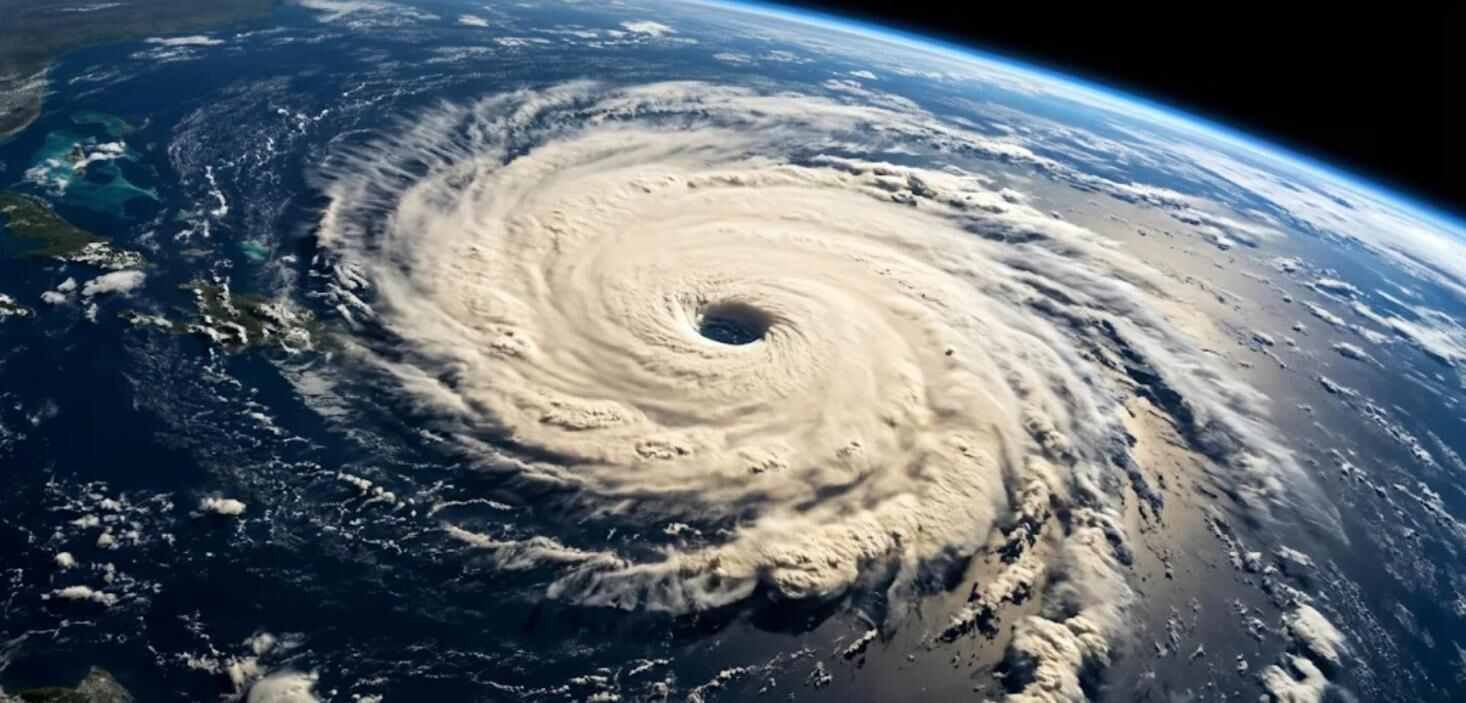
Lorenz’s model was built for weather, and the lesson stayed there: because tiny measurement errors grow, the useful range of a forecast has a ceiling that better computers can push out only slowly. The same idea shows up in other nonlinear systems. The Double Pendulum post shows it in a mechanical toy, and the Gravity Lab shows it in the three-body problem. A dripping tap is another everyday candidate for irregular rhythm, though I have not tested this in the app, and the app does not simulate fluids.

A few honest limits of the app. It integrates each system with a fourth-order Runge–Kutta step in plain JavaScript, so it is accurate enough to show the shapes but it is not a research integrator. The twin separation it reports is the Euclidean distance in the three variables. And the camera is a simple rotation of the 3D path onto the screen, so what you see depends on the viewing angle.
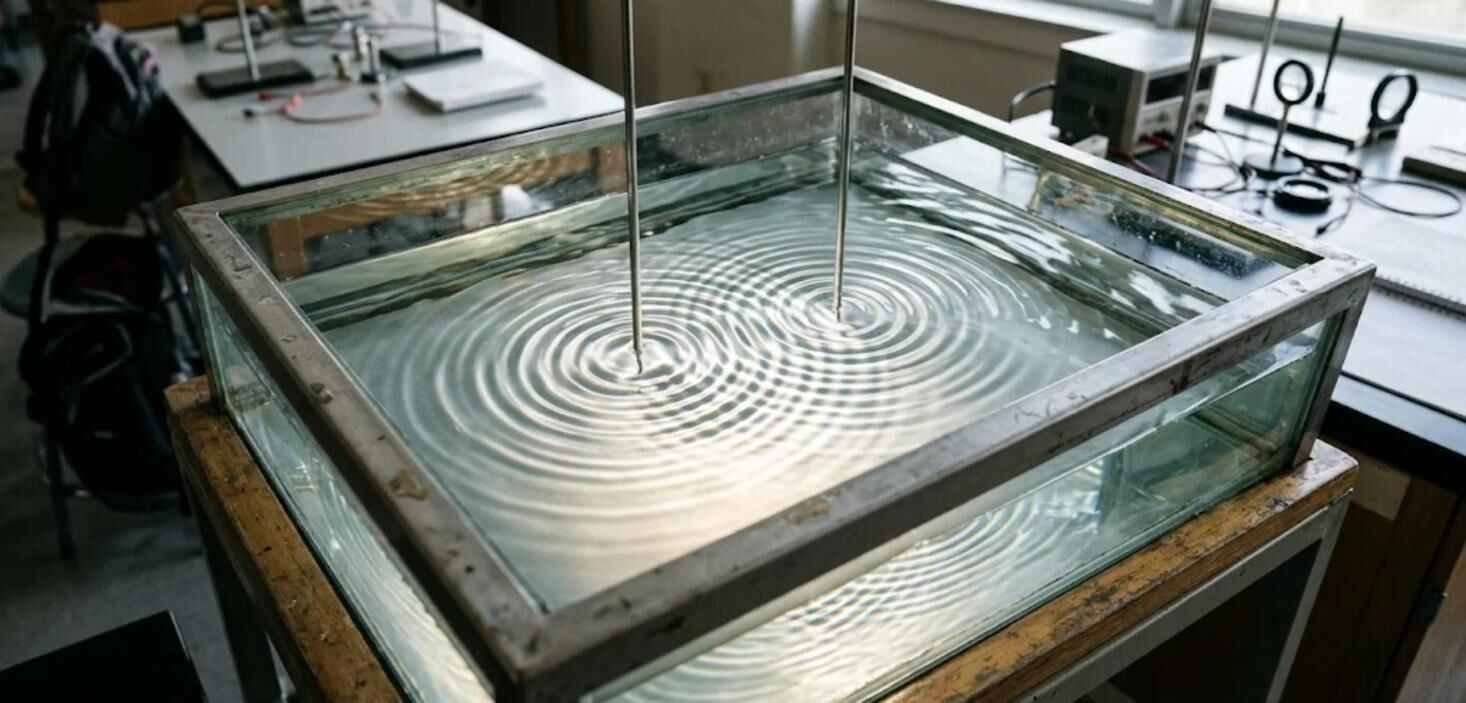
Related on this site: Cellular Automata explores another way simple rules produce complex behaviour, and the double-slit simulator covers wave interference.
Sources
- Lorenz system, Wikipedia (1963 paper citation, parameters, bifurcation values, dimension estimate): en.wikipedia.org/wiki/Lorenz_system
- Rössler attractor, Wikipedia (1976 paper, parameters, motivation): en.wikipedia.org/wiki/Rössler_attractor
- Thomas’ cyclically symmetric attractor, Wikipedia: en.wikipedia.org/wiki/Thomas%27_cyclically_symmetric_attractor



[…] simulators in this series: double-slit interference, chaos attractors and Orbit […]
[…] All planets sit in one plane and start at the same angle at time zero, so the app shows the pattern of orbits rather than a calendar of where the planets are today. Planet masses never tug on each other here, nor does the Sun wobble around the system’s centre of mass. Those effects are small but real, and they are what separates this model from a proper ephemeris. For gravity that does include planets pulling on each other, see the Gravity Lab, and for what happens when a three-body system turns unpredictable, the chaos attractors post. […]