Wi-Fi 8 (IEEE 802.11bn) trades peak speed for steadier latency and fewer dropped packets. Here is what Broadcom's first Wi-Fi 8 chips contain, what the draft changes, and what the announcements leave out.
Every Wi-Fi generation since 802.11n has sold itself on speed, and Wi-Fi 7 pushed the pitch to a theoretical 46 Gbps that almost no phone or laptop will ever reach. Wi-Fi 8 steps out of that race. The goal for IEEE 802.11bn is steadiness: fewer stalls, fewer lost packets, and tighter worst-case latency when a network is crowded or a device walks from one access point to another.
In May 2026 Broadcom began sampling the first silicon built around that goal. The parts are dual-band and aimed at routers, access points and fiber gateways, and their specifications show how the standard intends to deliver. What follows reads those chips against the problems the draft is trying to fix, and separates what the announcements confirm from what they leave out.
- Wi-Fi 8 (IEEE 802.11bn) targets reliability. The scope goals are roughly 25% better throughput in difficult conditions, 25% lower latency at the 95th percentile and 25% fewer lost packets than Wi-Fi 7.
- Broadcom announced three router-class chips (BCM6772, BCM6774, BCM6776) on May 27, 2026, after sampling a dual-band radio pair (BCM67142, BCM67192) and a 10G fiber gateway chip (BCM68565) earlier that month.
- Maximum channel width stays at 320 MHz, so peak speed is not the selling point.
- Ratification is projected for 2028, and Dell’Oro Group, as cited by The Register, does not expect Wi-Fi 8 to take off before then.
Why Wi-Fi 7’s headline number never reached the living room
Wi-Fi 7 doubled the maximum channel width from 160 MHz to 320 MHz, which roughly doubles the bandwidth available to each stream. The Register calls the 46 Gbps peak technically possible, then expects most consumer devices to top out below 5 Gbps. The ceiling was never the problem in an ordinary home or office.
What people notice is the bad moment. A video call freezes for two seconds. A game rubber-bands. A laptop clings to a distant access point after you walk down the hall. Averages hide all of it, which is why the Wi-Fi 8 targets lean on the 95th percentile: that figure describes the slowest one packet in twenty, and the freeze lives in that slice rather than in the typical packet.
What the 802.11bn draft changes
The task group frames the work as ultra high reliability. According to a 3DTested report that traces the numbers to an IEEE scope document and a Qualcomm post, the three goals are each about 25%: more throughput under weak signal or interference, lower latency at the 95th percentile, and fewer dropped packets, especially while devices move between access points. The 802.11bn entry on Wikipedia lists the same three figures.

Much of the delivery mechanism is coordination between access points that used to ignore each other. Coordinated spatial reuse lets neighboring access points or mesh nodes adjust signal strength to cut noise for one another, and coordinated beamforming points energy at the intended receiver so other devices see less interference. Dynamic sub-channel operation hands individual sub-channels to individual devices; The Register says this can lift throughput by more than 20 percent, though it does not say who measured that.
The draft carries a longer list of smaller tools. According to the Wikipedia summary:
- A seamless roaming domain for clients that connect over multiple links.
- An enhanced long-range packet format in 20 MHz using BPSK or QPSK modulation.
- Distributed-tone resource units spread across 20, 40 or 80 MHz.
- Four new modulation and coding schemes, worth rate improvements of 5 to 30 percent depending on conditions.
- High-priority EDCA and TXOP preemption for latency-sensitive traffic.
A caution on reading those targets. They are design goals set in a scope document, not measurements from shipping hardware, and the draft has not been finalized. Each 25 percent figure is also relative to Wi-Fi 7 under difficult conditions, so a household with a strong signal and few neighbors should not expect to see any of them. The benefit is likely to grow with how messy the radio environment is: apartment blocks, offices running dozens of access points, and homes where people carry video calls from room to room.
| Design question | Wi-Fi 7 (802.11be) | Wi-Fi 8 (802.11bn) |
|---|---|---|
| Main goal | Higher peak throughput | Reliability under load |
| Maximum channel width | 320 MHz | 320 MHz (unchanged) |
| Bands | 2.4, 5 and 6 GHz | 2.4, 5 and 6 GHz |
| Headline target | 46 Gbps theoretical peak | About 25% gains in throughput, 95th-percentile latency and packet loss versus Wi-Fi 7 |
| Rate steps | Up to 4096-QAM | Four additional MCS values, 5 to 30 percent rate gains depending on conditions |
Inside the first Wi-Fi 8 silicon
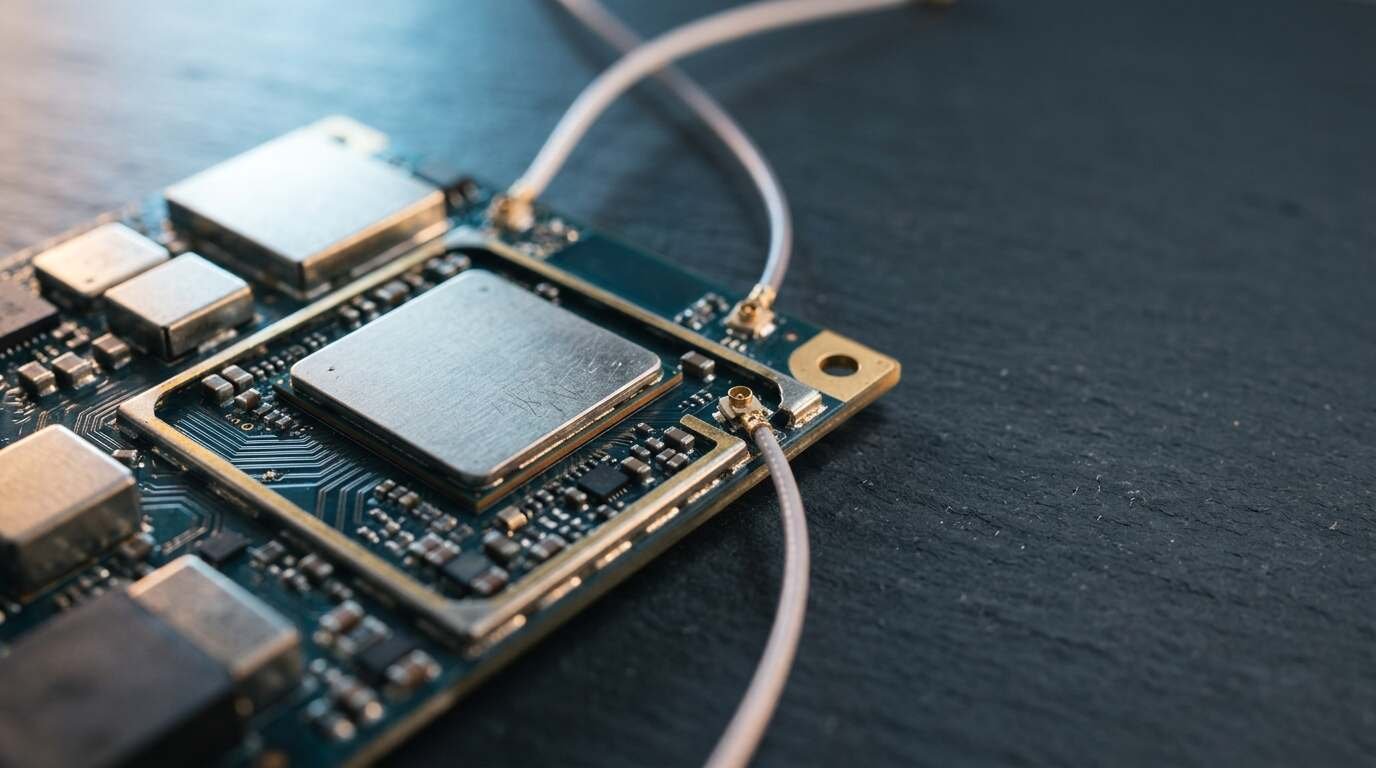
Broadcom is selling two kinds of product. The first is a router system-on-chip family: according to The Register, the BCM6772, BCM6774 and BCM6776 combine application processing, network processing, 2.4 GHz and 5 GHz radios and an Ethernet PHY on a single die, which the article says cuts power draw and heat. Multi-gigabit WAN and LAN ports are supported. Samples are with customers for evaluation, and TP-Link, Netgear and Asus are named as partners, but no consumer products have been announced.
The second is a split design, with a separate radio chip beside a gateway processor. EverythingRF reports that the BCM67142 and BCM67192 radios pack 2.4 GHz and 5 GHz onto one piece of silicon with on-chip 2.4 GHz power amplifiers and a hardware offload engine. Broadcom says its third-generation digital pre-distortion trims peak power by 25 percent. That figure is a vendor claim with no stated test conditions.
| Part | Role | Confirmed specifications |
|---|---|---|
| BCM6772 | Entry router SoC | 2×2 radios on 2.4 and 5 GHz |
| BCM6774 | Mid-range router SoC | Adds a larger 4×4 radio on 5 GHz |
| BCM6776 | High-end router SoC | Two PCIe 3.0 controllers, faster LPDDR support |
| BCM67142 | Dual-band radio | 3×3 on 2.4 GHz plus 4×4 on 5 GHz, seven spatial streams |
| BCM67192 | Dual-band radio | 4×4 on 2.4 GHz plus 4×4 on 5 GHz, eight spatial streams |
| BCM68565 | 10G PON gateway SoC | Multicore Armv8 up to 10K DMIPS, XGSPON, GPON and Active Ethernet, one 10 Gbps PHY and four gigabit PHYs |
The CNX Software breakdown adds that the radios handle 4096-QAM, multi-link operation on all bands, OFDMA and MU-MIMO in both directions, WPA3, and a PCIe Gen3 x2 host link. They also fall back to 802.11be and every older generation, so a Wi-Fi 8 access point will still serve today’s clients.
What the specifications leave unsaid
Announcements of this kind are as informative for their gaps as for their content. None of the sources I read gives a process node. None gives a measured throughput or latency number for the chips themselves; Broadcom describes gains only qualitatively. There is no general availability date for the radios or the gateway chip, only “sampling” to early-access partners.

Two details stand out. The radios on these parts cover 2.4 and 5 GHz, and the CNX listing tops out at 160 MHz channels on 5 GHz, while the 320 MHz channels that Wi-Fi 7 introduced belong to the 6 GHz band. The sources do not describe a 6 GHz radio on these chips, so it is fair to ask how a tri-band product would be built from them. That is my reading of the gap, not something Broadcom has addressed.
The gateway chip also supports operator middleware, RDK and prplWare, and CNX lists residential fiber access points and 10G PON gateways as the intended use. Taken together, this suggests internet providers, rather than retail shelves, may see the earliest Wi-Fi 8 boxes. Again, inference; nobody has said so.
When Wi-Fi 8 reaches shops
The standard is still in draft. Wikipedia’s timeline has the IEEE task group formed in 2021 and finalization projected for 2028, though the page gives both May and September without reconciling them. It also expects Wi-Fi Alliance certification to begin in early 2028. The Register, citing Dell’Oro Group, puts mass adoption at 2028 as well.
Silicon that ships ahead of a finished standard carries a familiar risk: late changes to the draft may not match hardware already built. The announcements do not say how Broadcom plans to handle that. For anyone choosing a router this year, the practical picture is simple. Wi-Fi 6E and Wi-Fi 7 are the real options, and Wi-Fi 8 is a 2028 conversation.
Questions readers ask
Is Wi-Fi 8 faster than Wi-Fi 7?
Not at the peak. The maximum channel width does not change, and the headline goals concern consistency in poor conditions. The four new modulation and coding schemes can add 5 to 30 percent to rates, depending on conditions.
What does 95th-percentile latency mean?
It is the delay that 95 percent of packets beat. Only the slowest five percent take longer, so lowering this number shrinks the worst stalls rather than the average ping.
Will Wi-Fi 8 gear work with my current devices?
Broadcom’s radios list support for 802.11be and earlier generations, so existing Wi-Fi 7, 6 and older clients should still connect. They will not gain Wi-Fi 8 benefits without Wi-Fi 8 hardware on their side.
When can I buy a certified Wi-Fi 8 router?
Certification is expected to start in early 2028, per the Wikipedia timeline. Chips are sampling now, and no consumer products have been announced.
Sources
- The Register: Broadcom gets early start on Wi-Fi 8 with new routing kit (May 27, 2026)
- EverythingRF: Broadcom introduces highly integrated dual-band Wi-Fi 8 radios
- CNX Software: Broadcom BCM67142, BCM67192 and BCM68565 chips (May 13, 2026)
- Wikipedia: IEEE 802.11bn
- 3DTested: Next-gen Wi-Fi 8 focuses on reliability instead of speed