
A Science Advances study dates Vesuvius pumice by argon-argon and lands within error of the Vesuvius eruption date in Pliny's letter. Numbers explained.
The Vesuvius eruption date is one of the few ancient disasters with an eyewitness, and it is still argued over. Pliny the Younger’s letters point to August 24, 79 CE. A coin found at Pompeii and some archaeological arguments have pushed a minority of historians toward autumn. A paper published on September 25, 2026 in Science Advances approaches the question from the other side: it asks what the rocks themselves say, and what the answer does for the clocks scientists use to date everything else.
The team, led by Paul Renne at the Berkeley Geochronology Center, dated sanidine crystals from Vesuvius pumice using the argon-argon method and got a calendar age of 87 plus or minus 13 CE. That is eight years from the historical date, and well inside its own error bar. The more important output is a tighter decay constant for potassium-40, which feeds every argon-based date in the geologic record.
The paper is peer reviewed. It is open to me only through press releases and secondary reports, so I will attribute numbers accordingly and say where those reports diverge.
The question the researchers were actually asking
Geochronology has a calibration problem. Argon-argon dating, which can reach back billions of years, depends on the decay rate of potassium-40 into argon-40. That rate was measured directly in nuclear physics experiments, and the measurements carry uncertainty that gets baked into every age. Uranium-lead dating, the other heavyweight, uses a different set of constants. When the two methods date the same event, they do not always agree, which is awkward for anyone trying to line up Earth history.
A volcanic eruption with a known calendar date is a rare gift. If you know independently when the rocks formed, you can run the argon-argon measurement on them and solve for whatever was uncertain. Renne had tried this in 1997 with Vesuvius, but the data were crude. According to The Brighter Side’s account of the paper, that early work had an age uncertainty around 94 years, so it carried little weight in later calibrations.
The 2026 paper redoes the experiment with better samples, a modern mass spectrometer and updated neutron irradiation procedures. It builds on a 2025 Bayesian framework that tries to reconcile the potassium-argon, argon-argon and uranium-lead systems statistically.
How argon-argon dating works
Potassium-40 is a radioactive isotope that decays slowly, with a half-life of over a billion years, and one of its decay products is argon-40, a noble gas. While a mineral is molten, argon escapes. Once it crystallizes and cools, argon-40 accumulates. Measure how much has built up relative to how much potassium is left, and you can compute the time since the mineral locked.

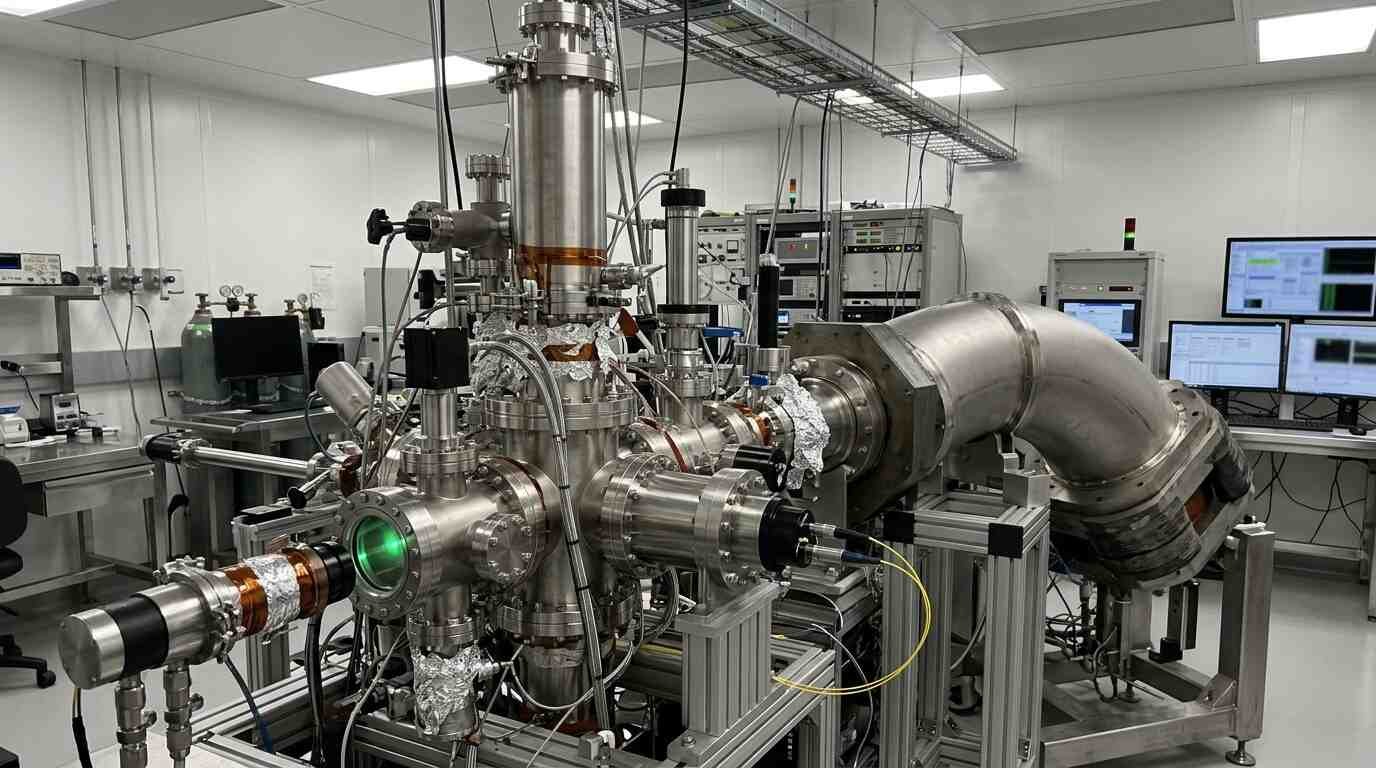
The argon-argon version avoids measuring potassium separately. The sample is first irradiated in a nuclear reactor, which turns a known fraction of the stable potassium-39 into argon-39. Then a laser heats the crystal, releasing the gas, and a mass spectrometer measures the ratio of argon-40 to argon-39. Compared with a standard of known age irradiated alongside, that ratio gives the age. Heating in steps, as the Vesuvius team did, lets you separate gas trapped from the atmosphere or older material from gas produced after the eruption.
The team used sanidine, a potassium-rich feldspar, from pumice at Oplontis, a Roman settlement buried by the same eruption. These samples came from the earliest phase. The reasoning, per the Berkeley release as relayed by ScienceDaily, is that potassium-rich magma erupts first and settles at the bottom of the deposit, so that is where the best crystals sit. Neutron irradiation lasted six minutes.
Working through the numbers
The sample statistics reported by The Brighter Side are eight uncontaminated irradiation wells, 153 incremental heating measurements and roughly 700 milligrams of mineral in total. The measured age was 1,938 plus or minus 10 years before 2025. After accounting for extra scatter beyond counting statistics, the uncertainty widened to plus or minus 13. Subtract from 2025 and you get 87 CE, which is how Gizmodo and The Brighter Side both report it.
Now the checks. The historical date, August 24, 79 CE, is 1,946 years before 2025 (the sources do not agree on whether the clock stops at the start of 2025 or the end, so treat that as approximate). The difference from the measured value is about eight years. Divide by 13 and the miss is around 0.6 standard deviations, which is why The Brighter Side says the result falls within one standard deviation of the historical date.
The percentages follow from the same arithmetic. Thirteen years out of 1,938 is 0.67 percent, which rounds to the 0.7 percent precision the authors quote. Eight years out of 1,946 is 0.41 percent, which rounds to the 0.4 percent accuracy figure. Precision is how tight the measurement is; accuracy is how close it landed to the historical anchor.
The second headline number is the decay constant. The team reports that the partial decay constant for potassium-40 to argon-40 is now known almost twice as precisely as the best earlier direct nuclear measurement. ScienceDaily’s version of the story states a potassium-40 half-life of 12.044 plus or minus 0.088 billion years. The other reports I read do not give the value, so treat that figure as single-sourced.
A circularity worth keeping in view
There is a logical wrinkle in how the result is described. If the historical date is used to fix the decay constant, then agreement between the Vesuvius age and the historical date cannot be treated as an independent test of the history. ScienceDaily says the method was calibrated against the eruption of 79 CE, and Gizmodo describes the historical date as a benchmark. The Brighter Side compares the age to the historical date as validation. These are different uses of one date.
I could not tell from the secondary coverage how the paper separates them. A reasonable reading is that the date constrains the decay constant, while the 0.4 percent accuracy figure expresses how well the whole system reproduces a known answer. Whether the 87 plus or minus 13 CE age is partly dependent on 79 CE is a question for the paper’s methods section, and it should be checked there before anyone cites the ‘confirmation’ framing.
The coin, the calendar, and the two months
The historical side is not settled either. The August 24 date comes from Pliny the Younger’s letters and is supported by Cassius Dio. Some archaeologists have argued for an autumn eruption, based partly on a coin found at the site that could only have been minted in September. Caroline Hasler, a co-author, compared it with other Roman coins and judged it likely minted before September. The team assumes a two-month uncertainty around the historical date in its work.
Note what the new measurement can and cannot say here. A plus or minus 13 year error bar spans centuries of possibilities relative to a dispute that is about weeks or months. The argon-argon age does not distinguish August from October, and it does not claim to. ScienceDaily’s phrasing that the date was validated to within about two months describes the assumed uncertainty on the historical anchor, not a measured result from the rocks.
What the study cannot show
It cannot settle the season of the eruption, as above. It cannot be generalized from one volcano to every deposit, since the sample is sanidine from a single eruption and the quality of the crystals matters. The Gizmodo piece notes that argon-argon dating is harder for recent eruptions because less argon has accumulated, and that the method and uranium-lead dating still do not give identical ages for the same event. Renne is quoted there saying it is close but that they can do better.
The reports also differ on what the numbers imply. Gizmodo points out that plus or minus 13 years is wider than the within-a-decade accuracy the authors talk about for events in recorded history. I could not check the paper’s full error budget, so I cannot say how much of the uncertainty is counting statistics, how much is the irradiation standard, and how much is the decay constant.
Finally, the larger ambition, linking argon-argon, uranium-lead and radiocarbon scales through shared statistics, is aspirational. Radiocarbon covers roughly the last 55,000 years. A deposit that contains both datable minerals and charred organic matter could bridge the clocks, and the authors say they hope to find them. That is a plan, not a result.
Frequently asked questions
What date did the argon-argon method give for Vesuvius?
Press accounts report 87 plus or minus 13 CE, which is about eight years from the historical 79 CE date and inside the error bar.
Does this prove the eruption was in August?
No. A plus or minus 13 year uncertainty cannot separate August from October. The paper treats Pliny’s date as a benchmark and allows about two months of uncertainty around it.
Is the study peer reviewed?
Yes, it appeared in Science Advances on September 25, 2026. I read press coverage and secondary reports, not the full paper.
Why does a Roman eruption matter for geology?
Its date is known from written records, so it can calibrate the potassium-40 decay constant that underlies argon-based ages across geologic time.
Pompeii has been used as an archaeological clock for centuries. This paper turns it into a physics instrument: one known disaster, a tiny amount of feldspar and a mass spectrometer, used to tighten a constant that underpins ages of volcanic ash beds from the last few thousand years to the early solar system. The practical consequence is not a new date for 79 CE, but a better ruler for events with no written record. Whether the improvement holds up depends on a methods question the press coverage skips: how independent the Vesuvius age is from the historical date it is compared with. Readers who care about that should go to the paper’s error budget before repeating the confirmation headline.
Sources
- ScienceDaily: Pompeii’s 2,000-year-old eruption gave scientists a better clock for Earth’s past
- The Debrief: Scientists turn Pompeii’s destruction into the most precise clock yet
- Gizmodo: Scientists dated the Pompeii eruption using only rocks
- The Brighter Side: The eruption that buried Pompeii is helping synchronize Earth’s geological clocks