






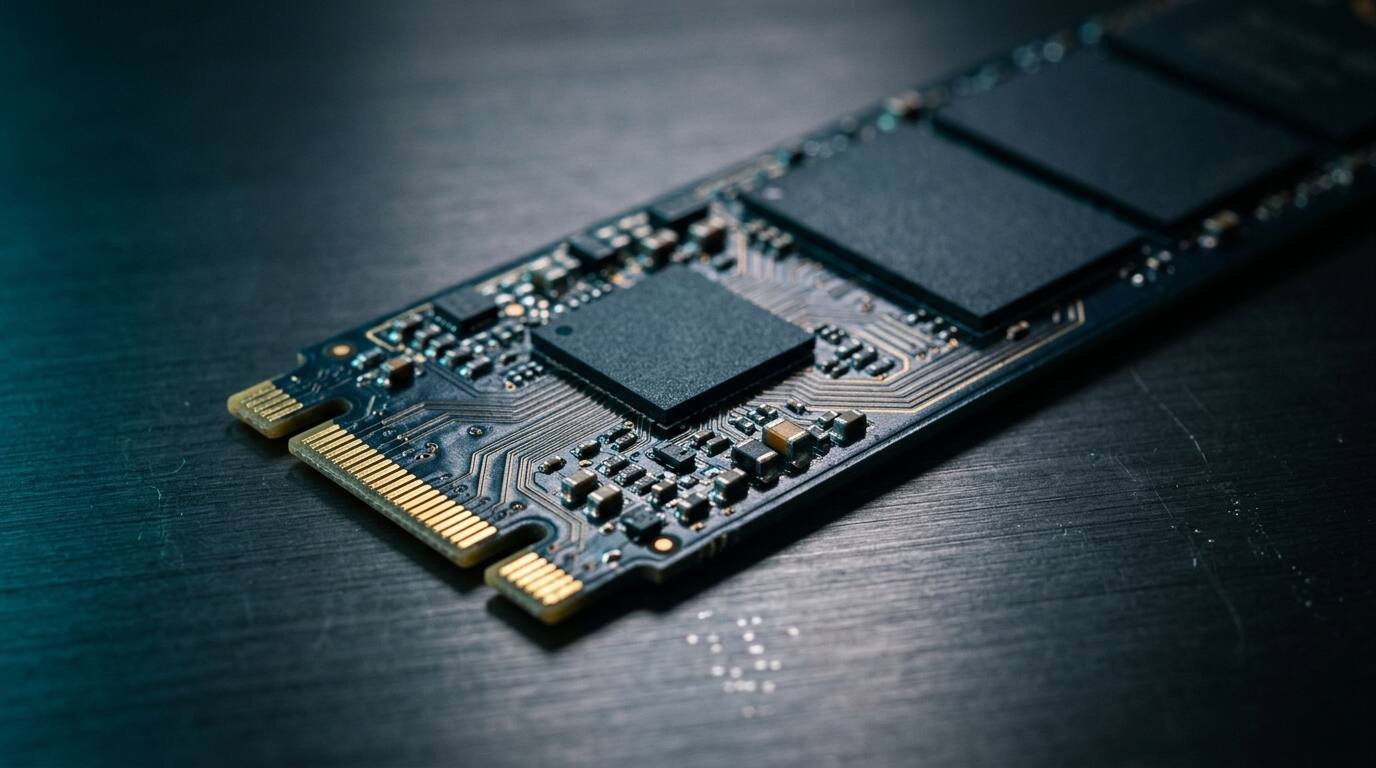
Micron’s 9650 delivers 28,000 MB/s in data centers, yet consumer PCIe 6.0 drives are not expected before late 2027. The signaling, controller and NAND reasons behind the gap.
In February 2026, Micron said its 9650 had entered mass production and described it as the first PCIe 6.0 SSD to ship at scale. The numbers are striking: sequential reads of up to 28,000 MB/s, about double what a PCIe 5.0 drive can sustain.
Anyone who builds PCs will ask the obvious follow-up, and the industry’s answer is a shrug stretched across several years. Silicon Motion, whose controllers sit inside many consumer drives, has pointed to roughly the end of 2027 for its first PCIe 6.0 client platform, with finished drives possibly landing after that. Why would a technology already in production sit out the consumer market?
The reasons are physical, economic and strategic, and they fit into four questions. What does the new interface change? What did Micron actually ship? What has Silicon Motion said about desktops and laptops? And could flash memory itself become the bottleneck? Throughout, vendor claims and reported roadmaps are labeled as such, because no consumer PCIe 6.0 SSD exists to test.
What Changes Between PCIe 5.0 and PCIe 6.0?
The headline is raw speed. The per-lane signaling rate doubles from 32 to 64 GT/s, which gives a four-lane SSD a theoretical ceiling of roughly 32 GB/s in each direction, according to igor’sLAB. Reaching that figure required a different way of encoding data.
PCIe 5.0 and its predecessors send one bit per symbol using two voltage levels. PCIe 6.0 switches to PAM4 signaling, where four levels carry two bits per symbol. Packing four levels into the same voltage swing shrinks the gap between them, so errors become likelier. To compensate, the standard adds FLIT-based transmission, which packages data in fixed-size units, together with forward error correction. The same igor’sLAB report lists the consequences: more complex PHYs, stronger error correction, probably higher power draw, renewed cooling challenges and trickier signal paths on the motherboard.
| Feature | PCIe 5.0 | PCIe 6.0 |
|---|---|---|
| Signaling rate per lane | 32 GT/s | 64 GT/s |
| Signaling | Two voltage levels (NRZ) | Four voltage levels (PAM4) |
| Theoretical x4 bandwidth, per direction (approximate) | About 16 GB/s | About 32 GB/s |
| Practical SSD sequential read ceiling | About 14,000 MB/s (Micron’s Gen5 baseline) | 28,000 MB/s (Micron 9650, vendor claim) |
What Micron Shipped, and Why It Isn’t a Desktop Drive
The 9650 is a PCIe Gen6 x4 NVMe 2.0 drive built on Micron’s G9 TLC NAND and sold in E1.S and E3.S enterprise form factors. StorageReview lists two lines: a PRO model from 7.68 TB to 30.72 TB rated for one drive write per day over five years, and a MAX model from 6.4 TB to 25.6 TB rated for three. Other outlets quote slightly different capacity ceilings, so check Micron’s datasheet before relying on any single figure.

Here are the vendor specifications as reported:
- Sequential: 28,000 MB/s read and 14,000 MB/s write
- Random read: 5.4 to 5.5 million IOPS
- Random write: 500,000 to 570,000 IOPS (PRO) and up to 900,000 (MAX)
- Maximum power: 25 W
- Versus Gen5 enterprise drives, per Micron: about 100% more sequential read, 40% more sequential write, 67% more random read and 22% more random write
Micron credits those gains to bandwidth plus efficiency. Sequential read efficiency reaches 1,120 MB/s per watt, about twice that of a Gen5 drive inside the same 25 W envelope. Every figure above is a vendor specification, and none of the sources I read included independent test data.
The target market explains the design. These drives serve AI training, inference and retrieval workloads in racks that can use air or liquid cooling, and TechSpot reports that E1.S versions up to 15.36 TB are optimized for liquid. A 25 W drive with engineered airflow poses a different problem than an M.2 stick tucked under a laptop’s heat spreader.
One more detail from TechSpot’s coverage deserves attention. Micron began demonstrating its PCIe 6.0 technology a year before launch, when no compatible hardware peripherals existed, and then spent 18 months validating interoperability. My read, which is inference: if a major flash maker needed that long in data centers, the consumer ecosystem of CPUs, chipsets and boards has even further to travel.
Cost and power budgets explain much of the gap between the two markets, and this part is my analysis rather than reporting from the sources. Data center buyers pay for bandwidth because accelerators sit idle while they wait on storage, and they run drives in chassis designed around airflow or liquid cooling. A mainstream laptop or desktop has neither the thermal headroom nor the parts-cost budget to absorb a PAM4 PHY, a larger controller and more NAND channels. That mismatch, more than any single technical hurdle, may be why the same interface can be routine in a server and years away from a retail box.
What Silicon Motion Has Actually Said About Client Drives
Silicon Motion’s consumer controller for this generation is called Neptune. Early roadmap figures put sequential reads above 25 GB/s and random performance up to 3.5 million IOPS, though igor’sLAB stresses that these come from earlier targets rather than a datasheet and may change.
Timing has shifted. According to igor’sLAB, Silicon Motion showed Neptune in 2025 with mass production planned for 2028 and finished consumer SSDs expected from 2029 or later. In an interview with Tom’s Hardware, Senior Vice President Nelson Duann moved the first PCIe 6.0 client platform up to about the end of 2027. I could not open the Tom’s Hardware piece itself, so these statements reach this article through igor’sLAB’s reporting. That coverage also notes that no SSD has been announced and expects wider availability later than 2027.
Design choices remain open. Under consideration, per the same report, are eight NAND channels and 16 KB LDPC error-correction codewords, with neither decided. For comparison, the company’s enterprise controller, the SM8466, uses 16 NAND channels and is expected in 2026.
Why NVIDIA, Not AMD or Intel, Is Setting the Pace
Duann’s explanation for the earlier schedule has little to do with gaming desktops. He credited NVIDIA’s push into high-performance client systems built for local AI, and he said neither AMD nor Intel is currently pressing hard for PCIe 6.0 in the client segment.
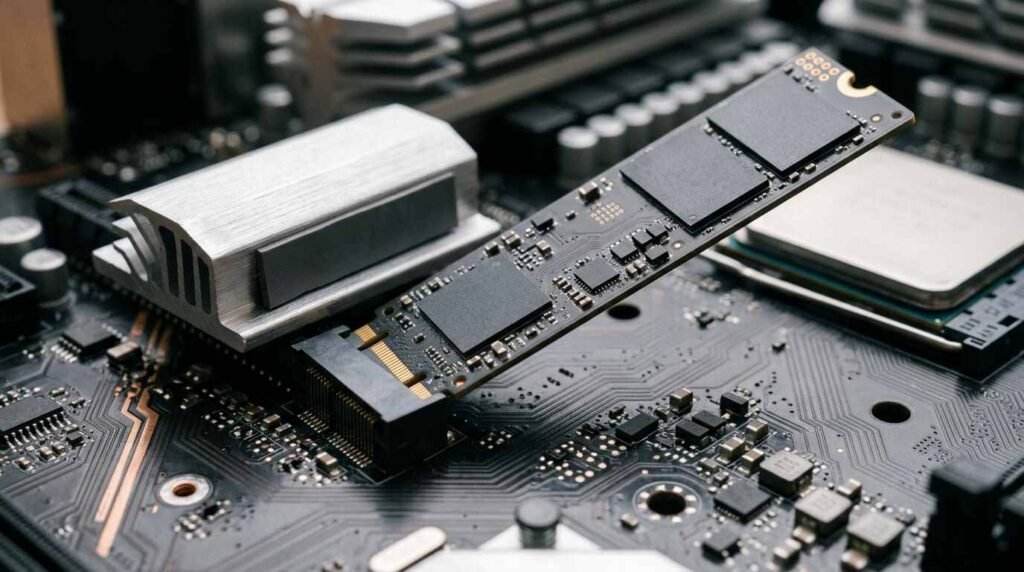
The reported example is NVIDIA’s RTX Spark platform, shown at Computex 2026, which pairs a Blackwell RTX GPU with a Grace CPU and up to 128 GB of shared memory. Silicon Motion expects platforms like that to demand far more memory bandwidth. NVIDIA, however, has not publicly said that RTX Spark supports PCIe 6.0 for internal SSDs, so the link between that platform and fast client storage is an expectation rather than a confirmed specification. In data centers the picture is clearer: AMD’s EPYC Venice and NVIDIA’s Vera Rubin are both reported to support the interface.
The NAND Problem Nobody Can Engineer Around
Interface speed means little without enough flash behind it. Reaching tens of gigabytes per second takes many NAND channels working in parallel, which is why channel counts appear in the roadmap discussion at all. And flash may be scarce. Duann expects shortages to worsen in 2027 as AI data centers claim a larger share of production, and he says PC makers increasingly buy through module makers because securing NAND directly has become harder.
igor’sLAB’s analysis, which is inference rather than reporting, is that premium segments are the likeliest first home for client PCIe 6.0 drives, that mainstream models may stay on PCIe 4.0 or 5.0 for longer, and that prices could rise as supply tightens. One figure in the coverage, a claim that 70 to 80 percent of NAND supply will go to AI data centers, is labeled a sector forecast rather than verified market data, so I haven’t treated it as fact.
What to Do While You Wait
These are my own suggestions, not findings from the sources:
- Check the slot, not just the drive. Confirm which PCIe generation and how many lanes your M.2 slot receives from the CPU or chipset. A newer drive in an older slot runs at the slot’s speed.
- Shop for sustained and random performance. Peak sequential figures describe a short burst. Sustained writes, random I/O, endurance and thermals shape everyday use.
- Treat consumer PCIe 6.0 claims with suspicion for now. I found no consumer PCIe 6.0 SSD announced, so any product advertising it today deserves a hard look.
Frequently Asked Questions
Can I buy a PCIe 6.0 SSD today?
Only in enterprise form. Micron’s 9650 ships in E1.S and E3.S formats for data centers, and none of the sources I reviewed describes a retail PCIe 6.0 drive.
Would a PCIe 6.0 drive work in a PCIe 5.0 slot?
PCIe is built to negotiate down to the speed both ends support, so in principle yes, at the slower rate. With no consumer drive available, that remains untested in practice.
Will it make games and apps load faster?
I found no benchmark evidence either way. Load times depend on more than raw throughput, including processor work and software design, so be cautious about promises.
How much faster is it, really?
On paper, the theoretical limit doubles to about 32 GB/s for a four-lane link. Micron’s own comparison sets the 9650’s 28,000 MB/s sequential read against roughly 14,000 MB/s for Gen5 drives.
Sources
- StorageReview: Micron 9650 NVMe SSD enters mass production as first PCIe Gen6 enterprise SSD (capacities, endurance, performance specifications)
- TechSpot: Micron’s world-first PCIe Gen 6 SSD doubles speeds (performance, cooling, validation timeline)
- igor’sLAB: Silicon Motion advances PCIe 6.0 client SSDs to late 2027 (roadmap, NVIDIA, PCIe 6.0 requirements, reporting on the Tom’s Hardware interview)
- igor’sLAB: Silicon Motion Neptune and the NAND problem in 2027 (Neptune targets, NAND supply)



2 Comments