
On Monday, December 7, 2026, the sun drops below the New York horizon at 4:28:26 p.m. Eastern Standard Time, and on Tuesday it does the same thing at the same second, according to the December 2026 table at sunrise-sunset.org. Those two afternoons hold the earliest sunset of the year. The winter solstice, the date most people would bet on, arrives two weeks later, at 3:50 p.m. EST on December 21 by the U.S. Naval Observatory’s count, and by then the sun is already setting more than three minutes later.
The darkest morning is a third date altogether. The calculation further down puts the latest sunrise on January 4, 2027, almost two weeks after the shortest day, and the Naval Observatory’s calculator gives 7:20 a.m. for New York that morning. The season’s darkness runs on three separate schedules, and only one of them belongs to the solstice.
Three dates, one dark season
The Naval Observatory’s numbers, minute by minute, for the four days that matter
The U.S. Naval Observatory publishes rise, set and transit times through a public API, rounded to the minute. Queried for latitude 40.71° N, longitude 74.01° W, at UTC−5, it returns this:
| Date | Sunrise | Solar noon (upper transit) | Sunset | USNO source |
|---|---|---|---|---|
| Mon, Dec 7, 2026 | 7:06 a.m. | 11:48 a.m. | 4:28 p.m. | Dec 7 |
| Tue, Dec 8, 2026 | 7:07 a.m. | 11:48 a.m. | 4:28 p.m. | Dec 8 |
| Mon, Dec 21, 2026 (solstice) | 7:17 a.m. | 11:54 a.m. | 4:32 p.m. | Dec 21 |
| Mon, Jan 4, 2027 | 7:20 a.m. | 12:01 p.m. | 4:42 p.m. | Jan 4 |
The middle column carries the whole story. Solar noon, the moment the sun crosses the meridian and stands highest, slides from 11:48 a.m. on December 7 to 12:01 p.m. on January 4. That is 13 minutes of drift in four weeks. A day with a fixed amount of daylight hung on a moving noon has to move both ends with it.
Sunrise-sunset.org’s seconds-level table lines up with the Navy’s minutes to within one. It lists December 21 with a sunset of 4:31:49 p.m., a sunrise of 7:16:35 a.m. and a day length of 9 hours, 15 minutes and 14 seconds, the shortest of the month, and a solar noon of 11:54:12 a.m.
A noon that shows up late
The wall clock keeps an average, and the sun has never agreed to it
Timeanddate.com puts the cause in one line: the gap comes from a discrepancy between modern timekeeping and time measured by the Sun. Astronomers have a name for that discrepancy, the equation of time, defined on the same page as apparent solar time minus mean solar time.
Mean solar time is the clock on the wall. It assumes every day lasts exactly 24 hours, like a punch clock that pays the same shift length all year. Apparent solar time is what a sundial reads, and the sundial’s day stretches and shrinks over the year. According to timeanddate, the variation comes from the elliptical shape of Earth’s orbit and its axial tilt, and near the solstices the solar day runs longer than 24 hours, so solar noon arrives a little later each day. The calculation further down puts that slip at about half a minute per day in New York.
The orbit part ties to a law that is four centuries old. Kepler’s second law says a line from the Sun to a planet sweeps out equal areas in equal times, a rule x9m8’s Orbit Lab lets readers watch in motion. Equal areas mean a planet covers more of its path when it is close to the Sun. Earth’s closest approach, perihelion, comes on January 2, 2027, at 9:33 p.m. EST per the Naval Observatory, squarely inside the stretch when solar noon keeps slipping later.
The same split shows up south of the equator. Timeanddate lists Sydney’s earliest sunset in mid-June and its latest sunrise at the end of the month.
Running NOAA’s equations from Thanksgiving to mid-January
A Python run of the Sun’s position, and a bowl with a very flat bottom
To see the split day by day, x9m8 computed New York sunrise and sunset for every date from November 25, 2026, through January 15, 2027, plus a wider window to confirm the extremes. The calculation used the open-source Python library astral (version 3.2), whose sun module, its documentation says, was adapted from NOAA’s solar calculation spreadsheets. Coordinates were the same 40.71° N, 74.01° W used for the Navy query, with times in fixed EST.
The computed results:
| Date | Sunrise | Sunset | Daylight |
|---|---|---|---|
| Nov 29, 2026 | 6:58:56 a.m. | 4:29:35 p.m. | 9 h 30 m 40 s |
| Dec 7, 2026 | 7:06:48 a.m. | 4:28:11 p.m. | 9 h 21 m 24 s |
| Dec 8, 2026 | 7:07:41 a.m. | 4:28:11 p.m. | 9 h 20 m 30 s |
| Dec 14, 2026 | 7:12:31 a.m. | 4:28:58 p.m. | 9 h 16 m 27 s |
| Dec 21, 2026 | 7:16:51 a.m. | 4:31:34 p.m. | 9 h 14 m 43 s |
| Dec 28, 2026 | 7:19:34 a.m. | 4:35:52 p.m. | 9 h 16 m 18 s |
| Jan 4, 2027 | 7:20:29 a.m. | 4:41:37 p.m. | 9 h 21 m 7 s |
| Jan 15, 2027 | 7:18:15 a.m. | 4:52:55 p.m. | 9 h 34 m 40 s |
The run lands on the same dates as both published sources. Its earliest sunset comes on December 7 and December 8, two-tenths of a second apart, and its latest sunrise on January 4. The computed sunsets run about 15 seconds earlier than sunrise-sunset.org’s, and the computed sunrises about 15 seconds later, a gap small enough to come from modeling choices such as how refraction near the horizon is handled. Every computed sunset rounds to the Navy’s minute in the table above; the December 7 and 8 sunrises round one minute past the Navy’s figures.
The mechanism shows up in the day-to-day changes. From December 7 to December 8, daylight shrinks by about 54 seconds, so each end of the day pulls in by roughly 27 seconds, while solar noon moves 26 seconds later. The two cancel, and sunset moves by −0.2 seconds. Between January 4 and 5 the same tug-of-war runs at the other end: half the daylight gain is 28.3 seconds, noon drifts 28 seconds, and sunrise barely moves at all. Around the solstice itself the daylight change is almost zero, so both sunrise and sunset ride the noon drift and move about 30 seconds later each day.
The publish date of this post makes the point in a smaller way. On November 29, New York’s computed sunset is 4:29:35 p.m. The earliest sunset of the year is only 84 seconds earlier than that.
Miami, Seattle and Anchorage
The farther north the clock hangs, the more tightly the three dates squeeze together
Timeanddate notes that places closer to the equator have their earliest sunset sometime in November, while higher latitudes see it closer to the solstice. The same astral run, pointed at three more U.S. cities, shows how wide that spread gets:
| City (latitude, time zone) | Earliest sunset | Latest sunrise | Days before / after Dec 21 | Solstice daylight |
|---|---|---|---|---|
| Miami (25.76° N, EST) | Nov 29, 5:28:59 p.m. | Jan 13, 7:09:16 a.m. | 22 / 23 | 10 h 31 m |
| New York (40.71° N, EST) | Dec 7–8, 4:28:11 p.m. | Jan 4, 7:20:29 a.m. | 13 / 14 | 9 h 15 m |
| Seattle (47.61° N, PST) | Dec 10, 4:17:19 p.m. | Jan 1, 7:57:53 a.m. | 11 / 11 | 8 h 25 m |
| Anchorage (61.22° N, AKST) | Dec 16, 3:39:30 p.m. | Dec 26, 10:16:13 a.m. | 5 / 5 | 5 h 26 m |
Miami’s earliest sunset falls on the very day this post goes up.
The reason is a matter of which force is bigger. The noon drift is nearly the same for every city on this list, about 23 seconds a day on December 1 in the computed numbers. What changes with latitude is how fast daylight is collapsing. On that same date, Miami loses about 40 seconds of daylight a day, New York about 75, Seattle about 99 and Anchorage about 209. A city losing daylight fast keeps pulling sunset earlier long after the noon drift has started pushing it later, so the turning point slides toward the solstice. Near the equator, daylight changes so little that the drift wins weeks ahead of time.
Changing the time zone offset slides every time on a city’s list by the same amount, so it moves the clock readings and leaves the dates alone.
The case for shrugging
Three and a half minutes, a flat-bottomed curve and a solstice that still wins the main event
The strongest argument against making anything of this is that the solstice keeps the title that counts. December 21 is still the shortest day of the year in New York, by both sunrise-sunset.org’s table and the calculation above. The difference between the earliest sunset and the solstice sunset is 3 minutes and 23 seconds in the computed numbers. Nobody on the Long Island Expressway at 4:30 p.m. will be able to tell the two evenings apart, and if anyone claims otherwise, the traffic is the more likely culprit.
There is also a precision problem. The “earliest sunset” isn’t a sharp point but the bottom of a very shallow bowl. In the computed series, every sunset from December 3 to December 12 sits within 30 seconds of the minimum, and rounded to the minute, the computed sunsets read 4:28 p.m. on every day from December 4 through December 11. The latest sunrise is flatter still: computed sunrises from December 28 to January 11 all round to 7:20 a.m. Any claim that crowns a single date is reading tenths of a second off a curve that the sky draws with a thick marker.
Both objections are fair. Neither one makes the split go away, because the split is about direction, and direction compounds. From December 8 to January 4, sunrise and sunset in New York both move later every day. For four weeks, evenings gain light while mornings lose it.
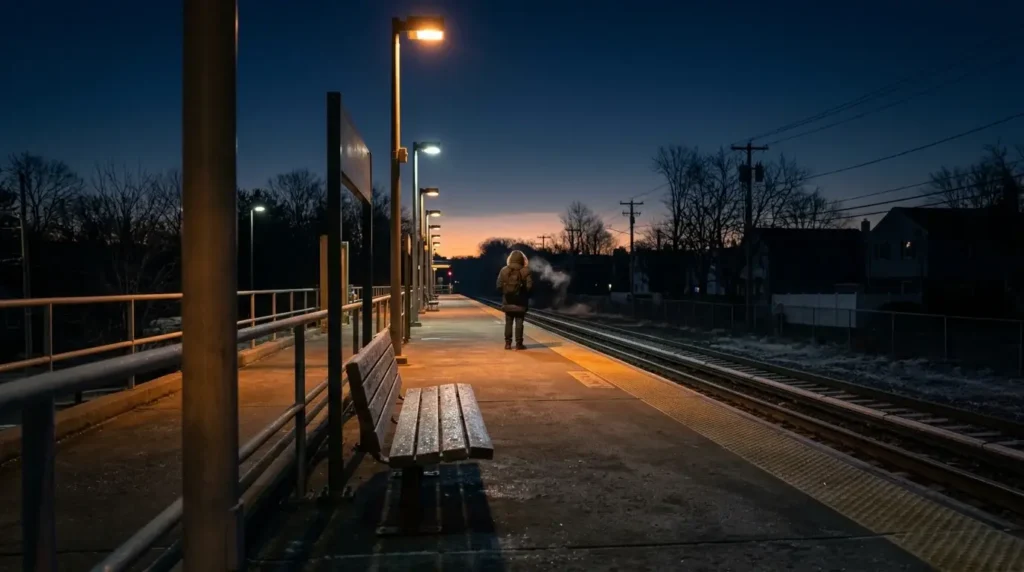
Where the new daylight goes
January’s longer days are mostly a gift to the afternoon
By January 15, 2027, New York has about 20 minutes more daylight than on the solstice, by the computed table. Almost none of it arrives at breakfast. Sunset on January 15 comes 24 minutes and 44 seconds later than the earliest sunset of December 7. Sunrise on the same day is 2 minutes and 14 seconds earlier than the latest sunrise of January 4.
The ledger is lopsided like a boiler that heats the top floor first. Anyone who leaves work at five gets the improvement in December; anyone who walks a dog at seven waits until the middle of January for the first real change. Skywatchers get the reverse of the commuter’s deal. After December 8 the sky starts going dark a little later each evening, so anyone reworking x9m8’s October 2026 night sky plan for winter evenings loses a few seconds of early darkness a night, even while the nights as a whole keep lengthening until the solstice.
The equation of time doesn’t care who notices. It will run the same way next December, with the same back-to-back ties and the same quiet Navy tables, and the solstice will again get the attention while 4:28 p.m. does the work.
In New York, which hurts more: the 4:28 sunset in early December, or the 7:20 sunrise in early January?
Sources
- sunrise-sunset.org, “Sunrise and sunset times in New York, December 2026”: https://sunrise-sunset.org/us/new-york-ny/2026/12
- U.S. Naval Observatory, Astronomical Applications API, Earth’s seasons 2026 (UTC−5): https://aa.usno.navy.mil/api/seasons?year=2026&tz=-5
- U.S. Naval Observatory, Astronomical Applications API, Earth’s seasons 2027 (UTC−5): https://aa.usno.navy.mil/api/seasons?year=2027&tz=-5
- U.S. Naval Observatory, rise/set/transit, New York, Dec 7, 2026: https://aa.usno.navy.mil/api/rstt/oneday?date=2026-12-07&coords=40.71,-74.01&tz=-5
- U.S. Naval Observatory, rise/set/transit, New York, Dec 8, 2026: https://aa.usno.navy.mil/api/rstt/oneday?date=2026-12-08&coords=40.71,-74.01&tz=-5
- U.S. Naval Observatory, rise/set/transit, New York, Dec 21, 2026: https://aa.usno.navy.mil/api/rstt/oneday?date=2026-12-21&coords=40.71,-74.01&tz=-5
- U.S. Naval Observatory, rise/set/transit, New York, Jan 4, 2027: https://aa.usno.navy.mil/api/rstt/oneday?date=2027-01-04&coords=40.71,-74.01&tz=-5
- timeanddate.com, “Why Isn’t the Year’s Earliest Sunset on the Winter Solstice?”: https://www.timeanddate.com/astronomy/earliest-sunset.html
- Astral documentation (sun calculations adapted from NOAA spreadsheets): https://astral.readthedocs.io/en/latest/
- x9m8, “Orbit Lab: Kepler’s Laws, the Real Planets and a Hohmann Transfer to Mars”: https://x9m8.com/orbit-lab-kepler-laws-planets-hohmann-transfer-mars/
- x9m8, “October 2026 Night Sky: A Seven-Step Plan for the Rest of the Month”: https://x9m8.com/october-2026-night-sky-viewing-plan/