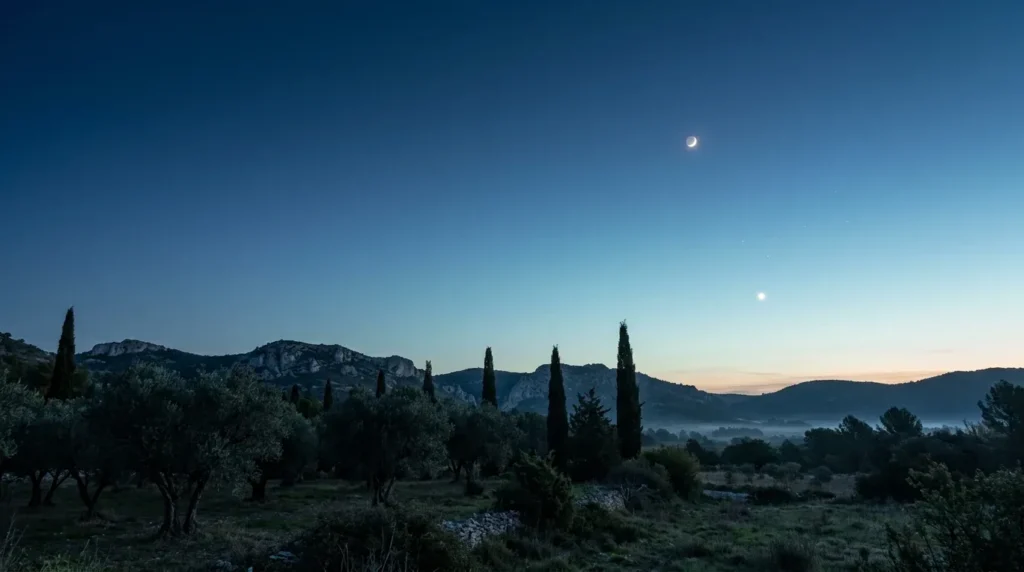
Sometime between the last day of May and the first week of June 1889, Vincent van Gogh wrote to his brother Theo from the asylum at Saint-Rémy-de-Provence that he had looked out his window long before sunrise and seen nothing but the morning star, which looked very big. The editors of his collected letters identify that star as Venus. About two weeks later he told Theo he had a new study of a starry sky, the painting now called The Starry Night. A paper published on October 22, 2026, argues that the sky in it belongs to a different morning entirely: July 22, 1889.
The disagreement is about five weeks wide. It matters because one side has the painter’s own letter and the other has the Moon, and the Moon does not take dictation.
A crescent, a planet and a V of stars
What the Scientific Reports team says it found over Saint-Rémy
The paper is “The actual sky of Van Gogh’s Starry Night: a multidisciplinary reconstruction,” by Elijah Jeong-hyun Kim and colleagues, published in Scientific Reports, volume 16, article 31109. Kim is the CEO of the South Korean robotic telescope company SLLAB and a Ph.D. candidate at Kyung Hee University’s School of Space Research, according to Space.com.
The team’s claim rests on three objects. The painted Moon is a waning crescent. Venus is present. And the cluster of stars, which one 1980s analysis read as part of Aries, the authors identify as the Hyades, the V-shaped cluster in Taurus. Kim put it plainly, as quoted by Popular Science: “To an observational astronomer, the cluster of stars in ‘The Starry Night’ is the Hyades in Taurus.”
To test how closely painted stars match a real pattern, the group used Procrustes shape analysis, a statistical technique that scores how closely a set of painted points matches a given constellation. Kim traveled to France in June and July 2019 to find the view the painter would have had from his window. As a control, the team ran the same method on Starry Night Over the Rhône, which clearly shows the Big Dipper; Science News reports that the degree of matching came out similar for both paintings.
Some of the evidence is not astronomical at all. The Nature Asia press release says the authors checked historical weather records to see whether the sky was clear enough, read van Gogh’s mentions of cicadas as a sign of hot weather that fits recorded July temperatures, and used his earlier landscape sketches to reconstruct the narrow field of view in the painting.
The authors hedge their own result. The same release says the evidence cannot definitively establish a single completion date, and that observations from several nights may have been combined in the canvas. Kim’s proposal, as Space.com reports it, is that van Gogh conceived the painting in June and finished it after July 22.
The full paper on nature.com could not be retrieved for this post. The claims above come from the publisher’s press release and from reporting that quotes the authors.
The same sky, recomputed
Saint-Rémy at civil dawn, June 18 and 19 against July 22, from a planetary theory in Python
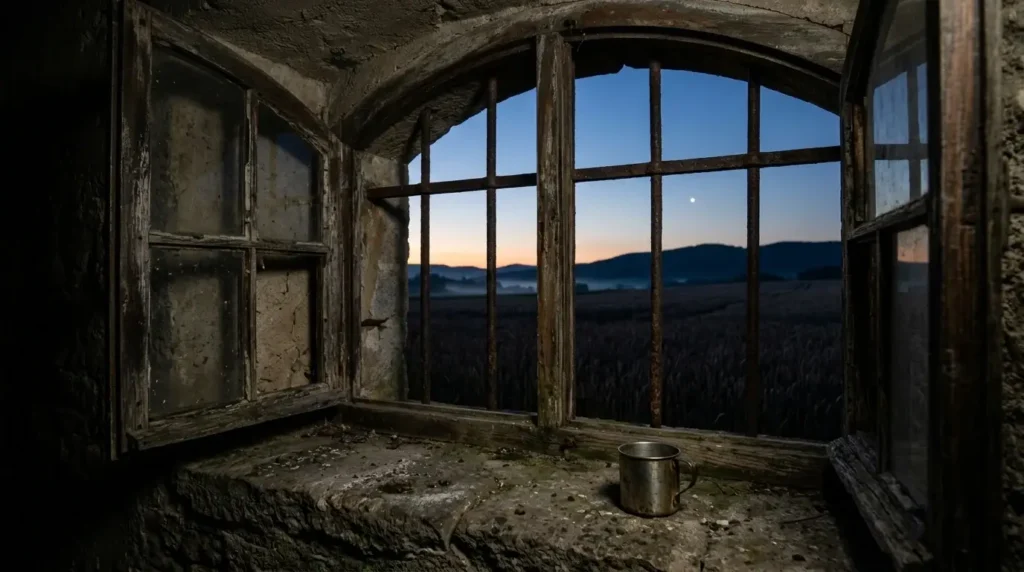
Checking the sky is the cheap part of this argument, so x9m8 did it. The calculation used PyEphem, a Python package that wraps the libastro C library behind the XEphem astronomy program and computes planet positions using methods from Jean Meeus’s Astronomical Algorithms, accurate to around one arcsecond by its own account. A second, independent check with the Astropy library’s built-in ephemeris matched the Moon and Venus positions below to within about a tenth of a degree. The observer was placed at approximately 43.78° N, 4.83° E, the town of Saint-Rémy, at 60 meters. Times are local mean solar time, which at this longitude runs about 19 minutes ahead of Greenwich. “Civil dawn” is the moment the Sun sits 6 degrees below the horizon, when the brightest objects are still easy to see and the landscape is starting to show.
| Morning, 1889 (civil dawn) | Moon, lit fraction | Moon altitude / direction | Venus altitude / direction | Aldebaran (Hyades) altitude | Moon to Venus |
|---|---|---|---|---|---|
| June 18, 3:40 a.m. | 73%, waning gibbous | 29°, south-southeast | 16°, east | 1°, at the horizon | 74° |
| June 19, 3:40 a.m. | 63%, waning gibbous | 30°, southeast | 16°, east | 1°, at the horizon | 61° |
| June 24, 3:41 a.m. | 16%, waning crescent | 17°, east | 18°, east | 5°, barely up | 2° |
| July 22, 4:03 a.m. | 28%, waning crescent | 36°, east-southeast | 26°, east | 28°, east | 18° |
Full Moon fell on June 13, 1889 by the same calculation, with last quarter on June 20 and new Moon on June 28. On the morning of the letter, the Moon was well past full and still more than half lit. That is no crescent, and the mismatch sits at the center of the case against mid-June as the coverage reports it. (Science News describes the June 19 Moon as waxing gibbous; the computation, and Popular Science’s account, have it waning. Either way, it is a fat Moon.)
July 22 is a different picture. The Moon is a 28% crescent riding high in the east, Venus is blazing at magnitude −4.2 about 26 degrees up, and Aldebaran, the brightest star in the Hyades’ V, sits about 28 degrees up and roughly six and a half degrees from Venus. Popular Science reports the study’s description of the Hyades rising in the eastern sky alongside Venus. The numbers agree with that.
Venus itself settles nothing. By the computation, the planet reached its greatest distance west of the Sun on about July 10, 1889, at nearly 46 degrees, so it was a bright morning star all summer, as the letter editors’ note says for mid-May through June. A morning star in the painting fits either month.
The crescent that came in June too
Four days after the letter, the Moon was thin again
None of the coverage cited here mentions the table’s third row. The Moon does not stay gibbous, and six days after the letter it had thinned to a crescent. On June 24, 1889, by the calculation, a 16% crescent hung in the east at dawn about two degrees from Venus, a tighter pairing than anything on July 22. A crescent Moon next to a brilliant morning star was available within a week of the letter that announced the painting.
What late June did not offer was the Hyades. At civil dawn on June 24, Aldebaran was about five degrees above a flat horizon, and on the hills around Saint-Rémy it may not have cleared them at all. By late July, Earth’s orbit had carried Taurus well up into the morning sky.
That narrows the dispute into something sharper than “Moon versus letter.” If the painted cluster is the Hyades, the sky points to late July. If the painted cluster is something else, or nothing in particular, late June offers a crescent and Venus within days of the letter. The star identification carries the weight, and the star identification is exactly what the critics attack.
The calculation also shows how fast the configuration drifts. Moon to Venus was 29 degrees on July 21, 18 on July 22, and about 7 on July 23. A painting that froze one of those mornings would have to be read very precisely to tell them apart; a painting made over several sittings would blur them.
Letters against the sky
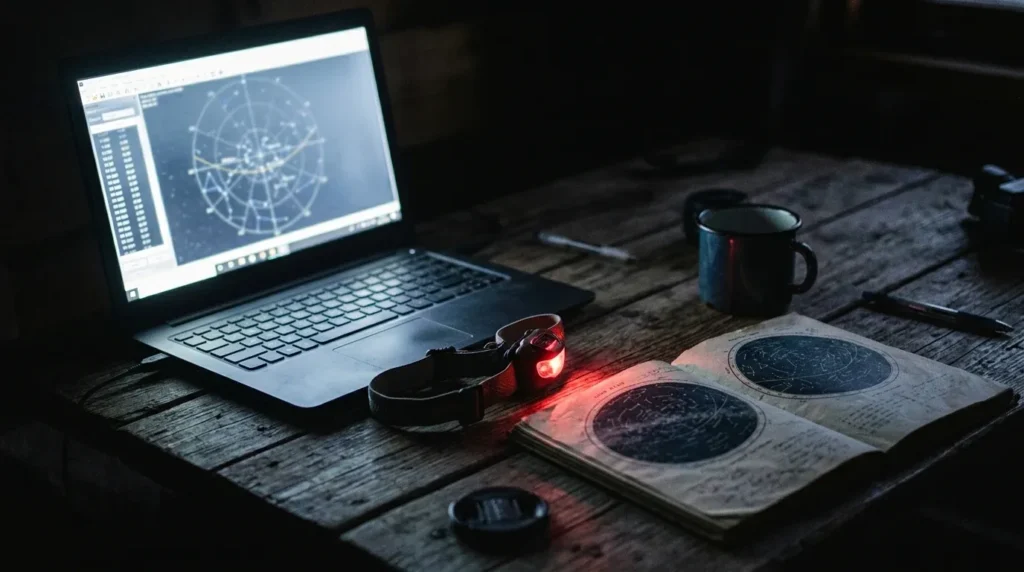
The dated record, in order, from the sources
- April 12, 1888. In a letter from Arles, van Gogh describes wanting to paint a starry sky, per Space.com’s account of the study.
- About May 31 to June 6, 1889. Letter 777 to Theo from Saint-Rémy: the view from the window before sunrise, the “morning star,” which the edition’s note identifies as Venus.
- On or about June 18, 1889. Letter 782: “At last I have a landscape with olive trees, and also a new study of a starry sky.” The edition’s note identifies the study as Starry Night (F 612 / JH 1731). An older edition dated the letter June 19.
- About June 22 to 26, 1889. Waning crescent in the dawn east near Venus, Aldebaran only 3 to 6 degrees up (x9m8 calculation above).
- Probably July 16 or 17, 1889. Van Gogh suffers an attack shortly after a trip to Arles, according to the editors’ note to letter 793, Theo’s letter of July 29.
- July 22, 1889. The Scientific Reports team’s proposed sky: waning crescent, Venus and the Hyades in the pre-dawn east.
- August 22, 1889. Letter 797: van Gogh writes that the crisis “came upon me in the fields,” while painting on a windy day, and that he had been unable to eat for four days. A note records that he tried to poison himself with paint and turpentine, probably why he was kept from his studio.
Science News sums up the art-historical view: the painting is dated to mid-June because of letter 782, and historians think it was made before an illness during which he didn’t paint for about six weeks.
Lay the July 22 date against that list and the problem is plain. The proposed morning falls five or six days after the attack the letter editors place on July 16 or 17, and before his next letter to Theo, on August 22, in which he writes that he had been absolutely distraught for many days and unable to go into the room set aside for his painting. The edition does not date that stretch exactly; July 22 sits inside the gap between the attack and the letter. Looking out a window at dawn does not require a studio. Finishing an oil painting usually does.
Donald Olson’s objections
A Texas astronomer proposes a test anyone with a printout can run
Donald Olson of Texas State University doubts the reconstruction. His first objection is geometric. He argued in Science News that “the authors’ assumed narrow field of view, essential for their theory” does not square with the wider view needed to take in the painting’s round hills and cliffs. Widen the frame and the Hyades match has more sky to compete with.
His second objection is a challenge. Olson suggests asking amateur astronomers to point to Aldebaran, the Hyades’ brightest star, in the painting. His guess, per Science News, is that an experienced amateur, even when prompted to see the Hyades, will not identify Aldebaran as either of the two stars to the left of the cypress tree. If the authors’ theory is correct, he said, “this should be easy.” It is a test that costs nothing but a printout and a few dozen people who know Taurus, the scientific equivalent of handing a stranger the wrench and seeing which bolt they reach for.
Olson also gives the plain reason the June date persists: historians favor it because “van Gogh himself said so.”
The 1980s round never settled the cluster either. Art historian Albert Boime began an analysis with astronomer George Abell at UCLA in 1984, and Harvard astronomer Charles Whitney continued the work later, and the analyses did not agree. Science News recounts that one proposed June 19, 1889, with the stars in Aries, while another ruled out June 19 on cloudy weather reports from Aix-en-Provence, about 70 kilometers away, and called the painting “a celestial composite, constructed to make an image of the morning sky.”

The case for July, at its strongest
A painting that disagrees with its own paperwork
The fair version of the July argument does not need van Gogh to have painted on July 22. It needs only that the finished sky looks like that morning. The letter of June 18 calls the canvas a “study,” and a study can be reworked. Kim’s own reading is exactly that: an idea in June, completion later. The researchers also cite art historians who see the painting as stylistically different from his other June works, according to Space.com.
The Moon is a hard fact on July’s side. On the morning of the letter and the two mornings either side, the computed Moon was more than half lit. Anyone holding to a canvas finished by June 18 has to accept that van Gogh invented the crescent, added it on a later morning, or painted the sky from memory and imagination. Any of the three is possible. None of them is evidence.
Kim himself concedes that apart from the Big Dipper, “there is no star pattern we can say for certain that Vincent painted.” The paper’s dating depends on reading the swirls of one canvas as a specific cluster. The ephemeris, as the table shows, can confirm what was in the sky on any morning. It cannot confirm what a patient at the asylum chose to put on the canvas.
A night sky over Saint-Rémy is still up there, and the same arrangement of crescent, Venus and Taurus returns on its own schedule. Earlier x9m8 posts laid out a month of night-sky viewing and how Kepler’s laws move the real planets, and the Gravity Lab simulator lets anyone push the Moon around for themselves.
Olson’s test is still sitting on the table. Print the painting, find someone who knows Taurus, and ask which star is Aldebaran. Readers who try it: which one did they pick?
Sources
- Nature Asia press release, “Astronomy: July sky may have inspired van Gogh’s The Starry Night (Scientific Reports),” October 23, 2026: https://www.natureasia.com/en/info/press-releases/detail/9468
- Kim, E.Jh., Kang, S., Song, J. et al., “The actual sky of Van Gogh’s Starry Night: a multidisciplinary reconstruction,” Scientific Reports 16, 31109 (2026), DOI 10.1038/s41598-026-73025-5 (could not be retrieved; cited via the press release): https://www.nature.com/articles/s41598-026-73025-5
- Lisa Grossman, “Was van Gogh’s ‘The Starry Night’ a flight of fancy or a real sky?,” Science News, October 22, 2026: https://www.sciencenews.org/article/van-gogh-starry-night-real-sky-stars
- Chelsea Gohd, “Van Gogh’s ‘The Starry Night’ depicts the sky on July 22, 1889, researchers find,” Space.com, October 22, 2026: https://www.space.com/astronomy/van-goghs-the-starry-night-depicts-the-sky-on-july-22-1889-researchers-find
- Laura Baisas, Popular Science, October 22, 2026: https://www.popsci.com/science/starry-night-van-gogh-date/
- Vincent van Gogh, letter 777 to Theo van Gogh, c. May 31–June 6, 1889, Van Gogh Letters edition: https://vangoghletters.org/vg/letters/let777/print.html
- Vincent van Gogh, letter 782 to Theo van Gogh, on or about June 18, 1889: https://vangoghletters.org/vg/letters/let782/print.html
- Theo van Gogh, letter 793 to Vincent van Gogh, July 29, 1889, with editorial notes: https://vangoghletters.org/vg/letters/let793/print.html
- Vincent van Gogh, letter 797 to Theo van Gogh, August 22, 1889: https://vangoghletters.org/vg/letters/let797/print.html
- PyEphem (calculation library; x9m8 computation, inputs and output in Notes): https://rhodesmill.org/pyephem/