





Do AI models play telephone better than people? Re-analysing about 51,000 hand-offs between language models: chat models almost never copy wording, but the gist survives about as well as it does between people.
Preprint, version 1 (October 2026). Not peer reviewed. This is the author’s manuscript, prepared for submission to a peer-reviewed journal. Code and derived results: download the reproducibility package (zip, 1.1 MB).
Cite as: Kalafatis, P. (2026). Rephrasing without replicating: Transmission fidelity in language-model telephone chains [Preprint]. x9m8.com.
Peter Kalafatis¹
¹ Independent researcher, x9m8.com, New York, USA. Correspondence: x9m8x7@gmail.com
Article type: Original Research
Keywords: cultural evolution; large language models; transmission chains; memetics; cultural attraction; transmission fidelity; machine culture
Social media summary: Chat AIs almost never pass text on word for word, yet the gist survives about as well as it does between people.
Abstract
Large language models now pass text to one another, so the dynamics of machine-to-machine transmission matter for cultural evolution. I apply the measures used for human transmission chains in an earlier error-threshold analysis to about 51,000 model-to-model transmissions from an open telephone-game dataset (seven models, 50 generations per chain, plus a sampling-temperature sweep). At the default temperature, chat-tuned models asked to rephrase almost never produced an exact copy (0 to 8 per 5,000 hand-offs, against 35–64% of human retellings), so selection could hold no wording in place without an advantage of several hundredfold. Base models copied 7–26% of the time, and copying became more likely as texts grew longer, the reverse of the human pattern: machine copying behaves as a discrete mode, not as leaky memory. The gist behaved much as it does between people. After a first hand-off that discarded about half or more of the seed’s content words, chat models lost 10–13% of content words per step and restored lost words 9–15 times more often than chance. Raising temperature quadrupled loss while leaving reconstruction flat. A two-state loss–reconstruction model predicted each condition’s long-run retention (r = 0.98, 11 conditions).
Introduction
Cultural transmission used to be something only people did. Large language models (LLMs) now summarise, rephrase and extend text, including one another’s output. Brinkmann et al. (2023) argued that intelligent machines are changing the cultural evolutionary processes of variation, transmission and selection, and that chatbots form a new mode of cultural transmission. If machines transmit culture, the questions cultural evolutionists ask of human transmission can be asked of machines, and the answers can be compared.
One of those questions concerns fidelity. Dawkins (1976) proposed that memes, like genes, are replicators whose success depends on longevity, fecundity and copying fidelity. Critics replied that people rarely copy anything: communication transforms what it passes on, and culture stays stable because transformations converge on the same attractors (Sperber, 1996; Claidière & Sperber, 2007). Others answered that cultural evolution does not require faithful replication of representations (Henrich & Boyd, 2002) and that stable traditions can arise with neither copying nor selection (Acerbi, Charbonneau, Miton & Scott-Phillips, 2021). In an earlier paper (Kalafatis, 2026) I turned this dispute into a measurement. Adapting Eigen’s error threshold (Eigen, 1971; Eigen, McCaskill & Schuster, 1988) to items that lose units with probability e and regain them with probability a per transmission, I estimated the parameters from open transmission-chain experiments (12,096 transmissions, 10,896 of them verbal). Per-word error rates in human recall of texts ranged from 0.030 to 0.117 per retelling. At plausible selective advantages, selection could hold an exact form in place only for items a few words long. Longer material persisted as gist, held near a resemblance of a/(a + e) by words that people restored.
That paper ended with a prediction: LLMs used as transmitters should show their own error rates and thresholds, measurable with the same methods. Several lines of work make the test possible. Acerbi and Stubbersfield (2023) ran classic transmission-chain designs with an LLM and found human-like content biases. Perez et al. (2025) built chains of LLM agents that rephrased, took inspiration from or continued a text for 50 generations, and showed that toxicity, positivity, difficulty and length drift toward attractors whose position depends on the model and the instruction. They released the generated texts. Acharjee, Aich, Mandal and Ali (2025) compared human-only, LLM-only and mixed summarisation chains using semantic measures of degradation, and Ghafouri and Ferrara (2026) tracked how certainty, emotion and balance change as content passes between AI systems. None of these studies asked how often a machine transmission is an exact copy, or how often individual words are lost and regained, or whether those rates fit the threshold model that applies to people. I am not aware of work that has done so.
This paper does. I re-analyse the rephrase chains of Perez et al. (2025) with the estimators of Kalafatis (2026), unchanged, so that model rates can be set beside human rates measured the same way. I ask four questions. Do LLMs copy exactly, and does copying fall with length as the threshold model assumes? Do they lose and reconstruct words at human-like rates? What does sampling temperature, a parameter with no human analogue, do to those rates? And does the two-state model predict where machine chains settle, a test that the shorter human chains could not support?
Model
The model is that of Kalafatis (2026), and I summarise only what the analysis uses. An item consists of L units. At each transmission every unit present in the version received is lost independently with probability e, and every unit absent from that version is restored with probability a. Two quantities follow.
The first concerns exact copies. Without reconstruction, a transmission reproduces an item exactly with probability Q(L) = (1 − e)^L ≈ exp(−μL), where μ = −ln(1 − e) is the per-unit error rate. If the intact item enjoys a selective advantage s over its variants, selection maintains it only when Q(L)(1 + s) > 1. Failures that do not depend on length can be absorbed by an intercept, Q(L) = q₀ exp(−μL). A small q₀ means that even the shortest item is rarely reproduced exactly; an intact form then needs s > 1/q₀ − 1 at any length, and if q₀ = 0 no finite advantage suffices.
The second concerns gist. Each unit behaves as a two-state Markov chain, and in the absence of selection the expected share of the original units that a descendant carries converges to a/(a + e), whatever the item’s length. In practice some units enter by chance, so I use the reconstruction rate above chance, a − a₀, and the predicted long-run share (a − a₀)/(e + a − a₀). The human chains in Kalafatis (2026) were analysed to depths of 6 to 20 generations, and their retention curves had not yet levelled off. The model chains run for 50.
Methods
Data
Perez et al. (2025) seeded chains with 20 human-written texts: 5 scientific abstracts, 10 news articles and 5 social-media comments, chosen to span a range of toxicity, positivity, difficulty and length. The seeds contained 91 to 760 word tokens (38 to 238 distinct content words). Each seed began five chains, and each chain ran for 50 generations, so each model and instruction yielded 100 chains and 5,000 transmissions. In the rephrase condition, each agent received the previous text with the instruction to rephrase it without modifying its meaning and to output only the new text. Perez et al. (2025) report generation at temperature 0.8 with nucleus sampling (top-p 0.95) unless varied. The data are at github.com/flowersteam/TelephoneGameLLM (commit 1b43c3d).
I analysed seven rephrase conditions: five chat-tuned models (GPT-3.5 Turbo 0125, Llama 3 70B Instruct, Llama 3 8B Instruct, Mixtral 8x7B Instruct v0.1 and Mistral 7B Instruct v0.2) and two base models (Llama 3 70B and Mixtral 8x7B v0.1) that received the same prompt. I also analysed the temperature sweep for Llama 3 8B Instruct at temperatures 0, 0.4, 0.8, 1.2 and 1.6. The folder for the default Llama 3 8B Instruct run and the folder for its temperature-0.8 run were byte-identical, consistent with the default temperature, so I treat them as one condition. At temperature 0, decoding is deterministic and the five chains for each seed were identical; I keep one chain per seed, leaving 1,000 distinct transmissions. Rows with an empty parent text (two, both for Mixtral 8x7B base) were skipped. This gives 11 distinct conditions and 50,998 transmissions. The take-inspiration and continue instructions, which ask for change rather than preservation, are reported as a contrast in Table S1.
The human comparison uses the published results of Kalafatis (2026) for the four verbal datasets: written recall of short texts in Gistr experiments 1–3 (Lerique, 2017) and spoken repetition of sentences heard in noise (Meylan, Nair & Griffiths, 2021). Most human seeds were 10 to 66 words long.
Measures
All text processing used the code of Kalafatis (2026) unchanged. Texts were split into lowercase alphanumeric tokens. Content words were tokens of three or more alphanumeric characters not on a fixed stop list.
Exact copies. A transmission was an exact copy if the child’s token sequence was identical to the parent’s. A lenient definition counted a copy as exact if the two texts had the same set of content words. Where exact copies occurred I fitted Q(L) = exp(−μL) and Q(L) = q₀ exp(−μL) (μ ≥ 0, multiple starting points) by binomial maximum likelihood, with L the parent’s length in words. Where none occurred I report the one-sided 95% Clopper–Pearson upper bound on Q, pooled over lengths, and the minimum selective advantage it implies, s* > 1/Q − 1. To test the threshold model’s assumption that copying falls with length, I fitted a logistic regression of exact copying on log₂ parent length with a fixed effect for each seed text, so that the slope compares longer and shorter versions of the same material (all 20 seeds varied in copying and were retained); its interval comes from a cluster bootstrap over seed texts (500 resamples). I also compared the probability of an exact copy after a transmission that was itself exact with the probability after one that was not.
Loss and reconstruction. For each chain, I tracked every content word of the seed. The loss rate e is the proportion of transmissions in which a seed word present in the parent was absent from the child. The reconstruction rate a is the proportion in which a seed word absent from the parent appeared in the child. The chance rate a₀ is the same quantity for a matched number of control words drawn at random, separately for each chain, from other seeds’ content words. Following Kalafatis (2026), e, a and a₀ were computed from generation 1 onward, because no seed word can be missing before the first transmission. I report the first hand-off separately as the share of seed content words retained in generation 1. Intervals are percentile cluster-bootstrap intervals over the 20 seed texts (1,000 resamples).
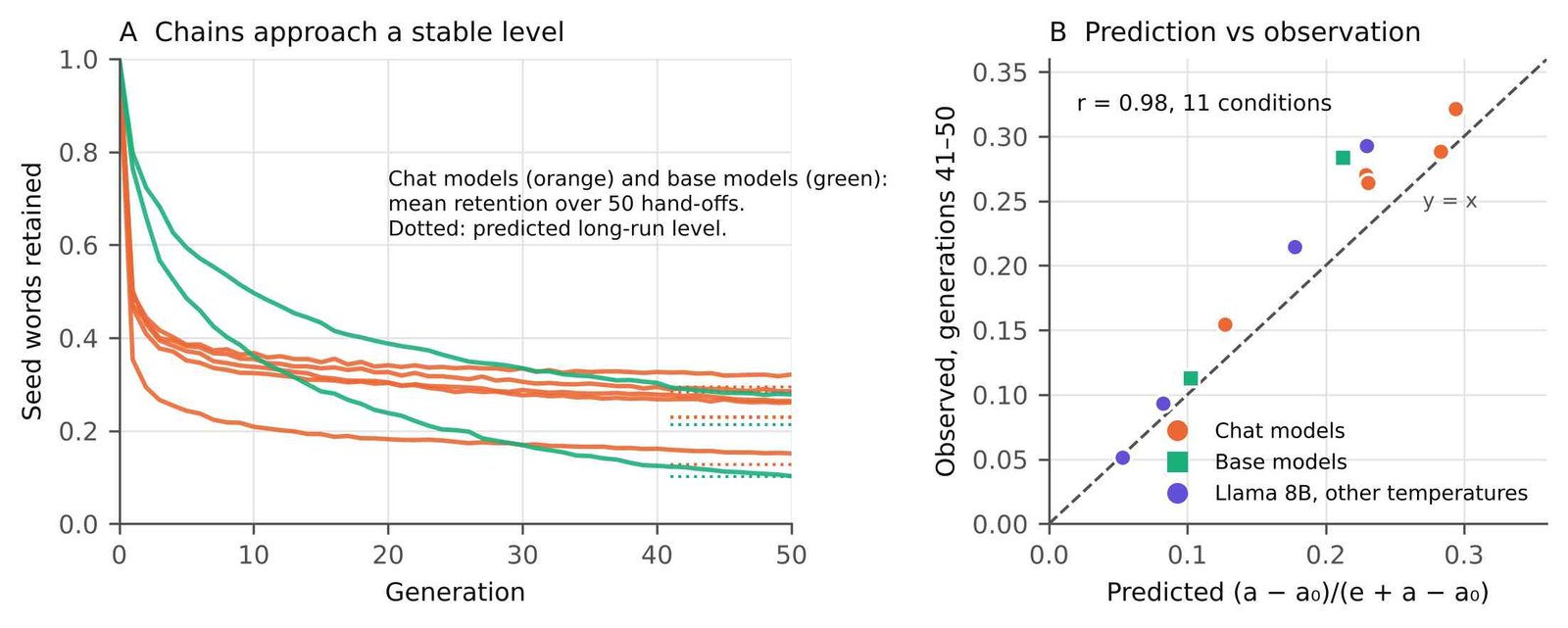
Long-run retention. I computed the mean share of seed content words present at each generation and compared the observed mean over generations 41–50 with the predicted level (a − a₀)/(e + a − a₀) across the 11 conditions. To separate reconstruction from heterogeneity in loss, I repeated the held-out analysis of Kalafatis (2026): word-specific loss and reconstruction rates, shrunk toward the mean by an empirical-Bayes beta-binomial prior, were estimated on three chains per seed (chains 1, 3 and 5) and used to predict the retention curve of the other two. As in that analysis, the word-specific loss rates here include the first hand-off. Three models were compared by root-mean-square error (RMSE): word-specific loss and reconstruction; word-specific loss with no reconstruction; and pooled rates. The temperature-0 condition has no distinct held-out chains and was excluded from this comparison. To describe the spread of per-word loss without the first-step shock, I also estimated word-specific loss from generation 1 onward on the same training chains, shrunk in the same way, for words present at least once after the first hand-off.
Sensitivity. A few outputs refused the task. I identified them with a text pattern (“I cannot”, “I’m sorry” and similar in the first 200 characters) and re-estimated the rates without the five toxicity seeds, where most refusals occurred. Separately, I re-estimated the rates with all word types in place of content words (Table S2). I also tested whether per-seed loss rates depended on seed length (Spearman correlation across seeds).
Software and AI use
Analyses used Python 3 with NumPy, SciPy, statsmodels and Matplotlib. The random seed for bootstraps and for control-word draws was 20261012. Literature searching, data acquisition, analysis code, figures and a first draft of the text were produced with the assistance of Claude (Anthropic; model identifier claude-opus-5-5) on 12 October 2026, working under the author’s direction. Independent AI-assisted audits checked every reported number against the analysis outputs and checked each cited claim against its source. The author reviewed the code, results and text, and takes full responsibility for the content. The AI system is not an author.
Results
Chat models do not copy; base models copy more as texts lengthen
At the default temperature, chat-tuned models asked to rephrase almost never reproduced their input (Fig. 1A; Table 1). Four of the five produced no exact copy in 5,000 transmissions, and GPT-3.5 produced 8 (0.16%). Under the lenient content-set definition, chat models matched their parent’s set of content words at most 10 times in 5,000. In the human chains of Kalafatis (2026), 35% to 64% of transmissions were exact copies. With zero copies in 5,000 transmissions, the pooled upper 95% bound on the exact-copy probability is 0.0006, so an intact text would need a transmission advantage of about 1,670-fold to persist. For GPT-3.5, the length-independent model fitted best: q₀ = 0.0016 with μ = 0, so copying, when it happened, did not depend on length, and an intact form of any length would need s > 620.
Base models behaved differently. Llama 3 70B copied its input exactly in 26% of transmissions and Mixtral 8x7B in 7%. The threshold model assumes that copying becomes less likely as items lengthen, and human data follow that pattern (Fig. 1B). In the base models it ran the other way. Within seed texts, doubling the length of the parent multiplied the odds of an exact copy by 1.76 (95% CI 1.53–2.11) for Llama 3 70B and 2.45 (1.50–3.67) for Mixtral 8x7B. Copying also persisted once it began. After an exact copy, the next transmission was exact with probability 0.39 for Llama 3 70B and 0.33 for Mixtral, against 0.22 and 0.05 after a transmission that was not exact. Llama 3 8B Instruct at temperature 0.4 showed the same lock-in on a small scale: 33 exact copies in all, and two-thirds of transmissions that followed an exact copy were themselves exact, against 0.2% otherwise. A per-word error rate cannot describe this behaviour. In these models copying is a mode that a chain enters and leaves, not a leak that grows with every word.
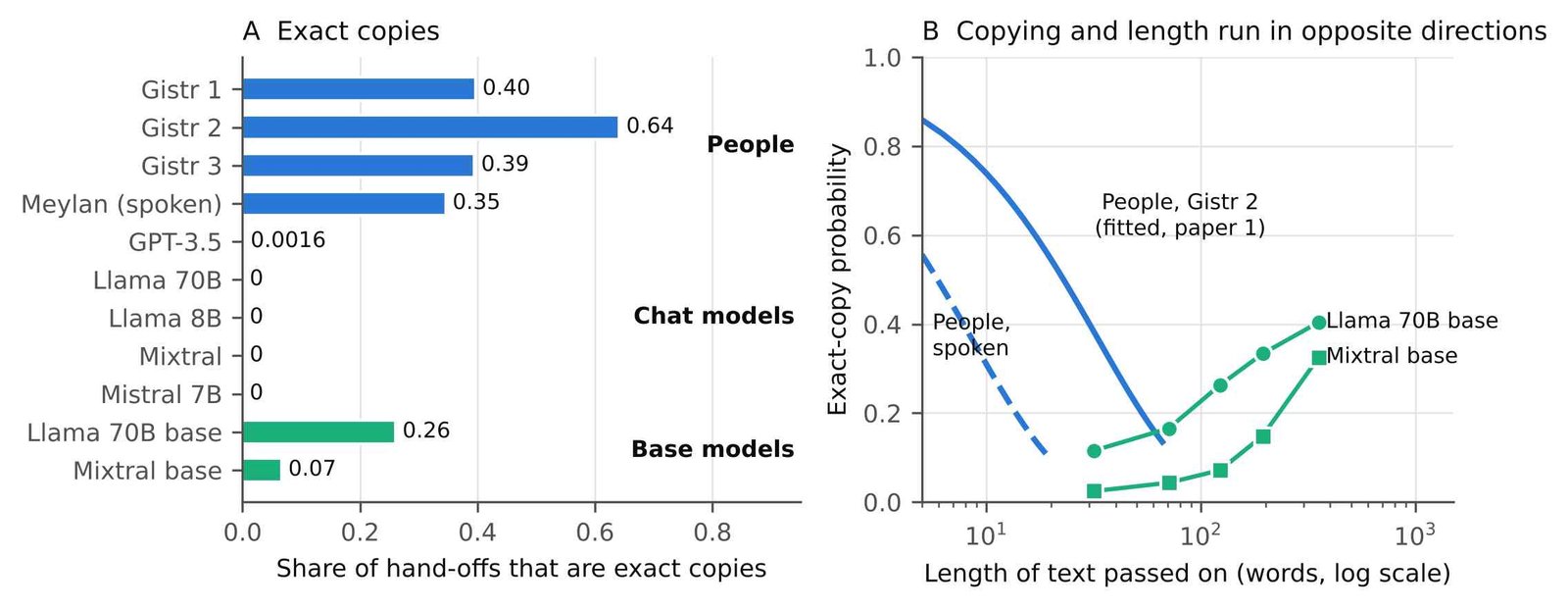
Table 1. Exact copies, loss and reconstruction in human and language-model transmission chains.
| Source | n | Mean words | Exact copies | Loss e (95% CI) | Reconstruction a (95% CI) | Chance a₀ | a/a₀ | Share, predicted | Share, observed |
|---|---|---|---|---|---|---|---|---|---|
| People (Kalafatis, 2026) | |||||||||
| Gistr 1, written | 1,980 | 19.9 | 0.40 | 0.130 (0.099–0.168) | 0.016 (0.011–0.025) | 0.0001 | 113 | 0.11 | – |
| Gistr 2, written | 2,411 | 14.7 | 0.64 | 0.037 (0.030–0.044) | 0.023 (0.016–0.031) | 0.0002 | 95 | 0.39 | – |
| Gistr 3, written | 3,506 | 17.4 | 0.39 | 0.117 (0.107–0.128) | 0.010 (0.008–0.012) | 0.0002 | 40 | 0.08 | – |
| Meylan et al., spoken | 2,999 | 9.1 | 0.35 | 0.123 (0.110–0.137) | 0.024 (0.021–0.029) | 0.0028 | 9 | 0.15 | – |
| Chat models | |||||||||
| GPT-3.5 Turbo | 5,000 | 94.8 | 0.0016 | 0.102 (0.087–0.117) | 0.033 (0.026–0.044) | 0.0026 | 12 | 0.23 | 0.27 |
| Llama 3 70B Instruct | 5,000 | 143.6 | 0 | 0.096 (0.079–0.113) | 0.043 (0.032–0.056) | 0.0028 | 15 | 0.29 | 0.32 |
| Llama 3 8B Instruct | 5,000 | 76.1 | 0 | 0.116 (0.098–0.136) | 0.019 (0.015–0.025) | 0.0021 | 9 | 0.13 | 0.15 |
| Mixtral 8x7B Instruct | 5,000 | 121.3 | 0 | 0.126 (0.114–0.139) | 0.042 (0.031–0.056) | 0.0044 | 10 | 0.23 | 0.26 |
| Mistral 7B Instruct | 5,000 | 156.2 | 0 | 0.123 (0.107–0.143) | 0.054 (0.043–0.068) | 0.0056 | 10 | 0.28 | 0.29 |
| Base models | |||||||||
| Llama 3 70B | 5,000 | 175.0 | 0.26 | 0.044 (0.038–0.053) | 0.013 (0.010–0.017) | 0.0010 | 13 | 0.21 | 0.28 |
| Mixtral 8x7B | 4,998 | 123.9 | 0.066 | 0.087 (0.074–0.107) | 0.011 (0.010–0.013) | 0.0012 | 9 | 0.10 | 0.11 |
Note. n: transmissions. Exact copies: share of transmissions whose token sequence equals the parent’s. Rates are per seed content word per transmission, from generation 1 onward (for Meylan et al., all words). Share, predicted: long-run share of seed words, (a − a₀)/(e + a − a₀). Share, observed: mean over generations 41–50. Intervals are cluster-bootstrap percentiles over seed items. Model chains run at temperature 0.8. Human chains were too short to observe a long-run level. Human values are taken from the published results of Kalafatis (2026). Mixtral 8x7B base has 4,998 transmissions because two parent texts were empty.
The gist travels much as it does between people
Words, unlike whole texts, survived machine transmission at rates close to the human range (Fig. 2; Table 1). From the second hand-off onward, chat models lost 9.6% to 12.6% of the seed content words present in the text they received, at the upper end of the human range of 3.7% to 13.0%. They restored lost words at rates of 1.9% to 5.4% per transmission, at or above the human range of 1.0% to 2.4%. Words from other seeds entered chains by chance at 0.21% to 0.56% per transmission, more often than in written human chains (0.01% to 0.02%) and similar to spoken ones (0.28%). Reconstruction therefore exceeded chance by a factor of 9 to 15, against about 9 for spoken human transmission and 40 to over 100 for written. The predicted long-run share of seed words, 0.13 to 0.29 for chat models, lay inside the human range of 0.08 to 0.39.
The first hand-off was different. A single rephrasing removed about half or more of the seed’s content words: chat models kept 35% to 50% of them in generation 1, base models 76% to 80%, and people 78% to 96%. The size of this first loss was unrelated to seed length (Spearman |ρ| ≤ 0.40 across seeds, all p ≥ 0.08). After this shock, loss settled to the human-like per-step rates above.
Per-word loss was also strongly bimodal in chat models. Leaving out the first hand-off, 30% to 40% of the seed words still present after it had loss rates above 0.5 per transmission, while 31% to 41% had rates below 0.05; the 25th percentile of per-word loss was 0.01 to 0.03 and the 75th percentile 0.67 to 0.76. A word tended either to drop out at once or to persist. Base models had almost no fast-loss group (under 0.4% of words above 0.5), and in Llama 3 70B base 90% of words had loss rates below about 0.19. In the human chains, per-word loss rates were more evenly spread; in Gistr 3, for example, the middle 80% of words had rates between 0.05 and 0.40 (Kalafatis, 2026).
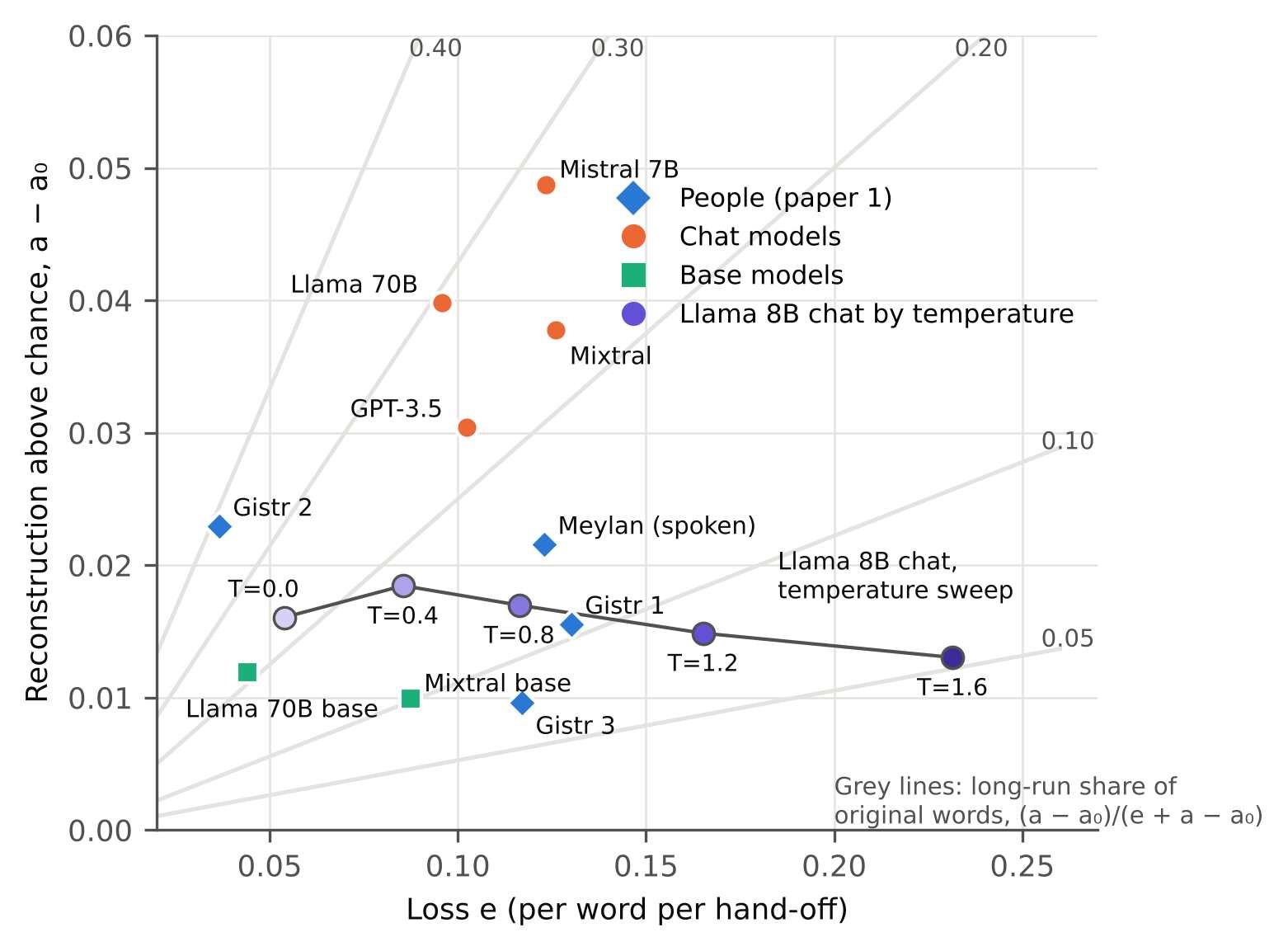
Temperature turns loss up and leaves reconstruction alone
Sampling temperature acted on loss alone (Fig. 3; Table S3). As temperature rose from 0 to 1.6, the loss rate in Llama 3 8B Instruct rose monotonically from 0.054 (0.034–0.077) to 0.231 (0.208–0.260), a 4.3-fold increase. Reconstruction stayed between 0.016 and 0.020, with overlapping intervals at every temperature. The model therefore predicts that the long-run share of seed words should fall, from 0.23 at temperature 0 to 0.05 at temperature 1.6, and the observed share over generations 41–50 fell from 0.29 to 0.05. Even greedy decoding at temperature 0 never produced an exact copy in its 1,000 distinct transmissions: the rephrase instruction alone was enough to change the wording at every step.
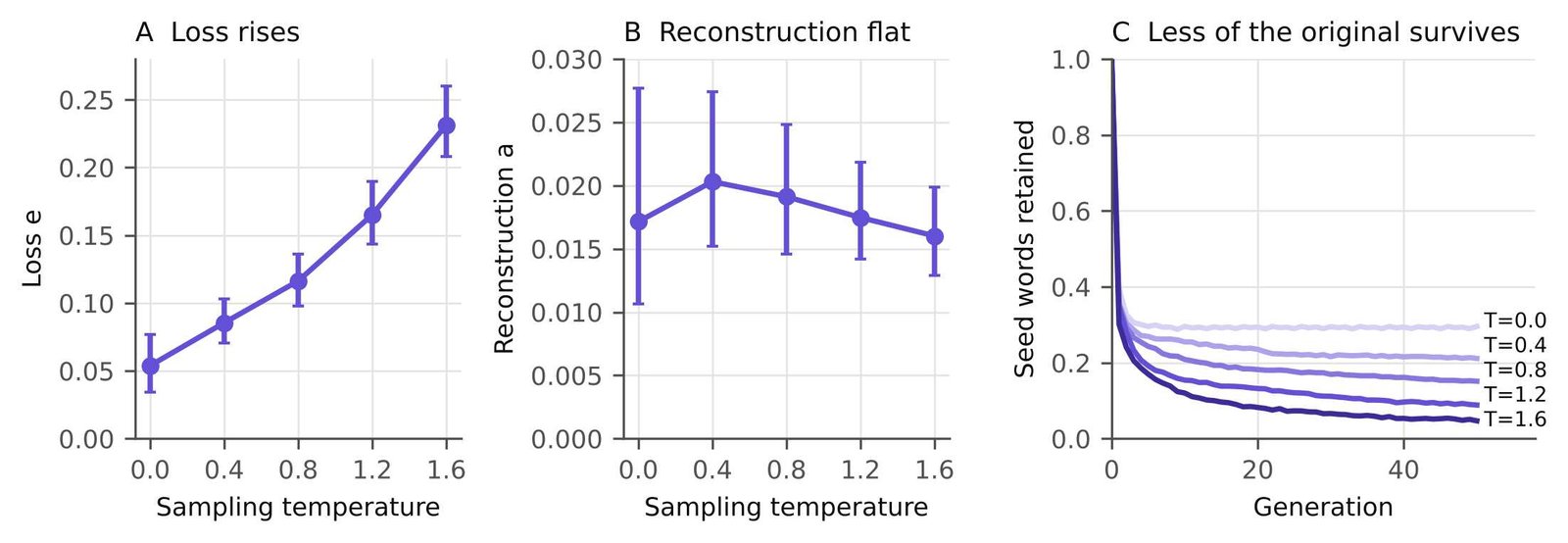
The two-state model predicts where chains settle
Mean retention fell steeply over the first few generations and then levelled off (Fig. 4A). Across the 11 conditions, the long-run share predicted from pooled loss and reconstruction rates correlated with the share observed over generations 41–50 at r = 0.98 (p < 0.001; Fig. 4B). Observed retention exceeded the prediction by 0.03 on average (range −0.002 to 0.07). The largest gap was for Llama 3 70B base, whose chains were still declining at generation 50, followed closely by temperature 0. A mostly upward bias is what heterogeneous loss produces: words that are rarely lost hold retention above the level set by average rates.
The held-out analysis confirmed both components. In all 10 conditions with distinct held-out chains, word-specific rates predicted the retention curves of held-out chains best (RMSE 0.009 to 0.038). Setting reconstruction to zero raised the error to between 0.039 and 0.120, and replacing word-specific rates with pooled ones raised it to between 0.060 and 0.148. In the human data, word-specific rates had outperformed pooled ones in only two of four datasets (Kalafatis, 2026). The longer machine chains, with more transmissions per seed, allow word-level heterogeneity to be estimated reliably.
Instructions that ask for change erase the seed
The rephrase instruction asks the model to preserve meaning. The other two instructions in Perez et al. (2025) do not, and the seed’s words fared accordingly (Table S1). Under take-inspiration, chat models lost 14% to 40% of seed words per transmission, and under continue they lost 47% to 77%. Reconstruction exceeded chance by a factor of only 1.8 to 4.7, and the predicted long-run share fell to 0.07 or less. Without an instruction to preserve, almost nothing of the seed’s vocabulary survives.
Robustness
Refusals were rare: between 4 and 52 of 5,000 outputs per condition (0.1% to 1.0%) matched the refusal pattern, and 151 of the 158 in total were for the toxicity seeds (all but six for Llama 3 8B Instruct). Excluding the five toxicity seeds changed loss rates by at most 0.009 and the predicted long-run share by at most 0.04 (Table S2). Counting all word types instead of content words lowered loss rates by up to a fifth and raised the predicted long-run share (to 0.17–0.35 for chat models), because function words are retained more easily; the ordering of conditions was largely preserved, with two close pairs swapping places on the predicted share and one on the loss rate. Per-seed loss rates were unrelated to seed length in five of seven conditions; they rose with length for GPT-3.5 (ρ = 0.64, p = 0.002) and fell for Llama 3 70B base (ρ = −0.66, p = 0.002).
Discussion
Kalafatis (2026) found that human memory is too leaky for selection, at plausible selective advantages, to hold anything much longer than a slogan in place, while the gist of longer material survives through reconstruction. The machines studied here split those two results apart. As copiers, chat-tuned models are not leaky but deliberate: asked to rephrase, they changed the wording at virtually every step, even with greedy decoding. As carriers of gist, they lost, restored and retained words at rates that overlap the human ones, and they settled at long-run levels that the same two-parameter model predicts.
What the results mean for machine memes
The error threshold is a statement about accidental error, and the chat models did not err by accident. Their exact-copy probability was close to zero at every length, and in the one model that copied at all, copying did not depend on length. In the intercept form of the model, an intact wording would then need a transmission advantage of several hundredfold or more, whatever its length. The likely cause is plain: the instruction asked for a new wording, and fine-tuning on human feedback is designed to make models follow such instructions (Ouyang et al., 2022). Within rephrase chains, then, a wording is not a replicator in any practical sense. This is a property of the task as well as of the models, since the same models may well reproduce text verbatim if asked to; the data analysed here contain no such condition.
Base models show what happens when instruction-following is weak. They copied a quarter of the time in the case of Llama 3 70B, and copying grew more likely with length and persisted once begun. Both features contradict the per-unit error process that defines a threshold. A per-unit process makes long items harder to copy; here they were easier. A plausible reading is that a base model either echoes its context, which may be easier for long contexts, or rewrites it, so that exact transmission is an all-or-nothing choice. Whatever the mechanism, machine replication in these chains is governed by modes of behaviour, not by a per-word error rate, and the threshold that limits human memes does not describe it. This bears on the prediction in Kalafatis (2026) that digital copying removes the threshold. Digital copying does, but a language model is not a copier unless something makes it one.
The finding that matters for cultural attraction runs the other way. Reconstruction in machine chains was clearly above chance, and its long-run consequence, the level at which a chain’s resemblance to its source settles, followed (a − a₀)/(e + a − a₀) across 11 conditions with a correlation of 0.98. In the theory of cultural attraction, stability comes from transformations that are biased in some directions rather than others, pulling variants toward attractors (Claidière & Sperber, 2007; Scott-Phillips, Blancke & Heintz, 2018). Perez et al. (2025) showed that machine chains converge on attractors in toxicity, positivity, difficulty and length. The present results add that the same process can be read at the level of individual words, that its strength is comparable to that seen in people, and that a model with two rates captures where it leads. Machine transmission is, in this sense, a convenient laboratory for attraction: chains can be run for 50 generations, conditions can be varied at will, and the predicted equilibrium can be checked directly, which the human data could not support.
The split of seed words into a fast-lost group and a durable core is a further difference from people. One rephrasing discarded about half or more of a seed’s content words. Of the words that remained in play, a large share were dropped again almost at once, while another large share were almost never lost. People retelling short texts lost words more evenly. The pattern resembles compression: rephrasing keeps the words that carry a text’s main content and treats the rest as interchangeable. Seeds in the machine experiments were longer than those in the human experiments, which may contribute to this difference, although the size of the first loss did not depend on seed length.
Temperature as an experimental dial
Sampling temperature has no counterpart in human transmission. Raising it increased loss more than fourfold while leaving reconstruction unchanged, and long-run retention fell accordingly. Temperature is thus an experimental handle on e alone, which human studies cannot offer: to test how loss rates shape the cultural equilibrium, one can turn a dial rather than recruit a different population. The result also accords with Perez et al. (2025), who found that higher temperature strengthened attraction in constrained tasks. In the present terms, higher temperature means faster loss with the same reconstruction, so chains move further from their seed. That decoding choices strongly affect the quality of generated text is well known (Holtzman, Buys, Du, Forbes & Choi, 2020); the present data show how they shape its transmission.
Implications
If LLMs increasingly mediate the transmission of text, culture that passes through them will behave less like a population of replicators and more like a population of reconstructions, even when the text is in digital form. Exact wording will survive where something forces a copy, such as quotation, retrieval or a copy-and-paste step, and not otherwise. The content that survives will be the content that models keep or restore. Concerns about recursive training on model output (Shumailov et al., 2024) concern what models learn from such text. The present results concern a simpler process that precedes it: what is lost and what returns each time a model passes text on.
Limitations
Several limitations qualify these conclusions. First, and most important, the human and machine tasks differed. People in the comparison data were asked to reproduce what they had read or heard, whereas the models were asked to rephrase. The near-absence of exact copies in chat models reflects that instruction, and a fair test of machine fidelity under a reproduce instruction requires new chains run on the human seed texts, which I leave to future work. The word-level comparison is less affected, since both tasks aim to preserve meaning, but it is not immune. Second, seeds differed in length: the machine seeds were 91 to 760 words, most human seeds 10 to 66. Loss rates were not related to seed length in most conditions, but long texts invite compression, which may explain part of the large first-step loss. Third, the models are those of 2024, run with one prompt and, temperature apart, one set of sampling parameters; the GPT-3.5 sampling settings could not be checked against the released code. Larger and newer models, other prompts and other decoding schemes may behave differently. Fourth, the measures are lexical. Words can be replaced by synonyms without loss of meaning, so word loss overstates semantic loss, and the long-run share of seed words understates how much of a text’s content survives. Fifth, the base-model results depend on how base models handle an instruction they were not tuned to follow, and their copying may partly reflect echoing of the prompt rather than transmission in any cultural sense. Sixth, the intercept model constrains μ to be non-negative, so it cannot represent the rise of copying with length in base models; that rise is documented by the logistic regression instead. Finally, with 20 seed texts per condition, interval estimates are wide for some quantities, and the per-seed length correlations rest on 20 points each.
Conclusion
Asked to rephrase, language models pass on the gist of a text about as well as people retelling it, and the level at which that gist settles follows from two rates that can be measured. They almost never pass on the wording. Where they do copy, copying is a mode they fall into rather than a fidelity that declines with length. Machine culture, at least in this form, is a culture of reconstruction, and its replicators appear only when something other than the instruction makes a model copy.
Related on x9m8
- Too leaky to replicate: an error threshold for memes in human memory, paper 1 in this series, on human transmission chains
- How large language models like ChatGPT actually work
- Why AI chatbots hallucinate, and can it be fixed?
- Open Questions: a series on what science and law have not settled
Acknowledgements
I thank Jérémy Perez and co-authors for releasing the generated texts from their telephone-game experiments, and the authors of the human datasets reanalysed in Kalafatis (2026). Literature search, data acquisition, statistical analysis, figure preparation, drafting and audit of numbers and citations were assisted by Claude (Anthropic; claude-opus-5-5) on 12 October 2026, as described in Methods.
Author contributions
P.K. conceived the study, directed the analysis, reviewed all results and wrote the paper with AI assistance as described above.
Financial support
This research received no specific grant from any funding agency, commercial or not-for-profit sectors.
Conflicts of interest
The author declares none.
Research transparency and reproducibility
All analyses use publicly available data. Language-model chains: github.com/flowersteam/TelephoneGameLLM (commit 1b43c3d4c11922e8e4308cf95d1318882ea7e1cd). Human comparison values are taken from the results files of Kalafatis (2026), included in the reproducibility package together with the original data sources. Analysis code, derived results and figure scripts are provided as supplementary material and at https://x9m8.com/wp-content/uploads/2026/10/kalafatis-2026-llm-telephone-fidelity-code.zip.
Supplementary material
Table S1. Loss and reconstruction of seed content words under instructions that do not ask for preservation (chat models, temperature 0.8).
| Model | Instruction | Loss e | Reconstruction a | Chance a₀ | a/a₀ | Predicted long-run share | Observed, gen. 41–50 |
|---|---|---|---|---|---|---|---|
| GPT-3.5 Turbo | take inspiration | 0.404 | 0.0099 | 0.0044 | 2.2 | 0.013 | 0.013 |
| Llama 3 70B Instruct | take inspiration | 0.135 | 0.0136 | 0.0029 | 4.7 | 0.074 | 0.079 |
| Llama 3 8B Instruct | take inspiration | 0.196 | 0.0052 | 0.0018 | 2.8 | 0.017 | 0.027 |
| Mixtral 8x7B Instruct | take inspiration | 0.198 | 0.0206 | 0.0049 | 4.2 | 0.074 | 0.074 |
| Mistral 7B Instruct | take inspiration | 0.264 | 0.0249 | 0.0054 | 4.6 | 0.069 | 0.064 |
| GPT-3.5 Turbo | continue | 0.582 | 0.0115 | 0.0055 | 2.1 | 0.010 | 0.016 |
| Llama 3 70B Instruct | continue | 0.593 | 0.0161 | 0.0069 | 2.3 | 0.015 | 0.020 |
| Llama 3 8B Instruct | continue | 0.769 | 0.0073 | 0.0034 | 2.2 | 0.005 | 0.007 |
| Mixtral 8x7B Instruct | continue | 0.526 | 0.0216 | 0.0123 | 1.8 | 0.017 | 0.032 |
| Mistral 7B Instruct | continue | 0.471 | 0.0135 | 0.0066 | 2.1 | 0.015 | 0.021 |
Note. Estimators as in Table 1; intervals omitted.
Table S2. Sensitivity of loss rate and predicted long-run share to refusals and to the word definition (rephrase task).
| Model | Refusal outputs (of 5,000) | e, main | e, no toxicity seeds | e, all words | Share, main | Share, no toxicity seeds | Share, all words |
|---|---|---|---|---|---|---|---|
| GPT-3.5 Turbo | 11 | 0.102 | 0.106 | 0.094 | 0.23 | 0.25 | 0.28 |
| Llama 3 70B Instruct | 5 | 0.096 | 0.094 | 0.079 | 0.29 | 0.32 | 0.34 |
| Llama 3 8B Instruct | 12 | 0.116 | 0.126 | 0.097 | 0.13 | 0.14 | 0.17 |
| Mixtral 8x7B Instruct | 34 | 0.126 | 0.127 | 0.110 | 0.23 | 0.25 | 0.29 |
| Mistral 7B Instruct | 4 | 0.123 | 0.124 | 0.100 | 0.28 | 0.32 | 0.35 |
| Llama 3 70B base | 52 | 0.044 | 0.042 | 0.042 | 0.21 | 0.23 | 0.29 |
| Mixtral 8x7B base | 40 | 0.087 | 0.090 | 0.084 | 0.10 | 0.11 | 0.17 |
Note. “Main” reproduces Table 1. Refusals were identified by a text pattern (“I cannot”, “I’m sorry” and similar) in the first 200 characters of an output.
Table S3. Sampling temperature, Llama 3 8B Instruct, rephrase task.
| T | n | Mean words | Exact copies | Loss e (95% CI) | Reconstruction a (95% CI) | Chance a₀ | Predicted long-run share | Observed, gen. 41–50 |
|---|---|---|---|---|---|---|---|---|
| 0 | 1,000 | 96.4 | 0 | 0.054 (0.034–0.077) | 0.017 (0.011–0.028) | 0.0011 | 0.23 | 0.29 |
| 0.4 | 5,000 | 86.6 | 33 | 0.085 (0.070–0.103) | 0.020 (0.015–0.027) | 0.0019 | 0.18 | 0.21 |
| 0.8 | 5,000 | 76.1 | 0 | 0.116 (0.098–0.136) | 0.019 (0.015–0.025) | 0.0021 | 0.13 | 0.15 |
| 1.2 | 5,000 | 67.7 | 0 | 0.165 (0.143–0.190) | 0.017 (0.014–0.022) | 0.0026 | 0.08 | 0.09 |
| 1.6 | 5,000 | 63.3 | 0 | 0.231 (0.208–0.260) | 0.016 (0.013–0.020) | 0.0030 | 0.05 | 0.05 |
Note. n: transmissions. At temperature 0 the five chains per seed were identical; one per seed is analysed. The temperature-0.8 row is the default Llama 3 8B Instruct condition of Table 1.
References
Acerbi, A., Charbonneau, M., Miton, H., & Scott-Phillips, T. (2021). Culture without copying or selection. Evolutionary Human Sciences, 3, e50. https://doi.org/10.1017/ehs.2021.47
Acerbi, A., & Stubbersfield, J. M. (2023). Large language models show human-like content biases in transmission chain experiments. Proceedings of the National Academy of Sciences, 120(44), e2313790120. https://doi.org/10.1073/pnas.2313790120
Acharjee, S., Aich, U., Mandal, D., & Ali, A. (2025). Who remembers what? Tracing information fidelity in human-AI chains. In Proceedings of the 14th International Joint Conference on Natural Language Processing and the 4th Conference of the Asia-Pacific Chapter of the Association for Computational Linguistics (pp. 2718–2726). Association for Computational Linguistics. https://doi.org/10.18653/v1/2025.ijcnlp-long.146
Brinkmann, L., Baumann, F., Bonnefon, J.-F., Derex, M., Müller, T. F., Nussberger, A.-M., Czaplicka, A., Acerbi, A., Griffiths, T. L., Henrich, J., Leibo, J. Z., McElreath, R., Oudeyer, P.-Y., Stray, J., & Rahwan, I. (2023). Machine culture. Nature Human Behaviour, 7(11), 1855–1868. https://doi.org/10.1038/s41562-023-01742-2
Claidière, N., & Sperber, D. (2007). The role of attraction in cultural evolution. Journal of Cognition and Culture, 7(1–2), 89–111. https://doi.org/10.1163/156853707X171829
Dawkins, R. (1976). The selfish gene. Oxford University Press.
Eigen, M. (1971). Selforganization of matter and the evolution of biological macromolecules. Die Naturwissenschaften, 58(10), 465–523. https://doi.org/10.1007/BF00623322
Eigen, M., McCaskill, J., & Schuster, P. (1988). Molecular quasi-species. The Journal of Physical Chemistry, 92(24), 6881–6891. https://doi.org/10.1021/j100335a010
Ghafouri, B., & Ferrara, E. (2026). Lost before translation: Social information transmission and survival in AI-AI communication (arXiv:2602.17674). arXiv. https://arxiv.org/abs/2602.17674
Henrich, J., & Boyd, R. (2002). On modeling cognition and culture: Why cultural evolution does not require replication of representations. Journal of Cognition and Culture, 2(2), 87–112. https://doi.org/10.1163/156853702320281836
Holtzman, A., Buys, J., Du, L., Forbes, M., & Choi, Y. (2020). The curious case of neural text degeneration. In International Conference on Learning Representations. https://arxiv.org/abs/1904.09751
Kalafatis, P. (2026). Too leaky to replicate: An error threshold for memes in human memory [Preprint]. x9m8.com. https://x9m8.com/are-memes-replicators-error-threshold/
Lerique, S. (2017). Epidemiology of representations: An empirical approach [Doctoral dissertation, École des hautes études en sciences sociales]. theses.fr. https://theses.fr/2017EHES0114
Meylan, S. C., Nair, S., & Griffiths, T. L. (2021). Evaluating models of robust word recognition with serial reproduction. Cognition, 210, 104553. https://doi.org/10.1016/j.cognition.2020.104553
Ouyang, L., Wu, J., Jiang, X., Almeida, D., Wainwright, C., Mishkin, P., Zhang, C., Agarwal, S., Slama, K., Ray, A., Schulman, J., Hilton, J., Kelton, F., Miller, L., Simens, M., Askell, A., Welinder, P., Christiano, P. F., Leike, J., & Lowe, R. (2022). Training language models to follow instructions with human feedback. In Advances in Neural Information Processing Systems 35. https://proceedings.neurips.cc/paper_files/paper/2022/hash/b1efde53be364a73914f58805a001731-Abstract-Conference.html
Perez, J., Kovač, G., Léger, C., Colas, C., Molinaro, G., Derex, M., Oudeyer, P.-Y., & Moulin-Frier, C. (2025). When LLMs play the telephone game: Cultural attractors as conceptual tools to evaluate LLMs in multi-turn settings. In International Conference on Learning Representations (pp. 88339–88378). https://proceedings.iclr.cc/paper_files/paper/2025/hash/dbdea7859f1d2fc10f2c9e79b8f5ae54-Abstract-Conference.html
Scott-Phillips, T., Blancke, S., & Heintz, C. (2018). Four misunderstandings about cultural attraction. Evolutionary Anthropology: Issues, News, and Reviews, 27(4), 162–173. https://doi.org/10.1002/evan.21716
Shumailov, I., Shumaylov, Z., Zhao, Y., Papernot, N., Anderson, R., & Gal, Y. (2024). AI models collapse when trained on recursively generated data. Nature, 631(8022), 755–759. https://doi.org/10.1038/s41586-024-07566-y
Sperber, D. (1996). Explaining culture: A naturalistic approach. Blackwell.

