The iPhone 18 Pro and iPhone 18 Pro Max reached stores on Friday, September 18, nine days after Apple announced them and six days after pre-orders opened. Pricing starts at $1,199 and $1,299 in the United States. Apple built its pitch around two changes: a camera with a mechanical aperture, and a 2-nanometer A20 Pro […]
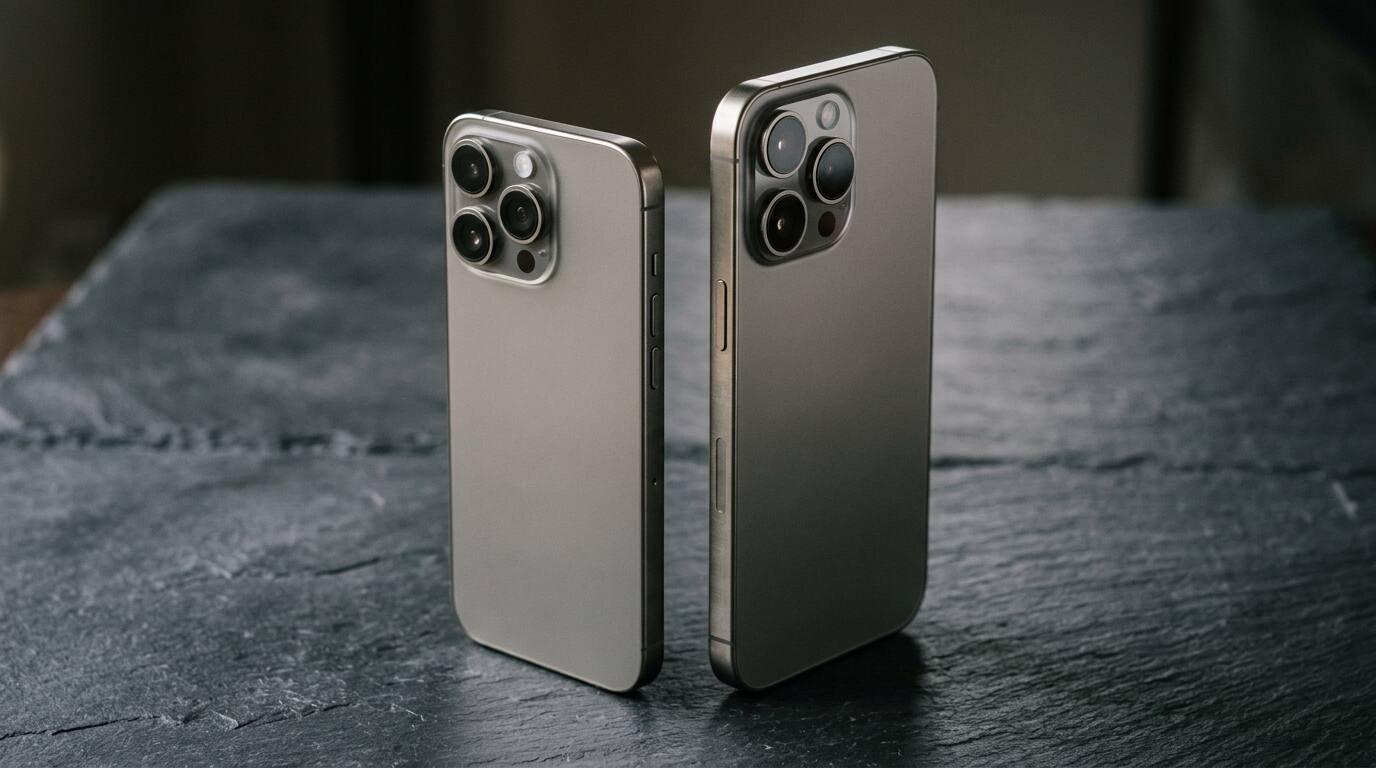
The iPhone 18 Pro and iPhone 18 Pro Max reached stores on Friday, September 18, nine days after Apple announced them and six days after pre-orders opened. Pricing starts at $1,199 and $1,299 in the United States. Apple built its pitch around two changes: a camera with a mechanical aperture, and a 2-nanometer A20 Pro chip wrapped in a new cooling layout.
Marketing copy and engineering are different things, so this guide separates what Apple has specified from what it has only claimed. Unless another source is named, the figures below come from Apple’s launch press release and its technical specifications page. Performance numbers are Apple’s own measurements, not independent test results.
What Apple Is Selling, and What It Costs
Both phones come in 256GB, 512GB, 1TB and 2TB capacities, in black, silver, glacier and a new burgundy. The iPhone 18 Pro starts at $1,199, or $49.95 a month over 24 months through Apple’s installment plan. The Pro Max starts at $1,299, or $54.12 a month. Pre-orders began Saturday, September 12, at 5 a.m. Pacific in more than 65 countries and regions, while 20 more get the phones on September 25.
| Spec | iPhone 18 Pro | iPhone 18 Pro Max |
|---|---|---|
| Display | 6.3-inch OLED, 2622 x 1206 | 6.9-inch OLED, 2868 x 1320 |
| Pixel density | 460 ppi | 460 ppi |
| Weight | 211 g | 249 g |
| Thickness | 8.75 mm | 8.75 mm |
| Video playback | Up to 36 hours | Up to 45 hours |
| Typical use | Up to 24 hours | Up to 30 hours |
| Starting price (US) | $1,199 | $1,299 |
A20 Pro: Two Nanometers and a Rearranged Heat Path
Apple says the A20 Pro is built on a 2-nanometer process. That label names a manufacturing generation, not a literal measurement, since modern node names no longer map to one specific feature size. What counts is density and efficiency: more transistors in the same area, or the same work for less energy. The release does not name the foundry.
The configuration is a six-core CPU (two high-performance cores and four efficiency cores), a seven-core GPU with Neural Accelerators, and a Neural Engine built as two 16-core blocks. Apple puts GPU speed at up to 40 percent above the A19 Pro, AI throughput at double, and memory bandwidth at 50 percent higher.
The quieter story is physical. Apple describes a package that sits the chip beside its memory rather than under it, which takes the memory out of the processor’s heat path, plus a vapor chamber with three times the surface area of the one in the iPhone 17 Pro. The company claims up to 40 percent better sustained performance than the previous generation.
Sustained is the operative word. A phone reaches peak speed for a few seconds, then throttles as heat soaks into the frame; a larger chamber spreads that heat over more area and pushes the throttle point later. Whether the 40 percent figure survives a half-hour game session or a long 4K recording is something only third-party testing can settle.
One number remains unpublished. Apple does not list RAM, and Smartprix’s assumption of 12GB is the author’s inference, not a confirmed spec.
Variable Aperture, Explained
Start with the hardware. The 48MP Fusion Main camera (24mm, according to the spec page) now carries an aperture that physically changes between ƒ/1.48 and ƒ/4.0 using six laser-cut blades, and the Camera app offers four settings. Apple calls it the first aperture control on an iPhone and cites ƒ/1.48 for low light, ƒ/1.8 for portraits and ƒ/4 for depth of field.
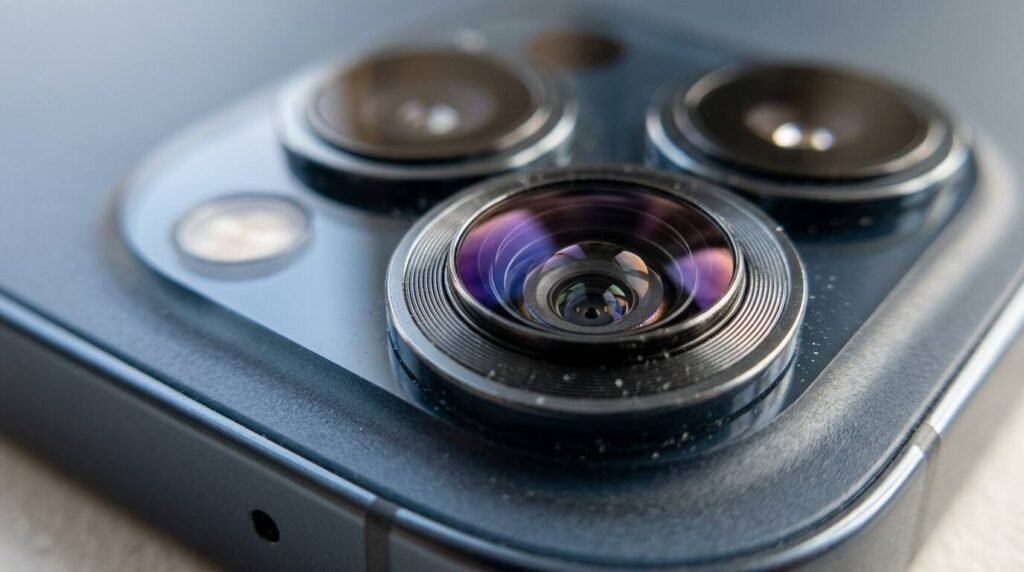
Physics keeps the creative effect modest. Depth of field depends on a lens’s real focal length, and a phone lens measures only a few millimeters. Closing down to ƒ/4 on an optic that small still leaves a deep zone of sharpness, far deeper than ƒ/4 on a full-frame camera. The larger gain is light. By simple arithmetic, ƒ/1.48 admits about 7.3 times the light of ƒ/4, roughly three stops.
Software wraps around the glass. Cinematic effects can be applied after capture to video shot at up to 60 fps, Photographic Styles gain texture and grain controls, and the pro controls expose manual shutter speed, white balance, aperture and a histogram. A feature called Apple Reference Image attaches signed sensor data, processed through Private Cloud Compute, so a photo’s authenticity can be verified. The release does not explain the mechanism further.
The Rest of the Camera Array
Behind the main lens sits the following lineup, per the spec page:
- Ultra Wide: 48MP, 13mm, ƒ/2.2, 120-degree field of view
- 2x Telephoto: 12MP “optical-quality,” 48mm
- 4x Telephoto: 48MP, 100mm, ƒ/2.8
- 8x Telephoto: 12MP “optical-quality,” 200mm, ƒ/2.8
Apple lists 8x optical zoom in, 2x optical out, a 16x optical-quality range, and digital zoom up to 40x. The megapixel counts hint at how the in-between stops work: a 12MP image from a 48MP sensor is a two-times linear crop of the center, which is presumably what “optical-quality” means for the 2x and 8x positions. That reading is an inference, not Apple’s wording.
Display, Battery and Charging
Resolution and size are on the table above. Smartprix, summarizing Apple’s specifications, reports an adaptive refresh rate up to 120Hz, 1,000 nits typical brightness, 1,600 nits peak for HDR and 3,000 nits peak outdoors. Those four figures could not be confirmed on the Apple pages used for this article, so check them against the spec sheet before relying on them.
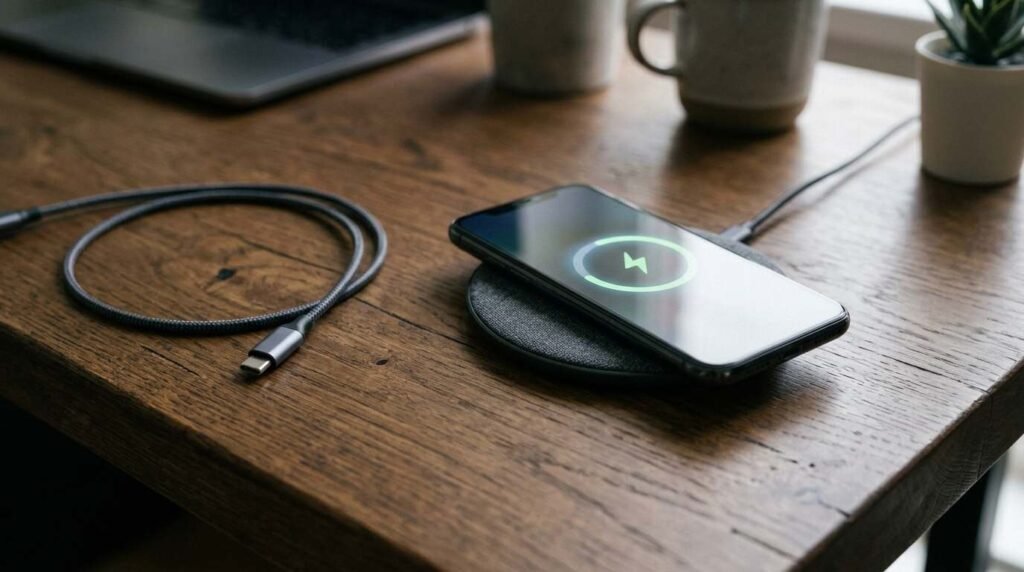
Battery ratings of 36 hours (Pro) and 45 hours (Pro Max) of video playback apply to eSIM-only models. Apple does not publish capacity in milliamp-hours. Charging claims are specific: the Pro reaches up to 50 percent in about 15 minutes wired, or in 30 minutes wirelessly, and Apple says five minutes of wired charging on the Pro Max yields about seven hours of video playback.
Both phones are rated IP68 (6 meters for 30 minutes) and use USB-C at USB 3 speeds, up to 10 Gb/s.
Radios: N1, C2 and a Phone Without a SIM Tray
Wireless duties move to Apple silicon. The N1 chip handles Wi-Fi 7, Bluetooth 6 and Thread. The C2 modem is credited with up to 15 percent less energy use than the C1X, faster uploads, and mmWave support in the U.S., and the spec page lists it for both the Pro and Pro Max. Cellular support spans sub-6 GHz and mmWave 5G plus Gigabit LTE.
There is no physical SIM option. Both phones are dual-eSIM only, which matters mostly for travelers who rely on swapping a local SIM card; check that your carrier or a travel eSIM provider supports activation before leaving home. Apple also describes iPhone Handoff, which lets two iPhones that share a number pass calls between them on supported carriers; in the U.S. that means T-Mobile at launch.
iOS 27, Siri AI and the Regional Footnotes
iOS 27 arrived as a free update on September 14, with Apple Intelligence available at the same time. Siri AI, the headline feature, starts as an English-language beta. French, Japanese, Korean, Portuguese and Spanish follow in October, and Apple notes it will not initially be available in the EU. MacRumors reports that Siri AI requires an iPhone 15 Pro or newer.
Pro Versus Pro Max: Where the Two Phones Differ
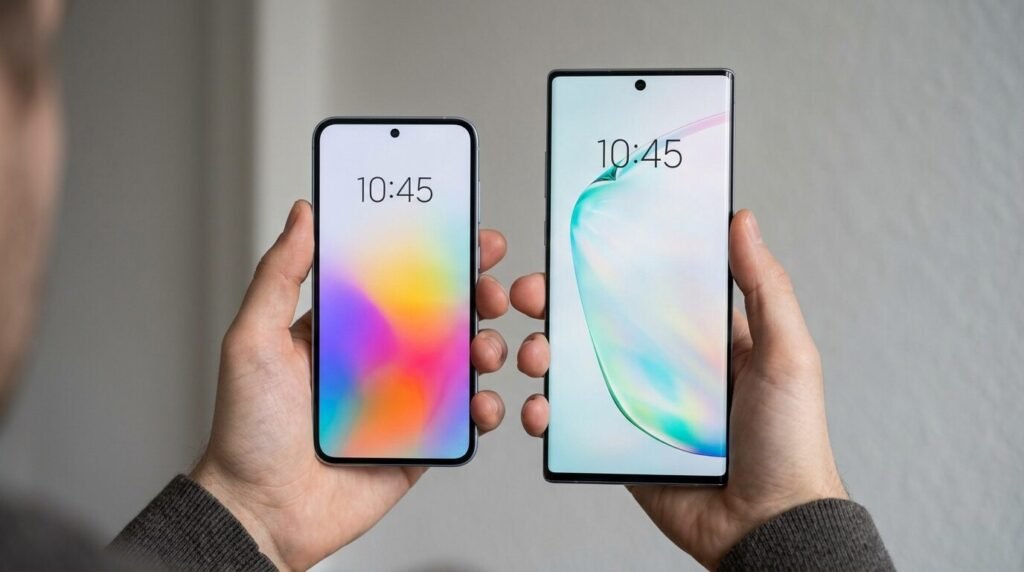
Apple’s pages list a single chip, a single camera array, one C2 modem and one N1 wireless chip for both models. The differences are physical and financial. The Pro Max has a 6.9-inch display against 6.3 inches, weighs 38 grams more (249 g versus 211 g), and carries a rated 45 hours of video playback to the Pro’s 36. That works out to 25 percent more rated playback, plus six more hours of typical use, for $100 more at the starting tier.
Whether that trade appeals depends on hand size and pocket tolerance more than any benchmark. Both are 8.75 mm thick, so the extra bulk lives entirely in width and height.
Canadian Pricing, for Reference
Readers north of the border can compare against iPhone in Canada’s pricing report. The iPhone 18 Pro runs C$1,749 for 256GB, C$2,049 for 512GB, C$2,649 for 1TB and C$3,549 for 2TB. The Pro Max runs C$1,899, C$2,199, C$2,799 and C$3,699 across the same four tiers. Canadian pre-orders opened September 12 at 5 a.m. Pacific, with shipping on September 18, matching the U.S. schedule.
How to Read the Performance Numbers
Apple’s claims all use the phrase “up to,” and each is measured against the previous generation: GPU speed up to 40 percent faster than the A19 Pro, sustained performance up to 40 percent better than last year’s model, AI throughput doubled, memory bandwidth up 50 percent. Best-case figures describe a particular test under particular conditions, and everyday use rarely matches them.
Four independent measurements will say more than any marketing figure. A sustained GPU stress test shows how much speed survives after ten or fifteen minutes, which is where the vapor chamber should help. Surface temperature readings show whether the heat moved somewhere uncomfortable. A looped video rundown checks the 36- and 45-hour ratings. A charging curve tests the claim of 50 percent in about 15 minutes. Until those results appear, Apple’s numbers are plausible targets rather than established facts.
Who Should Look Closely
Nothing here amounts to a purchase recommendation, but a few factors separate buyers.
- Heavy gamers and long-form video shooters have the most to gain from the thermal changes, if Apple’s sustained-performance claim holds up.
- Low-light shooters benefit most from the ƒ/1.48 setting, while portrait shooters should expect a subtler change from the aperture control.
- International travelers should confirm eSIM support first, since the SIM tray is gone.
- Owners of a recent Pro model should weigh the C2 modem and N1 wireless gains against a $1,199 starting price.
What Remains Unconfirmed
- RAM, which Apple has not disclosed
- Battery capacity in mAh
- Independent measurements of sustained performance, charging speed and battery life
- How well Siri AI performs at launch given its beta label
Sources