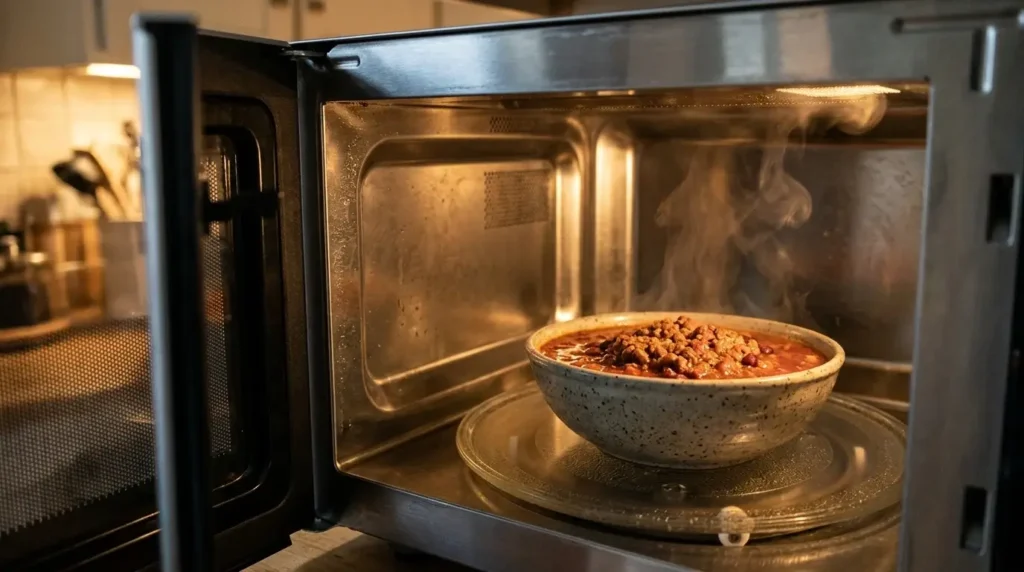
A bowl of leftover chili comes out of the microwave scalding at the rim and cold as a basement floor in the middle. The oven did nothing wrong. Household ovens run near 2.45 GHz, one of the frequencies federal rules set aside for industrial, scientific and medical equipment, listed as 2,450 MHz with a tolerance of ±50 MHz. At that frequency the energy inside a closed metal box arranges itself into a fixed pattern of strong and weak zones a few centimeters apart. The food sits in that pattern like a pallet parked under a leaky roof: some spots get drenched, some stay dry.
The 12-centimeter wave inside a metal box
A frequency picked so the food would not cook only on its skin
Divide the speed of light by 2.45 GHz and the free-space wavelength comes out to about 12.24 cm, the same figure Martin Chaplin’s water-science reference at London South Bank University lists for water at 25 °C. The oven’s walls are metal, and the FDA’s microwave radiation page says the microwaves “reflect off the metal interior of the oven and cause the water molecules in food to vibrate.”
Reflection is the root of the trouble. Waves bouncing between parallel walls overlap with themselves, and where crests keep meeting crests the field is strong, and where they cancel it is close to zero. That fixed arrangement is a standing wave. TU Delft’s physics demonstration notes put it plainly: “In the nodes, the food is not heated, and in the antinodes, the heating is maximal.” The same page says the oven’s dimensions are chosen so that standing waves occur, and that the distance between two antinodes equals half the wavelength.
Why 2.45 GHz at all? It is one of the shared industrial, scientific and medical frequencies in that FCC table, a neighborhood x9m8’s Wi-Fi channels explainer covers from the networking side. It is not water’s favorite frequency. Chaplin’s page says water’s frequency for maximum dielectric loss sits around 20 GHz, well above what ovens use, and explains the lower frequency is chosen “so that the radiation is not wholly absorbed by the first layer of water it encounters.” By that reasoning, a frequency near the absorption peak would spend its energy on the surface of a potato and leave the inside to conduction. The designers traded some absorption for reach.

The numbers, worked out
Six centimeters between hot spots, and a depth that runs out fast
The arithmetic below was run in Python 3 on a test container. Inputs: the speed of light, the 2,400 to 2,500 MHz band edges from the FCC rule, and the dielectric constant (78) and penetration depth (1.4 cm) Chaplin gives for water at 25 °C.
f=2.40 GHz  lambda=12.49 cm  half=6.25 cm
f=2.45 GHz  lambda=12.24 cm  half=6.12 cm
f=2.50 GHz  lambda=11.99 cm  half=6.00 cm
wavelength inside water (eps'=78): 1.39 cm
depth 0.5 in (1.27 cm): power left exp(-x/Dp) = 40.4%
depth 1 in (2.54 cm): power left exp(-x/Dp) = 16.3%
depth 1.5 in (3.81 cm): power left exp(-x/Dp) = 6.6%
depth 2 in (5.08 cm): power left exp(-x/Dp) = 2.7%
Hot spots along any one direction sit roughly 6 cm apart, whichever legal frequency a given magnetron happens to run at. And energy gets used up quickly once it enters wet food: by the 1.4 cm figure, about 84 percent of the power is gone within the first inch.
That second number matches what food-safety agencies tell cooks. The USDA Food Safety and Inspection Service says “Microwaves penetrate the food to a depth of 1 to 1½ inches.” The FDA adds that in thick foods the outer layers are heated by the microwaves while the interior cooks largely from heat moving inward from those layers. A microwave cooks the outside of a deep bowl the way a boiler heats a house with one radiator by the front door: everything past the first room waits on conduction.
The two depth figures are not identical, and they should not be expected to be. Chaplin’s 1.4 cm is for pure water at one temperature and marks the distance at which the incoming microwaves fall to 1/e, about 37 percent, of their original intensity. FSIS’s inch-and-a-half is practical cooking guidance for real food, which holds less water than a glass of it and absorbs differently.
The hot-spot test with the turntable removed
Melted patches, a ruler, and the speed of light from a kitchen appliance
The pattern can be seen directly. The classroom version from a 2009 Science in School article begins: “Remove the turntable from the microwave.” A plate of something that melts or browns easily goes in for a short burst without rotating, then a ruler measures the gap between melted patches. TU Delft uses unbaked papadums on a cardboard plate. x9m8 ran the version with a bar of chocolate in measuring the speed of light with a microwave and chocolate.
The gap between two melted spots is half a wavelength. Double it, multiply by the frequency printed on the oven’s label, and the result lands near the speed of light. Science in School says the doubled distance “should be around 12–12.5 cm,” which is close to the 11.99 to 12.49 cm range the FCC tolerance allows in the table above.
Food is not a passive witness in this experiment, though. A large wet object inside the cavity changes the field it sits in, so the clean 6 cm spacing shows best with a thin, flat, mostly dry layer. A full casserole dish rewrites the pattern for itself.

What a turntable fixes and what it cannot
Averaging around circles, never across them
The turntable is the cheap answer to a fixed pattern. If the pattern cannot move, move the food through it. TU Delft’s notes say “To achieve somewhat even heating, the food must rotate.” The word “somewhat” is honest.
A rotating plate drags each piece of food around a circle, so every point on that circle collects the average heating of the ring it traces. What it cannot do is move food from one radius to another. The exact center of the plate traces no circle at all; it sits on one spot of the pattern for the whole run, hot or cold, and rotation changes nothing for it.
To put rough numbers on that, a toy model was run in Python on the test container. It builds 200 random field patterns, each a sum of four standing waves at 2.45 GHz with random orientation and phase, and measures heating across a 24 cm plate with and without 180 steps of rotation. It is a two-dimensional intensity sketch, not an electromagnetic simulation: it ignores the food’s own effect on the field, depth, and heat spreading.
200 random 4-mode patterns, 24 cm plate, 2.45 GHz
median CV static 0.52  rotating 0.14  (median reduction 72%)
median coldest/hottest point: static 0.01  rotating 0.57
center vs plate mean (rotating): <0.5x in 20% of patterns, >1.5x in 16%
CV is the coefficient of variation, the spread of heating relative to its average. In the model, rotation cut that spread by about 72 percent, and the coldest point on a typical plate went from almost nothing to more than half of the hottest. The center, however, landed at less than half the plate’s average in one pattern out of five. That is a model result, not a lab measurement, but it lines up with the geometry: a turntable is an averaging machine that skips its own axle.
Ice, salt and the other half of the problem
Frozen water barely notices the microwaves; melted water notices too much
Standing waves explain the stripes. They do not explain why a frozen burrito ends up with lava at one end and an ice core at the other. That comes from the food’s own chemistry.
Chaplin’s page groups ice with bound water, whose critical frequencies sit near 10 MHz, far below the oven. At microwave frequencies such water is “almost transparent, absorbing little energy,” and the page notes the effect “is particularly noticed on thawing, where the thawed material may get very hot while unthawed material stays frozen.” The first spot to melt starts absorbing strongly, gets hotter, and keeps pulling energy away from its frozen neighbors. It is a feedback loop, the same shape as one hot breaker in a panel heating its own connection until it trips.
Salt pushes the same way. The same source says a lossy salty food such as salt beef “becomes a better microwave absorber with increasing temperature,” so the hotter a salty patch gets, the faster it heats. A bowl of soup with a pocket of salty broth and a block of plain rice beside it will not share the energy evenly no matter how the turntable spins.
A peer-reviewed review in Food and Bioprocess Technology by Vadivambal and Jayas (2010) states in its abstract that non-uniform temperature distribution is “the major drawback associated with microwave heating,” resulting in “hot and cold spots in the heated product.” The pattern in the cavity and the chemistry of the food both feed into that drawback, which is why fixing only one of them never fully works.

Where people get burned
Literally, sometimes, and in the food-safety sense more often
Trusting the turntable. FSIS says outright: “Even if the microwave oven has a turntable, it’s still helpful to stir and turn food top to bottom.” Rotation averages around rings; a spoon mixes across them.
Skipping standing time. The same FSIS page calls for “standing time of at least 3 minutes” after the oven stops. During those minutes conduction keeps finishing what the outer inch started, carrying heat from the hot rim toward the cold middle after the magnetron has stopped.
Probing one spot. FSIS tells cooks to “test food in several places.” Checking the edge of a casserole tells almost nothing about its center, and the center is where the food-safety risk lives.
Foil and metal pans. The FDA warns that metal pans or aluminum foil reflect microwaves, “causing the food to cook unevenly.” Shielding can be deliberate, but an unplanned sheet of foil blocks energy from part of a dish.
Superheated water. Plain water in a smooth cup can be heated past boiling without bubbling, then erupt when disturbed. The FDA says adding instant coffee or sugar before heating “greatly reduces this risk,” and warns against heating liquids longer than the manufacturer recommends.
Big, dense, frozen blocks. With power mostly spent in the first inch or so and thawed patches stealing energy, a thick frozen block is close to a worst case: the outside cooks while the core waits on conduction that never had time to arrive.
The appliance behaves exactly as its physics says it should. A fixed 6-centimeter pattern, energy that runs out an inch in, and food that absorbs more the hotter it gets: three separate reasons, and the turntable addresses only part of the first. What does the center of a plate look like in the oven in your kitchen, the next time something comes out half frozen?
Sources
- 47 CFR 18.301, Operating frequencies (eCFR): https://www.ecfr.gov/current/title-47/chapter-I/subchapter-A/part-18/subpart-C/section-18.301
- Martin Chaplin, Water and microwaves (London South Bank University): https://water.lsbu.ac.uk/water/microwave_water.html
- FDA, Microwave Oven Radiation: https://www.fda.gov/radiation-emitting-products/resources-you-radiation-emitting-products/microwave-oven-radiation
- USDA FSIS, Cooking Safely in the Microwave Oven: https://www.fsis.usda.gov/food-safety/safe-food-handling-and-preparation/food-safety-basics/cooking-microwave-ovens
- TU Delft, Show the Physics, Hot spots in the microwave: https://interactivetextbooks.tudelft.nl/showthephysics/demos/demo49/demo49.html
- Halina Stanley, Microwave experiments at school, Science in School (2009): https://scienceinschool.web.cern.ch/article/2009/microwaves
- Vadivambal R. and Jayas D.S., Non-uniform Temperature Distribution During Microwave Heating of Food Materials: A Review, Food and Bioprocess Technology (2010): https://link.springer.com/doi/10.1007/s11947-008-0136-0