At 100 kHz, the current an induction cooktop drives into a steel pan crowds into a layer about 56 micrometers deep. In an aluminum pan under the same field, that layer is about 290 micrometers, five times thicker, and the pan barely warms. Both figures come from a 2020 IEEE Access paper by Acero, Lope, Carretero and Burdío on induction heating, and the gap between them explains most of what people find confusing about induction: why the heat stops the moment a pan is lifted, why some pans do nothing, and why a refrigerator magnet is the best test equipment in the kitchen.
A transformer with a frying pan in it
The cooktop makes a field; the pan makes the heat
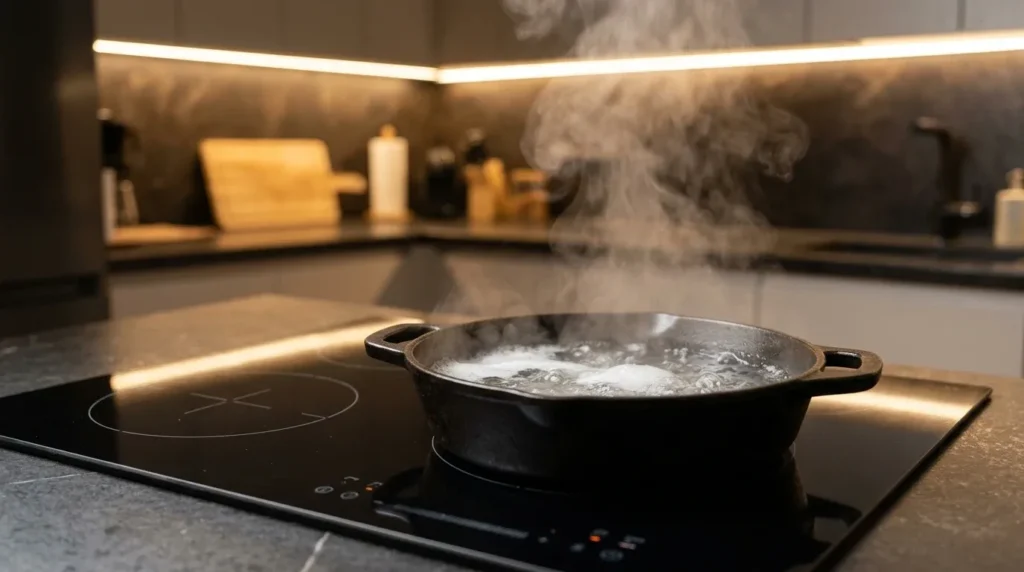
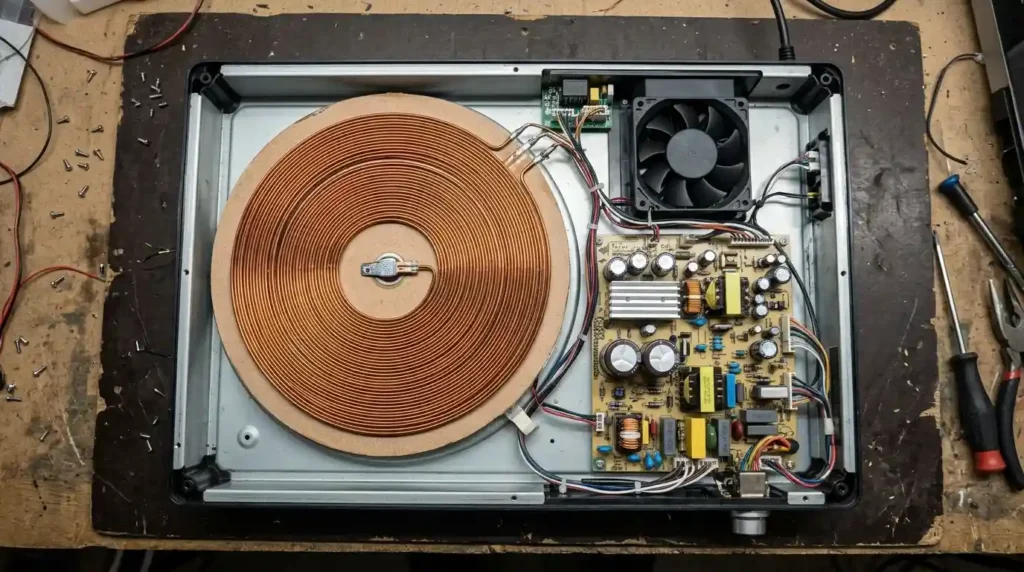
Under the glass of an induction hob sits a flat coil of wire driven by high-frequency alternating current. The Acero paper puts the usual operating range at “from 20 to 100 kHz.” That current produces a magnetic field that reverses tens of thousands of times a second, and any conductor sitting in it has currents induced inside it. The U.S. Department of Energy’s consumer guide says “induction cooking uses an electromagnetic field that transfers currents directly to the cookware.” ENERGY STAR’s 2021 induction cooking tops page puts the consequence plainly: “the cookware itself is the source of heat.”
The arrangement is close to a transformer. The coil is the primary winding. The bottom of the pan acts as a secondary winding shorted on itself, so the induced currents, called eddy currents, swirl around inside the metal and turn into heat through the metal’s own resistance. Because the heat is made in the pan, DOE notes, heating stops when the cookware comes off the burner.
A phone’s magnetometer can sense fields far weaker than this one, a topic covered in the x9m8 guide to measuring Earth’s magnetic field with a phone. An induction coil works at the other end of the scale, with a field strong enough to push kilowatts into a lump of iron.
Skin depth: where the current actually flows
High frequency squeezes the current toward the surface of the metal
Alternating current doesn’t spread evenly through a thick conductor. At high frequency it crowds toward the surface, within a distance called the skin depth, and the depth shrinks as frequency, conductivity and magnetic permeability rise. The Acero paper gives the material values it used: aluminum with a conductivity of 3 × 10⁷ S/m and relative permeability 1, and a ferromagnetic steel (F114) with conductivity 2 × 10⁶ S/m and relative permeability around 400.
Running the standard skin-depth formula, δ = √(2 / (ω μ σ)), on those inputs in Python on an Ubuntu test container reproduces the paper’s figures and adds the low end of the frequency range:
f=20 kHz  skin depth steel 126 um, aluminum 650 um; sheet R steel 3.97 mOhm, Al 0.051 mOhm; ratio 77.5x
f=100 kHz  skin depth steel 56 um, aluminum 291 um; sheet R steel 8.89 mOhm, Al 0.115 mOhm; ratio 77.5x
The useful number is the last one. For a thick plate, the effective resistance the induced current sees is roughly the material’s resistivity divided by the skin depth, a quantity the paper calls sheet resistance. Heat from a current goes as current squared times resistance, so for the same induced current, steel turns about 77 times as much of it into heat as aluminum does. The paper’s own comparison at 100 kHz says “the dissipation in the F114 is more than seventy five times higher than in the aluminum.”
Steel wins twice. Its resistivity is about fifteen times aluminum’s, and its permeability of 400 squeezes the current into a much thinner layer. A thin, resistive path for the current is exactly what a heating element is. Aluminum offers a wide, low-resistance path, so the current flows easily and wastes almost nothing as heat.
The hysteresis explanation, traced to its source
The usual story names a mechanism the paper’s model leaves out entirely
A popular account says induction needs magnetic pans because of hysteresis, the energy lost each time the magnetization of iron is dragged back and forth by the field. The Acero paper treats that as the common attribution rather than its own explanation, noting that “the inability of heating non-ferromagnetic materials is commonly attributed to the absence of the magnetic hysteresis,” and then explaining the difference through sheet resistance instead: “The suitability of a material for induction heating can be explained by means of its sheet resistance at a given frequency.”
Its conclusion is the cleaner rule. “An optimal material for induction heating should have a balanced sheet resistance, neither too low nor too high.” The paper models its materials as linear and computes heating from eddy currents alone, so it never puts a number on how much of a steel pan’s heat comes from hysteresis, and this post doesn’t either. Within that model, permeability by itself, by shrinking the skin depth and pushing resistance up, accounts for the gap between steel and aluminum. A magnet sticking to the pan is a cheap proxy for that.
The authors also show the rule can be engineered around. In their simulations, a copper layer just 1.5 micrometers thick on a non-metallic base reached efficiency similar to a typical ferromagnetic material, because a film that thin has a high sheet resistance no matter what the metal is.

The magnet test and which pans fail
A flat bottom that a magnet grabs, and a few exceptions worth knowing
DOE’s rule of thumb is the one printed on most induction boxes: “Any pots or pans with a flat bottom that a magnet sticks to will work with an induction cooktop,” per its guide. The Electric Power Research Institute’s 2014 ACEEE paper, by Sweeney, Dols, Fortenbery and Sharp, lists the incompatible materials: copper, aluminum and non-magnetic stainless steel. It adds that stainless compatibility is “highly sensitive to its alloy composition.”
That last point is where the magnet earns its keep. Two stainless pans can look identical on a shelf and behave nothing alike on the hob, because one alloy is magnetic and the other isn’t. Plain aluminum and copper fail outright. The flat-bottom half of DOE’s rule is easy to forget, and it is part of the test.
Not every fix needs a new pan. The same EPRI paper describes a prototype induction cooker built with gallium nitride transistors running at 60 kHz that heated non-ferrous stainless steel at 84 percent efficiency, though with aluminum it was “not able to deliver sufficient power for cooking.” That’s the physics from the previous section showing up in hardware: raise the frequency, shrink the skin depth, and a borderline material starts to behave.
Efficiency numbers: rated, measured and argued over
Induction reliably beats gas by a wide margin; its lead over electric coils depends on the pot
ENERGY STAR’s page gives the round numbers most articles repeat: induction transfers energy “with approximately 85% efficiency,” against roughly 32 percent for gas and 75 to 80 percent for electric resistance. DOE’s guide says induction is “up to three times more efficient than gas stoves” and “up to 10% more efficient than conventional smooth top electric ranges.” Neither page says how those figures were measured.
Two lab studies did measure. Frontier Energy’s 2019 report for the Sacramento Municipal Utility District, by Livchak, Hedrick and Young, heated 12 pounds of water from 70°F to 200°F in an 8-quart pot, a method based on ASTM F1521. EPRI’s 2014 study heated 10 pounds of water over the same temperature span.
| Cooktop | Frontier 2019, 12 lb water, large element | EPRI 2014, large vessel, full power |
|---|---|---|
| Induction | 83.0%, 85.2%, 86.1% (three models) | 77.6%, 77.2% (two models) |
| Electric coil | 79.3% | 83.4% |
| Smooth-top radiant (ceramic) | 75.5% | not tested |
| Gas | 31.9% | 35.2% (tested at 50°F, not directly comparable) |
The Frontier heat-up times tell the same story faster. Induction models took 9.3 to 11.6 minutes for the 12-pound test, the coil 15.5, the ceramic top 17.8 and gas 18.6.
Converted to energy, the results get easier to picture. With water’s specific heat of 4,184 joules per kilogram per degree Celsius, from the USGS Water Science School, Python gives:
water 5.443 kg, dT 72.2 K, energy into water 1.645 MJ = 0.457 kWh
induction GE 86.1%           input 0.531 kWh  wasted 0.074 kWh
induction Frigidaire 85.2%   input 0.536 kWh  wasted 0.079 kWh
coil 79.3%                   input 0.576 kWh  wasted 0.119 kWh
ceramic 75.5%                input 0.605 kWh  wasted 0.148 kWh
gas 31.9%                    input 1.432 kWh  wasted 0.975 kWh
And from the heat-up times, the average power actually reaching the water:
induction fastest  9.3 min -> avg 2948 W into water
coil               15.5 min -> avg 1769 W into water
gas                18.6 min -> avg 1474 W into water
For gas, more than two-thirds of the input never reaches the water. That waste is the same bookkeeping problem that runs through the x9m8 post on heat pump efficiency in cold weather: what matters is how much of the input ends up where the heat is wanted.
Where people get burned
The failures are mostly cookware, test conditions and fine print
- The wrong stainless pan. EPRI’s finding that stainless compatibility is “highly sensitive to its alloy composition” is the reason a magnet test beats reading the label.
- Expecting boiling-water efficiency in a sauté pan. Frontier’s sauté test, cooking a frozen burger patty, measured 47.8 to 54.0 percent for induction, 38.0 percent for the coil and 22.8 percent for gas. Every technology loses efficiency when the load is a thin piece of food instead of a full pot of water. Induction just loses less.
- Standby draw. Frontier measured idle consumption on the three induction units: one recorded “no noticeable energy consumption,” while two drew about 3 to 6 watts. The authors wrote that “it cannot be accurately concluded that the higher standby energies are inherent” to induction and pointed to screens and Wi-Fi as possible causes.
- Comparing numbers from different tests. EPRI tested gas at 50°F and electric units at 70°F and warned the figures aren’t directly comparable. The standard DOE procedure at the time used an aluminum test block, which EPRI notes induction can’t heat, and DOE had to propose a two-piece “hybrid test block” in 2013 to handle it.
- Reading “up to” as typical. “Up to three times more efficient than gas” is a ceiling. The measured ratios above run from about 2.2 to 2.7 depending on which units are compared.
When the old coil wins
Efficiency belongs to the pairing of element and pot, not to the cooktop alone
The EPRI table holds the uncomfortable result. With a large vessel, the plain electric coil measured 83.4 percent, ahead of both induction units at about 77 percent. The same coil with a small vessel fell to 41.5 percent, and the paper says its efficiency “fell from 83% to 42%” with the smaller pot, while induction “was found to maintain high efficiency regardless of cookware size.”
So induction’s real advantage is consistency across pots. A coil is efficient only when the cook happens to match pan and element. Induction puts the heat in whatever magnetic metal sits over the coil, which explains the speed figures, and it also explains a familiar complaint: a beloved aluminum pan that sits on a working burner and stays cold, like a radiator on a dead boiler.
How many pans in a typical kitchen drawer would pass the magnet test?
Sources
- J. Acero, I. Lope, C. Carretero, J. M. Burdío, “Adapting of Non-Metallic Cookware for Induction Heating Technology via Thin-Layer Non-Magnetic Conductive Coatings,” IEEE Access, vol. 8 (2020): https://zaguan.unizar.es/record/95877/files/texto_completo.pdf
- U.S. Department of Energy, Making the Switch to Induction Stoves or Cooktops (May 11, 2023): https://www.energy.gov/articles/making-switch-induction-stoves-or-cooktops
- ENERGY STAR, 2021 Emerging Technology Award: Residential Induction Cooking Tops: https://www.energystar.gov/about/2021_residential_induction_cooking_tops
- M. Sweeney, J. Dols, B. Fortenbery, F. Sharp (EPRI), “Induction Cooking Technology Design and Assessment,” ACEEE Summer Study 2014: https://www.aceee.org/files/proceedings/2014/data/papers/9-702.pdf
- D. Livchak, R. Hedrick, R. Young (Frontier Energy), “Residential Cooktop Performance and Energy Comparison Study,” prepared for SMUD (July 2019): https://sanjoseca.gov/home/showpublisheddocument/39054/637038749934400000
- USGS Water Science School, Specific Heat Capacity and Water: https://www.usgs.gov/special-topics/water-science-school/science/specific-heat-capacity-and-water
- x9m8, Measure Earth’s magnetic field with a phone magnetometer: https://x9m8.com/measure-earth-magnetic-field-phone-magnetometer/
- x9m8, Do heat pumps work in the cold?: https://x9m8.com/heat-pumps-in-cold-weather-cop/