At 18°F (−8°C), air-source heat pumps deliver anywhere from 1.1 to 3.7 units of heat for each unit of electricity, according to Natural Resources Canada. Same outdoor temperature, same category of machine, a spread of more than three to one. That range is the honest answer to whether heat pumps work in the cold: the physics allows a lot, the hardware delivers somewhere between barely-better-than-a-toaster and genuinely impressive, and the number that matters for a given house is the one measured at its own coldest week.
The physics ceiling: Carnot COP
A refrigerator running backwards has a speed limit set by temperature
A heat pump’s coefficient of performance is the heat delivered divided by the work put in. An open college physics text from Michigan State University gives the definition as the ratio of the heat delivered to the heated space to the work input required, and gives the ideal, Carnot version as COP = 1 / (1 − T_c/T_h), with temperatures in kelvin. The same page puts the consequence plainly: heat pumps perform best when the temperature difference between inside and outside is small.
Its worked example pumps heat from −15°C up to 45°C and gets a best possible COP of 5.30. Running the same formula in Python across the outdoor temperatures that show up in the published data, with two assumed hot-side temperatures (35°C and 45°C, roughly the range a coil has to reach to warm room air), produces the ceiling:
| Outdoor | Carnot COP, hot side 35°C | Carnot COP, hot side 45°C |
|---|---|---|
| 8°C (46°F) | 11.41 | 8.60 |
| −8°C (18°F) | 7.17 | 6.00 |
| −15°C (5°F) | 6.16 | 5.30 |
| −26°C (−15°F) | 5.04 | 4.47 |
The ceiling falls as the weather turns, but it never gets near 1. Even at −15°F, thermodynamics allows four to five units of heat per unit of electricity. Cold air still holds plenty of heat; what it lacks is the temperature to hand it over easily, so the compressor has to lift it farther, the way a pump on a deep well works harder than one on a shallow cistern.

What real cold-climate units measured
Lab specs, certification floors and 22 field sites
Real machines lose a large share of that ceiling to friction, imperfect heat exchangers and fan power. The published numbers line up like this:
- NRCan’s typical ranges. At 8°C, COP typically ranges from between 2.0 and 5.4; at −8°C, COPs can range from 1.1 to 3.7.
- NEEP’s cold-climate listing floor. Version 4.0 of the Northeast Energy Efficiency Partnerships specification, effective January 1, 2023, requires ducted and ductless central heat pumps to reach COP at 5°F ≥ 1.75 at maximum capacity operation.
- The DOE challenge target. The Department of Energy’s 2021 Cold Climate Heat Pump Challenge specification set a 5°F COP of 2.4 for units from 24,000 to 48,000 Btu/h and 2.1 for larger ones, and required a minimum ratio of maximum heating capacity at 5°F to rated capacity at 47°F of 1.0, meaning full output at 5°F.
- The field results. A 2024 ACEEE paper by researchers at Pacific Northwest National Laboratory, Guidehouse and DOE reported on 22 sites, 19 of them occupied homes across the northern United States. Compressor-only heating COPs ranged between 1.8 at the coldest temperatures of -15 ºF and 3.5 at 45 to 55°F.
Laying those against the Carnot ceiling (hot side 35°C) gives a sense of how much of the theoretical heat each one captures:
point                     out C  Carnot  real % of Carnot  elec saved vs resistance
NRCan, -8C, low end        -8.0    7.17  1.10         15%                        9%
NRCan, -8C, high end       -8.0    7.17  3.70         52%                       73%
NEEP v4 floor, 5F         -15.0    6.16  1.75         28%                       43%
DOE challenge, 5F         -15.0    6.16  2.40         39%                       58%
DOE field, -15F           -26.1    5.04  1.80         36%                       44%
The last column is just 1 − 1/COP: the share of electricity saved compared with resistance baseboard, which turns every kilowatt-hour into one kilowatt-hour of heat. At −15°F, a challenge unit in a real house still cut electricity for heat by about 44 percent against resistance, while it was running on the compressor alone.
Capacity: the number that runs out first
Efficiency drops gently; output drops in a way that leaves rooms cold
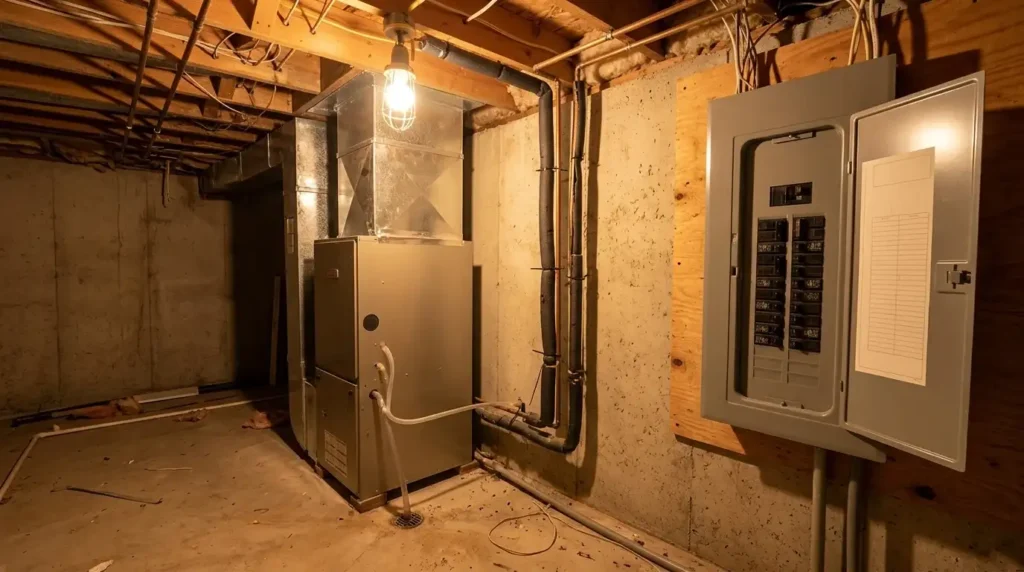
COP is half the story. The other half is how many BTUs the machine can move at all when the air is bitter, and that falls with temperature on ordinary units. NRCan defines the thermal balance point as the temperature below which the heat pump does not have enough capacity to meet the heating needs of the house. Below it, something else has to make up the difference.
That is why the DOE challenge wrote full 5°F capacity into its spec as a hard requirement, and why the NEEP listing asks manufacturers to report capacity at 47°F, 17°F and 5°F rather than only efficiency. A unit with a beautiful COP at 5°F and half its rated output is efficient and inadequate at the same time, which is a strange combination to pay for.
Every unit also has a floor. NRCan notes that the vast majority of air-source heat pumps have a minimum operating temperature, and that for newer models this cut-off can range from between -15°C to -25°C, roughly 5°F to −13°F. The DOE challenge’s optional cold segment asked for a compressor cut-out no higher than −20°F.
Defrost cycles
The outdoor coil grows ice, and melting it costs heat
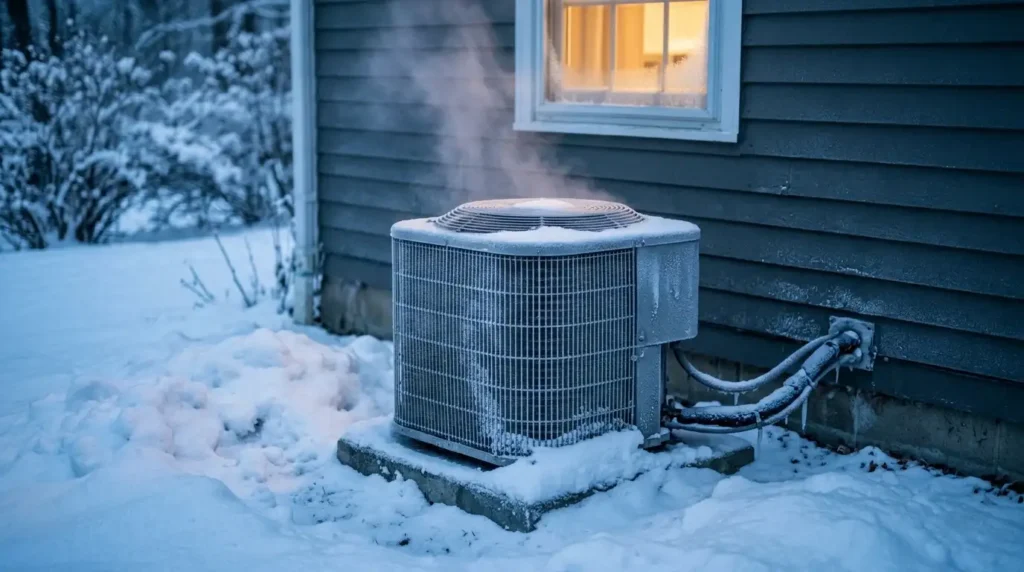
Near freezing, the outdoor coil runs colder than the air passing over it, and NRCan describes how moisture in the air passing over the outside coil will condense and freeze on it. Ice insulates the coil, so the machine has to clear it. To defrost, the reversing valve switches the device to the cooling mode and sends hot gas outside; NRCan adds that supplementary heat may be needed during defrost, and that the cycle can be initiated every 30, 60 or 90 minutes, depending on climate and design.
So for a few minutes the house is briefly air-conditioned in January while a heating element covers for it. DOE’s consumer guidance recommends a demand-defrost control, which it says will minimize the defrost cycles, thereby reducing supplementary and heat pump energy use. The field paper’s own numbers show the cost: the gap between COP measured with and without defrost and auxiliary heat grows smaller at warmer temperatures as less defrost operation and auxiliary support is noted. Read the other way, the 1.8 compressor-only figure at −15°F overstates what the whole system delivered on those nights.
Humid cold is often harder on a heat pump than dry cold. A 35°F drizzle frosts a coil faster than −5°F air with little moisture in it, which is one reason the COP-versus-temperature curves in spec sheets look smoother than a real February.
Where people get burned
The rating on the sticker is not the night that matters
Buying on HSPF2 alone. HSPF2 is a seasonal average. NEEP’s spec sets a 5°F COP floor separately because a seasonal number can look fine while the cold-end performance is weak. The 5°F COP and 5°F maximum capacity on the NEEP listing are the numbers that predict a cold-snap night.
Sizing to the 47°F rating. A unit sized to its mild-weather capacity drops below the house’s heat loss well above the coldest design day, and the thermal balance point moves up with it. Below that point the backup carries the load.
Backup heat that quietly does the work. The field paper found that at very cold outdoor temperatures, auxiliary heat contribution ranged from almost 0% to up to 90% across sites, using the same family of challenge units. Same hardware class, wildly different results, which points at installation and controls as much as the machine. Electric resistance backup is, in NRCan’s words, less efficient than the heat pump; a thermostat that calls for the strips too early turns a 2.0 COP system into something much closer to 1.0 for those hours.
Expecting a hybrid to run both at once. For dual-fuel setups paired with a furnace, NRCan notes these systems cannot be run simultaneously with the heat pump. The switchover temperature decides which one runs.
The paper’s authors still concluded that the units provided heat with little assistance from auxiliary elements even during the coldest weather, and that sentence sits right next to the 90 percent figure. Both are true across 22 different houses.
The case for keeping the furnace
When “works” and “saves money” come apart
Thermodynamics says yes, a heat pump works in the cold, and the field data says modern cold-climate units keep working well below 0°F. Whether it costs less to run than gas is a different question, and it depends on the price ratio, not the physics. NRCan names this the economic balance point: the temperature below which the ratio of electricity to a supplemental fuel makes the other fuel cheaper.
The break-even fits in one line of algebra. If electricity costs R times as much per kWh as gas does per kWh of fuel energy, a heat pump matches a furnace of efficiency η when COP = R × η. Python, with no prices assumed:
Break-even COP vs furnace (eta assumed)
furnace efficiency 0.80: R=2: COP 1.60, R=3: COP 2.40, R=4: COP 3.20, R=5: COP 4.00
furnace efficiency 0.95: R=2: COP 1.90, R=3: COP 2.85, R=4: COP 3.80, R=5: COP 4.75
In a market where electricity per kWh costs four times what gas does, a 95 percent furnace beats a heat pump at any COP below 3.8, and no unit in the field study reached that on the coldest nights. Where the ratio is near 2, the heat pump wins almost all winter. The same physics produces opposite bills two states apart, much as with rooftop and balcony solar, where the payback is set more by tariffs than by panels. Heat pumps, like the standing waves in a microwave oven, follow physics that is simple on paper and uneven in a real box.
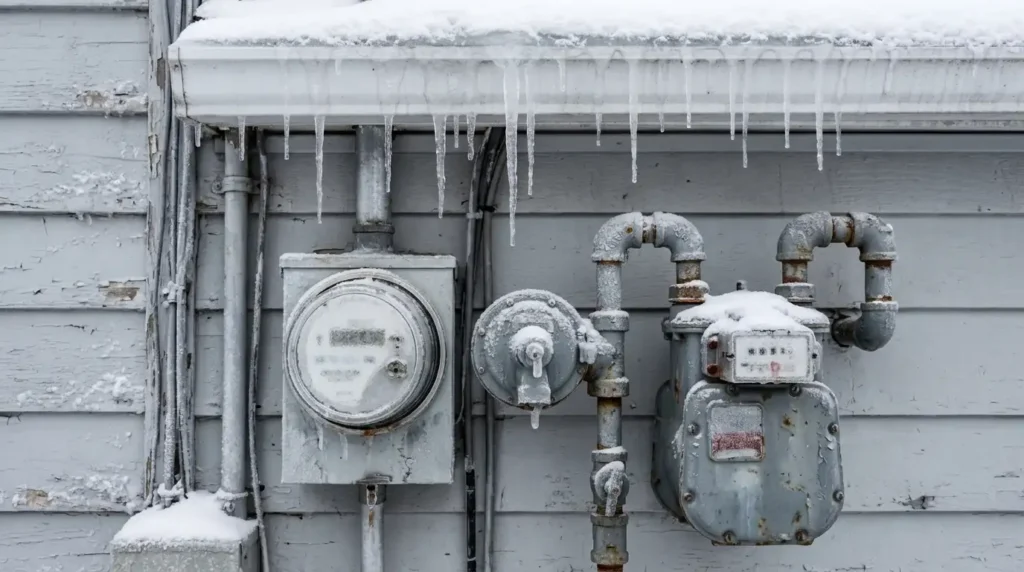
The machine on the concrete pad outside does not know what the utility charges. On the coldest night of the year it is moving heat out of air that feels like it has none, and the meter on the side of the house decides whether that was a bargain.
What is the ratio between electricity and gas prices on your own bill, and at what outdoor temperature would your system switch over?
Sources
- Natural Resources Canada, Heating and Cooling With a Heat Pump: https://natural-resources.canada.ca/energy-efficiency/energy-star/heating-cooling-heat-pump
- Michigan State University Open Books, College Physics, Applications of Thermodynamics: Heat Pumps and Refrigerators: https://openbooks.lib.msu.edu/collegephysics1/chapter/applications-of-thermodynamics-heat-pumps-and-refrigerators-2
- NEEP, Cold Climate Air Source Heat Pump Specification Version 4.0 (PDF): https://neep.org/sites/default/files/media-files/cold_climate_air_source_heat_pump_specification_-_version_4.0_final.pdf
- U.S. DOE, Residential Cold Climate Heat Pump Technology Challenge specification (Oct 2021, PDF): https://www.energy.gov/sites/default/files/2021-10/bto-cchp-tech-challenge-spec-102521.pdf
- Mendon et al., “Rising up to the Challenge: Cold Climate Heat Pumps in the Field,” ACEEE Summer Study 2024 (PDF): https://aceee.org/sites/default/files/proceedings/ssb24/pdfs/Rising%20up%20to%20the%20Challenge%20-%20Cold%20Climate%20Heat%20Pumps%20in%20the%20Field.pdf
- U.S. DOE Energy Saver, Air-Source Heat Pumps: https://www.energy.gov/energysaver/air-source-heat-pumps
- x9m8, California balcony solar law: https://x9m8.com/california-balcony-solar-law-sb-868/
- x9m8, Why microwave ovens heat unevenly: https://x9m8.com/how-microwave-ovens-heat-unevenly/