

On April 22, 2005, I got home to my house on Long Island’s North Shore, picked up the phone, and my father told me my brother was dead. He was 34. He had died of a drug overdose.
As an Amazon Associate I earn from qualifying purchases. A commission may be earned if you buy through this link, at no extra cost to you.
That afternoon is where A Rebel Life starts, and the book never gets far from it. Every chapter opens with a date, a time and a place, and the first eleven fit inside four days.
The question that runs through them is who answers for a death like that. I could blame my brother’s choices, or I could do what my mother did and treat the drugs as if they had never been a problem. I took neither. In the first chapter I ask it of myself: “Have I been condemned to live A Rebel Life even though I did not choose this existence?” The other twelve chapters are the answer.
Four days, thirteen chapters
Chapter 1 is stamped 2:50 p.m. Chapter 2 is 6:00 p.m., in my basement. I went down there to get through boxes I had kept for years: letters from friends in prison, a journal from the start of the bad years, a Newsday front page with my brother on it. Paper does that. It stays in a box until somebody dies.
From the basement the chapters move through a night, a morning, a funeral and a burial. Chapter 11 is set at the gravesite on the afternoon of April 25.
Three chapters are dreams, each headed “Asleep, dreaming”: “God’s Dream,” “Dream of a Ridiculous Man” and “My Brother’s Dream.” A man in a black suit turns up in at least two of them. Then the clock jumps. Chapter 12 is a letter dated June 14, 2005, and chapter 13 begins a year later, in June 2006.

The argument about responsibility
I wanted a verdict that did not let anyone off, and that included me. The one I reached is that a system built and run by the powerful steered my brother’s life, and that the demand for personal responsibility is how the system excuses itself.
I put it in philosophical terms in the letter that makes up chapter 12. Words about personal responsibility, I wrote, “serve as an illusion of free will” for people whose class status keeps them from coming to consciousness. It is a claim about how circumstance limits agency, argued from one family’s history rather than from a seminar room.
Revenge pulls the other way. In chapter 4, dated April 23, I decide I need a gun, and the chapter’s title, “The Gun or the Pen,” names the choice in front of me. By chapter 12 I am at home finishing a letter to my unborn child, and the wish for revenge has not gone anywhere. I just try to keep it away from the child.
Religion gets the same scrutiny. In chapter 9 I am listening to my mother cry through the walls of the family house, and I sum up how each of us is coping: “She has God and I have revenge.” At the burial I say nothing to the priest my mother sent, out of respect for her. In my head I dismiss the talk of sin and an afterlife as cover for what I call the greatest sin against the working man.
Nietzsche, Dostoevsky and Goethe
I read myself through other writers. In the dream of chapter 3 I sit in a room full of old books, and Nietzsche’s Zarathustra catches my eye. In chapter 4 I borrow a figure from it and aim it at myself: “I am becoming Nietzsche’s Last Man, the weed of history.”
The last man appears in Thus Spoke Zarathustra, beginning with its prologue, and Wikipedia’s summary describes him as a passive nihilist who is tired of life, avoids risk and seeks only comfort and security. My evidence against myself was a new SUV and a house full of things I had piled up over a decade. I had never owned anything new before. I had conformed to the system I swore to oppose, and I knew it while I was backing out of the driveway.
Chapter 5 shares its title with “The Dream of a Ridiculous Man,” the short story Fyodor Dostoevsky first published in 1877 in his journal A Writer’s Diary. In that story, according to Wikipedia, a man who has decided nothing matters dreams of a utopian planet and wakes up preaching an earthly paradise. My chapter is a dream too. It is headed 4:00 a.m. and opens with an image of man as a bridge between an ape ancestor and a new being. The letter in chapter 12 closes with an exchange I attribute to Goethe.

The letter in chapter 12
The twelfth chapter is a letter, dated June 14, 2005, to a child not yet born. I promise to name the child after my brother and call the child “my little brother’s justice.” The instructions that follow are to read without stopping, to resist what I call the herd mind, and to keep one’s ideals intact while moving through institutions one distrusts. “Be a rebel, intellectually first,” it says. It also warns that lashing out would set the family back.
The last chapter
The third edition adds chapter 13. It is titled “June 6, 2006 (666),” and it opens on June 7, 2006 in Saas-Fee, Switzerland, where I was attending a one-month residency for a doctoral program in media communications and sociology. A hotel desk clerk hands me a note: my father called. By 5:00 p.m. I am on a plane to New York. At 2:15 a.m. on June 8 the setting is Stony Brook Hospital, where the book ends.
Editions, content and where to find it
Amazon lists the paperback as published on August 14, 2007 by CreateSpace Independent Publishing Platform, at 198 pages, with ISBN 978-1434805065. The Kindle edition is listed under the publisher All & None NY Press, with a publication date of January 4, 2020, 200 pages, and an edition field reading “3rd.” That is the third and final edition. It adds the last chapter to the 2007 text, and everything before that chapter is unchanged.
The book contains violence, drug use and strong language, and its subject is a family member’s death from an overdose.
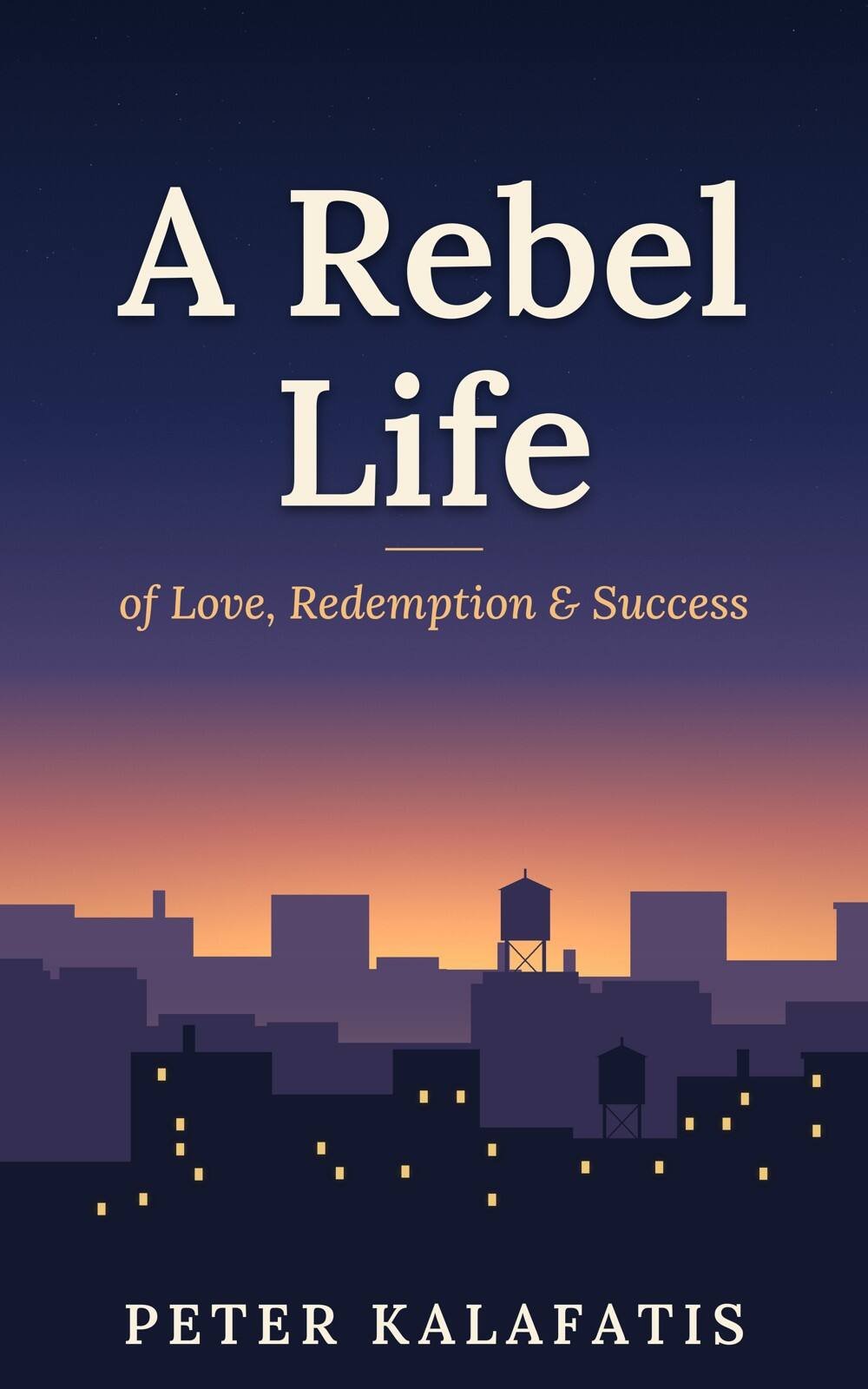
- A Rebel Life: of Love, Redemption & Success (Kindle edition): the third edition, 200 pages. See it on Amazon (affiliate link)
- A Rebel Life (paperback): 198 pages. See it on Amazon (affiliate link)
More from the author: Peter Kalafatis. About the site: About X9M8.
Sources
- Peter Kalafatis, A Rebel Life: of Love, Redemption & Success, Kindle edition, Amazon listing: https://www.amazon.com/dp/B083HMPXKB?tag=x9m8-20
- Peter Kalafatis, A Rebel Life, paperback, Amazon listing: https://www.amazon.com/dp/1434805069?tag=x9m8-20
- Wikipedia, “The Dream of a Ridiculous Man”: https://en.wikipedia.org/wiki/The_Dream_of_a_Ridiculous_Man
- Wikipedia, “Last man”: https://en.wikipedia.org/wiki/Last_man
- Quotations and chapter details are from the third-edition manuscript of A Rebel Life, checked against the text.