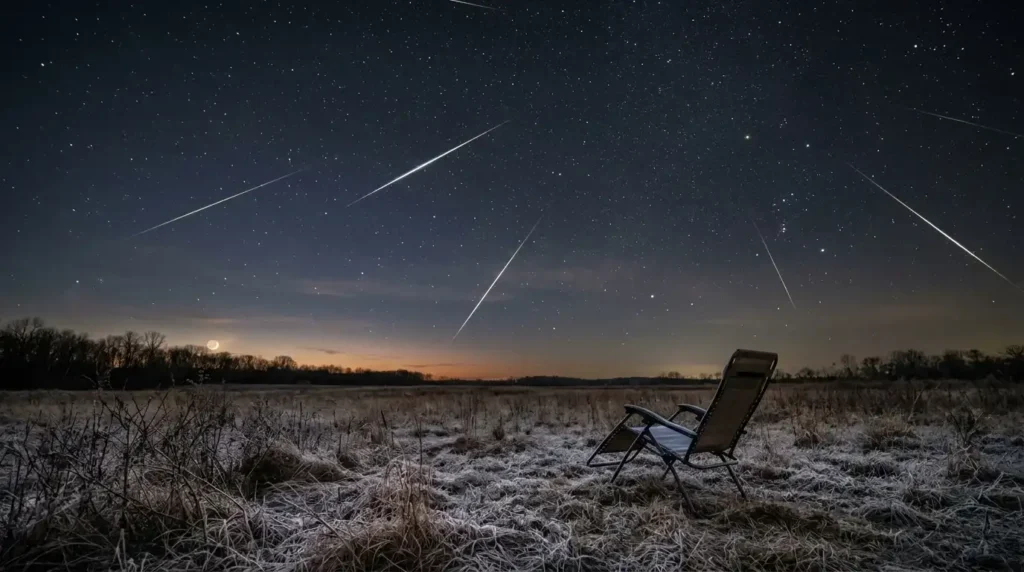
At 8:43 p.m. on Sunday, December 13, a crescent Moon 18% lit will drop below the western horizon of New York City, according to the U.S. Naval Observatory’s one-day almanac. From then until the first gray of dawn, the sky belongs to the stars. That same night, NASA lists the Geminid meteor shower at its peak, and the point the meteors appear to fly out of is already a third of the way up the eastern sky.
Young Moons set early and leave the rest of the night clean. For four U.S. cities, Naval Observatory moonset times and a radiant-altitude calculation run for each hour of the peak night turn that into clock times.
A young Moon on peak week
The phase calendar did most of the work before anyone looked up
The Naval Observatory’s 2026 phase table puts the New Moon at 00:52 UT on December 9 and First Quarter at 05:42 UT on December 17. The Geminid peak falls in between, four to five days after New Moon, when the Moon is a thin evening crescent trailing the Sun into the west.
A crescent at that age is up in daylight and sets a few hours after dark. On the night of December 12 in New York it goes down at 7:40 p.m., 12% lit. By December 14 it lingers until 9:45 p.m. at 26%. Each evening it stays up about an hour longer and gets fatter, like a pilot light someone keeps turning up.
EarthSky’s guide for this year says flatly that a waxing crescent moon will not interfere with viewing the meteor shower. The International Meteor Organization’s 2026 calendar calls the peak a broad moon-free maximum. Two organizations that make a living out of disappointing people about the Moon are, for once, not disappointing anyone.
The x9m8 Moon Phase and Dark-Sky Night Planner would rate these nights “moderate,” since it scores by lit fraction alone and its page says plainly that it doesn’t model moonrise or moonset. That gap matters more than the percentage. A Moon 18% lit sitting in the sky at midnight would matter. A Moon 18% lit that left at 8:43 does not.
When the Moon leaves, city by city
Naval Observatory moonsets for three nights, and the dark that follows
The moonset times and illuminated fractions here come straight from the Naval Observatory’s one-day API for each city and date, in local standard time. The “dark until” column is the end of astronomical darkness, when the Sun climbs back to 18 degrees below the horizon. That one was calculated, not fetched; the method is in the notes at the bottom, and the same code reproduced the Observatory’s sunset times to within a minute.
| City | Night of Dec 12 | Night of Dec 13 (peak) | Night of Dec 14 | Dark until (morning) |
|---|---|---|---|---|
| New York | Moon sets 7:40 p.m., 12% lit | Moon sets 8:43 p.m., 18% lit | Moon sets 9:45 p.m., 26% lit | about 5:33 to 5:35 a.m. |
| Chicago | 7:34 p.m., 12% | 8:37 p.m., 19% | 9:40 p.m., 27% | about 5:30 a.m. |
| Denver | 7:52 p.m., 12% | 8:54 p.m., 19% | 9:56 p.m., 27% | about 5:36 to 5:37 a.m. |
| Los Angeles | 8:02 p.m., 12% | 9:00 p.m., 19% | 9:58 p.m., 27% | about 5:21 to 5:22 a.m. |
Sources for each cell: Naval Observatory one-day data for New York Dec 12, Dec 13 and Dec 14; Chicago Dec 12, Dec 13 and Dec 14; Denver Dec 12, Dec 13 and Dec 14; Los Angeles Dec 12, Dec 13 and Dec 14.
Subtract one from the other and the moon-free dark on peak night runs 8 hours 51 minutes in New York, 8:53 in Chicago, 8:43 in Denver and 8:22 in Los Angeles. A night earlier, every city gets between nine and ten hours. A night later, the window shrinks to between about 7 hours 24 minutes (Los Angeles) and 7 hours 51 minutes (Chicago).
Los Angeles comes out shortest on every night, because its December nights are shorter at 34 degrees north and its Moon sets later by the clock. The difference is about half an hour, which won’t decide anything that a cloud bank won’t decide first.
The radiant, hour by hour
Where the meteors come from matters more than the Moon this year
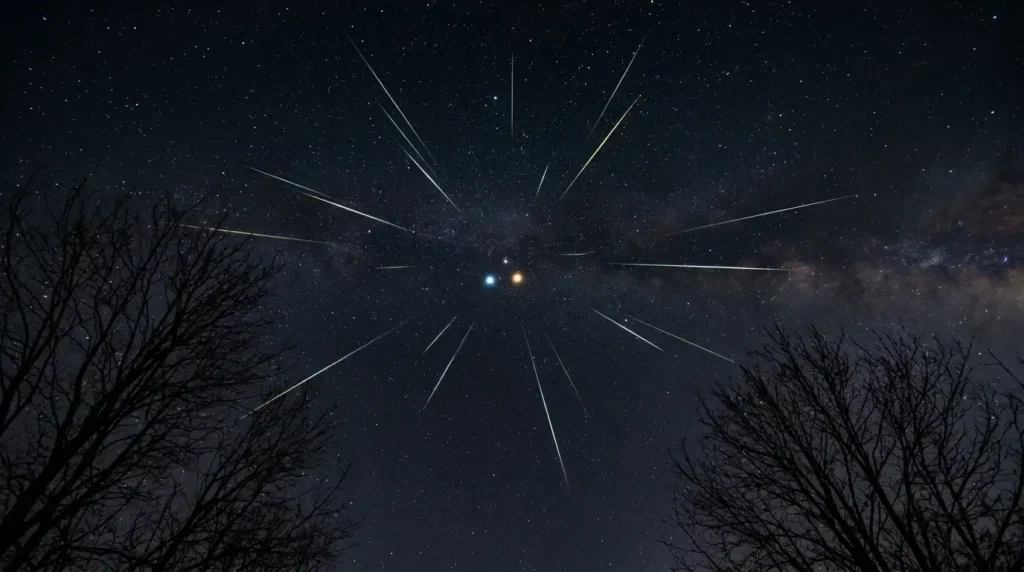
Geminids appear to stream out of a single point in the constellation Gemini, the Twins, which is how the shower got its name. The IMO calendar places that radiant at right ascension 112 degrees, declination +33 degrees at maximum. From those two numbers and each city’s latitude and longitude, the radiant’s height above the horizon can be worked out for any minute of the night.
The higher the radiant, the more of the shower’s paths land in the visible sky. When it sits on the horizon, half of the meteors are aimed at the ground below the observer’s feet, which is bad for viewing and very good for no one.
Peak night, December 13 into December 14, radiant altitude in degrees (local standard time; “—” means the Moon is still up):
| Local time | New York | Chicago | Denver | Los Angeles |
|---|---|---|---|---|
| 6 p.m. | 3° — | 5° — | 2° — | below horizon — |
| 7 p.m. | 12° — | 14° — | 11° — | 9° — |
| 8 p.m. | 22° — | 23° — | 21° — | 20° — |
| 9 p.m. | 33° | 34° | 32° | 31° (Moon sets 9:00) |
| 10 p.m. | 44° | 45° | 43° | 43° |
| 11 p.m. | 55° | 56° | 54° | 55° |
| Midnight | 66° | 67° | 66° | 67° |
| 1 a.m. | 77° | 77° | 77° | 80° |
| 2 a.m. | 82° | 81° | 83° | 87° |
| 3 a.m. | 74° | 73° | 75° | 75° |
| 4 a.m. | 63° | 62° | 64° | 63° |
| 5 a.m. | 52° | 51° | 53° | 50° |
| 6 a.m. | 41° (twilight) | 40° (twilight) | 41° (twilight) | 38° (twilight) |
The radiant clears the horizon between about 5:25 and 6:05 p.m. in all four cities and passes 30 degrees between 8:38 and 8:55 p.m., the calculation shows. It peaks near 1:50 a.m., close to straight overhead. EarthSky gives the same rule of thumb, with the radiant highest around 2 a.m. local time.
One coincidence falls out of the numbers. In each city, the Moon sets within about five minutes of the radiant reaching 30 degrees. The sky hands over from one to the other like a shift change at a plant.
Which hour, then
Six hours of dark sky with the radiant high, and three of them better than the rest
Combining the two tables, the strongest stretch on peak night runs from about 10 p.m. to 4 a.m. local time in all four cities: Moon gone, radiant above 40 degrees, and true astronomical darkness. Inside that, midnight to 3 a.m. is when the radiant is highest.
NASA’s own advice points earlier for families. The agency notes the Geminids start around 9 or 10 p.m., which it says makes this shower one of the best chances for young viewers. That fits the table: by 9 p.m. the Moon is down or nearly down everywhere and the radiant is above 30 degrees.
For those expecting rates, NASA’s table says to expect 40 to 50 meteors per hour under dark skies, with up to 120 an hour under perfect conditions at the peak. IMO lists a zenithal hourly rate of 150, a standardized figure for an ideal sky with the radiant overhead. Nobody in a suburban driveway sees ZHR. They see the number NASA gives, minus streetlights, minus the neighbor’s motion sensor.
NASA’s practical instructions are short. Get away from city and street lights, lie flat on your back with your feet facing south, and give the eyes about 30 minutes to adjust.
Two forecasts for the peak
EarthSky says one hour, the IMO says another, and both have a point
Past the tables, the shower’s timing holds a genuine disagreement. EarthSky’s 2026 guide says the peak is predicted for 5:44 UTC on December 14, 2026. Converted, that is 12:44 a.m. in New York, 11:44 p.m. in Chicago, 10:44 p.m. in Denver and 9:44 p.m. in Los Angeles, all in deep darkness with the Moon gone.
The IMO calendar puts the maximum at December 14, 14h UT, solar longitude 262.2 degrees. That is 9 a.m. in New York, broad daylight, and 6 a.m. in Los Angeles, with the radiant still 38 degrees up but the sky already in twilight. At 14h UT it is 11 p.m. in Tokyo, so on that forecast the crest lands in East Asia’s night and North America catches the slope leading up to it.
That is the strongest case against planning around moonset at all. If the IMO figure is the better one, the hour that matters most happens after sunrise for most of the United States, and moonset times won’t change that.
The IMO’s own text softens it. The calendar says reliably reported maxima over the past two decades fell between December 13 at 21h UT and December 14 at 18h UT, and the Geminid peak is broad. Every hour of the U.S. peak night, from New York’s dusk to Los Angeles’s dawn, lands inside that span. The calendar also says observing sites at middle and northern latitudes are best suited, and that well north of the equator the radiant rises about sunset.
So the night of December 13 holds up under either forecast. Whether the hour after midnight or the hour after breakfast is the true crest is a question the shower answers only on the night itself.
The rock behind the shower
An asteroid playing a comet’s part, badly enough to keep scientists busy
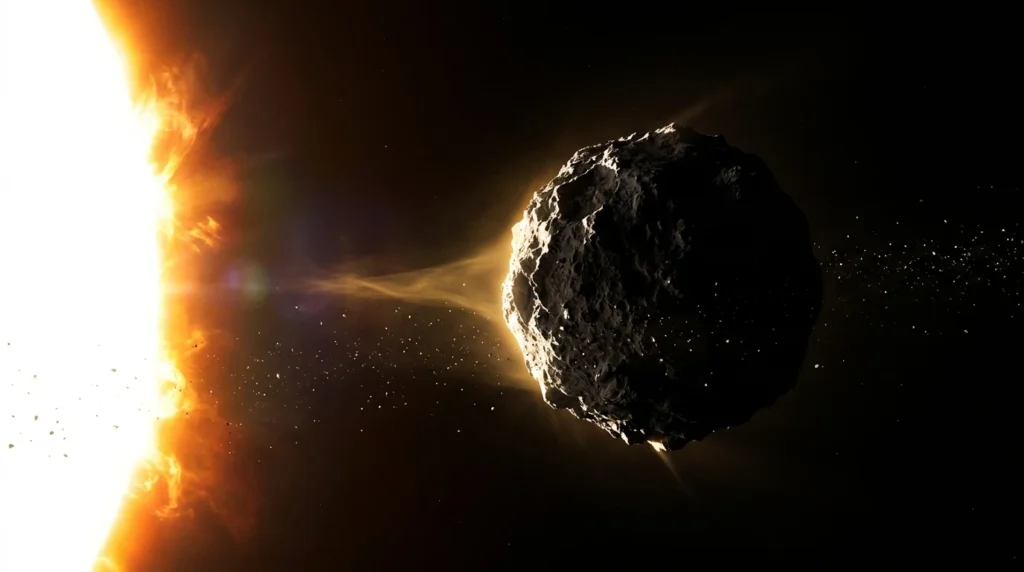
Most meteor showers come from comets. The Geminids come from an asteroid, 3200 Phaethon, which NASA says takes 1.4 years to circle the Sun. A 2023 NASA article puts the orbit at 524 days, consistent with that.
NASA can’t quite agree with itself on the size. The Geminids page gives a diameter of 3.17 miles (5.10 kilometers); the 2023 article calls it a 3.4-mile-wide asteroid. A quarter-mile is a rounding error on something that has never held still for a tape measure.
The 2023 work is the stranger part. Phaethon comes within about 13 million miles of the Sun and grows a short tail there, which had been read as dust. A team led by Caltech PhD student Qicheng Zhang, publishing in the Planetary Science Journal, found that Phaethon’s tail is not dusty at all but is actually made of sodium gas. That left the old question open: if the present-day tail isn’t shedding dust, where did the Geminid stream come from? Zhang’s team suspects a disruptive event a few thousand years ago, and NASA’s article says what that event was remains a mystery.
The particles themselves hit the upper atmosphere at about 22 miles (35 kilometers) per second, and the IMO calendar lists the same 35 kilometers per second. That covers a marathon’s 26.2 miles in just over a second, thrown off by a rock nobody has fully explained.
Before December 13
What a forecast can’t settle
The shower runs December 4 to 17 by NASA’s dates and December 4 to 20 by the IMO’s, so a clouded-out Sunday isn’t the end. December 12 has the darkest night of the three on the table and lower rates; December 14 has a fatter Moon that stays up until almost 10 p.m. and rates already falling.
For anyone trying to photograph it, the x9m8 guide to shooting the Orionids with a phone covers night mode and framing away from the radiant, and the same steps carry over. The October 2026 sky plan laid out a similar night-by-night approach for that month.
Every number in these tables can be checked except one. The Naval Observatory can say to the minute when the Moon will go down over the Hudson, and no agency anywhere can say whether the clouds will.
Readers in the four cities, or anywhere else: which night are you planning on, and how dark is the darkest spot within an hour’s drive?
Sources
- NASA Science, “Geminids”: https://science.nasa.gov/solar-system/meteors-meteorites/geminids/
- NASA, “Asteroid’s Comet-Like Tail Is Not Made of Dust, Solar Observatories Reveal” (Apr. 25, 2023): https://www.nasa.gov/solar-system/asteroids/asteroids-comet-like-tail-is-not-made-of-dust-solar-observatories-reveal/
- EarthSky, “Geminid meteor shower peaks December 13-14” (Deborah Byrd and Marcy Curran): https://earthsky.org/astronomy-essentials/everything-you-need-to-know-geminid-meteor-shower/
- International Meteor Organization, “2026 Meteor Shower Calendar” (ed. Jürgen Rendtel): https://www.imo.net/files/meteor-shower/cal2026.pdf
- U.S. Naval Observatory, Moon phases 2026: https://aa.usno.navy.mil/api/moon/phases/year?year=2026
- U.S. Naval Observatory, one-day Sun and Moon data, New York, Dec. 12: https://aa.usno.navy.mil/api/rstt/oneday?date=2026-12-12&coords=40.71,-74.01&tz=-5
- U.S. Naval Observatory, New York, Dec. 13: https://aa.usno.navy.mil/api/rstt/oneday?date=2026-12-13&coords=40.71,-74.01&tz=-5
- U.S. Naval Observatory, New York, Dec. 14: https://aa.usno.navy.mil/api/rstt/oneday?date=2026-12-14&coords=40.71,-74.01&tz=-5
- U.S. Naval Observatory, Chicago, Dec. 12: https://aa.usno.navy.mil/api/rstt/oneday?date=2026-12-12&coords=41.88,-87.63&tz=-6
- U.S. Naval Observatory, Chicago, Dec. 13: https://aa.usno.navy.mil/api/rstt/oneday?date=2026-12-13&coords=41.88,-87.63&tz=-6
- U.S. Naval Observatory, Chicago, Dec. 14: https://aa.usno.navy.mil/api/rstt/oneday?date=2026-12-14&coords=41.88,-87.63&tz=-6
- U.S. Naval Observatory, Denver, Dec. 12: https://aa.usno.navy.mil/api/rstt/oneday?date=2026-12-12&coords=39.74,-104.99&tz=-7
- U.S. Naval Observatory, Denver, Dec. 13: https://aa.usno.navy.mil/api/rstt/oneday?date=2026-12-13&coords=39.74,-104.99&tz=-7
- U.S. Naval Observatory, Denver, Dec. 14: https://aa.usno.navy.mil/api/rstt/oneday?date=2026-12-14&coords=39.74,-104.99&tz=-7
- U.S. Naval Observatory, Los Angeles, Dec. 12: https://aa.usno.navy.mil/api/rstt/oneday?date=2026-12-12&coords=34.05,-118.24&tz=-8
- U.S. Naval Observatory, Los Angeles, Dec. 13: https://aa.usno.navy.mil/api/rstt/oneday?date=2026-12-13&coords=34.05,-118.24&tz=-8
- U.S. Naval Observatory, Los Angeles, Dec. 14: https://aa.usno.navy.mil/api/rstt/oneday?date=2026-12-14&coords=34.05,-118.24&tz=-8
- x9m8, Moon Phase and Dark-Sky Night Planner: https://x9m8.com/moon-phase-dark-sky-planner/