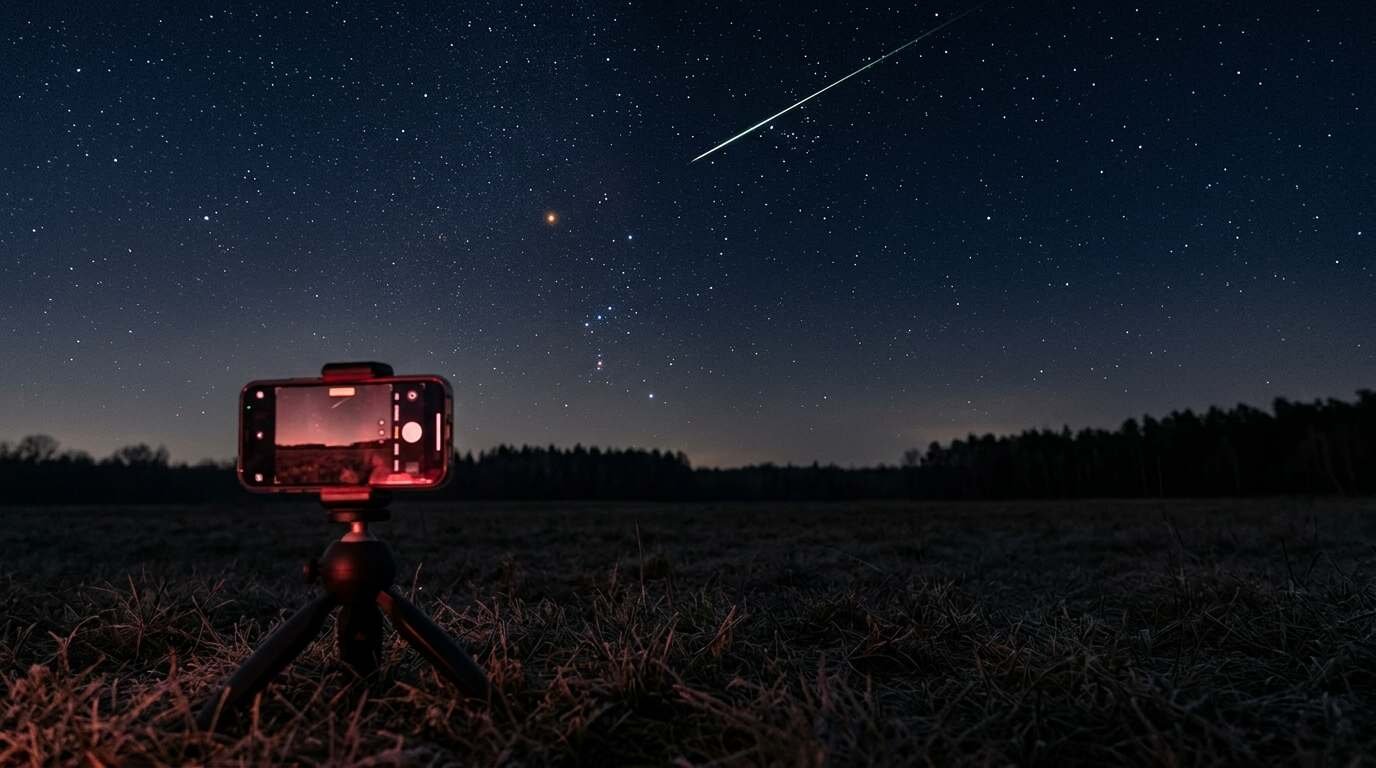
The Orionid meteor shower peaks October 21–22, 2026. Here is a step-by-step plan for capturing Halley's Comet debris with an iPhone, Pixel, or Galaxy phone.
Every October, Earth drives through a river of dust left behind by the most famous comet in history. Halley itself last visited the inner solar system in 1986 and won’t be back until 2061. The debris keeps arriving on schedule anyway, and this year the busiest stretch lands on the night of October 21 into 22.
Your phone can catch some of it. Not every streak, and not on every frame, but enough to justify a cold hour in a dark field.
This guide runs like a mission plan. It starts with a countdown from today, moves through launch night, and ends with sorting the results. Follow it in order and you will arrive with a tested setup instead of a drained battery and a blurry sky.
The Orionids at a Glance
- Peak: the night of October 21–22, 2026. The shower is active from October 2 to November 7, according to Star Walk.
- Rate: about 20 meteors per hour in ideal conditions, with the radiant directly overhead. That figure is a ceiling, and real counts usually come in lower. The Farmers’ Almanac puts dark-sky peaks at roughly 15 to 25 per hour and light-polluted suburbs at 5 to 10.
- Source: Halley’s Comet, catalogued as 1P/Halley.
- Speed: around 66 kilometers per second, which works out to about 41 miles per second.
- Radiant: the constellation Orion, just north of the bright star Betelgeuse.
- Moon: waxing gibbous, about 80 percent lit, setting near 3 a.m. local time.
That last line matters more than the rest, so it gets its own section.
The Catch Nobody Puts in the Headline: The Moon
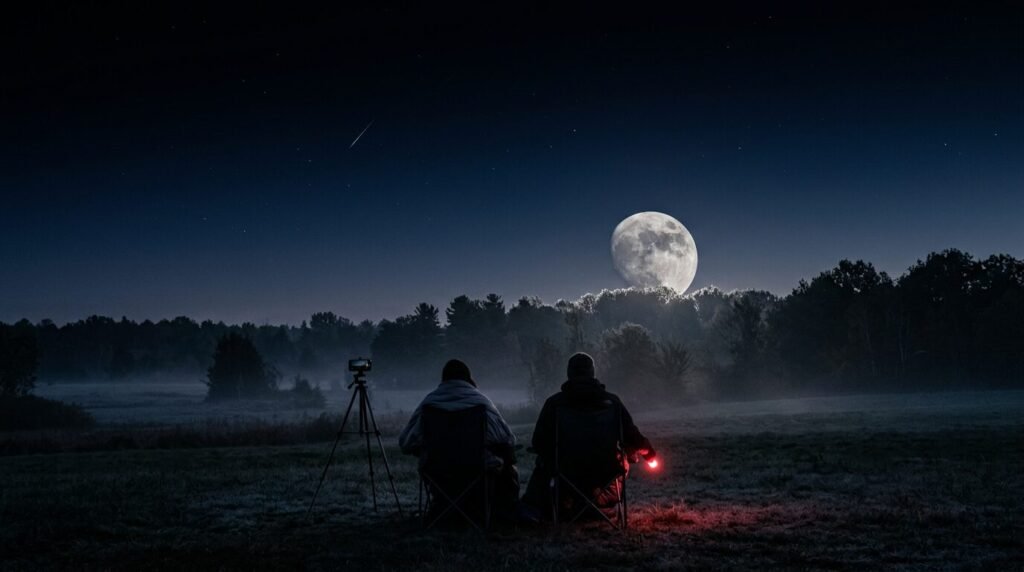
A bright moon washes out the fainter meteors. A phone sensor is also far less sensitive than a dark-adapted human eye, so the loss hits your camera roll harder than it hits a person lying on a blanket.
The fix is timing. The Farmers’ Almanac points to the window between moonset and dawn as the darkest stretch, and that happens to coincide with Orion climbing higher. The shower improves steadily after the constellation rises around midnight. If a building, a tree, or a hill can block the moon from your frame before it sets, use it. Star Walk recommends exactly that trick.
Plan the shoot around those hours rather than fighting the glare.
T-Minus 12 Days: Scout and Test
You have until the 21st. Spend part of that time on dry runs, because a meteor shower gives you no second take.
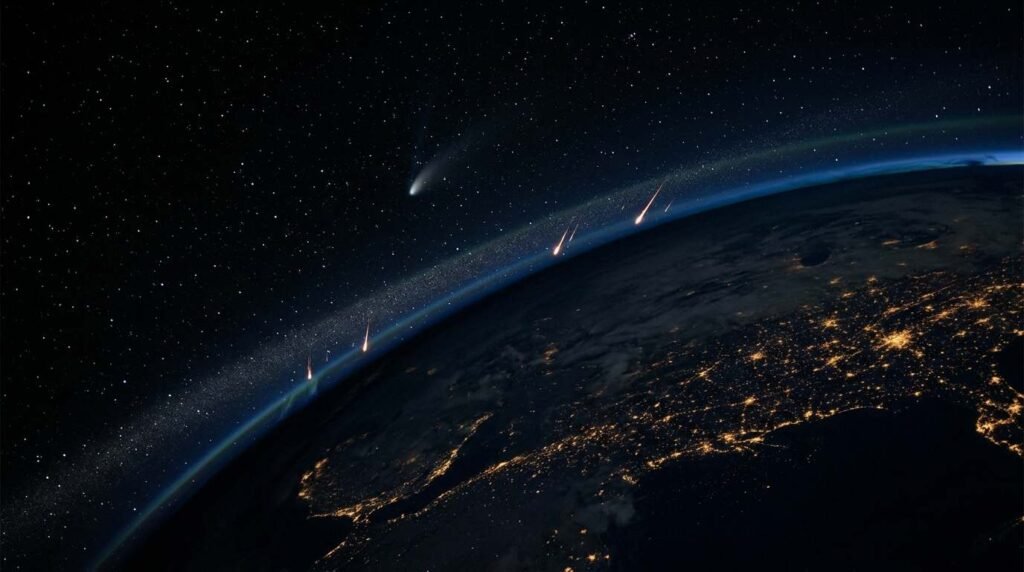
- Pick the location now. Get as far from city lights as you reasonably can. The Farmers’ Almanac says driving at least 30 minutes out of town can roughly double what you see. Check that the spot is open after dark, that parking is legal, and that someone knows where you are.
- Shoot a practice night. Kain Jones, CEO of Pixsy, tells photographers to take practice shots at night before the real event (reported by FOX Weather). Do it on a clear evening with the same gear you plan to use.
- Learn your phone’s night mode. Know where the toggle lives, how the exposure time shows up, and how long the phone takes to finish a shot.
- Decide on an app if your camera falls short. Many camera apps offer manual control of exposure and shutter speed. FOX Weather lists most as costing between $2.99 and $25 a year and names NightCap, at $2.99, as one built for astrophotography. Prices change, so check the store listing.
Gear That Matters (and Gear That Doesn’t)
A tripod is the one purchase worth making. Phone-sized models are cheap, and they turn a shaky handheld smear into a steady exposure. Add a clamp or mount that grips your specific phone.
Beyond that, keep the kit short:
- A power bank and cable, since cold weather tends to drain phone batteries faster.
- A red flashlight or a phone red-light mode, so you don’t wreck your night vision.
- Warm layers and something to sit on.
- A lens cloth, because dew collects on a phone camera faster than you’d expect.
Skip the clip-on telephoto lenses and filters. Meteors streak across wide patches of sky, so a wide view serves you better than magnification.
Stray light causes more ruined frames than shaky hands. Jones says it plainly: “You don’t want any extra light to flood into the lens.” Stay clear of lampposts and parked car headlights, and don’t let a companion check a phone screen in front of yours.
Phone Settings by Platform
The steps below come from FOX Weather’s guide, so confirm menu names on your own device before the night.
iPhone. Night mode on the iPhone 11 Pro and later simulates a slow shutter speed. If your phone offers RAW capture, turn it on, because uncompressed files hold more detail for editing later.
Google Pixel. Night Sight is available on the Pixel 4a and newer. For long exposures that can pick up several meteors in one frame, try the Motion option. On a Pixel 4 or later you can also record a night-sky time-lapse. Open the camera, tap Night Sight, and hold the phone steady until an “astrophotography on” message appears.
Samsung Galaxy. The Galaxy S21 Ultra’s 108-megapixel sensor is described as the strongest for low light, and the S21 Pro’s night mode can produce good results too. Samsung’s own guidance suggests a shutter speed of up to 30 seconds and a high ISO for stars.
Any phone, any night:
- Turn the flash off.
- Use the wide camera, not a zoomed lens.
- Set the self-timer to 5 seconds so pressing the shutter doesn’t shake the phone. Jones suggests this and recommends staying still while the exposure runs.
- Focus on a distant bright star or far-off light, then lock it if your camera allows.
- Expect exposures somewhere between 5 and 30 seconds, depending on your phone and the sky.
Launch Night: The Run Sheet
This is the sequence for October 21 into 22. Adjust the clock to your own moonset time.
- Check the forecast before you leave. Heavy cloud cover can ruin the shot no matter how good your gear is. If the sky looks hopeless, the shower is still active through early November, and a clearer night nearby beats a perfect night under overcast.
- Charge everything. Phone, power bank, red light.
- Arrive early and give your eyes time. Star Walk suggests about 20 minutes to adapt to the dark. Use red mode on any stargazing app.
- Around midnight, start test frames. Orion is rising, and you can confirm focus and framing while the moon is still up.
- Set up for moonset. Once the moon drops near the horizon, switch to your real settings and start shooting continuously.
- Keep going until twilight. Meteor counts tend to improve toward the pre-dawn hours, so the last stretch of the night is often the most productive.
- Look up. Trigger the shots, then put the phone down and watch the sky with your own eyes. Screen glare costs you night vision, and the live view is half the reason to go.
For a walkthrough of a similar setup in action, this tutorial covers phone astrophotography for meteor showers. It was found through a search and not reviewed in full before publishing, so preview it before you rely on it.
Composition: Aim Away From the Radiant
It feels natural to point the camera straight at Orion. Resist that.
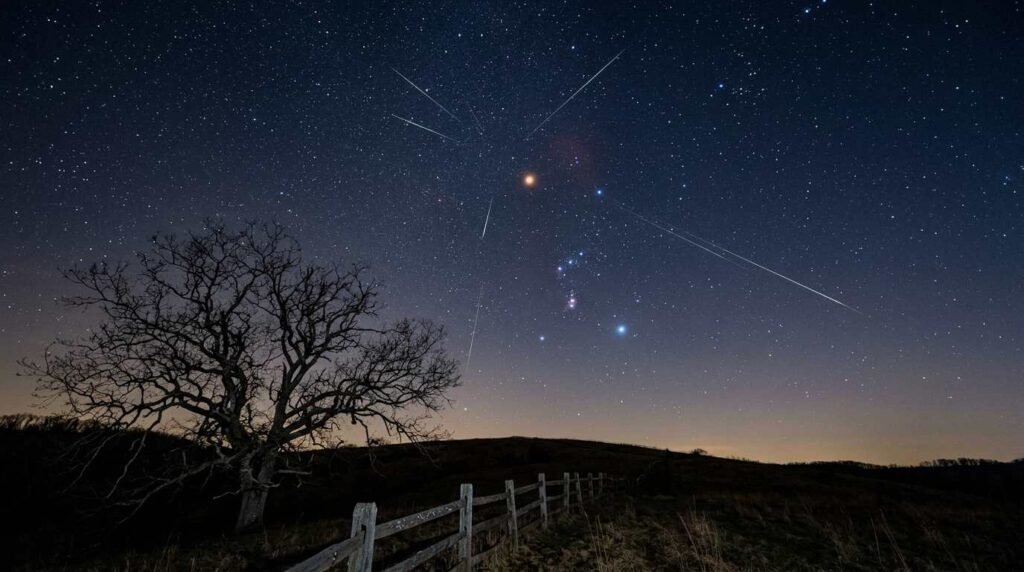
Meteors can appear anywhere in the sky, but trails look longest when you watch roughly 45 degrees away from the radiant, according to both Star Walk and the Farmers’ Almanac. Frame a wide patch of sky to one side of the constellation and you give streaks room to travel across the frame instead of arriving head-on as short dots.
A foreground adds scale and context. A tree line, a ridge, or a silhouetted fence post turns a technical record into a photograph someone wants to look at. Just keep it dark, since any lit foreground will force the exposure shorter.
What Phones Caught in Earlier Seasons
Posts from past showers show what people actually recorded. These went up during the 2025 and 2024 Orionid seasons, so the dates and sky conditions differ from this year’s.
UK stargazers – the Orionid meteor shower peaks tonight!
— UK Space Agency (@spacegovuk) October 21, 2025
The UK Space Agency’s post repeats the numbers that matter: debris from Halley’s last pass in 1986, entering the atmosphere at about 66 kilometers per second.
Some very nice meteors this morning. First clip has 3 at once!
— EricTheCat (@EricTheSpaceCat) October 19, 2025
According to its own text, this post includes a clip with three meteors at once, plus a bright sporadic meteor unrelated to the shower.
Orionids Meteor Shower Peaking this weekend!
This TikTok is an Orionid viewing guide from a stargazing creator. Whatever the clip shows, the lesson from the moon section still applies: faint streaks disappear into a bright sky, so shoot when the sky is darkest.
After the Night: Sorting Your Frames
Most of what you shot will contain stars and nothing else. That is normal, not failure.
Scroll through everything and delete the empties. Keep any frame with a clear streak, even a short one. Edit lightly: lift the shadows a touch, reduce noise if your editor offers it, and avoid pushing contrast so hard that the sky turns muddy. Save the untouched original beside every edited version.
Stacking several frames in an astrophotography app can bring out detail, but treat it as an optional extra. A single clean frame with one honest meteor in it beats a heavily processed composite.
Frequently Asked Questions
Can any phone photograph a meteor shower?
Phones with a night mode do best. Older models can still try if they run an app with manual exposure control.
What is the best time to shoot on October 21–22?
After moonset, around 3 a.m. local time, through the pre-dawn hours. Orion is higher by then and the sky is at its darkest.
Do I need to aim at the radiant in Orion?
No. Aim about 45 degrees to one side of it for the longest-looking trails.
Will I see Halley’s Comet itself?
No. You are seeing small bits of its dust burning up in the atmosphere. The comet returns in 2061.
Should I bring binoculars or a telescope?
Not for watching. Both Star Walk and the Farmers’ Almanac say your eyes work best because the field of view is wide.
What if it is cloudy?
Check the forecast and consider driving to a clearer area. The shower runs through early November, though the strongest rates fall near the peak.
Sources