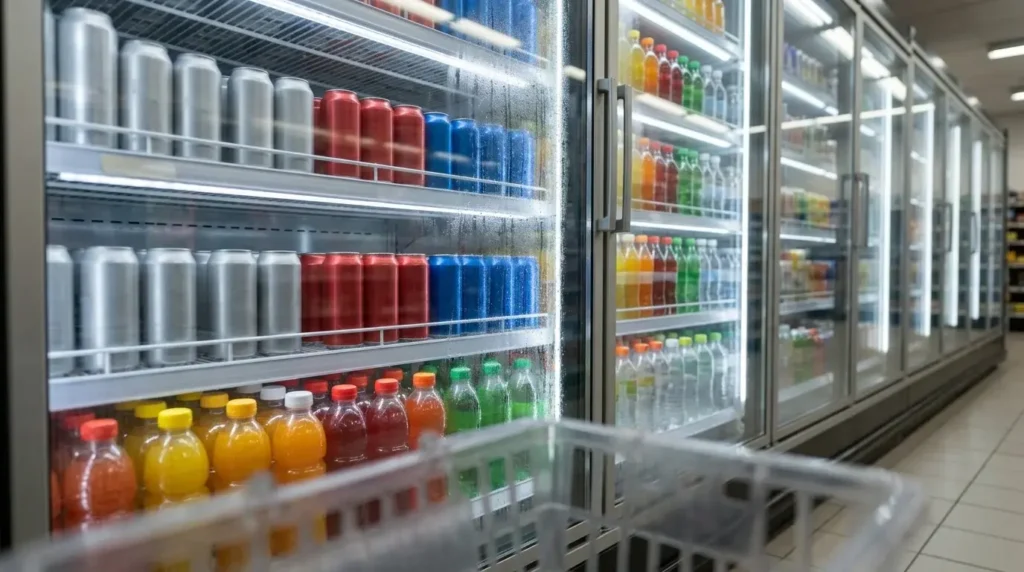
A sweetened zero-sugar soft drink gives a sugar limit nothing to grab. The World Health Organization’s new draft food profiling model would flag it anyway, because the model reads the ingredient list as well as the nutrition panel, and one of its specified sweeteners, colours or flavours on that list is enough. Run against a database of packaged products, the draft caught 97.27 percent of the nutrient-validated foods that the NOVA system classes as ultra-processed, according to Food Safety Magazine’s summary of the draft, without asking how any of them were made. Public comments close at 23:59 Geneva time on Friday, 27 November 2026.
A sorting rule with two doors
Fat, sugar and salt are still in the model. The new part is a list of ingredients
The document’s full name is long enough to need its own shelf: Integrated Food Profiling Model for Regulatory Measures: Implementing the WHO Best Buys and Recommended Food Policies to Prevent Diet-Related Non-Communicable Diseases. Food Safety Magazine describes two criteria. The first catches products exceeding specified thresholds for saturated fats, trans fats, sugars, or sodium. The second catches products containing specified flavours, colours or sweeteners, which WHO says are used mainly to make food more appealing.
Either door is enough. A product that meets one or more criteria in either category becomes what the draft calls an “industrially produced, prepackaged food to be consumed in moderation,” or IFM.
Katrin Engelhardt, a technical officer in WHO’s nutrition and food safety department, said in comments reported by Reuters that the draft “goes beyond traditional nutrient profiling,” recognising that formulation matters along with nutrient content. Reuters reports it is the first time the agency has put this type of ingredient into its profiling guidance, which until now dealt only with nutritional content such as fat and salt.
WHO also spells out what the draft is not. It does not say the listed additives are dangerous. Food Safety Magazine reports WHO stressed that including flavours, colours and sweeteners does not imply that these ingredients are inherently unsafe, and that it is not trying to classify foods by processing level or call individual products healthy or unhealthy. The model is also not a law. Countries could adapt it for marketing limits, front-of-pack warnings, taxes and public procurement, or ignore it.

The same shelf, scored two ways
What a nutrient-only model flags, next to what the integrated draft flags
The difference shows most clearly on products that have already been reformulated. The draft document itself was not read for this post, and neither were its numeric thresholds or its list of specified ingredients. WHO’s consultation portal releases the draft only after a reader enters personal details, so the criteria below come from the summaries published by Reuters, Food Safety Magazine, FoodBev Media and Global Agriculture. For that reason the nutrient column says “over or under threshold” rather than giving grams, and every row is an illustration, not a scoring WHO has published.
| Generic product | Nutrient-only model (saturated fat, trans fat, sugars, sodium) | Integrated draft (nutrients or specified flavours, colours, sweeteners) |
|---|---|---|
| Zero-sugar carbonated soft drink, sweetened with a non-sugar sweetener, with added colour and flavouring | Likely passes: no sugar, negligible sodium and fat | Flagged: contains a sweetener, a colour and a flavour |
| Low-fat fruit-flavoured yogurt, sugar cut and replaced with a sweetener | Can pass if sugar falls under the threshold | Flagged: sweetener and flavouring on the ingredient list |
| Plain salted butter in a tub | Very likely flagged on saturated fat, depending on the threshold | Same nutrient result; the ingredient door adds nothing |
| Canned chickpeas in water with a little salt | Passes or fails on the sodium threshold alone | Same result: no listed sensory ingredient |
| Regular sugar-sweetened cola with colour and flavour | Flagged: sugars | Flagged twice over: sugars, plus colour and flavour |
The top two rows are where the argument lives. Under a nutrient-only system, a company that swaps sugar for a sweetener can move a product out of scope. Under the draft, the swap no longer works. The trade publication Global Agriculture put it directly: a product reformulated from sugar to a sweetener could, under this draft, remain within scope. The same outlet notes that the published material does not separate natural from synthetic flavours or colours.
That row also matches a position WHO took three years ago. Its 2023 guideline on non-sugar sweeteners recommends against the use of NSS to control body weight or reduce the risk of noncommunicable diseases. The agency rated that recommendation conditional, because the evidence linking sweeteners to disease outcomes might be confounded.
For comparison, a classic nutrient profile model looks like the one WHO’s European office published in its second edition in March 2023: food categories, each with its own nutrient thresholds, built to decide which products can be marketed to children. It is a scale. The new draft bolts a checklist onto the scale.
The industry’s case
Reformulation took years, and the companies say the new door punishes it
The International Food and Beverage Alliance, which represents large multinational food and drink companies, said it was concerned the approach shifts attention away from nutritional quality and could bring more products under potential regulation, Reuters reported. Its secretary-general, Rocco Renaldi, was direct: “Of particular concern is the potential to undermine established nutrition priorities and reformulation efforts,” he said.
That argument has real force, and the table shows why. Sugar and sodium limits have pushed manufacturers to reformulate. Global Agriculture notes that where governments adopted nutrient-based warning labels or marketing limits, companies often responded by reformulating, cutting sugar or sodium to stay under thresholds. If the reward for taking sugar out is staying under the warning label, and the draft removes that reward, the incentive to reformulate weakens, at least for sweetened products.
Reuters lists other industry worries: the cost of reformulating, stricter labelling requirements, class-action exposure of the kind seen in the US, and higher taxes. Kraft Heinz chief executive Steve Cahillane said the week before that companies “ought to have a seat at the table as these discussions evolve.”
There is also a scientific objection to the ultra-processed category the draft is calibrated against. A 2022 study in the European Journal of Clinical Nutrition asked French food and nutrition specialists to sort foods into the four NOVA processing groups. Agreement was low, with Fleiss’ κ of 0.32 and 0.34 for marketed and generic foods, and the authors concluded that consistency was low even when ingredient information was available. If the definition of ultra-processed is that slippery, a 97 percent match with it proves less than it appears to.

The public health case
The draft’s defenders say nutrients and formulation were never rival theories
Lindsey Smith Taillie, co-director of the Global Food Research Program at the University of North Carolina at Chapel Hill, said the model is meant to target unhealthy foods by combining nutrient criteria with the ultra-processed approach, according to Reuters. “These two frameworks have never been mutually exclusive,” she said, adding that policymakers can and should use them as a starting place.
The strongest single piece of evidence for looking past nutrients is a small experiment at the NIH Clinical Center. Twenty adults lived there for a month and, in random order, spent two weeks on an ultra-processed diet and two weeks on what NIH calls an unprocessed one, with meals matched for calories, sugars, fiber, fat, and carbohydrates. Participants could eat as much as they wanted. On the ultra-processed diet, they ate about 500 calories more per day and gained weight; on the other diet, they lost it.
That result is the reason a nutrient panel alone can miss something. Two diets with the same numbers on paper produced different eating.
The same NIH release carries its own caveat, and it belongs here. Slight differences in protein between the two diets could potentially explain as much as half the difference in calorie intake. Twenty people is a small trial. And the study tested ultra-processed diets as a whole, not flavours, colours or sweeteners one at a time, which is what the draft would actually count.
WHO’s stated stakes are large. Reuters reports the agency links about 11 million deaths a year to unhealthy diets, based on data from a global study.
Where the argument turns
A checklist is easier to apply than a definition, and easier to dodge in a different way
The NOVA reliability problem cuts both ways. The Braesco study measured experts making judgment calls about processing. The WHO draft, as described, asks a narrower question: does the ingredient list name one of the specified additives? That is closer to reading a gas meter than diagnosing a boiler. Two inspectors with the same label should usually get the same answer, provided the list of specified ingredients is precise. No study reviewed for this post has tested the draft’s own criteria for that kind of agreement, and WHO’s own analysis, as reported, measured overlap with NOVA rather than agreement between users.
Precision brings its own weakness. A rule that keys on named ingredients rewards the company that finds an unnamed substitute. WHO appears to know enforcement depends on labels: Food Safety Magazine reports it recommends countries review existing nutrition labeling requirements so ingredient lists carry enough information to apply the criteria. A model is only as good as the fine print it reads.
There is also the question the industry raises without quite saying it. Under the draft, a diet soft drink and a full-sugar one sit in the same bin. Public health researchers who see sweetness itself as the target, as WHO’s 2023 sweetener guidance does, will call that consistency. Companies that spent a decade pulling sugar out will call it moving the goalposts. The table row is the same either way.

How to comment before 27 November
The portal is open to anyone, with conditions attached to submissions
WHO’s consultation page says anyone may access and download the draft document after entering their details in the online form. Comments must come with a completed and signed declaration of interests (DOI) form, and WHO says comments submitted without one will not be considered. Commenters agree to have their name, organization or affiliation and full comments posted on the WHO website.
The deadline is 23:59 Geneva time on Friday, 27 November 2026; WHO’s page labels it CEST and FoodBev Media’s report says CET. The page directs questions to nfs@who.int, with “Comments: Food profiling model” in the subject line. It also notes that the online form confirms receipt on screen only, with no confirmation email.
FoodBev Media reports WHO is asking for feedback on the clarity of the model and its criteria, and on how to apply them across different food systems and regulatory settings.
Earlier x9m8 work has looked at what packaged-food labels promise and deliver, from protein-named packaged foods and their breakeven prices to retractions in nutrition and obesity research and modelled nutrient gaps on GLP-1 drugs. The WHO draft asks a blunter question of the same shelf.
Pick up any diet soda in a refrigerator case and read the ingredient list. Under the old scale it was the reformed version of a sugary drink. Under the draft, it is the same drink with a different sweetener. Which reading should a government tax?
Sources
- Reuters via BusinessDay, Alexander Marrow and Jennifer Rigby, “Food industry pushes back on WHO proposal for further food labels” (Nov. 9, 2026): https://www.businessday.co.za/world/2026-11-09-food-industry-pushes-back-on-who-proposal-for-further-food-labels/
- WHO, “Public consultation on the draft WHO Integrated food profiling model for regulatory measures”: https://extranet.who.int/dataformv6/index.php/912614?lang=en
- Food Safety Magazine, “WHO Proposes Food Profiling Model to Inform Regulation of Ultra-Processed Foods” (Nov. 5, 2026): https://www.food-safety.com/articles/11995-who-proposes-food-profiling-model-to-inform-regulation-of-ultra-processed-foods
- FoodBev Media, Melissa Bradshaw, “World Health Organization opens consultation on integrated profiling model to inform UPF regulation” (Nov. 9, 2026): https://www.foodbev.com/news/world-health-organization-opens-consultation-on-integrated-profiling-model-to-inform-upf-regulation
- Global Agriculture, “WHO Draft Model Targets Packaged Foods With Added Flavours, Colours and Sweeteners” (Nov. 10, 2026): https://www.global-agriculture.com/food-nutrition-wellness/who-draft-model-targets-packaged-foods-with-added-flavours-colours-and-sweeteners/
- WHO, “WHO advises not to use non-sugar sweeteners for weight control in newly released guideline” (May 15, 2023): https://www.who.int/news/item/15-05-2023-who-advises-not-to-use-non-sugar-sweeteners-for-weight-control-in-newly-released-guideline
- WHO Regional Office for Europe, “Nutrient profile model: second edition” (March 6, 2023): https://www.who.int/europe/publications/i/item/WHO-EURO-2023-6894-46660-68492
- NIH, “NIH study finds heavily processed foods cause overeating and weight gain” (May 16, 2019): https://www.nih.gov/news-events/news-releases/nih-study-finds-heavily-processed-foods-cause-overeating-weight-gain
- Braesco et al., “Ultra-processed foods: how functional is the NOVA system?” European Journal of Clinical Nutrition (2022), via PMC: https://pmc.ncbi.nlm.nih.gov/articles/PMC9436773/