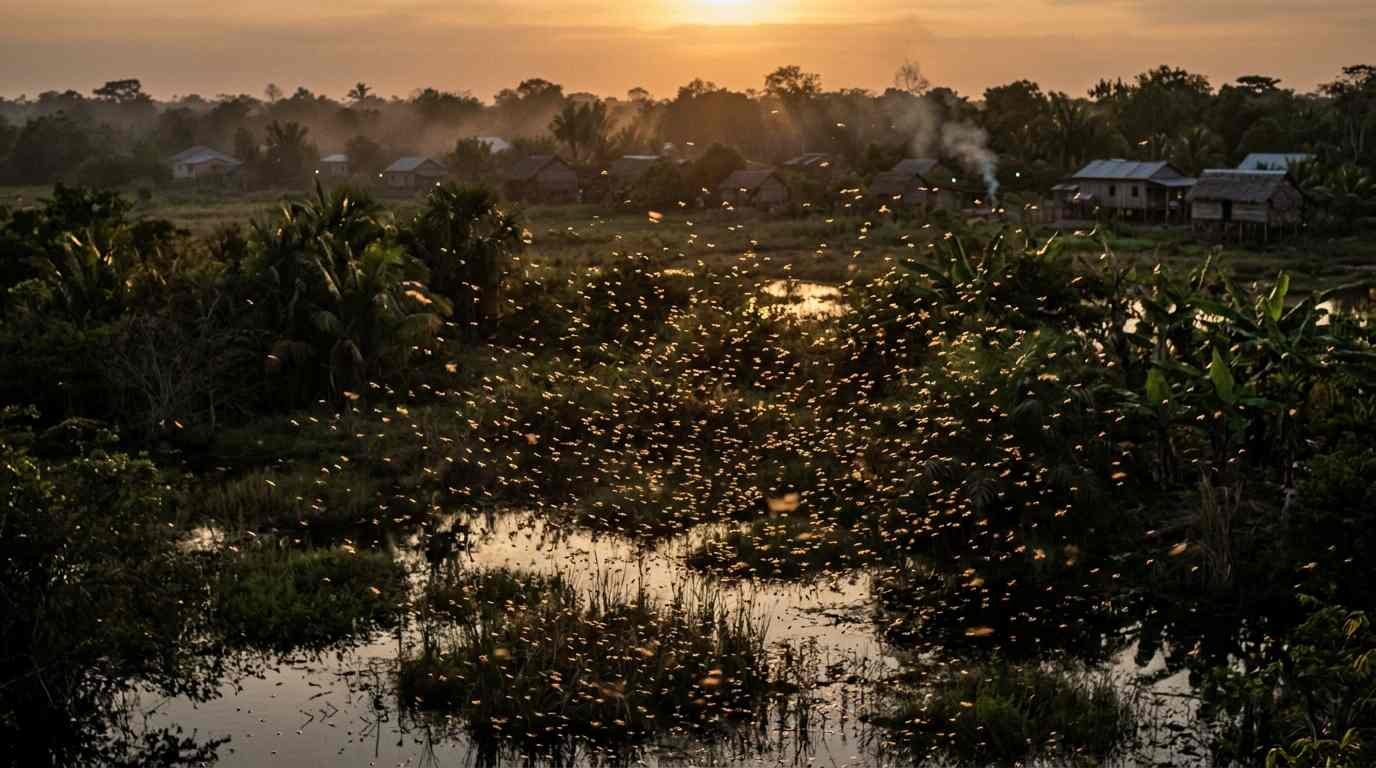
Can a gene drive be stopped once it is loose in a wild population, and who has the standing to make that call? The two halves of that question are usually discussed by different people. Population geneticists argue about whether a self-propagating genetic element can be driven back out of a species. Lawyers and treaty delegates argue about which body gets to authorise the release in the first place, and what happens when the organism crosses a border on its own wings. Neither argument has settled, and they are coupled: a release that cannot be undone needs a stronger consent procedure than one that can, so an unresolved biological question propagates straight into an unresolved legal one. This article states both halves precisely, sets out the competing positions with the evidence for each, and reports a small allele-frequency simulation built for the article to test one specific claim — that releasing a second genetic element can return a population to the way it was.
The authority question is asked openly, and not only by specialists. A 2016 commentary for the Heinrich Böll Stiftung by Dana Perls was titled “Gene drives: Who decides for Hawai’i and beyond?”, and argued that residents should determine which conservation methods are acceptable where they live. A 2023 panel recorded at Emory University’s Rollins School of Public Health and indexed by the MESA malaria hub put the same point as “Who should call the shots?” Both framings assume the thing being decided is hard to take back. That assumption deserves inspection.
Two questions hiding in one
Separating them helps. The first is mechanical: given a population in which an engineered allele has become common, is there any intervention that restores the original genetic composition? The second is institutional: before any such release, whose agreement is legally required, and whose is merely desirable?
Phrasing the first question as “can it be stopped” hides an ambiguity that turns out to matter a great deal. Stopping the spread of an engineered allele, stopping its effect on the population, and removing engineered sequence from the gene pool are three different outcomes. A countermeasure can achieve the first two while failing completely at the third. Much of the public argument conflates them, and the simulation below was built to make the gap visible.
What is established
A few things are not in serious dispute. The underlying editing chemistry works and is well characterised; if the general mechanism of targeted editing is unfamiliar, the background is covered in how CRISPR works. Standard single-locus population genetics describes how an allele with a transmission advantage changes in frequency across generations, and those dynamics are the same machinery that governs ordinary selection, mutation and drift.
Second, resistance arises. When the conversion process fails, it can leave behind an allele that is no longer susceptible to conversion, and that allele is then favoured whenever the drive imposes a fitness cost. This is the central result of a 2017 modelling paper in Scientific Reports by Marshall, Buchman, Sánchez C. and Akbari, which concluded in its discussion that with the designs then available:
“population suppression is expected to be moderate and short-lived with current construct architectures.”
Marshall, Buchman, Sánchez C. and Akbari, 2017
Third, countermeasures have been modelled rather than deployed. A 2017 preprint by Vella, Gunning, Lloyd and Gould compared several genetic strategies for reversing a drive in a discrete-generation model, and its abstract reports plainly that “Efficacy of drive reversal varies between countermeasures.” No countermeasure has been released into a wild population. Everything anyone says about reversal in the field is extrapolation from mathematics and cage work.
On the legal side the frame is also reasonably clear, even where its application is not. The Cartagena Protocol on Biosafety attaches its advance informed agreement procedure, under Article 7(1), to the first intentional transboundary movement of a living modified organism for introduction into the environment of the importing Party. Article 10(6) then protects a Party that wants to act despite thin evidence:
“Lack of scientific certainty due to insufficient relevant scientific information and knowledge regarding the extent of the potential adverse effects of a living modified organism on the conservation and sustainable use of biological diversity”
Cartagena Protocol on Biosafety, Article 10(6)
— shall not prevent that Party from taking a decision in order to avoid or minimise those effects. Layered on top, Decision 14/19 of the Convention on Biological Diversity, adopted at Sharm El-Sheikh in 2018, addressed engineered gene drive organisms directly, calling on Parties to apply a precautionary approach and to proceed only where case-by-case risk assessment has been done and risk management measures are in place. The same decision records that
“the free, prior and informed consent of indigenous peoples and local communities might be warranted”
CBD Decision 14/19, Synthetic biology, 2018
when releases are being considered. Four years later, Decision 15/31 at Montreal declined to treat the field as requiring fresh analysis of its novelty, set up a horizon-scanning process with an expert group, and left the gene drive language in its preamble rather than its operative paragraphs. The 2016 National Academies report Gene Drives on the Horizon remains the standard reference work; its publisher’s description characterises these elements as designed to spread rapidly and as impossible to roll back completely.
The case that drives stop themselves
Steelmanned, this position runs as follows. Any element that imposes a fitness cost and converts imperfectly generates its own antagonist. Each failed conversion is a lottery ticket for a non-convertible allele, and selection then does the rest without anyone intervening. The recall problem is therefore somewhat artificial: the realistic failure mode is not an unstoppable sweep but an expensive release that fizzles, leaving a population that looks superficially normal and a programme with nothing to show. Marshall and colleagues’ conclusion is direct evidence for this reading, and it has an uncomfortable corollary for proponents, since a drive that cannot persist also cannot deliver sustained public health benefit.
Against it: “the drive disappears” is not the same as “the population is as it was.” Resistant alleles are themselves products of the intervention, and they persist. Spatial structure, migration and chance in small local populations can also produce outcomes that a single well-mixed model will not capture, in either direction.
The case that a countermeasure can stop one
The second position holds that the problem is tractable by design. If an element can spread, a second element can be built to spread against it, and the models show this is possible across a reasonable parameter range. On this view, recall capability should simply be a licensing condition.
The objections are serious. Every countermeasure studied so far exists in a model, not a field; the Vella preprint’s own finding is that performance differs by strategy, which is an argument for caution rather than confidence. More fundamentally, releasing a second engineered element to counteract the first is a second release, raising the same consent questions the first one raised, and it does not return anything to a baseline.
The case that the binding constraint is legal, not genetic
A third position sets the biology aside. Whatever the dynamics turn out to be, the decision architecture does not fit the object. Advance informed agreement is built around a shipment: an exporter notifies, an importing Party assesses and decides. An organism that disperses under its own power and carries a heritable element into a neighbouring country has not been exported by anyone, and no notifier exists to trigger the procedure. The Protocol’s text keys the obligation to intentional transboundary movement; autonomous spread is neither intentional on the mover’s part nor a movement anyone arranged.
Decision 14/19’s reference to free, prior and informed consent sharpens the mismatch instead of resolving it. The phrasing is conditional — consent “might be warranted” — and a COP decision is not self-executing in domestic law. Who is the relevant community when the affected range is an entire sub-continent? International law handles this kind of gap badly in general, as the parallel argument over lunar and asteroid resources shows: a treaty written for one activity is asked to govern a different one, and the text does not stretch cleanly. This paragraph is general information about how these instruments are structured, not legal advice.

A small simulation built for this article
To test the “returns the population to normal” claim, I wrote a deterministic single-locus model and ran it in Python. It is an undergraduate population-genetics exercise, not a laboratory study, and it contains no design or methods information of any kind: alleles are abstract symbols with transmission and fitness parameters attached. The population is infinite, mating is random, generations are discrete. Four alleles share one locus — wild type (W), drive (D), a resistant allele (R) formed when conversion fails, and a blocking allele (B) that is not convertible and that converts D in heterozygotes. Each generation, Hardy–Weinberg genotype frequencies are formed, genotype fitnesses applied, gamete contributions summed, and frequencies renormalised. Conversion parameter 0.95, resistance formation 0.02 where enabled, drive homozygote cost 0.9 with dominance 0.1, blocking-allele cost 0.05, starting drive frequency 0.01, and B introduced as a one-off 10% substitution at generation 20. The seed is fixed; the model is deterministic, so the seed changes nothing.
import itertools
ALL = ["W", "D", "R", "B"]          # wild type, drive, resistant, blocking
GENO = [tuple(sorted(x)) for x in
        itertools.combinations_with_replacement(ALL, 2)]

def gametes(g, c, r, c2):
    a, b = g
    if a == b:
        return {a: 1.0}
    if set(g) == {"D", "W"}:        # conversion, with failures yielding R
        return {"D": 0.5 + 0.5*c, "R": 0.5*r, "W": 0.5*(1 - c - r)}
    if set(g) == {"D", "B"}:        # blocking allele acts on the drive allele
        return {"B": 0.5 + 0.5*c2, "D": 0.5*(1 - c2)}
    return {a: 0.5, b: 0.5}

def fitness(g, sD, h, sB):
    n = list(g).count("D")
    w = (1 - sD) if n == 2 else (1 - h*sD) if n == 1 else 1.0
    return max(w * (1 - sB)**list(g).count("B"), 0.0)

def step(p, c, r, c2, sD, h, sB):
    out = {a: 0.0 for a in ALL}; tot = 0.0
    for g in GENO:
        a, b = g
        f = p[a]*p[b]*(1 if a == b else 2)          # Hardy-Weinberg
        w = fitness(g, sD, h, sB); tot += f*w
        for al, q in gametes(g, c, r, c2).items():
            out[al] += f*w*q
    q = {a: out[a]/tot for a in ALL}
    q = {a: (0.0 if v < 1e-12 else v) for a, v in q.items()}   # absorbing floor
    s = sum(q.values())
    return {a: v/s for a, v in q.items()}

def run(gens=120, c=0.95, r=0.0, c2=0.0, sD=0.9, h=0.1, sB=0.05,
        d0=0.01, b_gen=None, b0=0.10):
    p = {"W": 1 - d0, "D": d0, "R": 0.0, "B": 0.0}
    hist = []
    for t in range(gens + 1):
        if b_gen is not None and t == b_gen:        # one-off introduction of B
            p = {a: p[a]*(1 - b0) for a in ALL}; p["B"] += b0
        hist.append(dict(p, gen=t))
        p = step(p, c, r, c2, sD, h, sB)
    return hist
Allele frequencies after 120 generations, from my own run:
| Scenario | Peak D | W | D | R | B | Engineered total |
|---|---|---|---|---|---|---|
| No resistance, no countermeasure | 1.000 | 0.000 | 1.000 | 0.000 | 0.000 | 1.000 |
| Resistance only (r = 0.02) | 0.766 | 0.005 | 0.00001 | 0.995 | 0.000 | 0.995 |
| Countermeasure at gen 20, no resistance | 0.999 | 0.014 | 0.000 | 0.000 | 0.986 | 0.986 |
| Countermeasure plus resistance | 0.766 | 0.000 | 0.008 | 0.991 | 0.001 | 0.992 |
Three results stand out. The drive allele is eliminated in every scenario except the first, so in this model “stopping the drive” is easy. Wild type never recovers past about 1.4% of the locus within the horizon, and the engineered or derived allele total stays above 98% in all four runs: the locus has been permanently altered in each case, including the one where the drive vanishes on its own. In the resistance-only run the drive peaks at 76.6% around generation 11 before collapsing, which is high enough to have whatever effect the element was built to have.
A timing result was unexpected. Sweeping the countermeasure’s conversion parameter from 0.5 to 1.0 against introduction at generations 10, 20, 30 and 40, a weak countermeasure released early performed worse than the same countermeasure released later: at 0.5 and generation 10 the drive allele still sat at 18.0% at generation 120, while every later release at that same value cleared it. The reason is mundane once seen. A blocking allele only acts when it meets the drive allele, so releasing before the drive is common wastes it on wild-type partners while the drive keeps converting. In this model, waiting is better than hurrying — the opposite of the intuition that an emergency response should be immediate.
One robustness note. Varying the blocking allele’s fitness cost over a longer horizon, wild type does eventually return to near-fixation once the drive is gone and the cost is 0.05 or higher, because nothing then favours B. Long-run runs near fixation were numerically fragile until I added a floor that zeroes frequencies below 1e-12; the 120-generation numbers above were identical with and without it, which is the only reason I trust them.
What the simulation does and does not show
It shows that, within one deterministic well-mixed locus model, suppressing a drive allele and restoring a population’s original genetic composition are separable outcomes, and that the first is much easier than the second. It also shows that countermeasure timing interacts with countermeasure strength in a non-monotonic way, which is a testable claim about models of this class.
It does not show what would happen in any real species. There is no space, no migration, no finite population size, no demography, no seasonality, no mating structure, no standing genetic variation, and a single locus with four idealised alleles. Parameters were chosen to be plausible and round, not fitted to any organism. Nothing here speaks to how any element would be built, and nothing here is evidence about safety or efficacy in the field. Treat it as an argument-clarifying device: it tells you which question you are asking, not what the answer is outdoors.

My reading, and what would settle it
What follows is my own assessment rather than anything established. I think the recall debate is largely mis-specified, and the simulation is why. Asking whether a drive can be stopped invites a yes, because suppressing one allele is the easy part; asking whether a population can be restored invites a no, because every route back runs through additional engineered or derived alleles that themselves persist. If that reading is right, then “reversibility” is the wrong licensing criterion, and the honest framing of any release is that the gene pool changes permanently and the only live question is how.
On the legal half, my view is that the Cartagena Protocol’s trigger is a genuine structural mismatch rather than a drafting detail, and that the horizon-scanning route taken in 2022 postponed the problem instead of addressing it. I would also guess, with low confidence, that the first consequential dispute will be between neighbouring states over a release neither notified, rather than a challenge to a release that was properly assessed. Work on what synthetic biology is actually building has consistently outpaced the instruments meant to govern it.
Several things would move me. A field or large cage release in which an introduced countermeasure demonstrably reduces a drive allele’s frequency, with sequencing showing what occupies the locus afterwards, would convert reversal from modelling into evidence — and the sequencing is the informative part, because my claim is specifically about what remains. A spatially explicit stochastic model that reproduces the timing non-monotonicity reported above, or fails to, would tell us whether that result survives realism. On the legal side, a formal interpretation by the Protocol’s governing body on whether autonomous spread constitutes transboundary movement would be dispositive, and its absence is itself informative. Falsifiable version of my own position: if any published model or experiment shows a population returning to above 95% original wild-type composition at the target locus without a persisting engineered or derived allele, I am wrong about the central claim.
Common questions
Has any gene drive been released into the wild?
No self-propagating drive organism has been released into an open environment, and no countermeasure has either. Work to date is laboratory and contained-cage work plus modelling. That is why both halves of the question remain open rather than answered by experience.
Does resistance mean drives are harmless?
It does not follow. Resistance can end an element’s spread while leaving the population changed, and in the model above the drive allele still reached roughly three quarters of the locus before collapsing. A transient high frequency is enough to produce whatever effect the element causes.
Which treaty governs a release?
The Cartagena Protocol on Biosafety governs transboundary movements of living modified organisms, and CBD Decision 14/19 asks Parties to apply precaution and case-by-case risk assessment to engineered gene drive organisms specifically. Domestic biosafety law does the actual authorising. None of this is legal advice.
Who has to consent?
Legally, the Party of import under the Protocol’s procedure, plus whatever national regulator has jurisdiction. Decision 14/19 says the free, prior and informed consent of indigenous peoples and local communities might be warranted, which is hortatory rather than binding, and it does not define the affected community for an organism that spreads on its own.
Is the simulation in this article evidence about real releases?
No. It is a textbook allele-frequency model written to separate two claims that are often merged, run in an infinite, unstructured, single-locus population. It cannot predict any organism’s behaviour and is not a safety assessment.
References
- Marshall, J. M., Buchman, A., Sánchez C., H. M., & Akbari, O. S. (2017). Overcoming evolved resistance to population-suppressing homing-based gene drives. Scientific Reports, 7, 3776. doi:10.1038/s41598-017-02744-7. PMC5476637
- Vella, M. R., Gunning, C. E., Lloyd, A. L., & Gould, F. (2017). Evaluating strategies for reversing CRISPR-Cas9 gene drives. bioRxiv 144097 (preprint). biorxiv.org/content/10.1101/144097v2
- National Academies of Sciences, Engineering, and Medicine (2016). Gene Drives on the Horizon: Advancing Science, Navigating Uncertainty, and Aligning Research with Public Values. Washington, DC: The National Academies Press. doi:10.17226/23405. doi.org/10.17226/23405
- Secretariat of the Convention on Biological Diversity. Cartagena Protocol on Biosafety to the Convention on Biological Diversity, Articles 7 and 10. cbd.int/doc/legal/cartagena-protocol-en.pdf
- Conference of the Parties to the Convention on Biological Diversity (2018). Decision 14/19, Synthetic biology. CBD/COP/DEC/14/19, Sharm El-Sheikh. cbd.int/doc/decisions/cop-14/cop-14-dec-19-en.pdf
- Conference of the Parties to the Convention on Biological Diversity (2022). Decision 15/31, Synthetic biology. CBD/COP/DEC/15/31, Montreal. cbd.int/decisions/cop/15/31
- Perls, D. (2016, 27 September). Gene drives: Who decides for Hawai’i and beyond? Heinrich Böll Stiftung. boell.de
- Rollins School of Public Health, Emory University (2023). Gene drive technologies for malaria control in Africa: Who should call the shots? MESA Malaria Knowledge Hub resource entry. mesamalaria.org