






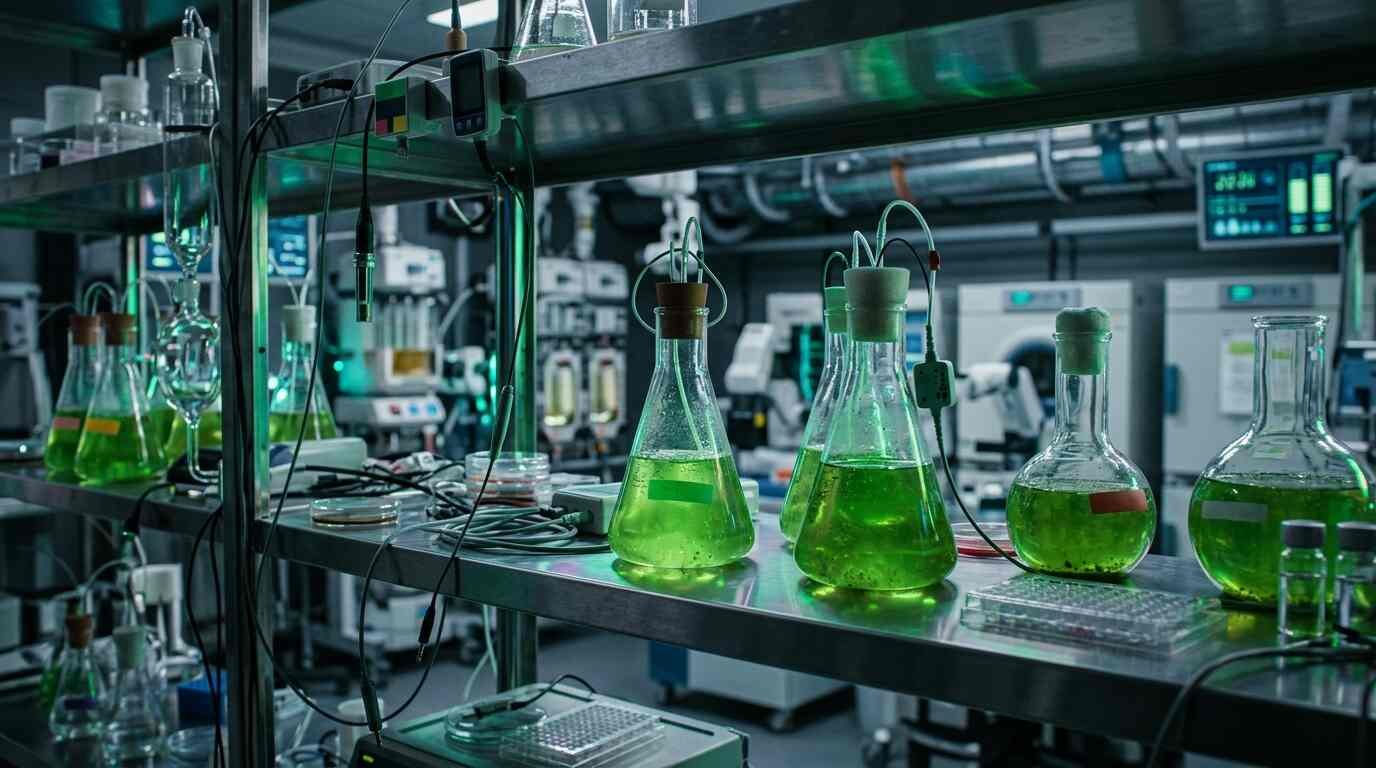
Synthetic biology treats cells like programmable machines. Here is what the field is, what it has built, and what is still only a goal.
Synthetic biology is the practice of designing and building biological parts, circuits and whole organisms with engineering habits: standard components, models that predict behavior, and repeated build-and-test cycles. The field has no single agreed definition, which tells you something about how young and broad it is. It overlaps with genetic engineering, but it aims at something more ambitious than moving one gene from one species to another. The goal is closer to treating a cell as a programmable machine, and the results so far range from malaria drug precursors to bacteria with rewritten genetic codes.
What is synthetic biology, in plain terms?
Think of ordinary genetic engineering as editing a sentence, and synthetic biology as drafting a new paragraph, with a style guide. Practitioners design DNA sequences on a computer, order them from a synthesis service or build them in the lab, put them into a host cell such as a bacterium or yeast, and measure what happens.
The field borrows from molecular biology, systems biology, electrical and control engineering, and computer science. One scholarly framework sorts it into five areas: bioengineering, synthetic genomics, protocell work, unnatural molecular biology, and computational (in silico) design. Another splits the work by approach, such as top-down rewriting of existing genomes or bottom-up assembly of simple living-like systems from non-living parts.
The word itself is old. The French biologist Stéphane Leduc used it in 1910, though he meant something quite different from the modern field. The version people mean today took shape in the early 2000s.
How did the field get started?
Most accounts begin with recombinant DNA. In 1973, Stanley Cohen, Herbert Boyer and colleagues published the first molecular cloning of DNA in plasmids, which let researchers move genes between organisms. The next big step was cheap, reliable copying of DNA, helped along by the polymerase chain reaction as improved in 1988.
The engineering mindset arrived around the year 2000. Two papers in Nature that year described a genetic toggle switch and a biological clock built in the bacterium E. coli, both explicitly designed like circuits. In 2003, Tom Knight proposed BioBrick parts, standardized DNA pieces meant to snap together, and an artemisinin precursor pathway was engineered in E. coli. A first synthetic biology conference was held at MIT in 2004, the same year the iGEM student competition began.
A milestone in synthesis followed in 2010: the J. Craig Venter Institute reported a bacterial cell controlled by a genome assembled from chemically synthesized DNA, using yeast to stitch the pieces together. The cell was a copy of an existing bacterium’s genome, not a new design. It showed that the writing of a genome could be done.
What tools do synthetic biologists use?
A small number of capabilities do most of the work.
DNA synthesis lets researchers order custom sequences. By 2007 the price had dropped to roughly one dollar per base pair, with delivery times of under two weeks, and the trend has been downward ever since. Standard parts and software design tools make it easier to predict how a circuit will behave before building it.
CRISPR-Cas9, shown in 2012 by the groups of Emmanuelle Charpentier and Jennifer Doudna to be programmable for cutting DNA, made editing a genome a matter of weeks, not months or years. Directed evolution, where researchers mutate a protein repeatedly and keep the best performers, remains a workhorse for improving enzymes.
Computing has joined in. AlphaFold2, released in 2020, predicted structures for essentially all of roughly 200 million known proteins, which helps with designing new ones. Whether software can reliably design a whole working cell is a much harder question, and the answer for now is no.
What has actually been built with it?
Several things are in use, and several others are still demonstrations.
- Medicines: artemisinin, an antimalarial compound, and the cancer drug paclitaxel are among the natural products made by engineered microbes. CAR T-cell therapies, which reprogram a patient’s immune cells, use engineered receptors that the field counts among its applications.
- Diagnostics: engineered biosensors have been built to detect heavy metals, toxins, explosives residues such as TNT and, during the pandemic, the SARS-CoV-2 virus.
- Food and materials: yeast has been engineered to make rose oil, and researchers have produced spider-silk-like proteins using microbes. Cultivated meat and milk proteins are often grouped under the same heading.
- Industry: enzymes in laundry detergent and lactose-free milk come from engineered organisms, and engineered microbes are used for biofuels and cleaning up pollution.
- Data storage: in 2012, George Church’s group encoded a 5.3-megabit book in synthetic DNA.
Some of these are commercial products, while others, such as engineered gut yeast to neutralize toxins from Clostridioides difficile, were at trial stages when the sources were written. A reader should treat each claim as a stage on a development path.
Can scientists really rewrite a genetic code?
Yes, in bacteria, and the results are striking. In 2014, an E. coli strain was reported with an expanded genetic alphabet, using two artificial DNA letters not found in nature. In 2019, researchers reported an E. coli variant using 59 codons instead of the usual 64 to encode the 20 standard amino acids, with some codons freed up for other purposes.
Also in 2019, a team at ETH Zurich designed an entire bacterial genome by computer, named Caulobacter ethensis-2.0. Per the source consulted, no viable form of the organism existed at the time, so it counts as a design exercise, not a living cell.
Why do this? A cell with a rewritten code can be made resistant to viruses, since viruses depend on the standard code to hijack their host. It can also build proteins containing building blocks that nature never uses. The practical payoffs are still largely ahead.
What are xenobots and synthetic cells?
Two different projects get lumped together under the “new life forms” headline.
Xenobots, first reported in 2020, are small living machines assembled from frog cells, with shapes designed using artificial intelligence. In 2021 the same line of work reported that they can gather loose cells and make copies of themselves. They are not made of synthetic DNA, so many biologists consider them an example of cell engineering more than synthetic genomics.
Synthetic cells are a more fundamental goal: building a cell from non-living molecules. Efforts such as the Build-a-Cell collaboration (begun in 2017) and the European SynCellEU network (2019) coordinate that work. No one has yet built a fully living synthetic cell from scratch, and researchers disagree about how long it might take.
What are the risks and who regulates them?
Concerns fall into three buckets: accidental release of engineered organisms, deliberate misuse, and questions of fairness and ownership, such as who may patent a designed organism. A more philosophical objection, that scientists are “playing God,” appears in the ethical literature but is a matter of values, not evidence.
Researchers have built safeguards into organisms themselves. Auxotrophy makes a microbe dependent on a nutrient absent from nature, and kill switches cause cells to self-destruct without a signal. Xenobiology goes further, using chemistry so unlike natural biology that escaped cells could not survive.
There is a live debate about whether existing rules for genetically modified organisms are enough. Some bioethicists argue the current framework works and that heavy new regulation would slow beneficial safety research. The sources reviewed note one argument that no engineered microbe has so far shown a lasting advantage in the wild, but absence of an event is not proof of impossibility.
Biosecurity, meaning the risk of deliberate misuse of cheap DNA synthesis, is handled in part by screening policies at synthesis companies. The details vary, and this article did not review them in depth.
Where is the field heading?
Several threads stand out in the literature reviewed. RNA-based tools are drawing attention because RNA does not integrate into a host genome and acts faster than DNA-based systems, which makes it attractive for medicines and vaccines. Tissue engineering has produced a 3D-bioprinted external ear that was tested in a clinical trial reported in 2022. Researchers have also grown embryo-like structures from stem cells, reported in 2023, which raises ethical questions that regulators are only beginning to address.
Progress will probably be uneven. Cells are noisy, evolve, and interact with their surroundings in ways circuit diagrams do not capture, and a design that works in one strain can fail in another. Much of the engineering effort goes into making biology behave predictably enough to be a reliable platform, which is why standardized parts and better models keep coming up.
How is it different from GMOs and gene therapy?
The differences are of degree and intention. A conventional genetically modified crop usually involves adding one or a few genes. A synthetic biology project may restructure many genes, or build a multi-part pathway, and treats the genetic parts like interchangeable components.
Gene therapy is a medical use of related tools: delivering genes to patients to treat disease. Synthetic biology provides some of its techniques, such as engineered receptors and safety switches. The overlap is real, but the categories are not identical.
Common questions
Is synthetic biology the same as genetic engineering?
They overlap heavily. Genetic engineering is the older, broader term for changing an organism’s DNA, while synthetic biology emphasizes standardized parts, design models and building new systems.
Has anyone created artificial life?
Not from scratch. A cell run entirely by a chemically synthesized genome was reported in 2010, but it was built into an existing bacterial cell. Building a cell from non-living components remains a research goal.
What is iGEM?
It is an annual international student competition in synthetic biology, founded in 2004 according to the history reviewed here. Teams design and build biological systems from standard parts.
Is it dangerous?
Risk depends on the organism and the use. Most work uses harmless lab strains in contained facilities, while some applications carry biosafety and biosecurity concerns that scientists and regulators debate.
Will it make fuel, food and medicine cheaper?
Some products, such as certain enzymes and drug compounds, are already made this way. Broad claims about replacing fossil fuels or farming are predictions, and cost has often been the stumbling block.
What to remember
Synthetic biology applies engineering methods to living systems, and its tools include cheap DNA synthesis, CRISPR editing and computational design. The established results include engineered microbes that make useful compounds, bacteria with rewritten codes, and genomes built from synthetic DNA. Designing a cell entirely by software, or building one from non-living parts, is still a goal. The sensible stance is interest in the results and attention to the safeguards.
Further reading
- Regenesis by George Church and Ed Regis: A readable account of the field's ambitions by one of its leading researchers. See it on Amazon (affiliate link)
- Life at the Speed of Light by J. Craig Venter: First-person account of the synthetic genome work. See it on Amazon (affiliate link)
As an Amazon Associate I earn from qualifying purchases. A commission may be earned if you buy through this link, at no extra cost to you.
Sources



