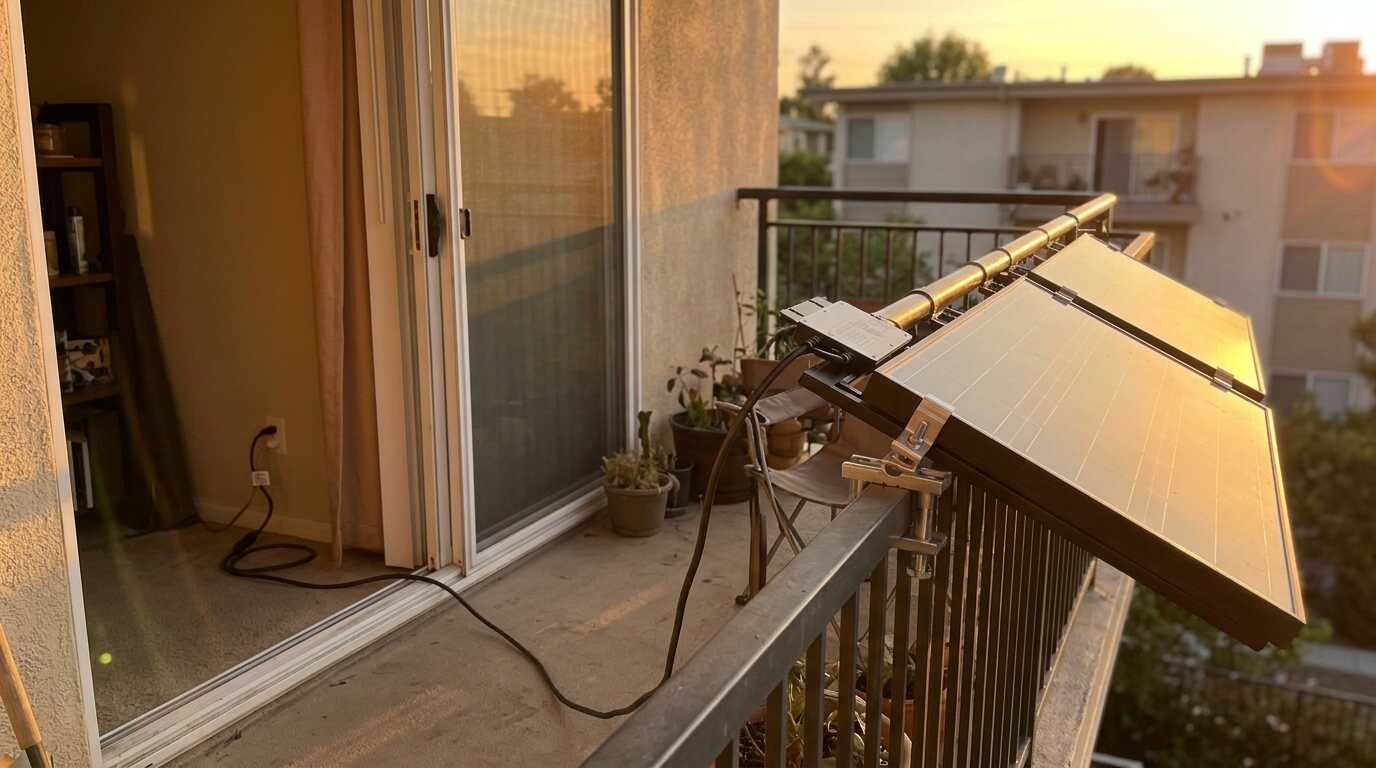
California's new balcony solar law lets renters plug in up to 1,200 W without utility approval. What SB 868 says, the math, and what's unconfirmed.
California has made balcony solar legal without a utility interconnection agreement. Governor Gavin Newsom signed SB 868, the Plug and Play Solar Act, on September 30, 2026, according to one trade report, and energy trade press covered it on October 2. The law applies to small kits that plug into an ordinary wall outlet and feed the home’s own wiring.
The headline numbers are short. A cap of 1,200 watts of AC output, a standard 120-volt outlet, certified hardware, and an automatic shutoff during a grid outage. The effective date is January 1, 2027, and no product currently on sale meets every requirement.
This piece goes through what the bill actually says, how a plug-in kit works electrically, what the savings look like when you do the arithmetic, and which parts of the story rest on a single source or on estimates.
What SB 868 actually says
The bill was authored by Senator Scott Wiener and is formally called the Plug and Play Solar Act. It defines a ‘portable solar generation device’: a few panels paired with a small inverter that plugs into a 120-volt outlet. Qualifying systems are exempt from the interconnection agreements and fees that normally govern anything that can push power onto the utility’s lines. Utilities may ask owners to register through a free online form, which is a notification step rather than an approval step.
Three limits define the category. The system is capped at 1,200 watts of AC output. It must offset the household’s own consumption rather than export to the grid. And the kit has to be certified by UL or an equivalent laboratory, meet national and California electrical codes, and shut itself off within seconds when the grid goes down.
The legislative record was lopsided. According to Energy-Storage.News, the Senate committee passed the bill 14-0 with three abstentions in March, and the Senate floor vote reported in May was 35-1. The Assembly vote in August was 73-0, per Solar.com. California is not first. The same trade report lists Utah, Colorado, Maryland, Virginia, Vermont, Connecticut, New Hampshire and Maine as states that already allow plug-in solar without utility approval, and says Washington, Oregon, Wyoming, New Mexico, Georgia and Arizona have blocked similar bills.
How a plug-in solar kit works
A panel produces direct current. A household outlet carries 120-volt alternating current at 60 hertz. The piece of hardware in between is a microinverter, which does two jobs at once. It converts the DC to AC, and it locks its output to the phase and frequency of the grid so that the two waveforms line up. It does not choose the voltage; the grid does. The inverter simply pushes current into whatever voltage it sees.
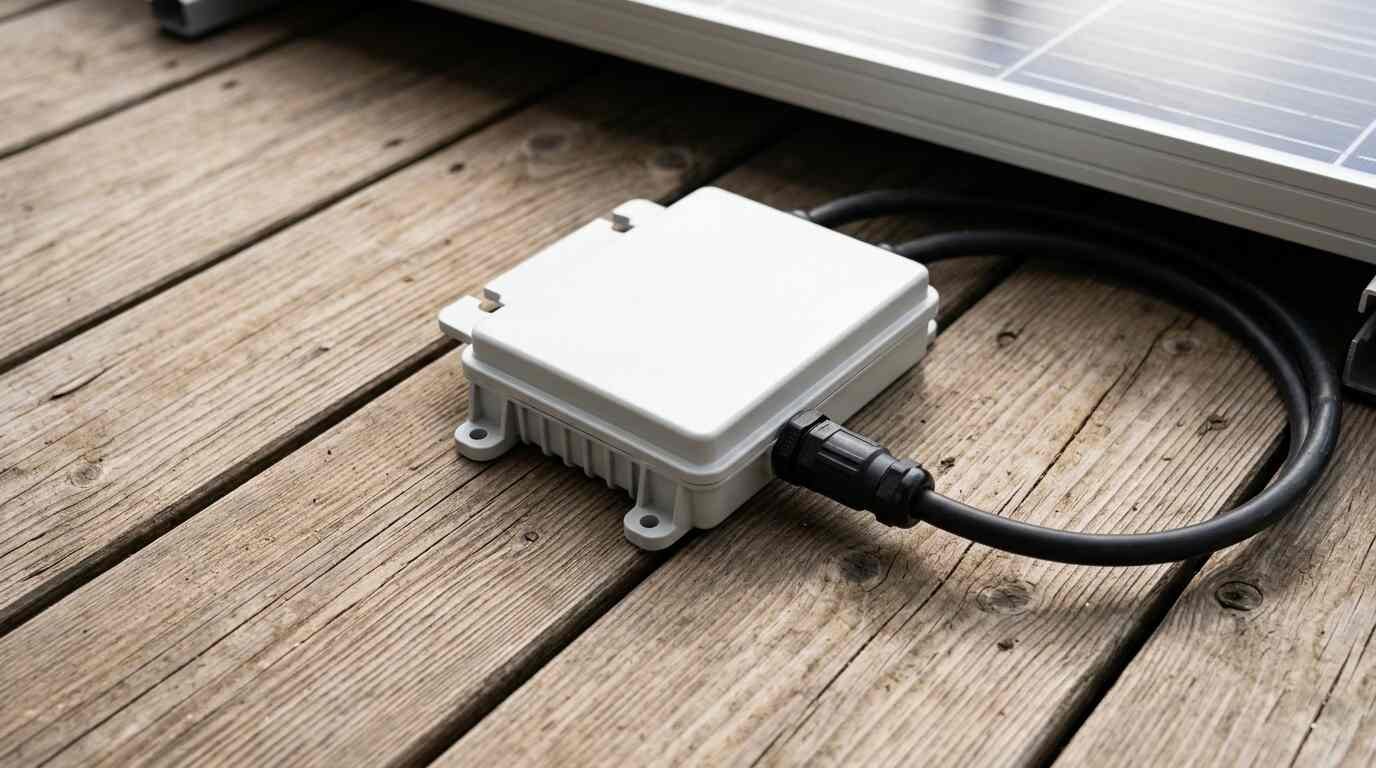
That is why the power ends up where it does. Current flows from the outlet circuit into the home’s wiring, and every device on that circuit draws from the cheapest nearby source, which is the incoming solar. The utility meter then sees less demand. Nothing in the house has to know the panels exist.
The shutoff requirement exists because of a failure mode called islanding. If a line crew has de-energized a street for repairs and a home’s inverter keeps pushing power backward through the transformer, the wires the crew is touching can become live. Grid-tied inverters therefore monitor voltage and frequency continuously and stop within a fraction of a second to a few seconds when the grid disappears. It also means a plug-in kit will not keep your lights on in an outage. It goes dark with everything else.
Working through the numbers
Start with the power cap. At 120 volts, 1,200 watts is 10 amps (1,200 divided by 120). A typical 15-amp household branch circuit is rated for 1,800 watts at its limit, so a 1,200-watt source leaves headroom on paper. This is my arithmetic from general electrical practice, not a figure from the bill, and real circuits share outlets and loads, so it is a sanity check rather than an installation guide.
Now the energy. Solar.com says a sunny California location can produce 1,000 to 1,400 kilowatt-hours per year from a plug-in kit. Spread over 365 days that is roughly 2.7 to 3.8 kWh a day. Its worked example uses a $1,000 kit producing 1,000 kWh a year. Over ten years that is 10,000 kWh, so the kit’s cost works out to about 10 cents per kWh. Buying the same electricity at roughly 35 cents per kWh, the figure the article assumes, would cost $3,500, a difference of about $2,500, assuming utility rates stay flat.
The simple payback follows from the same inputs. At 35 cents, 1,000 kWh is worth $350 a year and 1,400 kWh is worth $490. A $1,000 kit then pays back in about 2.9 years at the low end and about 2.0 years at the high end. Those are my calculations from the article’s inputs. They assume every kilowatt-hour produced displaces a kilowatt-hour you would otherwise buy, which is the weak point.
It is weak because a 1,200-watt array at midday can easily out-produce what a small apartment is drawing. If production exceeds the household’s instantaneous demand and the bill forbids export, the surplus is either lost, curtailed by the inverter, or pushed to the grid anyway. The sources I read do not explain how compliant kits are supposed to handle that case, and they do not say how older meters respond. The savings figure is best read as an upper bound for a home with steady daytime loads.
Why renters are the target
Rooftop solar needs a roof you own, a contract, a permit and an interconnection application. Renters, condo owners and people with shaded roofs are mostly shut out. Energy-Storage.News estimates that about 14 million rental units, roughly 40 percent of California households, could benefit. That is the outlet’s estimate and the article does not show its method.
Solar.com also argues that California alone roughly doubles the size of the U.S. plug-in market, which it expects to bring more products and lower prices. That is a forecast, not a measurement. The practical constraint is the one the same article states plainly: a kit is a supplement. It will offset always-on loads like a refrigerator, a router and standby electronics. It will not take a home off the grid.
The other energy bills signed the same week
Newsom signed more than one energy bill in this batch. SB 913 directs the California Public Utilities Commission to create a method for valuing customer-owned batteries that export power during high-demand periods. SB 905 creates a measure of load factors on segments of the distribution network, aimed at finding circuits and substations that could take more load without expensive upgrades, and lets the commission require annual utilization improvements.
He also vetoed AB 1813, a community solar bill. In his veto message, as reported, he said it would effectively require an administratively set price above the value the generation provides to the grid, and cited a Public Advocates Office estimate that it could cost ratepayers an extra $1.5 billion a year. A UCLA study published in August argued the opposite: that the commission pays community solar only wholesale rates and ignores avoided distribution costs, estimating $4.6 billion in potential 20-year savings. The two numbers come from different parties using different assumptions, and neither was checked against primary documents here.
The context matters for balcony solar. A plug-in kit is the one piece of this package that needs no regulator to design a program before it works. The virtual power plant bills, by contrast, leave the details to a commission. The California Solar & Storage Association’s executive director, Brad Heavner, said the governor ‘has done his part’ and that implementation under the next governor will determine whether customers see lower bills.
How this compares with Germany
Germany is the usual reference point. Energy-Storage.News cites BSW Solar as reporting more than one million balcony solar installations there as of June 2025. That figure shows the demand exists when permitting friction is removed. It does not transfer cleanly to California. German rules, grids, outlet types and electricity prices differ, and I did not retrieve German technical limits for this post, so I will not compare wattage caps.
What the German example does show is that the technology is not experimental. Microinverters are mass-produced, and the safety logic described above is standard in grid-tied equipment. The open question in California is regulatory and commercial: how quickly certified products exist, and whether the certification requirements prove strict enough to protect people and cheap enough to keep prices low.
What is still unconfirmed
Several details need watching. The first is product availability. Solar.com says no product on the market yet meets every requirement, and that Wiener’s office expects compliant kits by spring 2027. That is the office’s expectation, not a manufacturer commitment.

The second is the sunset. The interconnection exemption expires on January 1, 2030, unless lawmakers extend it, so any purchase made in 2027 is protected by a statute with a roughly three-year window. The bill’s Section 1 text, as quoted by one trade outlet, says interconnection fees and processes can add substantial costs and time. That is the policy rationale, and also the reason a lapse would matter.
The third is the state count. Solar.com calls California the tenth state to legalize plug-in solar, while the Energy-Storage.News list names eight other states, which would make nine. The difference may come from a state not listed there; I could not resolve it. Finally, the signing date varies by report, September 30 in one and an October 2 publication date in another, which is consistent with a signature on or before September 30 but is not a primary-source confirmation.
Frequently asked questions
Is balcony solar legal in California now?
The bill was signed, but the law takes effect on January 1, 2027. Solar.com also reports that no product on the market yet meets all the requirements, so there is nothing to buy that is certified for the new framework today.
How much power can a plug-in solar system produce under SB 868?
The cap is 1,200 watts of AC output. Solar.com cites 1,000 to 1,400 kilowatt-hours a year for a sunny California location, but actual output depends on panel orientation, shading and season.
Do I need permission from my utility?
Not an interconnection agreement. Utilities may ask owners to register through a free online form. Check your lease or HOA rules separately, because the law’s utility exemption does not address them in the sources I read.
Will a plug-in solar kit power my home during an outage?
No. The law requires the system to shut off automatically within seconds of a grid outage to protect line workers, so it stops producing when the grid goes down.
The interesting part of this story is not the 1,200-watt number. It is the decision to treat a household appliance-scale generator as an appliance rather than a power plant. Eight or nine states have now done that, and California’s size will test whether manufacturers build to a shared standard or to a patchwork. Watch two dates: spring 2027, when the first certified kits are supposed to appear, and 2030, when the exemption lapses unless legislators renew it. If prices fall and no safety incident surfaces, extension becomes easy. If either fails, the statute’s sunset gives the legislature a built-in chance to revisit it.
Sources