





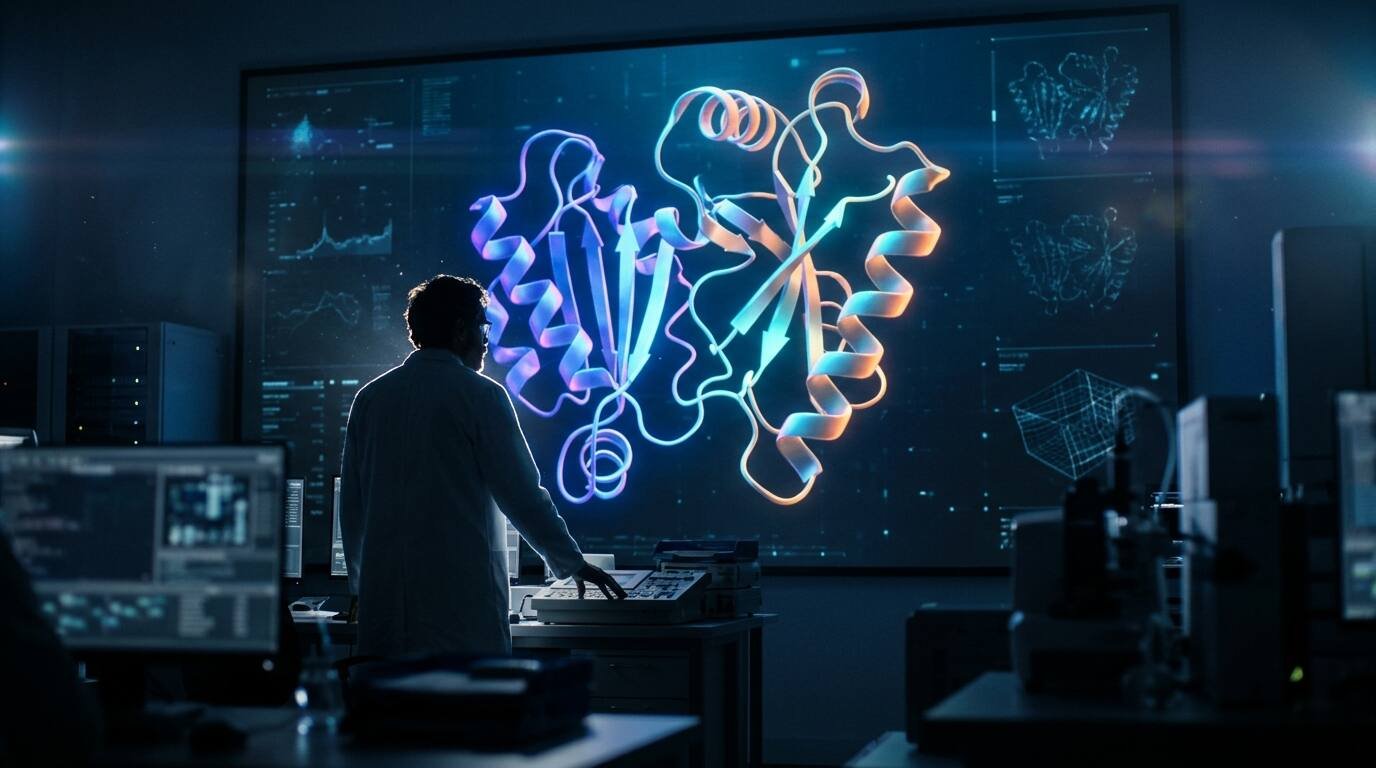
How AlphaFold works at a high level, what it changed for disease research and drug discovery, and where it still falls short.
AlphaFold is the clearest case so far of an AI system solving a long-standing scientific problem well enough that working biologists changed how they work. It predicts the three-dimensional shape of a protein from nothing but its sequence of amino acids, a task that stumped researchers for about half a century. In 2024 it earned a share of the Nobel Prize in Chemistry. It has also been oversold in places, so the useful question is what it did change, what it did not, and what remains hard.
Why does a protein’s shape matter?
Proteins do most of the work in living cells: they speed up reactions, carry signals, build structures and fight infections. A protein starts as a chain of amino acids, and that chain folds into a specific three-dimensional shape. The shape largely determines what the protein can do. A drug works, in many cases, by fitting into a pocket on a protein the way a key fits a lock, and a mutation can cause disease by bending a protein out of shape.
Knowing a shape has traditionally required experiments. The main methods, X-ray crystallography and NMR spectroscopy, are described as time-consuming and relatively expensive, and a single structure can take a lot of lab time. Meanwhile, DNA sequencing became fast and cheap, so researchers had far more known sequences than known structures. Predicting the shape from the sequence would close that gap, which is why computational biologists treated it as a central goal.
What is the protein folding problem?
Given an amino acid sequence, predict the structure it folds into. Chemists had long suspected the sequence contains everything needed. The difficulty is the sheer number of possible shapes. A chain can twist in an astronomically large number of ways, a point often illustrated by Levinthal’s paradox: a protein could not possibly find its shape by trying every option, yet real proteins fold quickly.
Since 1994, a community experiment called CASP (Critical Assessment of Structure Prediction) has tested the state of the art every two years. Teams predict structures that experimentalists have solved but not yet published, and judges compare the predictions with the real thing. For years progress was steady and modest.
How did AlphaFold change that?
DeepMind entered CASP13 in December 2018 with the first AlphaFold and placed first overall. It produced the best prediction for 25 of 43 targets in the hardest category. That was a notable jump, but the results were still short of what experimentalists would call reliable.
The shock came at CASP14 in November 2020. AlphaFold 2 made the best prediction for 88 of 97 targets, with a median score of 92.4 on the standard GDT scale, where 100 would be a perfect match. Organizers and many scientists described the accuracy as close to experimental quality for many proteins, and the problem was widely described as largely solved for single protein chains.
Under the hood, AlphaFold 2 uses a neural network that combines two kinds of evidence: patterns in the sequences of related proteins from many species, and geometric constraints on how amino acids can sit in space. I will not try to describe the architecture in detail, since the published paper does so better. The important point is that it learned from the known structures in public databases, which is why its predictions are strongest where it has relatives to learn from.
What is the AlphaFold database, and who uses it?
Rather than keep the model to itself, DeepMind and the European Bioinformatics Institute released predictions publicly. The AlphaFold Protein Structure Database launched on 22 July 2021 with over 365,000 predicted structures, covering nearly the whole human proteome and 20 other organisms. In July 2022 it expanded to about 200 million structures from roughly a million species, which is close to every protein sequence then known.
Uptake was large. By October 2024, the Nobel committee reported that AlphaFold 2 had been used by more than two million people in 190 countries. A bibliometric analysis found 1,680 peer-reviewed papers referencing AlphaFold between January 2019 and May 2024, and another summary reported that more than 40 percent of 2023 protein-structure papers in the journals Cell, Nature and Science cited AlphaFold 2.
Those figures show use, not importance, and citation counts can be inflated by routine mentions. They do indicate how quickly the tool entered everyday workflows.
The release strategy mattered as much as the model. Because the predictions were free to download, a lab without any structural biology equipment could use them on day one, including groups in countries where crystallography facilities are scarce. That openness is a large part of why the usage numbers grew so fast. The caveat is that open access to predictions does not give anyone the expertise to judge them, so the benefit goes disproportionately to people who already know how to read a structure.
What did it change in medicine?
Mainly it changed the starting point. Instead of waiting months for an experimental structure, a researcher studying an unfamiliar protein can look up a predicted one in minutes and use it to plan experiments. That helps in several ways.
- Understanding disease: a predicted structure can show where a disease-causing mutation sits and why it might disrupt the protein. The Nobel committee singled out insight into how antibiotic resistance arises as one use.
- Early drug discovery: structures of drug targets help scientists choose or design molecules that might bind them. The expectation, voiced when CASP14 results came out, was that this would accelerate drug discovery.
- Fast response: structures for proteins of the SARS-CoV-2 virus were predicted in early 2020, before experimental ones were available.
- Enzyme and materials research: the committee also noted work on why some microbes can break down plastic.
Here is where care is needed. Predicting a structure is a step in drug development, not the whole thing. A drug candidate still has to bind its target well, avoid harming other proteins, reach the right tissue, be manufacturable, and survive clinical trials, which take years and fail often. I did not find a source that credits an approved drug to AlphaFold alone, and I would be skeptical of claims that AI has already delivered one on that basis. The honest summary is that AlphaFold made one slow stage faster. It did not remove the later ones.
What is AlphaFold 3, and what is the Nobel connection?
On 8 May 2024, DeepMind and Isomorphic Labs announced AlphaFold 3, which extends the approach from single proteins to complexes of proteins with DNA, RNA, small molecules (ligands) and ions. Its developers reported at least a 50 percent improvement in accuracy for protein interactions with other molecules over existing methods. That matters for medicine because drugs are small molecules, and what they do depends on how they bind.
Code and model weights were released for non-commercial academic use in November 2024, and made publicly available in February 2025, still under a non-commercial restriction. A free AlphaFold Server gives non-commercial researchers access.
On 9 October 2024, the Nobel Prize in Chemistry went half to Demis Hassabis and John Jumper of DeepMind for protein structure prediction, and half to David Baker for computational protein design. Baker’s work is the other side of the coin: where AlphaFold predicts the shape of a given sequence, his team’s software designs new sequences for shapes that nature never made. His group’s Top7 protein, designed in 2003, was described as the first protein entirely unlike any known one, and experiments showed it folded almost exactly as designed.
What are AlphaFold’s limits?
Quite a few, and they are documented by the people who use it.
- It predicts a snapshot. Proteins move and flex, and AlphaFold’s ability to capture multiple natural conformations is limited.
- Floppy regions are uncertain. Intrinsically disordered stretches are often predicted with low confidence, as they should be, since they may have no fixed shape.
- Complexes and context are missing in the database. The database provides single chains, not the multi-part assemblies that often matter in biology, and predictions leave out context such as sugar attachments called glycans, which are important for a large share of human proteins.
- It does worse on the unfamiliar. Accuracy drops for proteins with few relatives in the training data, including de novo designed and orphan proteins, and for AlphaFold 3, ligand predictions are notably weaker on cases unlike its training examples.
- Occasional errors look plausible. Models can produce topologically impossible results, such as knots, because chain integrity is not enforced.
Each prediction comes with confidence scores, and using them is part of using the tool properly. A confident-looking picture is not a measurement.
A fair way to hold all this is that AlphaFold gives a strong hypothesis about shape, quickly and at scale. Hypotheses are valuable, and a good one saves months. They still need testing, especially when a medical decision or a drug program depends on a fine detail such as the exact position of one amino acid in a binding pocket. Researchers who use the predictions routinely check confidence scores and, where the stakes justify it, confirm with an experiment.
Common questions
Did AlphaFold solve the protein folding problem?
For predicting the structure of single protein chains with relatives in known databases, it came close enough that many scientists say it is largely solved. The deeper problem of how folding happens, how proteins move, and how they behave in cells is still open.
Does AlphaFold replace experiments?
No. Predictions guide and prioritize experiments, and experimental structures still serve as the check. Researchers often use predictions to plan which experiments to run.
Is AlphaFold free to use?
The database of predicted structures is publicly available, and the AlphaFold Server is free for non-commercial research. The AlphaFold 3 code and weights are limited to non-commercial use.
Has AlphaFold produced a new drug?
I did not find a source stating that it has produced an approved drug. It is used in early research stages, and drug development takes many years, so a lack of approved products yet would not be surprising.
Who won the Nobel Prize for AlphaFold?
Demis Hassabis and John Jumper shared half of the 2024 Nobel Prize in Chemistry for protein structure prediction. David Baker received the other half for computational protein design.
What to remember
AlphaFold turned a decades-old puzzle into a lookup. Its predictions are now routine tools in biology, supported by an open database and a Nobel Prize. In medicine it makes early research faster and cheaper, mostly by giving scientists a good guess at a shape before they commit to experiments.
It is not a drug-discovery machine, not an oracle, and not a replacement for the lab. Its weak spots, flexible regions, unfamiliar proteins and molecular partners, are where active research is concentrated now.
Sources