






Two scientist declarations say animals are probably conscious. Here is what they claim, how strong the evidence is for each group, and what is still unknown.
Animal consciousness, the question of whether other creatures have felt experience of their own, has moved in a few decades from a fringe topic to a mainstream research area. Most people who live with a dog or watch a crow solve a puzzle already believe the answer is yes. Science is more cautious, because no one can observe another being’s inner life directly, and that includes the inner life of other humans. What researchers can do is look for evidence that points one way or the other, and the pile of evidence has grown.
This article covers what “conscious” means in this context, what two public declarations by scientists actually claim, how different animal groups compare, and where the real uncertainty lies.
What does “conscious” mean when we ask about animals?
The word covers several things, and much confusion comes from mixing them. The narrowest sense is sentience or phenomenal consciousness: having experiences that feel like something, such as pain, pleasure, hunger or fear. A broader cluster includes self-awareness, thinking about one’s own thoughts, and planning for the future.
The neuroscientist Gerald Edelman distinguished primary consciousness, an awareness of the present scene built from the senses, from secondary consciousness, which adds self-reflection, abstract thought and metacognition. Many researchers think primary consciousness is widespread among animals. Secondary consciousness is probably far rarer, though how rare is disputed.
Most current debate is about the first kind. Asking whether a fish feels pain is a different question from asking whether it knows it is a fish.
How can anyone test animal consciousness at all?
Nobody can step inside another mind, so researchers work with indirect markers. One approach looks at brain structure: do animals have brain networks that, in humans, are tied to experience? Many share older, subcortical systems with us. Another approach looks at behaviour. Does an animal trade off pain against reward, protect an injured limb, learn to avoid places where it was hurt, or show states that look like moods?
A third approach uses drugs. Anaesthetics and some psychoactive substances alter human consciousness, so if they alter an animal’s behaviour in parallel ways, that is weak but relevant evidence.
None of these is decisive on its own. Together they allow an argument by inference, much like the one we use to conclude that other people are conscious. It is a probability judgement, not a proof.
What did the Cambridge Declaration say?
On 7 July 2012 a group of neuroscientists meeting at the University of Cambridge released a short statement. It concluded that non-human animals have the neural substrates that generate consciousness, and it named all mammals and birds, along with many other creatures including octopuses.
The statement was important mostly as a signal. A respectable group of specialists said in public that humans are not the only animals with the brain machinery for conscious experience. It did not claim that animals think as we do, and it did not claim to resolve any philosophical puzzle.
What is the New York Declaration?
The 2012 statement was followed on 19 April 2024 by the New York Declaration on Animal Consciousness, which grew out of a conference at New York University. It was organised by the philosophers Kristin Andrews, Jeff Sebo and Jonathan Birch. Its central claim is careful: there is a realistic possibility of conscious experience in all vertebrates, and in many invertebrates including cephalopod molluscs, decapod crustaceans and insects.
Note the wording. It says “realistic possibility”, not “proven fact”. The declaration concerns basic feeling states such as pain, pleasure and hunger, not self-awareness. It also says that when a realistic possibility exists, it is irresponsible to ignore it in decisions that affect animals, and that enrichment and natural behaviour matter, not only the avoidance of pain.
At publication it had 39 signatories, including Anil Seth, Christof Koch, Nicola Clayton, Irene Pepperberg, Lars Chittka, David Chalmers and Peter Godfrey-Smith. It has since gathered many more; one reference work reports more than 500 academics and scientists. Signing an open letter is a statement of professional judgement, not an experiment, so it is better read as a map of where expert opinion has moved.
What about mammals and birds?
These are the groups where the case is strongest, and few specialists doubt it. Mammals share cortical structure with us. Birds are more surprising, since their brains are organised differently, yet a region called the pallium appears to do work similar to the mammalian cortex, and a 2020 study of crows is cited in support of that comparison. Birds also show sleep patterns in the brain that resemble those of mammals.
Self-recognition tests have supported the case for some species. In the mirror test devised by Gordon Gallup, a mark is placed on an animal where it can only see it in a mirror, and spontaneous attempts to touch or groom the mark are read as evidence of self-recognition. Great apes, elephants, bottlenose dolphins and killer whales have been reported to pass, and so did magpies in a 2008 study.
The test has limits, though. It depends on vision, so it may undercount species whose main sense is smell. A proposed “sniff test of self-recognition” from 2015 aimed to address this for dogs. Failing a mirror test is not good evidence of having no self.
Are fish conscious?
Fish are vertebrates, so the New York Declaration includes them in its realistic-possibility category. The most discussed evidence is a 2019 report that cleaner wrasse passed a version of the mirror test, the first fish said to do so. The test’s inventor disputed that this counts as self-recognition, which shows how much interpretation hangs on a single result.
The argument for fish rests less on any single experiment and more on the overall pattern: shared basic brain structures, learning, and behaviour that suggests feelings. The argument against rests on differences in brain anatomy, such as the lack of a layered cortex. As the bird example shows, though, a different design does not by itself rule out a similar function.
What about octopuses and other invertebrates?
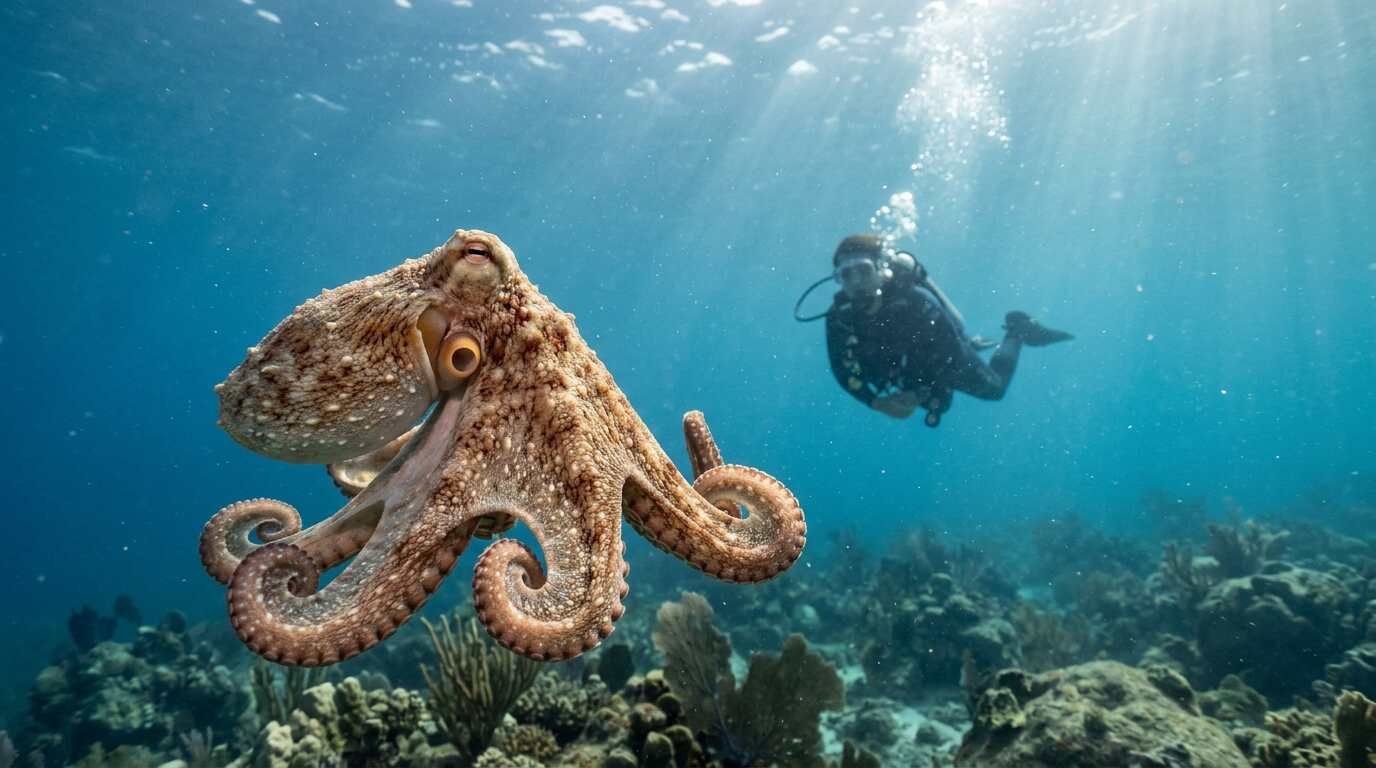
Octopuses are the standard test case for minds that evolved separately from ours. They are clever, they learn, and they can solve puzzles that require pushing or pulling and apply the solution to new set-ups. Observers have recorded veined octopuses carrying coconut shell halves and reassembling them as shelter, although some biologists argue that the shells mainly protect the animal in transit and that the behaviour should not be read as tool use in the full sense.
Their nervous system is strange. Roughly two-thirds of an octopus’s neurons sit in nerve cords in the arms, which can run complex reflex actions without the central brain. Whether that is one experiencing subject or something more spread out is an open question.
The law has already moved. The UK’s Animal Welfare (Sentience) Act, which received royal assent on 28 April 2022 and came into force on 22 May 2023, covers all vertebrates and also recognises octopuses and lobsters. It was widened to include them after a scientific review found strong evidence for their sentience. This is a policy decision made under uncertainty, not a scientific verdict.
Do insects have inner lives?
This is the most contested part of the 2024 declaration. Insects have tiny brains. A bee’s brain holds about a million neurons, far fewer than a mammal’s, but each cell can be structurally complex and connect to as many as tens of thousands of others. The size of a brain says less than we might assume.
The behavioural evidence includes a 2022 study from Queen Mary University of London in which bumblebees pushed and rotated small wooden balls for no obvious benefit, which the researchers described as play. Fruit flies have sleep that is shaped by their social surroundings. Such findings are suggestive. They do not show that any insect has experiences, and reasonable scientists disagree about how far to take them.
Expressed as a probability, the claim for insects is lower than for mammals and birds, and the declaration’s authors say as much. What they argue is that the chance is high enough to deserve attention.
Is there a better framework than a yes-or-no answer?
Several philosophers argue that asking “conscious or not?” is too blunt. In 2020 Jonathan Birch, Alexandra Schnell and Nicola Clayton proposed five dimensions along which conscious experience might vary: perceptual richness, evaluative richness, unity, temporality and selfhood. Different species could then have different profiles, instead of being ranked on a single ladder with humans at the top.
This framing suits the evidence better. A crow and an octopus might each have rich perception but very different senses of time or self, and nobody has to decide which one is “more conscious”. The approach is a proposal under discussion, not an established measurement.
Common questions
Do dogs and cats have feelings?
The evidence strongly suggests yes, at least in the sense of basic emotions and sensations. They share brain systems with humans that are associated with fear, reward and pain, and both declarations include all mammals. Whether they experience complex feelings like guilt is less clear.
Is consciousness the same as intelligence?
No. Intelligence is about solving problems, and consciousness is about experience. An animal could be clever without feeling anything, or feel a great deal without being especially clever. That is part of why puzzle-solving results alone cannot settle the matter.
Can animals feel pain?
Pain involves both a signal and a felt experience. Many animals react to harmful stimuli. The disputed point is whether the reaction is felt. For vertebrates the case is considered strong, and for cephalopods and decapods it was judged strong enough to influence UK law. For insects it remains an open question.
Did the declarations prove animals are conscious?
No. They are statements of expert judgement about probability and about how to act when the evidence is incomplete. They are influential, yet not experiments.
Why does it matter?
If an animal can suffer, how we farm, research on and fish animals carries moral weight. The declarations argue that uncertainty is not a reason for ignoring the possibility. How much weight to give it is an ethical and political question that science alone cannot answer.
What to remember
Established points: animals with similar brain structures to ours, especially mammals and birds, are widely accepted by specialists as having conscious experience, and a growing body of work points toward at least a realistic possibility in fish and some invertebrates. Hypotheses: that insects and other small-brained creatures feel anything, and what their experiences, if any, are like. Those remain open.
The best framing is probability and dimension, not a switch that is on or off. The New York Declaration of 2024 reflects that shift and asks that the uncertainty be taken seriously when decisions affect animals.
Further reading
- Other Minds by Peter Godfrey-Smith: Well-regarded popular book on octopus minds and the evolution of consciousness. See it on Amazon (affiliate link)
- The Edge of Sentience by Jonathan Birch: A 2024 book by a New York Declaration organiser on how to reason about sentience under uncertainty. See it on Amazon (affiliate link)
As an Amazon Associate I earn from qualifying purchases. A commission may be earned if you buy through this link, at no extra cost to you.
Sources



