
A 23 percent solution of ordinary salt in water stays liquid down to about -6°F. That number comes from a Federal Highway Administration manual on anti-icing, and in the same paragraph the manual notes that some highway agencies believe it is not practical to use salt below 15°F, at least not without calcium chloride. Between the chemistry and the plow yard sits a gap of 21 degrees Fahrenheit, about 12 on the Celsius scale, and every cold snap that settles inside it puts the difference to work.
Both numbers are real. One describes what salt can do eventually, the other what it can do before the next car arrives, and a single table from Minnesota’s stormwater agency shows both halves of that sentence at once.
The floor the phase diagram sets
Every brine has a coldest point, and for sodium chloride it sits near -6°F
The FHWA appendix, part of a 1996 Manual of Practice for an Effective Anti-Icing Program, walks through freezing points with a phase diagram for a generic salt-water solution. The rule it states is simple: the freezing point of a brine drops as concentration rises, up to a limit called the eutectic composition. Past that point, adding more salt stops helping. For sodium chloride the eutectic mixture is 23 percent salt by weight, and it freezes at about -21°C, or -6°F.
Other deicers have their own floors, listed in the same appendix:
| Chemical | Eutectic concentration (by weight) | Eutectic temperature |
|---|---|---|
| Sodium chloride (NaCl) | 23% | about -21°C (-6°F) |
| Magnesium chloride (MgCl2) | 21.6% | about -33°C (-28°F) |
| Calcium magnesium acetate (CMA) | 32.5% | -27.5°C (-17.5°F) |
| Calcium chloride (CaCl2) | about 30% | -51°C (-60°F) |
| Potassium acetate (KAc) | 49% | -60°C (-76°F) |
Read as a ranking, the table makes calcium chloride and potassium acetate look like they could clear a sidewalk on the dark side of the Moon. The FHWA authors cut that reading short: the fact that calcium chloride has a much lower eutectic temperature than salt is, in their words, not of importance for anti-icing operations. A floor tells how low a brine can go. It says nothing about how fast it gets there.
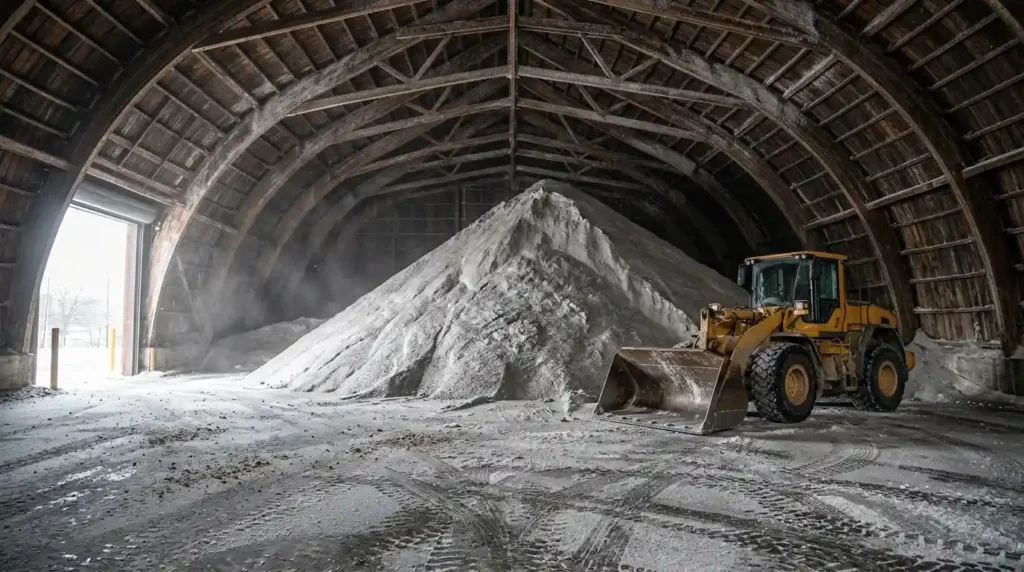
One pound of salt, eight temperatures
Minnesota’s table turns the phase diagram into pounds and minutes
The Minnesota Pollution Control Agency’s winter maintenance factsheet gives a melt table for one pound of dry sodium chloride at different pavement temperatures. At 30°F, that pound melts 46.3 pounds of ice in 5 minutes. At 15°F, it melts 6.3 pounds, and the job takes an hour. At 10°F, the table stops giving a time and says dry salt is ineffective and will blow away before it melts anything.
Running the agency’s figures through a short Python script produces two columns the factsheet does not print: the temperature in Celsius and the melt rate in pounds of ice per minute.
| Pavement temp (°F) | °C | Ice melted by 1 lb NaCl (lb) | Time | Rate (lb ice per min) |
|---|---|---|---|---|
| 30 | -1.1 | 46.3 | 5 min | 9.26 |
| 25 | -3.9 | 14.4 | 10 min | 1.44 |
| 20 | -6.7 | 8.6 | 20 min | 0.43 |
| 15 | -9.4 | 6.3 | 1 hour | 0.105 |
| 10 | -12.2 | 4.9 | ineffective, blows away | n/a |
| 5 | -15.0 | 4.1 | none given | n/a |
| 0 | -17.8 | 3.7 | none given | n/a |
| -6 | -21.1 | 3.2 | none given | n/a |
Chart data (CSV, for a line chart of the last column against the first): 30,9.26 / 25,1.44 / 20,0.43 / 15,0.105.
Between 30°F and 15°F the amount of ice per pound shrinks about sevenfold. The time stretches twelvefold. Multiply those together and the rate falls by a factor of about 88. A spreader truck working at 15°F is effectively carrying 1/88th of the melting speed it had on a 30°F morning, per pound, and nobody has asked the pavement to wait an hour.
Capacity is chemistry, speed is the problem
The pounds column follows the phase diagram; the minutes column is what runs out
It would be tidy to say the practical limit is all about rate and none about chemistry. The table does not allow it. The shrinking pounds column is the phase diagram talking: colder ice only gives way to a stronger brine, so each pound of salt can dissolve into less water before the mix reaches its own freezing point.
That claim can be checked with the FHWA’s own number. At the eutectic, the brine is 23 percent salt and 77 percent water, so one pound of salt can hold at most 0.77 ÷ 0.23 = 3.35 pounds of water in liquid form. Minnesota’s table lists 3.2 pounds of ice at -6°F. The two agencies, using different documents written for different readers, land within about 5 percent of each other. The capacity numbers are equilibrium numbers.
The minutes column is a different animal. The FHWA appendix describes dissolving as a process that needs energy to begin and to keep going, says the solution process for salt will take place very slowly, and adds that solubility falls with temperature. The agencies that draw the line at 15°F without calcium chloride do so, the manual says, because experience convinced them salt’s action is too slow at those temperatures. Calcium chloride, by contrast, dissolves much faster.
So the 21-degree gap has two layers. At 15°F a pound of salt can still, given enough time, liquefy more than six pounds of ice. The time is the part a road cannot supply. Dry crystals blow away first, as Minnesota’s 10°F note warns, and the brine that does form gets diluted by the melt it creates. The FHWA appendix makes that last point directly: concentration falls as melting snow and ice water the brine down, and once its freezing point climbs above the pavement temperature, it refreezes.
Salt on a 15°F road is like a boiler with plenty of fuel and a pilot light the size of a match: the energy is in the tank, and the house is still cold at breakfast.
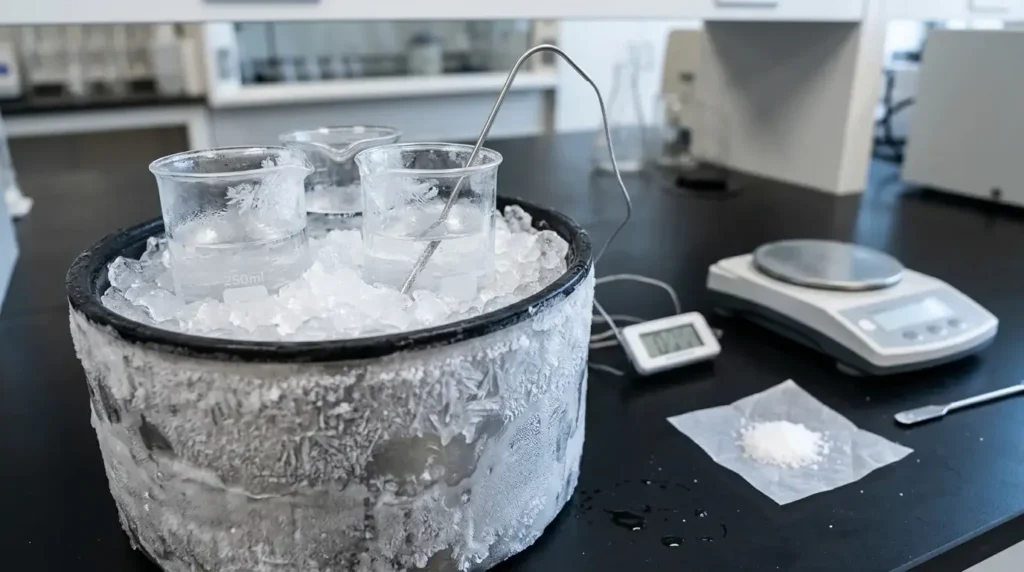
The practical chart, chemical by chemical
Minnesota’s working limits sit far above every eutectic
The same Minnesota factsheet lists a lowest practical melting temperature for each common deicer. Set beside the FHWA eutectics, the two columns show how much margin crews leave between theory and practice.
| Chemical | Eutectic (FHWA) | Lowest practical (MPCA) | Gap |
|---|---|---|---|
| NaCl | -6°F | 15°F | 21°F |
| MgCl2 | -28°F | -10°F | 18°F |
| CaCl2 | -60°F | -20°F | 40°F |
| CMA | -17.5°F | 20°F | 37.5°F |
| KAc | -76°F | -15°F | 61°F |
Calcium chloride’s paper advantage over salt is 54 degrees. Its working advantage, by Minnesota’s figures, is 35. Potassium acetate, with the lowest floor in the FHWA table, loses the most between the lab and the lot. CMA, which the FHWA lists with a eutectic well below salt’s, is rated by Minnesota as practical only down to 20°F, five degrees warmer than plain salt.
One more arithmetic detail falls out of the eutectic concentrations, and it cuts against the instinct to reach for a stronger chemical. At its own eutectic, a pound of sodium chloride can hold about 3.35 pounds of water as brine. By the same calculation, a pound of calcium chloride at its 30 percent eutectic holds about 2.33 pounds, and a pound of potassium acetate at 49 percent holds about 1.04. Those comparisons are at different temperatures, so they are not a contest. For calcium chloride, CMA and potassium acetate, the lower floor is bought with more chemical per pound of water. Magnesium chloride breaks the pattern: at 21.6 percent, a pound of it holds about 3.63 pounds of water, slightly more than salt.
Element-level background on sodium, calcium and chlorine is in the periodic table trends piece on this site, which covers electronegativity, ionization energy and atomic radius.
Where the salt goes after the thaw
Chloride does not leave with the snowbank
A pound of salt that blew off a 10°F parking lot did not vanish. Minnesota’s factsheet puts the stakes in one line: about one teaspoon of salt contaminates 5 gallons of water.
The longer record comes from the U.S. Geological Survey. A 2014 study by Steven Corsi and colleagues analyzed 30 monitoring sites on 19 streams in snow-affected urban areas, with records running 18 to 49 years. Average chloride concentrations roughly doubled from 1990 to 2011. At 29 percent of the sites, chloride exceeded the EPA’s chronic water-quality criterion of 230 milligrams per liter, and those sites did so on more than 100 days a year on average during 2006 to 2011. Concentrations also climbed outside deicing season, which the authors read as chloride stored in groundwater over winter and released to streams the rest of the year. The increases outpaced the rate of urbanization.
The USGS news release on the study says chloride levels increased substantially in 84 percent of urban streams analyzed. In it, Corsi warns that some freshwater organisms are sensitive to chloride and that the concentrations found could harm them.
The EPA’s Southeast New England Program adds the costs that land on dry ground. Its page says high chloride in surface waters is toxic to some fish, bugs and amphibians, that road salt can contaminate drinking water reservoirs and wells, and that high sodium in drinking water affects people with high blood pressure. The same page puts corrosion from rock salt at roughly $5 billion a year in U.S. repairs, and notes that nearly half a million tons go onto roads in Massachusetts alone each year. The water, as the erosion simulator on this site shows in miniature, always finds the low ground.

The best argument for salting anyway
Salt is cheap, familiar, and on a 28°F morning it works fast
The case for keeping salt at the center of winter maintenance is strong, and the Minnesota table makes it. In the high 20s and low 30s, a pound of salt melts tens of pounds of ice in minutes. Salt’s floor is not the limiting factor at those temperatures, which is the FHWA authors’ point when they call calcium chloride’s lower eutectic not of importance for anti-icing.
The harder fact sits underneath. The habit that makes salt so effective at 30°F also makes it easy to over-apply at 15°F, when the same handful of crystals is working at one eighty-eighth the speed and more of it ends up in the ditch, the storm drain and, by the USGS record, the stream well outside deicing season. The extra salt thrown at a cold morning is the salt least likely to melt anything before the thaw carries it off.
Minnesota’s table has a blank cell at 10°F where a melt time should be. Which number would change a crew’s decision on a cold morning: the pounds a bag could melt eventually, or the minutes it would take?
Sources
- Federal Highway Administration, Manual of Practice for an Effective Anti-Icing Program (FHWA-RD-95-202), Appendix B, “Freezing-Point of Chemical Solutions”: https://www.fhwa.dot.gov/publications/research/safety/95202/005.cfm
- Minnesota Pollution Control Agency, Minnesota Stormwater Manual, “Winter Parking Lot and Sidewalk Maintenance Factsheet”: https://stormwater.pca.state.mn.us/Winter_Parking_Lot_and_Sidewalk_Maintenance_Factsheet
- U.S. Geological Survey, Corsi, De Cicco, Lutz and Hirsch, “River chloride trends in snow-affected urban watersheds,” Science of the Total Environment (2014): https://www.usgs.gov/publications/river-chloride-trends-snow-affected-urban-watersheds-increasing-concentrations-outpace
- U.S. Geological Survey news release, “Urban Stream Contamination Increasing Rapidly Due to Road Salt,” Dec. 15, 2014: https://www.usgs.gov/news/national-news-release/urban-stream-contamination-increasing-rapidly-due-road-salt
- U.S. EPA Southeast New England Program, “Winter is Coming! And with it, tons of salt on our roads”: https://www.epa.gov/snep/winter-coming-and-it-tons-salt-our-roads