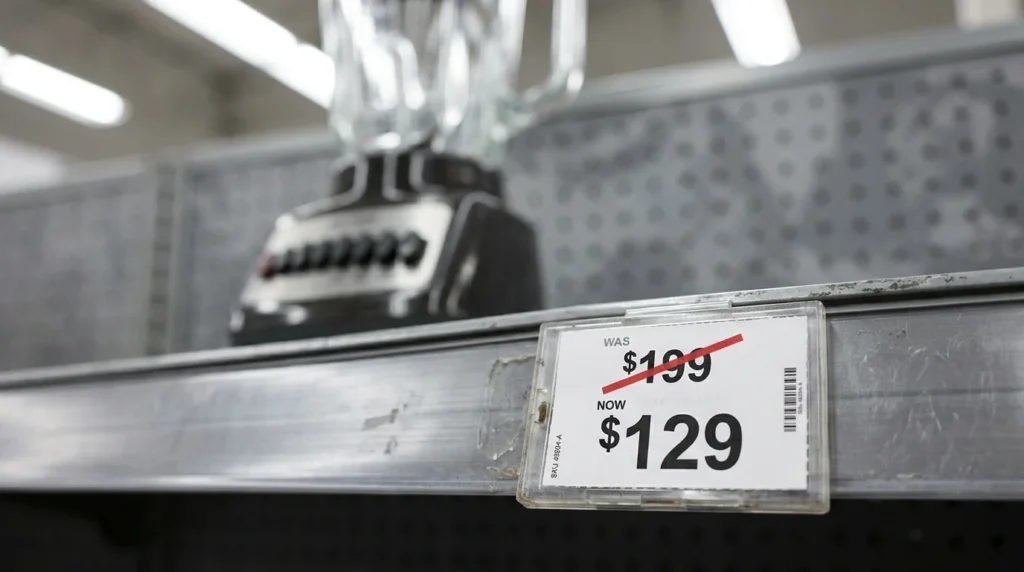
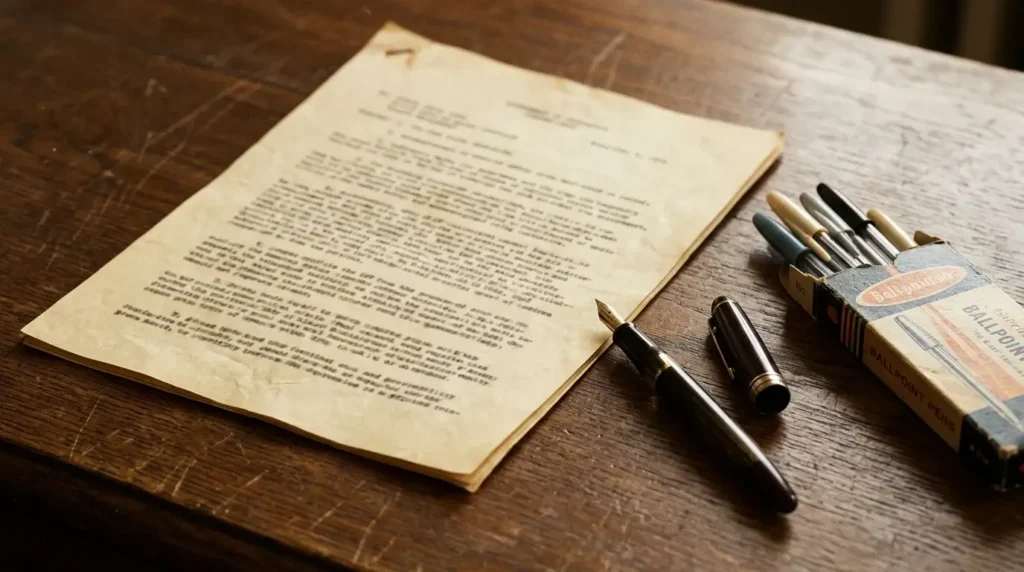
The federal rule that governs the crossed-out number on a Black Friday tag was published on November 8, 1967, and one of its examples is a retailer selling pens. In the scenario, the seller sets an inflated price for a few days knowing it will be able to sell no, or very few, pens at this inflated price, then advertises a “cut” back to the usual price. The Federal Trade Commission’s guide calls that “obviously a false claim.” Fifty-nine years later the pens have become televisions and air fryers, Black Friday lands on November 27, 2026, and the question behind every strikethrough is still the one the FTC asked about the pens.
A “was” price is a factual claim about the past. It says the item sold, or at least was genuinely offered, at that number, recently enough to matter. Federal law and a handful of states test that claim in different ways, and a $199 tag that passes one test can fail another.
The federal test from 1967
Four phrases in 16 CFR 233.1 do most of the work
The FTC’s Guides Against Deceptive Pricing sit at 16 CFR Part 233, issued under the commission’s Section 5 authority (15 U.S.C. 45) and first published at 32 FR 15534. Section 233.1 covers former price comparisons, and its standard is compact. A former price is a legitimate basis for a comparison when it is “the actual, bona fide price at which the article was offered to the public on a regular basis for a reasonably substantial period of time,” in the section’s own words.
Two more phrases fill out the picture. The price should be one at which the product was “openly and actively offered for sale,” and it should have been offered “in the recent, regular course of his business, honestly and in good faith,” the guide’s 1967 pronoun intact.
One sentence in the guide runs against most shoppers’ instincts: “A former price is not necessarily fictitious merely because no sales at the advertised price were made.” The federal test asks whether the price was a real offer, not whether anyone paid it. On that wording, a store that kept a $199 tag on a blender for months and sold almost none could still have a defensible “was $199” under the federal guide, provided the offer was genuine and not set up to manufacture a later discount. The guide does warn advertisers not to imply that a former price was a selling price unless substantial sales at that price were actually made.
The federal guide also sets no number of days. “Reasonably substantial” is the measurement, which is like a building code that tells a contractor to pour “enough” concrete.
California counts the market, not the store
Section 17501 looks at the prevailing price, within three months
California’s statute, Business and Professions Code § 17501, starts from a different place. For the purposes of the false advertising article, the worth or value of anything advertised is “the prevailing market price,” wholesale or retail depending on the offer, at the time and in the locality where the ad runs.
The former-price rule follows from that. A retailer may advertise a former price only if it was the prevailing market price within the three months immediately before the ad was published, or else the ad must state, “clearly, exactly and conspicuously,” the date when that former price prevailed.
The word “market” changes the question. Under the federal guide, a seller mostly has to answer for its own offers. Under § 17501, the reference point is the predominant price for the item in the market, which a compliance article by Richard B. Newman in The National Law Review describes as the common price at which a product is sold in the market, not just by the retailer. A store that alone charged $199 for three months, while everyone else in town sold the same model at $149, would have trouble calling $199 the prevailing market price.
For a Black Friday ad published November 27, 2026, the three-month window reaches back to roughly August 27. A “was $199” tag in California either points to a prevailing price inside that stretch or carries a date telling shoppers when $199 was last real.
New Jersey puts a number on it
Twenty-eight days out of ninety, and a basis printed on the ad
New Jersey’s Division of Consumer Affairs regulations are the most arithmetic of the group. Under N.J.A.C. 13:45A-9.6, “An advertiser shall not use a fictitious former price,” and a former price is fictitious if it cannot be substantiated “based upon proof.” The rule offers three ways to prove it:
- A substantial number of sales of the item, or comparable goods, in the trade area during the most recent 60 days before the ad, or the first 60 days after it takes effect.
- Active and open offers at that price in the trade area on at least 28 of the most recent 90 days before or after the ad’s effective date.
- A price no higher than the supplier’s cost plus the merchant’s usual and customary markup.
The 28-of-90 test also appears in N.J.A.C. 13:45A-9.4, which governs price-reduction ads for merchandise advertised at $100 or more. A $199 item falls squarely inside it. That section requires the ad to state the selling price, the former price or the dollar savings, the period during which the reduced price applies, and the basis for the former price, using terms such as “comparable value,” “competitor’s price” or “our regular price.” If the former price was not actively or openly offered in the trade area on at least 28 of the 90 days before the ad, the ad has to identify when that price was in effect.
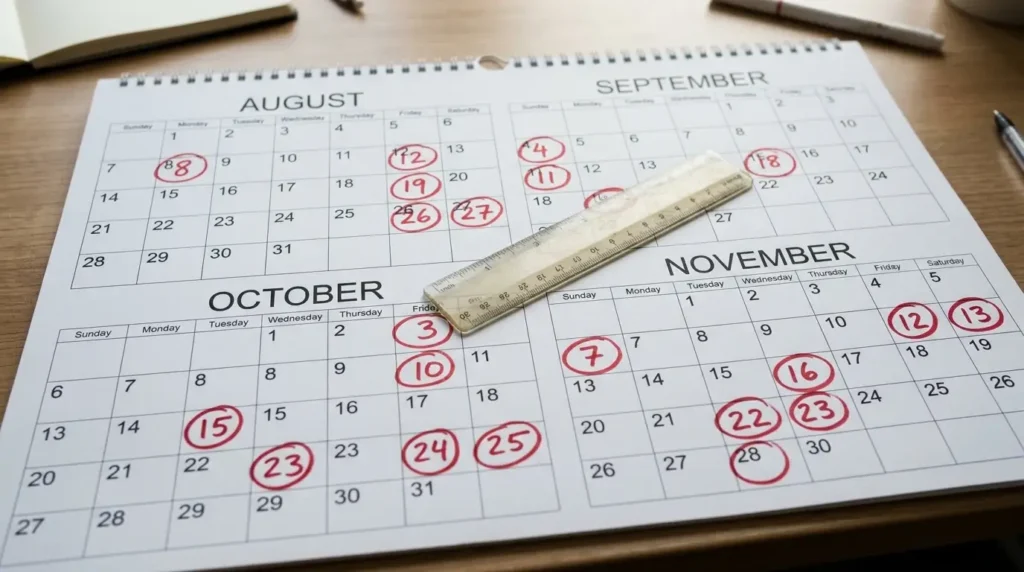
For a November 27 ad, the 90-day window runs from August 29 through November 26, 2026. Twenty-eight days is about 31% of that stretch. A blender priced at $199 for four weeks in September and then sold at $149 through October and November would still clear the 28-day count. Whether it clears California’s “prevailing market price” test is a separate question, and the answer could be no.
New York and the District of Columbia use broad words
No day counts, wide nets, and in DC no need to show anyone was fooled
New York’s two general consumer statutes do not mention former prices at all. General Business Law § 349(a) declares unlawful “Unfair, deceptive, or abusive acts or practices in the conduct of any business, trade or commerce.” Section 350-a defines false advertising as advertising that is “misleading in a material respect.” A Legal 500 article by Jennifer M. Oliver of Buchanan Ingersoll & Rooney notes that plaintiffs use §§ 349 and 350 against misleading pricing even though neither sets a former-price standard.
What New York does have is a private remedy with a floor. Under § 349(h), an injured person may recover “actual damages or fifty dollars, whichever is greater,” and a court may increase damages up to three times actual damages, capped at one thousand dollars, if the defendant acted willfully or knowingly.
The District of Columbia’s Consumer Protection Procedures Act, D.C. Code § 28-3904, lists price reductions by name. It is an unlawful trade practice to “Make false or misleading representations of fact concerning the reasons for, existence of, or amounts of price reductions,” and the same paragraph reaches comparisons with “one’s own price at a past or future time.” The opening of the section adds the phrase that does the heavy lifting: the practices are unlawful “whether or not any consumer is in fact misled, deceived, or damaged thereby.”
That clause matters more than any day count. In most of these frameworks, a plaintiff eventually has to show harm. In DC’s list, the false claim about a price reduction is the violation.
What a $199 “was” price would need to pass
One tag, five tests, for an ad running November 27, 2026
The table assumes an ad reading “Was $199, now $129,” a cut of $70, or about 35%.
| Jurisdiction | Source | What “$199” has to be | Time window | Sales required? | Disclosure if outside the window |
|---|---|---|---|---|---|
| Federal (FTC) | 16 CFR 233.1 | The “actual, bona fide price,” openly and actively offered, honestly and in good faith | “Reasonably substantial period,” “recent”; no day count | No, but no implying sales that didn’t happen | Former prices from the distant past should not be used without disclosure |
| California | B&P Code § 17501 | The prevailing market price, measured in the market, not just at that store | Within the three months before the ad (about Aug. 27 to Nov. 26) | Not stated as such; the test is the market price | Date the former price prevailed, “clearly, exactly and conspicuously stated” |
| New Jersey | N.J.A.C. 13:45A-9.4, 9.6 | Provable by recent sales, by 28-of-90-day offers, or by cost plus usual markup | 28 of the 90 days (Aug. 29 to Nov. 26); 60 days for the sales method | One of three methods; sales is only one | At $100 or more, the ad must say when the former price applied if it fails the 28-of-90 test, and must state the basis and the sale period |
| New York | GBL § 349, § 350-a | Not “misleading in a material respect”; not deceptive, unfair or abusive | None in the statute | Not specified | Not specified |
| District of Columbia | D.C. Code § 28-3904 | No false or misleading representation about the existence or amount of the reduction | None in the statute | Not specified | Unlawful even if no consumer is actually misled |
Read across, the table shows the bind for a retailer that prints one tag for every store: that tag has to clear California’s market test and New Jersey’s day count at the same time, and the broad language in New York and DC catches whatever slips past both.
The case for leaving strikethroughs alone
A buyer who wanted the blender at $129 still has the blender
The strongest argument against treating every inflated reference price as fraud is about harm. The Legal 500 article reports that New Jersey courts have held consumers suffered no measurable loss when they received what they bought, even with an inaccurate reference price. In California, it says, damages are measured as the difference between the price paid and the product’s actual value, which usually requires expert testimony. The same article says many pricing cases settle early, so theories of liability and damages remain largely untested.
That argument has weight. A shopper who paid $129 for a blender worth $129 got a blender worth $129. The lie, on this view, was about the shopper’s sense of victory, and the courts have not settled whether a bruised sense of victory is money.
The other side has an answer. A fake discount can move buyers who would otherwise have waited, compared stores or walked away, and DC’s statute makes a false price-reduction claim a violation whether or not any consumer was misled or damaged. New York’s $50 floor under § 349(h) lets an injured shopper recover something even when the provable loss is smaller.
A real overcharge looks different, and the timing is a useful contrast. On October 26, 2026, the FTC and a coalition of states filed a complaint against Dollar General in the Middle District of Tennessee. The plaintiffs are the FTC, 19 states (California and Michigan appear as “the People” of each state) and Utah’s Division of Consumer Protection. The theory is not a fake “was” price. The complaint alleges the chain “continues to advertise one price while charging a higher price at checkout,” and cites state inspection results, including Wisconsin’s finding that 662 of 7,344 scanned products, about 9%, were overcharged in 2023, with an average overcharge of 17%. These are allegations, and Dollar General has its chance to answer them in court.
Put side by side, the two problems sit at opposite ends of the pipe. A shelf-and-register mismatch takes money at the till. A fictitious “was” price takes the decision before the shopper ever gets there.
How a shopper can check a “was” price
Most of the evidence is public, and some of it is already archived
No single tool settles whether $199 was real, but a few steps make the claim checkable.
- Look for an archived copy of the product page. The Internet Archive’s Wayback Machine lets anyone enter a URL and browse its captured history on a calendar. Coverage is incomplete; the archive’s help page says not every date for every archived site is complete, and some sites are missing because the crawlers did not know they existed. A snapshot from September showing $149 is strong evidence that “was $199” in November is shaky.
- Save the page now. The same help page describes “Save Page Now,” which captures a single page once. A capture before a sale starts gives a dated record to compare against later.
- Use a price-history tracker. Several free services log prices for large online retailers over time and chart them. They differ in coverage and accuracy, and their charts are only as good as how often they check, so a chart is a lead, not proof. The legal footing of the scraping behind such services has its own history, covered in what the CFAA, hiQ and Van Buren cases say about web scraping.
- Read the fine print on the tag or ad. In New Jersey, a $199 reduction ad should say what the former price is based on, such as “our regular price” or “competitor’s price,” and how long the sale lasts. In California, a former price outside the three-month window should carry a date. A tag with neither, in those states, is worth a photograph.
- Compare the same model elsewhere. California’s test is the market, so the same model number at other sellers during the prior three months is the relevant comparison, not one store’s history.
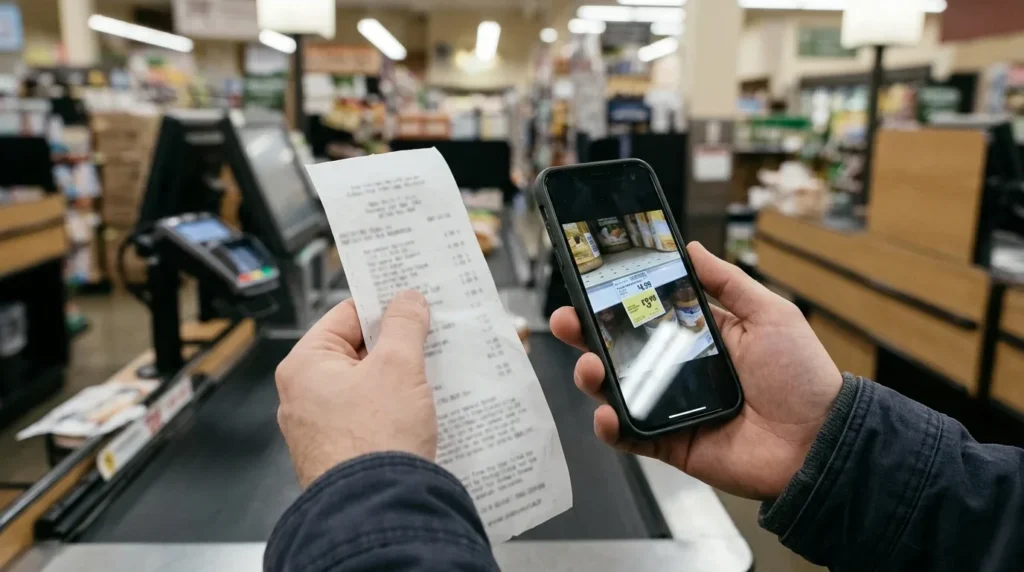
- Keep the receipt next to the shelf photo. The Dollar General complaint is a reminder that the price at the register can differ from the one on the shelf, and the two documents together make a dated record that can go with a complaint to a state consumer protection office.
Retail fine print has been a running subject here, from whether click-through terms of service hold up in court to what the FTC and state laws say about the right to repair.
On November 27, millions of tags will carry a crossed-out number, and the 1967 pen example will apply to every one of them. How many of those numbers would survive a Wayback Machine search from August?
For informational purposes only — consult a licensed attorney or financial advisor.
Sources
- 16 CFR Part 233, Guides Against Deceptive Pricing (eCFR): https://www.ecfr.gov/current/title-16/chapter-I/subchapter-B/part-233
- 16 CFR 233.1, Former price comparisons (eCFR): https://www.ecfr.gov/current/title-16/chapter-I/subchapter-B/part-233/section-233.1
- California Business and Professions Code § 17501 (California Public Law mirror of leginfo.legislature.ca.gov): https://california.public.law/codes/business_and_professions_code_section_17501
- N.J.A.C. 13:45A-9.4, Price reduction advertisements over $100 (Justia Regulations): https://regulations.justia.com/states/new-jersey/title-13/chapter-45a/subchapter-9/section-13-45a-9-4
- N.J.A.C. 13:45A-9.6, Prohibition on fictitious pricing and methods of substantiation (Justia Regulations): https://regulations.justia.com/states/new-jersey/title-13/chapter-45a/subchapter-9/section-13-45a-9-6
- New York General Business Law § 349 (NY Senate): https://www.nysenate.gov/legislation/laws/GBS/349
- New York General Business Law § 350-a (NY Senate): https://www.nysenate.gov/legislation/laws/GBS/350-A
- D.C. Code § 28-3904 (DC Council Code): https://code.dccouncil.gov/us/dc/council/code/sections/28-3904
- Richard B. Newman, “How to Comply With FTC and California Strike-Through Pricing Laws,” The National Law Review, Feb. 16, 2026: https://www.natlawreview.com/article/how-comply-ftc-and-california-strike-through-pricing-laws
- Jennifer M. Oliver, “One Strike And You’re Out: Strikethrough Pricing And Perpetual Promotion Claims Surge,” Legal 500, March 30, 2026: https://www.legal500.com/intelligence/united-states/litigation-mediation-arbitration/one-strike-and-you%E2%80%99re-out-strikethrough-pricing-and-perpetual-promotion-claims-surge
- FTC et al. v. Dollar General Corp., complaint, M.D. Tenn., filed Oct. 26, 2026: https://www.ftc.gov/system/files/ftc_gov/pdf/DollarGeneral-Complaint.pdf
- Internet Archive Help Center, “Using the Wayback Machine”: https://help.archive.org/help/using-the-wayback-machine/