






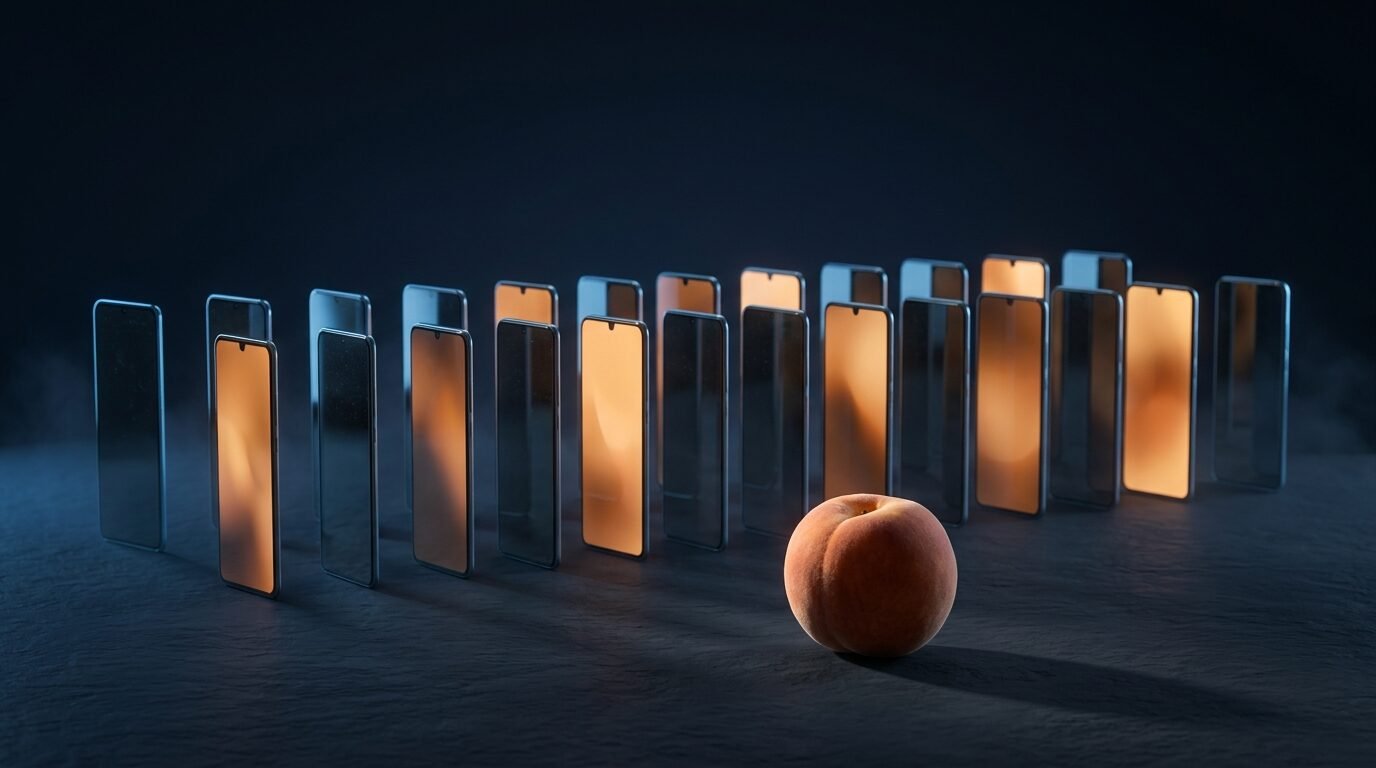
Nine days. That is how long it took a cast of talking fruit to rack up roughly 300 million views on TikTok. Fruit Love Island, a vertical, AI-animated send-up of the dating show Love Island, premiered on March 13, 2026, and by the end of the month its anonymous creator had stopped making it, a […]
Nine days. That is how long it took a cast of talking fruit to rack up roughly 300 million views on TikTok.
Fruit Love Island, a vertical, AI-animated send-up of the dating show Love Island, premiered on March 13, 2026, and by the end of the month its anonymous creator had stopped making it, a large share of the episodes had vanished from the platform, and the whole affair had hardened into the standard case study for everything people fight about when they fight about generative video. What follows is a case file: the timeline, the numbers (and where they disagree), and what the wreckage suggests.
- Subject
- Fruit Love Island, an AI-generated microdrama with 2 to 4 minute episodes
- Account
- @ai.cinema021 (“AI Cinema”), creator never identified
- Launched
- March 13, 2026, on TikTok
- Reported peak
- 3M+ followers and about 300M total views within nine days
- Status
- Production halted March 28; many episodes removed. Verify current availability directly.
Exhibit A: The timeline
The sequence matters more than any single figure, because the rise and the collapse happened inside three weeks.
| Date (2026) | What happened | Reported by |
|---|---|---|
| March 13 | First episode posted to TikTok; fruit versions of a Love Island-style cast move into a villa. | Wikipedia; The Triangle |
| Within nine days | Account passes 3 million followers and about 300 million total views. Viewers vote on plot turns, often through a Google Form. | Wikipedia; DesignRush |
| March 24 | OpenAI announces it is shutting down Sora, its video app and API. | Engadget |
| March 28 | Creator halts new episodes, citing hate and no revenue. | DesignRush; Wikipedia |
| March 31 | Of 22 TikTok episodes, only 10 remain. A new account, “The Shore Between Us,” is linked from the creator’s bio. | Fast Company |
| April 17 | A student-paper retrospective calls the ending a loss for fans and a win for AI opponents. | The Triangle |
For a sense of the genre’s texture, this third-party commentary video covers the spring pile-on. It is someone else’s work, embedded for context.
Exhibit B: Where the numbers disagree
Anyone quoting this story should know the record is messy. Outlets published within days of each other and still landed on different counts.
| Question | One version | Another version |
|---|---|---|
| How many episodes? | 22 on TikTok (Fast Company, C21Media, DesignRush) | 28 across two seasons (Wikipedia) |
| Biggest single episode | 38.7M views as of March 31 (Fast Company) | First episode at 35M+ views (The Triangle) |
| What happened on YouTube? | Account taken down (Fast Company) | Episodes still up (C21Media, same day); creator pledged to continue there (Wikipedia) |
| Why were episodes removed? | Cause unclear: mass reporting or a guideline violation (Fast Company) | Creator blames hate and lost income (DesignRush) |
| When did Sora end? | Shutdown announced March 24 (Engadget) | Dated March 25 (Fast Company) |
None of these gaps changes the arc. They do change which figures deserve repeating, and the safest habit is to name the outlet each time.
Exhibit C: The economics of a hit nobody could bill
Three hundred million views sounds like a payday. It was not.

According to Fast Company, the creator described each episode as hours of work, with generations that kept failing and needing to be redone, and then posted a line that doubles as an epitaph for the whole experiment.
“All my videos banned I make no money.”Creator of Fruit Love Island, as reported by Fast Company
The reporting I found does not explain how, or whether, the account ever earned from those views before the removals, so treat any claim about payouts as unverified. What the record does show is a lopsided trade: enormous attention, heavy production labor, and a distribution channel that could pull the plug without notice. Viewer participation made the loop feel like a community (people voted on who entered the villa), yet votes cost nothing and settled nothing financially.
Exhibit D: Who objected, and why
Opposition came from two directions at once. Ordinary viewers piled into the comments to criticize the environmental cost of generative video and the quality of the animation, per Fast Company. Wikipedia’s summary of the coverage notes that commentators branded it a textbook example of low-effort AI content, and that singer Zara Larsson posted about the characters, then deleted the post after a wave of negative replies. Other reactions from the Love Island world were split between amusement and open dislike.
Rights holders were a separate matter. ITV Studios, the company behind Love Island, said it would act against unauthorized commercial use of the brand while still welcoming fan enthusiasm, according to C21Media. The platform’s own rulebook prohibits content that violates intellectual property rights, Fast Company notes, though it stops short of confirming that rule caused the removals.
The climate around the series was already tense. In February, Disney and Paramount Skydance had sent letters to ByteDance over its Seedance 2.0 video model, and in March two US senators urged the company to shut it down, per Wikipedia. A parody built on a famous format, made with generative tools and posted at scale, walked straight into that weather.
The industry read: microdramas are not slowing down
Here is the twist. The collapse of one series barely dented the business case for the category.

C21Media reported that Harlequin and Dashverse plan to co-produce 40 animated microdramas based on Harlequin’s romance novels, and that TikTok had recently launched PineDrama, a standalone app for serialized 60 to 90 second stories. Holywater co-founder Bogdan Nesvit told the outlet why studios keep leaning in:
“Faster, cheaper, and increasingly indistinguishable to the audience.”Bogdan Nesvit, Holywater co-founder, via C21Media (his own business claims; unverified)
Brands face a harder calculation. DesignRush argued that the very traits that powered the series’ spread also made its audience “hostile territory for brands,” because viewers extend latitude to a lone creator that they withhold from a company. That is an argument, not a measurement, but it matches the comment-section mood Fast Company described.
And the creator? Fast Company reported that the new “Shore Between Us” account had 189,000 followers before it posted a single episode, with a March 30 teaser showing a fruit-based riff on another existing show. The audience, it seems, followed the person rather than the premise.
Same month, different signal: Sora
Timing makes for an odd footnote. While the fruit series was peaking, OpenAI posted that it was closing one of the most visible AI video products.

“We’re saying goodbye to Sora.”OpenAI, March 24, 2026, as reported by Engadget
Engadget cited Appfigures data showing new installs and spending sliding in early 2026, and said Disney was reportedly exiting a planned $1 billion investment. Nothing in the reporting ties the Sora decision to Fruit Love Island, and I would not draw that line. The overlap is simply a reminder that the tools, the audiences, and the legal posture around AI video were all moving at once.
What to take from it
Opinion, clearly labeled: these are my reads, not findings from the sources.
Attention is not income. A creator can hold the biggest audience on a platform and still earn nothing if the platform removes the work. Borrowed formats invite owners of the original to take an interest, and generative tools make borrowing cheap enough to do at scale. Distribution you do not control is a lease, and the landlord can end it. Finally, hostility in the comments is data that sponsors read closely, even when the view counter looks spectacular.
Frequently asked questions
What is Fruit Love Island?
An AI-generated microdrama on TikTok in which anthropomorphic fruit compete on a dating reality show modeled on Love Island. Episodes ran two to four minutes in a vertical format.
Who made it?
The account is @ai.cinema021, run by a creator who has never been identified. Wikipedia notes that several online personalities have claimed to be behind it.
Why were episodes removed?
Fast Company called the cause unclear, pointing to mass reporting or a violation of TikTok’s guidelines on intellectual property. The creator blamed hate and lost revenue.
Is it still available?
As of the latest reporting I could find (April 2026), only part of the run remained on TikTok, and accounts of its YouTube status conflicted. Check the platforms directly.
Which AI tool made it?
The sources I read do not say. The creator described writing the scripts and planning scenes, and said the generation step often needed redoing.
Sources
- Fruit Love Island (Wikipedia)
- Fast Company, March 31, 2026: “Fruit Love Island is TikTok’s most popular AI-generated series. It’s now facing trouble in paradise”
- C21Media, March 31, 2026: Fruit Love Island and the surge of AI microdramas
- DesignRush, April 8, 2026: TikTok series Fruit Love Island reveals AI risk after 300M views
- The Triangle, April 17, 2026: “The rise and fall of Fruit Love Island”
- Engadget, March 24, 2026: OpenAI is shutting down its Sora video generation app
- Seedance 2.0 (Wikipedia)
- “Love Island AI Slop Has Taken Over TikTok” (YouTube)



One thought on “Fruit Love Island: Anatomy of a 300-Million-View AI Hit”