






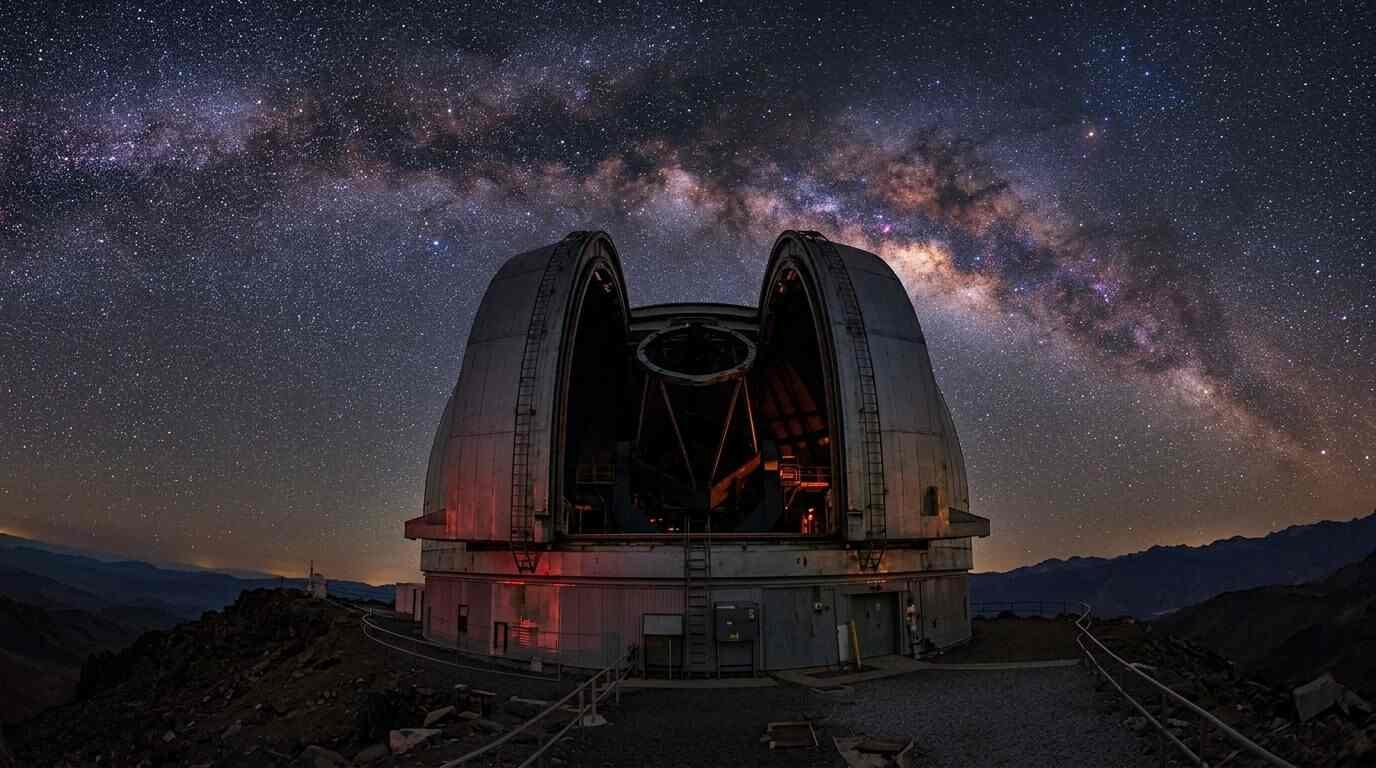
Rubin Observatory's ten-year survey began June 30, 2026, with a 3,200-megapixel camera, about 10 terabytes of data nightly and up to seven million alerts. Here is how it works.
The Rubin Observatory LSST began on June 30, 2026, when the Vera C. Rubin Observatory in Chile started a ten-year survey that will photograph the entire southern sky about 800 times. Each night it gathers roughly 10 terabytes of data and flags up to seven million changes in the sky, from exploding stars to moving asteroids. The idea is to turn astronomy from a set of snapshots into a movie, and the first weeks already added more than 11,000 new asteroids to the catalog.
What the survey is, in plain numbers
LSST stands for Legacy Survey of Space and Time. It runs on the 8.4-meter Simonyi Survey Telescope on Cerro Pachón, and the National Science Foundation and the Department of Energy’s Office of Science fund the project. The observatory is jointly operated by NSF NOIRLab and the DOE’s SLAC National Accelerator Laboratory, as the Brookhaven National Laboratory announcement lays out.
| Quantity | Reported figure |
|---|---|
| Survey length | 10 years, starting June 30, 2026 |
| Camera | 3,200 megapixels, the largest digital camera built |
| Image rate | A new image about every 40 seconds, roughly 1,000 per night |
| Sky coverage | Entire southern sky every few nights, each point revisited about 800 times |
| Data per night | About 10 terabytes |
| Alerts per night | Up to 7 million |
The Brookhaven lab built the camera’s sensor array, which it describes as the largest charge-coupled device array ever made. The final product will be a catalog of billions of objects with trillions of measurements, released through regular public data releases.
A few comparisons make the numbers easier to hold. A typical 4K television screen has about 8.3 million pixels, so a single frame from this camera carries roughly as many pixels as 385 of them; that is my arithmetic from the 3,200-megapixel figure, not a number from the project. The cadence works out similarly. Ten years is about 3,650 days, and 800 visits spread across them means an average gap of between four and five days at any given spot, which fits the “every few nights” language in the releases. Real gaps will vary with weather and with which part of the sky is up.
Why repeat the same sky 800 times?
Most big sky surveys behave like a photographer who takes one careful picture of each place. Rubin is a filmmaker. Return to the same patch hundreds of times over a decade and anything that changes will give itself away: a star that pulses, a supernova that brightens and fades, an asteroid that slides against the background.
That is what the NSF’s Brian Stone meant when he said that “today, we begin filming the greatest cosmic movie ever made.” The slogan has a literal basis. Time is the new axis. Where earlier surveys gave a map, this one gives a map with a clock attached.
Repetition also helps with faint things. Stack hundreds of images of the same galaxy and noise averages out, which reveals structure too dim to see in one exposure. The same data serve both the study of fast changes and the measurement of very faint, steady objects.
Seven million alerts a night: who reads them?
No person can read seven million messages. According to the University of Washington, researchers there, led by Eric Bellm, developed the alert pipeline, and automated alert brokers sort and classify the output. Scientists then pick the events they care about, such as a new supernova or an unusual brightening, and point other telescopes at it.
That handoff is the heart of what is called multi-messenger astronomy. Rubin spots that something happened, and other instruments, optical, radio, gravitational wave and cosmic ray detectors, follow up. Fermilab’s release says the survey is meant to guide follow-up telescopes to transient events. For a view of how follow-up works in the opposite direction, our post on Einstein Probe’s X-ray tail on a neutron star merger shows what a fast alert can lead to.
The scale is sobering. Ten terabytes a night, if every night were used, would add up to more than 3.6 petabytes a year. That is simple arithmetic and an upper bound, since weather and maintenance will cost some nights.
The early catch: 11,000 asteroids
The survey officially began after commissioning, a first look event in June 2025, a readiness review and the start of the alert stream, as Fermilab recounts. Even before the official start, the telescope ran early optimization surveys. In about six weeks they turned up more than 11,000 asteroids new to science. Among them were 33 near-Earth objects and 380 trans-Neptunian objects, the icy bodies that orbit beyond Neptune.
These numbers deserve a careful reading. A near-Earth object, in astronomy jargon, is a body whose orbit brings it into Earth’s neighborhood; it does not mean one is headed here. Finding more of them is how observers learn which ones need watching. The 380 distant bodies matter for a different reason, because their orbits record the history of the outer solar system.
Why does a survey of the whole southern sky find so many asteroids so fast? Because they move, and moving things are what repeated imaging detects best. An asteroid shows up as a dot that shifts from one visit to the next. Link those dots across several nights and you can compute an orbit. With one image every 40 seconds and a revisit every few nights, the telescope produces exactly that kind of record for the whole sky at once, and the discovery count should keep climbing as the years of data accumulate.
What astronomers hope to learn
The project lists several targets: pulsating stars, supernovae, the fossil record of galaxies, dark energy, dark matter, the accelerating expansion of the universe, moving objects and phenomena nobody has seen yet. Dark energy is the one most tightly tied to repeated imaging. By measuring how galaxies look and cluster across billions of objects, researchers can test models of cosmic expansion.
The reasoning, in short, is that dark energy shapes how fast the universe grows, and growth leaves fingerprints on how matter clumps and how light bends as it passes through that matter. A survey with this many galaxies measured this many times gives statistics that smaller surveys cannot match. Whether the result confirms the standard picture or complicates it is exactly the open question, and nobody can answer it from a start-of-survey announcement.
Fermilab supports Rubin’s data management, processing, survey strategy and validation, and its work belongs to the DOE-funded LSST Dark Energy Science Collaboration. Carnegie Mellon University contributed algorithms and open-source software for the data stream, according to its own announcement. The scale of the collaboration is wide: 43 international teams contribute through an in-kind program in exchange for LSST data rights.
The survey also takes its name from a scientist. Vera Rubin gathered early evidence for dark matter, and the observatory that bears her name will now hunt for the same invisible mass at a scale she could not have imagined.
Four things people get wrong
Myth: Rubin is a space telescope. Fact: it sits on Cerro Pachón, a mountaintop in Chile, so weather and daylight shape its schedule, and a space-based instrument such as Roman complements it.
Myth: the pictures will be public the next morning. Fact: the alerts about changes are the fast product, streamed to alert brokers that classify them. The full catalog arrives through regular data releases, so the deep, cleaned-up dataset takes time.
Myth: only American scientists get to use it. Fact: Bob Blum, the observatory’s director at NSF NOIRLab, said “Rubin Observatory is for everyone,” and the final dataset is described as publicly accessible. Forty-three international teams also take part through the in-kind program, which trades contributions for data rights.
Myth: a bigger camera means it sees farther than anything else. Fact: the camera’s strength is breadth and repetition. It covers a wide field of view and returns again and again. Narrow, deep observation of one object is a job for other telescopes, which Rubin’s alerts are meant to direct.
What is established, and what is still ahead
What is established is the start itself and the engineering: a working camera, a running alert stream, a ten-year schedule. Observatory head Željko Ivezić said the decision to begin rested on image quality, survey speed, system uptime and calibration accuracy.
What remains to be shown is the science. No dark energy result exists yet, and the headline discoveries the survey might make, a new class of transient or a distant planet-sized body in the outer solar system, are possibilities rather than findings. Jeff Carlin of NOIRLab told Astronomy magazine that astronomers expect to find “all kinds of unexpected things.”
If you are following the new generation of survey instruments, our summary of the Roman Space Telescope’s first light covers a space-based companion that looks deeper into a smaller patch of sky.
Sources
- Brookhaven National Laboratory, Action! NSF-DOE Vera C. Rubin Observatory Begins Capturing the Greatest Cosmic Movie Ever Made
- University of Washington, Rubin Observatory begins its Legacy Survey of Space and Time
- Fermilab, press release on the start of the Legacy Survey of Space and Time
- Carnegie Mellon University, Rubin LSST officially begins
- Astronomy, Vera C. Rubin Observatory begins its Legacy Survey of Space and Time



